PUBLISHER: Mordor Intelligence | PRODUCT CODE: 2119204

PUBLISHER: Mordor Intelligence | PRODUCT CODE: 2119204
United States Laundry Care - Market Share Analysis, Industry Trends & Statistics, Growth Forecasts (2026 - 2031)
According to Mordor Intelligence, the United States laundry care market was valued at USD 26.21 billion in 2025 and is estimated to grow from USD 27.68 billion in 2026 to reach USD 36.65 billion by 2031, at a CAGR of 5.77% during the forecast period (2026-2031).
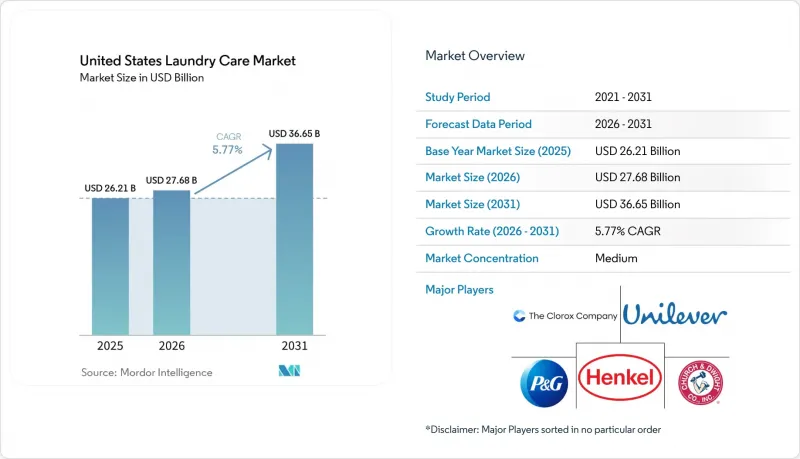
This report is Segmented by Product Type (Laundry Detergents, Fabric Softeners and Conditioners, Bleach, Laundry Boosters, Laundry Sanitizers and Disinfectants, and Other Product Types), Form (Liquid, Powder, Pods and Capsules, Sheets, and Solid and Tablet), and Application (Residential and Commercial). The Market Forecasts are Provided in Terms of Value (USD).
United States Laundry Care Market Trends and Insights
Heightened Hygiene and Cleanliness Routines
Private label growth puts sustained pressure on branded suppliers in the United States laundry care market. Store brands reached 21.3% dollar share and 23.5% unit share across U.S. retail categories for the 52 weeks ending December 28, 2025. Store brands also captured 47% of dollar sales gains in U.S. retail during 2025. Private label fabric-care additives recorded 31.6%-dollar growth and 21.2%-unit growth in 2025. As retailers expand their own-label shelf space, national brands need more promotional spending and placement investment to defend visibility. This pressure is strongest for conventional branded products that do not offer a clear format, performance, or price advantage.
Convenience-Led Adoption of Unit-Dose and Concentrated Formats
Unit-dose pods and water-soluble sheets shift product comparisons from price per ounce to price per load in the United States laundry care market. This change helps brands support per-load pricing where consumers value easier dosing and less handling. Dedicated cold-wash cycles in newer washing machines can reinforce the use of compatible concentrated formats. Clean Cult launched laundry detergent sheets at Costco nationwide in January 2026, offering a 180-sheet pack for USD 22.99. The launch provided a national club-retail route for sheets and placed the format before routine bulk shoppers. Pre-measured products also reduce dosing uncertainty, which supports convenience for households that want a simpler wash routine.
Private-Label Expansion and Promotional Price Pressure
Private label growth puts sustained pressure on branded suppliers in the United States laundry care market. Store brands reached 21.30% dollar share and 23.50% unit share across U.S. retail categories for the 52 weeks ending December 28, 2025. Store brands also captured 47% of dollar sales gains in U.S. retail during 2025. As retailers expand their own-label shelf space, national brands need more promotional spending and placement investment to defend visibility. This pressure is strongest for conventional branded products that do not offer a clear format, performance, or price advantage.
Other drivers and restraints analyzed in the detailed report include:
- Sustainability Demand for Low-Water and Lower-Packaging Solutions
- Premiumization Through Multifunctional Fabric-Care Benefits
- State-Level Environmental Claims and Packaging Compliance Complexity
For complete list of drivers and restraints, kindly check the Table Of Contents.
Segment Analysis
Laundry detergents accounted for 45.34% of the United States laundry care market size in 2025. Their leading position reflects wide retail availability, deep household use across income groups, and long-established brand recognition. Within the category, value is moving from standard liquids toward concentrated pods, waterless tiles, and cold-water sheets. These formats can carry a higher price per load and improve per-load margins for branded suppliers and sustainability-focused challengers. Fabric softeners and conditioners remain the second-largest product type because consumers value fragrance, fabric protection, and longer-lasting scent. Laundry boosters are also gaining relevance as in-wash scent and enzyme products that add to a detergent routine without requiring a complete product switch.
Laundry sanitizers and disinfectants are forecast to grow at a 6.82% CAGR from 2026 to 2031. The United States laundry care market size for this product group benefits from residential hygiene routines and commercial purchasing requirements. Healthcare and hospitality buyers can favor products with Environmental Protection Agency (EPA)-related credentials when setting supplier requirements. That requirement can make certified lines more attractive in institutional contracts. The category also raises potential household spending because sanitizers are used alongside detergent rather than instead of it. Bleach retains institutional demand in healthcare laundry and food service, although multifunction sanitizing products have taken some of its residential role.
Complete Report Scope:
- By Product Type
- Laundry Detergents
- Fabric Softeners and Conditioners
- Bleach
- Laundry Boosters
- Laundry Sanitizers and Disinfectants
- Other Product Types
- By Form
- Liquid
- Powder
- Pods and Capsules
- Sheets
- Solid and Tablet
- By Application
- Residential
- Commercial
List of Companies Covered in this Report:
- Betco
- Church & Dwight Co., Inc.
- EARTH BREEZE
- Ecolab Inc.
- Henkel AG & Co. KGaA
- Method Products, PBC
- Procter & Gamble
- Reckitt Benckiser Group plc
- S.C. Johnson & Son, Inc.
- The Clorox Company
- The Honest Company, Inc.
- Tru Earth Environmental Products Inc.
- Unilever
Additional Benefits:
- The market estimate (ME) sheet in Excel format
- 3 months of analyst support
TABLE OF CONTENTS
1 Introduction
- 1.1 Study Assumptions and Market Definition
- 1.2 Scope of the Study
2 Research Methodology
3 Executive Summary
4 Market Landscape
- 4.1 Market Overview
- 4.2 Market Drivers
- 4.2.1 Heightened Hygiene and Cleanliness Routines
- 4.2.2 Convenience-Led Adoption of Unit-Dose and Concentrated Formats
- 4.2.3 Sustainability Demand for Low-Water and Lower-Packaging Solutions
- 4.2.4 Premiumization Through Multifunctional Fabric-Care Benefits
- 4.2.5 Cold-Water Enzyme Performance and High-Efficiency Washer Compatibility
- 4.3 Market Restraints
- 4.3.1 Private-Label Expansion and Promotional Price Pressure
- 4.3.2 State-Level Environmental Claims and Packaging Compliance Complexity
- 4.3.3 Polymer-Film, Residue, and Ingredient-Scrutiny Risk
- 4.4 Value Chain Analysis
- 4.5 Porter's Five Forces Analysis
- 4.5.1 Threat of New Entrants
- 4.5.2 Bargaining Power of Suppliers
- 4.5.3 Bargaining Power of Buyers
- 4.5.4 Threat of Substitutes
- 4.5.5 Competitive Rivalry
5 Market Size and Growth Forecasts (Value)
- 5.1 By Product Type
- 5.1.1 Laundry Detergents
- 5.1.2 Fabric Softeners and Conditioners
- 5.1.3 Bleach
- 5.1.4 Laundry Boosters
- 5.1.5 Laundry Sanitizers and Disinfectants
- 5.1.6 Other Product Types
- 5.2 By Form
- 5.2.1 Liquid
- 5.2.2 Powder
- 5.2.3 Pods and Capsules
- 5.2.4 Sheets
- 5.2.5 Solid and Tablet
- 5.3 By Application
- 5.3.1 Residential
- 5.3.2 Commercial
6 Competitive Landscape
- 6.1 Market Concentration
- 6.2 Strategic Moves
- 6.3 Market Share (%)/Ranking Analysis
- 6.4 Company Profiles (includes Global Overview, Market Overview, Core Segments, Financials as available, Strategic Information, Products and Services, and Recent Developments)
- 6.4.1 Betco
- 6.4.2 Church & Dwight Co., Inc.
- 6.4.3 EARTH BREEZE
- 6.4.4 Ecolab Inc.
- 6.4.5 Henkel AG & Co. KGaA
- 6.4.6 Method Products, PBC
- 6.4.7 Procter & Gamble
- 6.4.8 Reckitt Benckiser Group plc
- 6.4.9 S.C. Johnson & Son, Inc.
- 6.4.10 The Clorox Company
- 6.4.11 The Honest Company, Inc.
- 6.4.12 Tru Earth Environmental Products Inc.
- 6.4.13 Unilever
7 Market Opportunities and Future Outlook
- 7.1 White-Space and Unmet-Need Assessment
- 7.2 Affordable Sustainable Formats Without a Green Premium

