PUBLISHER: Mordor Intelligence | PRODUCT CODE: 2119212

PUBLISHER: Mordor Intelligence | PRODUCT CODE: 2119212
Asia-Pacific Semiconductor Manufacturing Equipment - Market Share Analysis, Industry Trends & Statistics, Growth Forecasts (2026 - 2031)
According to Mordor Intelligence, the Asia-Pacific semiconductor manufacturing equipment market size is expected to grow from USD 92.14 billion in 2025 to USD 101.35 billion in 2026 and is forecast to reach USD 181.02 billion by 2031 at 12.30% CAGR over 2026-2031.
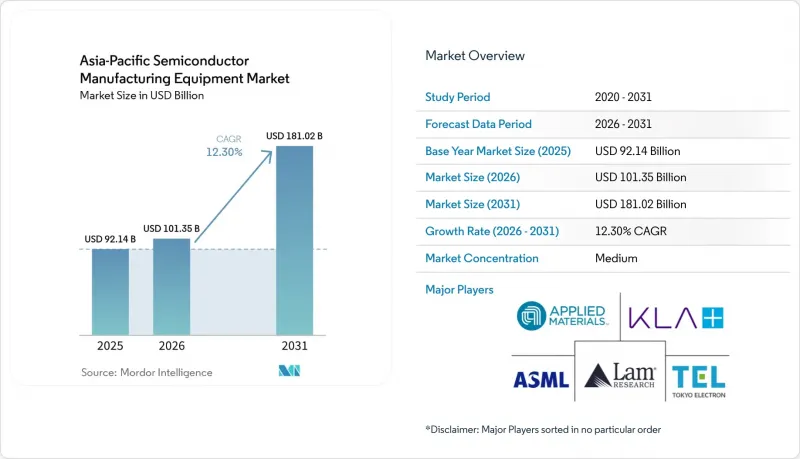
This report is Segmented by Equipment Type (Wafer Fab Equipment / Front-End Equipment, and More), by Device Type (Logic and Micro-Components, Memory, Analog, and More), by End-User (Integrated Device Manufacturers (IDMs), Foundries, and More), and by Geography (China, Taiwan, Japan, and More). The Report Offers Market Size and Value (USD) Forecasts for all the Above Segments.
Asia-Pacific Semiconductor Manufacturing Equipment Market Trends and Insights
AI, HPC, and HBM Capacity Expansion
AI and high-performance computing are raising equipment demand across Taiwan and South Korea, where advanced logic and HBM capacity programs are concentrated. SEMI expects global 300 mm fab equipment spending to total USD 374 billion from 2026 to 2028, signaling a sustained period of investment in capacity that supports AI workloads.SEMI also expects DRAM-related equipment investment to exceed USD 79 billion over the same period, linking demand for memory equipment to growing requirements for AI systems. Taller HBM stacks require additional deposition, etch, through-silicon-via, bonding, inspection, and test steps. This raises equipment content per unit of memory output and provides suppliers with greater visibility into planned capacity additions. The Asia-Pacific semiconductor manufacturing equipment market benefits from the region's key logic foundries and memory producers that serve these programs.
Advanced-Node Migration to GAA and 2 nm-Class Production
The move to gate-all-around structures and 2 nm-class production is increasing demand for lithography, deposition, etch, metrology, and inspection equipment. TSMC began volume production of its N2 technology in 2025, using nanosheet transistors that require more complex process integration than earlier FinFET designs. Samsung is continuing work on 2 nm GAA manufacturing for logic applications, which still requires the development and qualification of advanced equipment. Advanced-node programs need tightly controlled process windows, making tool performance, process control, and field support critical. These requirements favor suppliers that can work with fabs through long qualification cycles. The Asia-Pacific semiconductor manufacturing equipment market gains from this shift because Taiwan, South Korea, and Japan are central to advanced-node production and to the supply of supporting materials.
Export Controls and Technology-Access Restrictions
Export controls limit access to certain semiconductor manufacturing equipment, components, software, and related technology for specified end uses and end users. The United States Bureau of Industry and Security issued controls on semiconductor manufacturing equipment in 2024, expanding restrictions on advanced semiconductor production. These restrictions can alter supplier sales plans, delivery schedules, product configurations, customer support, and compliance processes. They also encourage separate technology paths, with Chinese fabs giving greater attention to domestic equipment while other regional fabs retain access to established international tool platforms. The Congressional Research Service notes that allied coordination affects the reach and effectiveness of semiconductor-related controls. The Asia-Pacific semiconductor manufacturing equipment market faces a more fragmented customer environment, as access to advanced tools depends on licensing and cross-border policy alignment.
Other drivers and restraints analyzed in the detailed report include:
- Government-Led Semiconductor Localization and Fab Incentives
- Advanced Packaging and Heterogeneous Integration
- Extreme Capital Intensity and Long Tool Payback Periods
For complete list of drivers and restraints, kindly check the Table Of Contents.
Segment Analysis
Front-end wafer fabrication equipment accounted for 68.30% of the market share in 2025 because logic and memory production depend on repeated lithography, deposition, etching, cleaning, and process-control steps. Advanced-node flows require tightly controlled layers and more frequent measurement than earlier node generations. Atomic layer deposition and plasma etch are important for nanosheet structures and high-aspect-ratio features. Suppliers also provide metrology and inspection systems to support yield learning. These requirements make front-end equipment procurement a long-term manufacturing decision.
Assembly and Packaging equipment is projected to be the fastest-growing segment, with a 14.50% CAGR through 2031 as chip designers integrate logic, memory, and interconnects into complex packages. The Asia-Pacific semiconductor manufacturing equipment industry is responding by providing tools for hybrid bonding, wafer bumping, molding, inspection, dicing, and final testing. Heterogeneous integration requires accurate alignment and defect control across multiple dies and substrates. Test equipment is also important because HBM stacks and AI devices need more complex validation before shipment. Fab automation, chemical delivery, and cleanroom systems support these purchases by helping high-volume fabs control contamination and material movement.
Complete Report Scope:
- By Equipment Type
- Wafer Fab Equipment / Front-End Equipment (lithography, deposition, etching, cleaning, CMP, thermal processing, front-end metrology & inspection equipment, etc.)
- Assembly and Packaging Equipment (die attach, wire bonding, flip-chip bonding, wafer bumping, thinning, dicing, molding, etc.)
- Semiconductor Test Equipment (automated test equipment, wafer probers, test handlers, burn-in equipment, and final test equipment)
- Fab Facility, Automation and Support Equipment (automation systems, wafer handling systems, AMHS, chemical & gas delivery systems, chillers, cleanroom support equipment, etc.)
- By Device Type
- Logic and Microcomponents (logic ICs, microprocessors, etc.)
- Memory (DRAM, NAND, HBM, NOR, etc.)
- Microprocessors (MPUs)
- Analog (Power management ICs, signal chain, interface Ics, etc.)
- Discrete and Power Devices (Diodes, transistors, MOSFETs, etc.)
- Sensors, MEMS and Optoelectronic Devices (Image sensors, MEMS sensors, etc.)
- By End User
- Integrated Device Manufacturers (IDMs)
- Foundries
- Outsourced Semiconductor Assembly and Test (OSAT) Companies
- Others (Research & Development (R&D) and Pilot Lines)
- By Geography
- China
- Taiwan
- South Korea
- Japan
- Singapore
- India
- Rest of Asia-Pacific
List of Companies Covered in this Report:
- Applied Materials, Inc.
- ASML Holding N.V.
- LAM RESEARCH CORPORATION
- Tokyo Electron Limited
- KLA Corporation
- SCREEN Holdings Co., Ltd.
- ADVANTEST CORPORATION
- Teradyne, Inc.
- Hitachi High-Tech Corporation
- ASM International N.V.
- Canon Inc.
- Nikon Corporation
- Onto Innovation Inc.
- Nova Ltd.
- DISCO Corporation
- BE Semiconductor Industries N.V.
- Kulicke & Soffa Industries, Inc.
- FormFactor, Inc.
- Veeco Instruments Inc.
- ASMPT Limited
- Kokusai Electric Corporation
- Advanced Micro-Fabrication Equipment Inc.
- Naura Technology Group Co., Ltd.
- Hanmi Semiconductor Co., Ltd.
- SuSS MicroTec SE
- EV Group
Additional Benefits:
- The market estimate (ME) sheet in Excel format
- 3 months of analyst support
TABLE OF CONTENTS
1 INTRODUCTION
- 1.1 Study Assumptions and Market Definition
- 1.2 Scope of the Study
2 RESEARCH METHODOLOGY
3 EXECUTIVE SUMMARY
4 MARKET LANDSCAPE
- 4.1 Market Overview
- 4.2 Market Drivers
- 4.2.1 AI, HPC and HBM Capacity Expansion
- 4.2.2 Advanced-Node Migration to GAA and 2 nm-Class Production
- 4.2.3 Government-Led Semiconductor Localization and Fab Incentives
- 4.2.4 Advanced Packaging and Heterogeneous Integration
- 4.2.5 China Equipment Localization and Mature-Node Capacity Build-Out
- 4.2.6 Equipment Demand from Power, Automotive and Compound Semiconductors
- 4.3 Market Restraints
- 4.3.1 Export Controls and Technology-Access Restrictions
- 4.3.2 Extreme Capital Intensity and Long Tool Payback Periods
- 4.3.3 Field-Service Talent and Applications-Engineering Bottlenecks
- 4.3.4 Qualification Delays for Domestic and Second-Source Tools
- 4.4 Value and Supply-Chain Analysis
- 4.5 Regulatory and Policy Landscape
- 4.6 Technology and Innovation Trends
- 4.7 Insights on Asia-Pacific Semiconductor Fab Expansion and Capacity Additions
- 4.8 Insights on AI and Automation in Semiconductor Manufacturing
- 4.9 Equipment Demand Outlook by Manufacturing Stage (Wafer fabrication, Assembly and packaging, Testing, Fab facility and automation)
- 4.10 Impact Assessment of Geopolitical Events on the Market
5 MARKET SIZE AND GROWTH FORECASTS
- 5.1 By Equipment Type
- 5.1.1 Wafer Fab Equipment / Front-End Equipment (lithography, deposition, etching, cleaning, CMP, thermal processing, front-end metrology & inspection equipment, etc.)
- 5.1.2 Assembly and Packaging Equipment (die attach, wire bonding, flip-chip bonding, wafer bumping, thinning, dicing, molding, etc.)
- 5.1.3 Semiconductor Test Equipment (automated test equipment, wafer probers, test handlers, burn-in equipment, and final test equipment)
- 5.1.4 Fab Facility, Automation and Support Equipment (automation systems, wafer handling systems, AMHS, chemical & gas delivery systems, chillers, cleanroom support equipment, etc.)
- 5.2 By Device Type
- 5.2.1 Logic and Microcomponents (logic ICs, microprocessors, etc.)
- 5.2.2 Memory (DRAM, NAND, HBM, NOR, etc.)
- 5.2.3 Microprocessors (MPUs)
- 5.2.4 Analog (Power management ICs, signal chain, interface Ics, etc.)
- 5.2.5 Discrete and Power Devices (Diodes, transistors, MOSFETs, etc.)
- 5.2.6 Sensors, MEMS and Optoelectronic Devices (Image sensors, MEMS sensors, etc.)
- 5.3 By End User
- 5.3.1 Integrated Device Manufacturers (IDMs)
- 5.3.2 Foundries
- 5.3.3 Outsourced Semiconductor Assembly and Test (OSAT) Companies
- 5.3.4 Others (Research & Development (R&D) and Pilot Lines)
- 5.4 By Geography
- 5.4.1 China
- 5.4.2 Taiwan
- 5.4.3 South Korea
- 5.4.4 Japan
- 5.4.5 Singapore
- 5.4.6 India
- 5.4.7 Rest of Asia-Pacific
6 COMPETITIVE LANDSCAPE
- 6.1 Market Concentration
- 6.2 Strategic Moves
- 6.2.1 Capacity Expansion and Localization Partnerships
- 6.2.2 Advanced-Node and Advanced-Packaging Collaborations
- 6.2.3 Product Launches and Platform Extensions
- 6.2.4 Mergers, Acquisitions and Minority Investments
- 6.3 Market Share Analysis
- 6.4 Company Profiles (Includes Global Level Overview, Market Level Overview, Core Segments, Financials as available, Strategic Information, Products and Services, Recent Developments)
- 6.4.1 Applied Materials, Inc.
- 6.4.2 ASML Holding N.V.
- 6.4.3 LAM RESEARCH CORPORATION
- 6.4.4 Tokyo Electron Limited
- 6.4.5 KLA Corporation
- 6.4.6 SCREEN Holdings Co., Ltd.
- 6.4.7 ADVANTEST CORPORATION
- 6.4.8 Teradyne, Inc.
- 6.4.9 Hitachi High-Tech Corporation
- 6.4.10 ASM International N.V.
- 6.4.11 Canon Inc.
- 6.4.12 Nikon Corporation
- 6.4.13 Onto Innovation Inc.
- 6.4.14 Nova Ltd.
- 6.4.15 DISCO Corporation
- 6.4.16 BE Semiconductor Industries N.V.
- 6.4.17 Kulicke & Soffa Industries, Inc.
- 6.4.18 FormFactor, Inc.
- 6.4.19 Veeco Instruments Inc.
- 6.4.20 ASMPT Limited
- 6.4.21 Kokusai Electric Corporation
- 6.4.22 Advanced Micro-Fabrication Equipment Inc.
- 6.4.23 Naura Technology Group Co., Ltd.
- 6.4.24 Hanmi Semiconductor Co., Ltd.
- 6.4.25 SuSS MicroTec SE
- 6.4.26 EV Group
7 MARKET OPPORTUNITIES AND FUTURE OUTLOOK
- 7.1 White-Space and Unmet-Need Assessment

