PUBLISHER: Mordor Intelligence | PRODUCT CODE: 2119250

PUBLISHER: Mordor Intelligence | PRODUCT CODE: 2119250
Sodium-Ion Battery-Grade Hard Carbon - Market Share Analysis, Industry Trends & Statistics, Growth Forecasts (2026 - 2031)
According to Mordor Intelligence, the sodium-ion battery-grade hard carbon market size was valued at USD 81.87 million in 2025 and is estimated to grow from USD 107.62 million in 2026 to reach USD 440.50 million by 2031, at a CAGR of 32.56% during the forecast period (2026-2031).
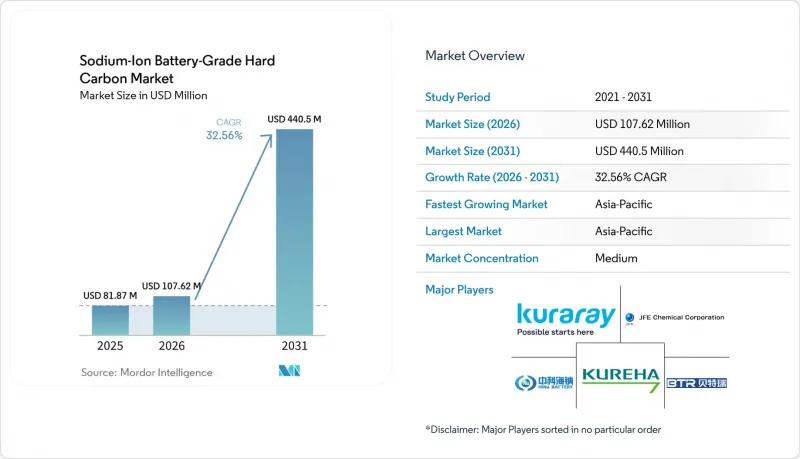
This report is Segmented by Feedstock (Biomass-Based and More), Process Type (Carbonization/Pyrolysis and More), Grade (Energy-Oriented Grade and More), Application (Energy Storage Systems and More), and Geography (Asia-Pacific, North America, Europe, South America, and Middle-East and Africa). The Market Forecasts are Provided in Terms of Value (USD).
Global Sodium-Ion Battery-Grade Hard Carbon Market Trends and Insights
Commercialization of Sodium-Ion Batteries
The commercialization of sodium-ion batteries is a direct driver of demand for the sodium-ion battery-grade hard carbon market. The International Energy Agency has identified growing momentum in sodium-ion batteries, while noting that the technology still faces manufacturing and performance challenges. CATL introduced its second-generation Naxtra battery in April 2025, raising expectations for materials with more consistent batch quality and improved rate capability. Cell producers increasingly require hard carbon suppliers to meet tighter specifications before material can enter qualified production lines. Approval by a large cell manufacturer can shorten procurement discussions with other buyers, as the supplier has already demonstrated performance under demanding conditions. As sodium-ion batteries move from pilot projects to larger vehicle and stationary storage deployments, the market will require a substantial increase in hard carbon output.
Demand for Lower-Cost Stationary Energy Storage
Stationary energy storage supports demand in the sodium-ion battery-grade hard carbon market, as buyers seek alternatives amid lithium-related price and supply risks. Sodium-ion technology can provide a supply chain option for storage developers that need long-duration assets and want to reduce reliance on critical minerals. Peak Energy delivered a grid-scale sodium-ion battery storage system in the United States in July 2025 and announced commercial activity with utility and independent power producer partners. Storage projects require different anode performance levels depending on expected dispatch patterns and operating life. Energy-oriented grades suit applications that prioritize capacity, while long-cycle grades suit frequent cycling requirements. This distinction is expanding the role of application-specific specifications within hard carbon procurement.
Low Initial Coulombic Efficiency and Pre-Sodiation Requirements
Initial Coulombic efficiency remains a material constraint for the sodium-ion battery-grade hard carbon market. Early commercial hard carbon materials showed initial Coulombic efficiency as low as 17%, while interface modification methods have raised performance to 82% in laboratory work. Research on aryl-sodium pre-sodiation has reported pathways toward near-100% initial Coulombic efficiency within 60 seconds, but maintaining accurate pre-sodiation at industrial throughput remains difficult. Chemical vapor deposition, pre-sodiation, and heteroatom doping can improve performance but increase process control requirements. These steps can raise manufacturing costs and reduce part of the price advantage available from sodium-ion chemistry. Cost-focused applications may accept lower efficiency, while demanding storage and vehicle applications require premium grades with stronger first-cycle performance.
Other drivers and restraints analyzed in the detailed report include:
- Growth of Cost-Sensitive Electric Mobility
- Abundant and Diversified Sodium-Ion Battery Supply Chains
- Feedstock Variability in Biomass-Derived Hard Carbon
For complete list of drivers and restraints, kindly check the Table Of Contents.
Segment Analysis
Biomass-based hard carbon held 40.56% of the sodium-ion battery-grade hard carbon market share in 2025 and is forecast to grow at a 34.27% CAGR through 2031. Bamboo, coconut shells, rice husks, and crop residues offer geographically distributed precursor options and can support localized sourcing where agricultural residues are already collected at scale. These feedstocks align with procurement programs aimed at reducing life-cycle carbon emissions, although their composition requires careful process management. A 2026 Green Chemistry study reported that cellulose-based hard carbon produced via carbonization and graphitization exhibited a reversible capacity of 320.38 mAh/g and retained 88.15% of its capacity after 1,000 cycles at high current density. These results indicate that biomass-derived materials can meet demanding performance requirements when precursor treatment and processing are controlled.
Pitch-based materials offer tighter microstructural consistency, while resin-based routes can provide high carbonization yields and particle shapes suited to automated electrode coating. Chinese producers initially relied on imported coconut shells but have since considered domestic alternatives, as tropical biomass alone cannot meet the required scale. A 2025 Science China Chemistry study found that optimized phenolic resin hard carbon achieved 92.2% initial coulombic efficiency and a reversible capacity of 324.4 mAh/g. Petroleum coke, biochar, and mixed-precursor composites remain smaller routes but offer additional options where industrial supply is more reliable. The sodium-ion battery-grade hard carbon market is not moving toward a single universal precursor, as supply security, quality, and carbon characteristics vary by route.
Carbonization and pyrolysis accounted for 56.41% of the sodium-ion battery-grade hard carbon market share in 2025. This position reflects established industrial infrastructure and the relative simplicity of converting organic precursors into turbostratic carbon. Processing generally occurs between 1,000°C and 1,500°C, with heating rate, dwell time, and atmosphere influencing pore structure and interlayer spacing. These parameters govern sodium storage behavior, while activation creates additional surface sites for applications that prioritize discharge rate over capacity. The process remains central to production because it accommodates a broad range of precursor materials.
Surface modification is forecast to grow at a 33.51% CAGR through 2031, making it the fastest-growing process segment in the sodium-ion battery-grade hard carbon market. Coating, doping, and pre-sodiation-compatible processing address higher initial coulombic efficiency and lower irreversible capacity loss. A 2025 RSC Advances study reported that nitrogen-doped hard carbon produced via ammonia-modified carbonization achieved an initial coulombic efficiency of 81.81% and a first-cycle discharge capacity of 373.3 mAh/g. The study described sodium storage through adsorption, intercalation, and pore filling. Modified material can command premiums over standard carbonized grades when cell makers require specific performance profiles.
Complete Report Scope:
- By Feedstock
- Biomass-Based
- Pitch-Based
- Resin-Based
- Others
- By Process Type
- Carbonization/Pyrolysis
- Activation
- Surface Modification (Coating, Doping, Pre-sodiation Compatible Processing)
- Others
- By Grade
- Energy-Oriented Grade
- Power-Oriented Grade
- Long-Cycle Grade
- Others (Low-Temperature and Specialty Grades)
- By Application
- Energy Storage Systems
- Electric Vehicles (Including Two-/Three-Wheelers and Low-Speed EVs)
- Consumer and Industrial Batteries
- UPS and Telecom
- Others
- By Geography
- Asia-Pacific
- China
- India
- Japan
- South Korea
- ASEAN Countries
- Rest of Asia-Pacific
- North America
- United States
- Canada
- Mexico
- Europe
- Germany
- United Kingdom
- France
- Italy
- NORDIC Countries
- Rest of Europe
- South America
- Brazil
- Argentina
- Rest of South America
- Middle-East and Africa
- Saudi Arabia
- South Africa
- Rest of Middle-East and Africa
- Asia-Pacific
Geography Analysis
Asia-Pacific held 47.34% of the sodium-ion battery-grade hard carbon market share in 2025 and is forecast to grow at a 34.11% CAGR through 2031. China integrates battery manufacturing, carbonization capacity, precursor processing, and cell assembly within a single supply chain. This structure supports lower logistics costs, faster supplier collaboration, and strong demand from stationary storage and cost-sensitive electric mobility applications. Japan contributes technical capability in consistent microstructural quality and established qualification relationships with cell manufacturers. South Korea is also developing its materials base to address sodium-ion battery opportunities.
Asia-Pacific's position is supported by its ability to utilize biomass, coal-derived materials, and synthetic resins as feedstocks. The sodium-ion battery-grade hard carbon market in the region benefits from established battery infrastructure and policy support for local supply chains. India holds agricultural residues, including rice husks, crop stubble, and bamboo, that could help meet domestic demand for precursors. Lower processing temperatures compared to graphite are relevant where energy costs affect anode economics. Feedstock collection, material consistency, and qualification capacity will determine how quickly new regional suppliers can scale.
North America and Europe currently represent lower output but may develop into higher-value markets for traceable and lower-carbon hard carbon. Peak Energy's 2025 delivery of grid-scale systems in the United States demonstrated commercial interest in sodium-ion storage. European buyers face carbon-footprint disclosure requirements that favor documented data on precursor origins and lifecycles. South America, the Middle-East, and Africa represent early-stage demand, though agricultural residues, renewable energy deployment, and energy-transition programs could support future stationary-storage applications.
- Aekyung Chemical Co., Ltd.
- BTR New Material Group Co., Ltd.
- Fujian Yuanli Active Carbon Co., Ltd.
- HiNa Battery Technology Co., Ltd
- Hunan Zhongke Shinzoom Technology Co., Ltd.
- JFE Chemical Corporation
- Jiangxi Zeto New Energy Technology Co., Ltd.
- KURARAY CO., LTD.
- KUREHA CORPORATION
- Ningbo Ronbay New Energy Technology Co., Ltd.
- Putailai New Materials Technology Co., Ltd.
- Shanghai PTL New Energy Technology Co.,Ltd.
- SHENGQUAN GROUP
- Shenzhen XFH Technology Co., Ltd.
- Sumitomo Bakelite Co., Ltd.
Additional Benefits:
- The market estimate (ME) sheet in Excel format
- 3 months of analyst support
TABLE OF CONTENTS
1 Introduction
- 1.1 Study Assumptions and Market Definition
- 1.2 Scope of the Study
2 Research Methodology
3 Executive Summary
4 Market Landscape
- 4.1 Market Overview
- 4.2 Market Drivers
- 4.2.1 Commercialization of Sodium-Ion Batteries
- 4.2.2 Demand for Lower-Cost Stationary Energy Storage
- 4.2.3 Abundant and Diversified Sodium-Ion Battery Supply Chains
- 4.2.4 Growth of Cost-Sensitive Electric Mobility
- 4.2.5 Carbon-Footprint Reduction in Anode Material Supply Chains
- 4.2.6 Qualification Advantage of Consistent Hard Carbon Batch Quality
- 4.3 Market Restraints
- 4.3.1 Low Initial Coulombic Efficiency and Pre-Sodiation Requirements
- 4.3.2 Feedstock Variability in Biomass-Derived Hard Carbon
- 4.3.3 Limited Commercial-Scale Qualification Capacity
- 4.3.4 Competition from Improving Lithium-Ion Anode Materials
- 4.4 Value Chain Analysis
- 4.5 Porter's Five Forces
- 4.5.1 Bargaining Power of Suppliers
- 4.5.2 Bargaining Power of Buyers
- 4.5.3 Threat of New Entrants
- 4.5.4 Threat of Substitutes
- 4.5.5 Competitive Rivalry
5 Market Size and Growth Forecasts (Value)
- 5.1 By Feedstock
- 5.1.1 Biomass-Based
- 5.1.2 Pitch-Based
- 5.1.3 Resin-Based
- 5.1.4 Others
- 5.2 By Process Type
- 5.2.1 Carbonization/Pyrolysis
- 5.2.2 Activation
- 5.2.3 Surface Modification (Coating, Doping, Pre-sodiation Compatible Processing)
- 5.2.4 Others
- 5.3 By Grade
- 5.3.1 Energy-Oriented Grade
- 5.3.2 Power-Oriented Grade
- 5.3.3 Long-Cycle Grade
- 5.3.4 Others (Low-Temperature and Specialty Grades)
- 5.4 By Application
- 5.4.1 Energy Storage Systems
- 5.4.2 Electric Vehicles (Including Two-/Three-Wheelers and Low-Speed EVs)
- 5.4.3 Consumer and Industrial Batteries
- 5.4.4 UPS and Telecom
- 5.4.5 Others
- 5.5 By Geography
- 5.5.1 Asia-Pacific
- 5.5.1.1 China
- 5.5.1.2 India
- 5.5.1.3 Japan
- 5.5.1.4 South Korea
- 5.5.1.5 ASEAN Countries
- 5.5.1.6 Rest of Asia-Pacific
- 5.5.2 North America
- 5.5.2.1 United States
- 5.5.2.2 Canada
- 5.5.2.3 Mexico
- 5.5.3 Europe
- 5.5.3.1 Germany
- 5.5.3.2 United Kingdom
- 5.5.3.3 France
- 5.5.3.4 Italy
- 5.5.3.5 NORDIC Countries
- 5.5.3.6 Rest of Europe
- 5.5.4 South America
- 5.5.4.1 Brazil
- 5.5.4.2 Argentina
- 5.5.4.3 Rest of South America
- 5.5.5 Middle-East and Africa
- 5.5.5.1 Saudi Arabia
- 5.5.5.2 South Africa
- 5.5.5.3 Rest of Middle-East and Africa
- 5.5.1 Asia-Pacific
6 Competitive Landscape
- 6.1 Market Concentration
- 6.2 Strategic Moves
- 6.3 Market Share (%)/Ranking Analysis
- 6.4 Company Profiles (includes Global Overview, Market Overview, Core Segments, Financials as available, Strategic Information, Products and Services, Recent Developments)
- 6.4.1 Aekyung Chemical Co., Ltd.
- 6.4.2 BTR New Material Group Co., Ltd.
- 6.4.3 Fujian Yuanli Active Carbon Co., Ltd.
- 6.4.4 HiNa Battery Technology Co., Ltd
- 6.4.5 Hunan Zhongke Shinzoom Technology Co., Ltd.
- 6.4.6 JFE Chemical Corporation
- 6.4.7 Jiangxi Zeto New Energy Technology Co., Ltd.
- 6.4.8 KURARAY CO., LTD.
- 6.4.9 KUREHA CORPORATION
- 6.4.10 Ningbo Ronbay New Energy Technology Co., Ltd.
- 6.4.11 Putailai New Materials Technology Co., Ltd.
- 6.4.12 Shanghai PTL New Energy Technology Co.,Ltd.
- 6.4.13 SHENGQUAN GROUP
- 6.4.14 Shenzhen XFH Technology Co., Ltd.
- 6.4.15 Sumitomo Bakelite Co., Ltd.
7 Market Opportunities and Future Outlook
- 7.1 White-Space and Unmet-Need Assessment

