PUBLISHER: Mordor Intelligence | PRODUCT CODE: 2119262

PUBLISHER: Mordor Intelligence | PRODUCT CODE: 2119262
Campaign Management Services - Market Share Analysis, Industry Trends & Statistics, Growth Forecasts (2026 - 2031)
According to Mordor Intelligence, the campaign management services market size is projected to be USD 24.35 billion in 2025, USD 26.89 billion in 2026, and reach USD 44.66 billion by 2031, growing at a CAGR of 10.72% from 2026 to 2031.
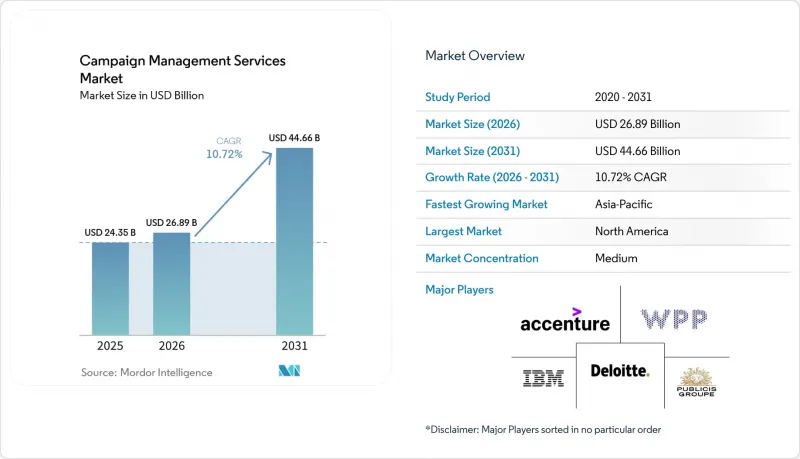
This report is Segmented by Service Type (Strategy and Planning, Campaign Execution, Activation, and Management, and More), by Client Organization Size (Large Enterprises, and Small and Medium Enterprises), End-User (Retail and E-Commerce, BFSI, Healthcare and Life Sciences, Technology and Telecom, and More), and Geography. The Market Forecasts are Provided in Terms of Value (USD).
Global Campaign Management Services Market Trends and Insights
Omnichannel Personalization Spend Expansion
Personalization is now treated as a core operating requirement rather than an optional marketing layer. That shift increases demand for providers that can coordinate messaging, timing, and audience logic across email, paid media, web, mobile, and in-store activation without breaking campaign continuity. The main issue for many brands is not strategy alone; it is the day-to-day workload of keeping these programs active across multiple channels simultaneously. That execution gap supports the campaign management services market because specialist providers can always run on personalization programs while internal teams stay focused on planning cycles, product launches, and approval workflows. Providers with stronger data orchestration and AI-led decisioning capabilities are better positioned to win this work because they can connect personalization to live activation rather than treating it as a separate advisory task.
AI-Enabled Campaign Optimization and Automation
AI is changing campaign operations by raising the performance standard that enterprise buyers expect from external providers. Google reported that AI Max for Search Campaigns delivered a 14% average uplift in conversions or conversion value, and that uplift rose to 27% for campaigns that had been overly dependent on exact and phrase match keywords, making AI-enabled optimization harder for clients to ignore. As a result, buyers increasingly want managed service partners that can deploy, monitor, retrain, and govern AI agents across search, social, and commerce media within one operating model. This is also changing provider economics because automation pushes human teams toward higher-value work in planning, creative direction, and audience interpretation rather than repetitive trafficking tasks. The campaign management services market gains from this shift because providers that combine AI performance gains with human review controls are becoming more relevant in enterprise procurement.
Data Privacy and Consent Compliance Complexity
Privacy obligations now vary across jurisdictions, making cross-border campaign execution harder to standardize. The European Data Protection Board's Opinion 08/2024 tightened the interpretation of what may constitute freely given consent in consent or pay models, adding legal and operational pressure to behavioral advertising workflows. For managed providers, this increases the review work needed for audience use, activation rules, suppression logic, and documentation across markets. The burden tends to slow smaller operators first, while larger providers can incorporate consent management, geofenced activation rules, and review controls into their service offer. Even so, this restraint limits the speed of the campaign management services market because compliance work can delay launches, narrow targeting choices, and increase delivery costs.
Other drivers and restraints analyzed in the detailed report include:
- First-Party Data Activation and Clean-Room Adoption
- Retail Media and Creator Commerce Workflow Convergence
- Legacy MarTech Integration and Data Silos
For complete list of drivers and restraints, kindly check the Table Of Contents.
Segment Analysis
Campaign Execution and Activation commanded 27.32% of the campaign management services market share in 2025, underscoring how much enterprise outsourcing still centers on the operational layer, where plans become live campaigns. This segment remains the anchor of managed demand because providers are responsible for keeping search, social, email, and retail media programs running with the speed and consistency that internal teams often struggle to maintain. The work is becoming more complex because activation now involves more channels, more data dependencies, and tighter turnaround expectations within the same campaign cycle. Strategy and Planning still supports premium billing, but it usually serves as the front door into broader execution work rather than the largest pool of recurring spend. Campaign Analytics and Reporting is also changing because clients increasingly want performance views that feed directly into live optimization rather than sit in separate reporting cycles.
Campaign Optimization and Personalization is projected to expand at a 14.78% CAGR through 2031, making it the fastest-growing service type in the campaign management services industry. That growth reflects the spread of AI-led personalization tools that require ongoing deployment, model supervision, and audience refreshes to deliver stable results over time. Deloitte Digital's May 2026 collaboration with Optimizely shows how leading providers are competing not only on execution capacity but also on marketing operating model redesign for AI-powered delivery. WPP's February 2026 expansion with Adobe follows the same pattern by integrating Adobe Firefly Foundry into WPP Open, so creative and media teams can work inside a more unified AI-enabled content and activation workflow
Complete Report Scope:
- By Service Type
- Strategy and Planning
- Campaign Execution, Activation, and Management
- Campaign Analytics and Reporting
- Creative and Content Operations
- By Client Organization Size
- Large Enterprises
- Small and Medium Enterprises
- By End-user Industry
- Retail and E-commerce
- BFSI
- Healthcare and Life Sciences
- Technology and Telecom
- Media and Entertainment
- Consumer Goods and Manufacturing
- Travel and Hospitality
- Government and Non-Profit
- By Geography
- North America
- United States
- Canada
- Mexico
- South America
- Brazil
- Argentina
- Chile
- Rest of South America
- Europe
- Germany
- United Kingdom
- France
- Italy
- Spain
- Russia
- Rest of Europe
- Asia-Pacific
- China
- India
- Japan
- South Korea
- Australia
- Singapore
- Rest of Asia-Pacific
- Middle East
- United Arab Emirates
- Saudi Arabia
- Turkey
- Rest of Middle East
- Africa
- South Africa
- Nigeria
- Kenya
- Rest of Africa
- North America
Geography Analysis
North America held 38.53% of the campaign management services market share in 2025, which made it the largest regional center for outsourced campaign operations. The region benefits from large enterprise marketing budgets, dense retail media activity, and faster investment in first-party data and identity infrastructure than most other markets. Publicis Groupe's agreement to acquire LiveRamp and Omnicom's completed acquisition of Interpublic both show that campaign leadership in the region is increasingly tied to ownership of identity, data collaboration, and decisioning assets rather than creative capability alone. Canada and Mexico add support through nearshore delivery expansion and a broader base of digital transformation demand across mid-market and enterprise accounts. South America remains smaller, but demand is improving as brands in the region expand digital commerce, platform advertising, and performance-led customer acquisition programs.
Europe remained the second-largest geography, with Germany, the United Kingdom, and France forming the core demand base for the campaign management services market. Ongoing GDPR interpretation has made privacy-safe campaign architecture a real competitive issue for providers managing cross-border work, not just a legal review step. Merkle's March 2026 appointment by Samsung Electronics Europe for a three-year CRM transformation program across 16 markets shows the scale of AI-enabled, compliance-aware campaign transformation now moving through the region. The United Kingdom is also seeing competitive realignment as identity-led operating models gain ground, while continental Europe continues to support cloud-native managed marketing operations tied to broader enterprise transformation programs.
Asia-Pacific is projected to expand at a 12.81% CAGR through 2031, making it the fastest-growing geography in the campaign management services market. Growth comes from mobile commerce, social commerce fragmentation, and the rising need to manage campaigns across multiple platform ecosystems with different algorithms, formats, and measurement rules. Alibaba Mama's March 2026 launch of AI Wanxiang, which uses 4 specialized AI agents across brand intelligence, content creation, media planning, and optimization, shows how platform-led AI infrastructure is changing campaign execution in China. YRGLM's January 2026 survey in Japan, along with Concentrix's September 2025 acquisition of SAI Digital, which positions Vietnam as a strategic hub, points to both a modernization gap and a delivery build-out opportunity across the region. Middle East markets, especially the UAE and Saudi Arabia, are growing through large-scale digital transformation programs, while Africa remains early-stage, with South Africa, Nigeria, and Kenya as the main demand nodes.
- Accenture plc
- Capgemini SE
- Cognizant Technology Solutions Corporation
- Concentrix Corporation
- DEPT Holding B.V.
- Dentsu Group Inc.
- Deloitte Touche Tohmatsu Limited
- eClerx Services Limited
- EXLService Holdings, Inc.
- Genpact Limited
- HCL Technologies Limited
- Infosys Limited
- International Business Machines Corporation
- Merkle Inc.
- PricewaterhouseCoopers International Limited
- Publicis Groupe S.A.
- R.R. Donnelley & Sons Company
- Stagwell Inc.
- Tata Consultancy Services Limited
- Tech Mahindra Limited
- Wipro Limited
- WPP plc
Additional Benefits:
- The market estimate (ME) sheet in Excel format
- 3 months of analyst support
TABLE OF CONTENTS
1 INTRODUCTION
- 1.1 Study Assumptions and Market Definition
- 1.2 Scope of the Study
2 RESEARCH METHODOLOGY
3 EXECUTIVE SUMMARY
4 MARKET LANDSCAPE
- 4.1 Market Overview
- 4.2 Market Drivers
- 4.2.1 Omnichannel Personalization Spend Expansion
- 4.2.2 AI-Enabled Campaign Optimization and Automation
- 4.2.3 First-Party Data Activation and Clean-Room Adoption
- 4.2.4 Retail Media and Creator Commerce Workflow Convergence
- 4.2.5 Cloud-Native Managed Marketing Operations Adoption
- 4.2.6 Asia-Pacific Mobile Commerce and Social Engagement Expansion
- 4.3 Market Restraints
- 4.3.1 Data Privacy and Consent Compliance Complexity
- 4.3.2 Legacy MarTech Integration and Data Silos
- 4.3.3 Measurement Fragmentation Across Retail Media and Creator Ecosystems
- 4.3.4 Agentic AI Governance and Brand Safety Controls
- 4.4 Impact of Macroeconomic Factors on the Market
- 4.5 Industry Value Chain Analysis
- 4.6 Regulatory Landscape
- 4.7 Technological Outlook
- 4.8 Porter's Five Forces Analysis
- 4.8.1 Threat of New Entrants
- 4.8.2 Bargaining Power of Buyers
- 4.8.3 Bargaining Power of Suppliers
- 4.8.4 Threat of Substitutes
- 4.8.5 Intensity of Competitive Rivalry
5 MARKET SIZE AND GROWTH FORECASTS (VALUE)
- 5.1 By Service Type
- 5.1.1 Strategy and Planning
- 5.1.2 Campaign Execution, Activation, and Management
- 5.1.3 Campaign Analytics and Reporting
- 5.1.4 Creative and Content Operations
- 5.2 By Client Organization Size
- 5.2.1 Large Enterprises
- 5.2.2 Small and Medium Enterprises
- 5.3 By End-user Industry
- 5.3.1 Retail and E-commerce
- 5.3.2 BFSI
- 5.3.3 Healthcare and Life Sciences
- 5.3.4 Technology and Telecom
- 5.3.5 Media and Entertainment
- 5.3.6 Consumer Goods and Manufacturing
- 5.3.7 Travel and Hospitality
- 5.3.8 Government and Non-Profit
- 5.4 By Geography
- 5.4.1 North America
- 5.4.1.1 United States
- 5.4.1.2 Canada
- 5.4.1.3 Mexico
- 5.4.2 South America
- 5.4.2.1 Brazil
- 5.4.2.2 Argentina
- 5.4.2.3 Chile
- 5.4.2.4 Rest of South America
- 5.4.3 Europe
- 5.4.3.1 Germany
- 5.4.3.2 United Kingdom
- 5.4.3.3 France
- 5.4.3.4 Italy
- 5.4.3.5 Spain
- 5.4.3.6 Russia
- 5.4.3.7 Rest of Europe
- 5.4.4 Asia-Pacific
- 5.4.4.1 China
- 5.4.4.2 India
- 5.4.4.3 Japan
- 5.4.4.4 South Korea
- 5.4.4.5 Australia
- 5.4.4.6 Singapore
- 5.4.4.7 Rest of Asia-Pacific
- 5.4.5 Middle East
- 5.4.5.1 United Arab Emirates
- 5.4.5.2 Saudi Arabia
- 5.4.5.3 Turkey
- 5.4.5.4 Rest of Middle East
- 5.4.6 Africa
- 5.4.6.1 South Africa
- 5.4.6.2 Nigeria
- 5.4.6.3 Kenya
- 5.4.6.4 Rest of Africa
- 5.4.1 North America
6 COMPETITIVE LANDSCAPE
- 6.1 Market Concentration
- 6.2 Strategic Moves
- 6.3 Market Share Analysis
- 6.4 Company Profiles (includes Global Level Overview, Market Level Overview, Core Segments, Financials as available, Strategic Information, Market Rank/Share, Products and Services, Recent Developments)
- 6.4.1 Accenture plc
- 6.4.2 Capgemini SE
- 6.4.3 Cognizant Technology Solutions Corporation
- 6.4.4 Concentrix Corporation
- 6.4.5 DEPT Holding B.V.
- 6.4.6 Dentsu Group Inc.
- 6.4.7 Deloitte Touche Tohmatsu Limited
- 6.4.8 eClerx Services Limited
- 6.4.9 EXLService Holdings, Inc.
- 6.4.10 Genpact Limited
- 6.4.11 HCL Technologies Limited
- 6.4.12 Infosys Limited
- 6.4.13 International Business Machines Corporation
- 6.4.14 Merkle Inc.
- 6.4.15 PricewaterhouseCoopers International Limited
- 6.4.16 Publicis Groupe S.A.
- 6.4.17 R.R. Donnelley & Sons Company
- 6.4.18 Stagwell Inc.
- 6.4.19 Tata Consultancy Services Limited
- 6.4.20 Tech Mahindra Limited
- 6.4.21 Wipro Limited
- 6.4.22 WPP plc
7 MARKET OPPORTUNITIES AND FUTURE OUTLOOK
- 7.1 White-Space and Unmet-need Assessment

