PUBLISHER: Mordor Intelligence | PRODUCT CODE: 2119263

PUBLISHER: Mordor Intelligence | PRODUCT CODE: 2119263
Skills-Based Organization Technology - Market Share Analysis, Industry Trends & Statistics, Growth Forecasts (2026 - 2031)
According to Mordor Intelligence, the skills-based organization technology market size was valued at USD 7.93 billion in 2025 and estimated to grow from USD 9.46 billion in 2026 to reach USD 22.85 billion by 2031, at a CAGR of 19.29% during the forecast period (2026-2031).
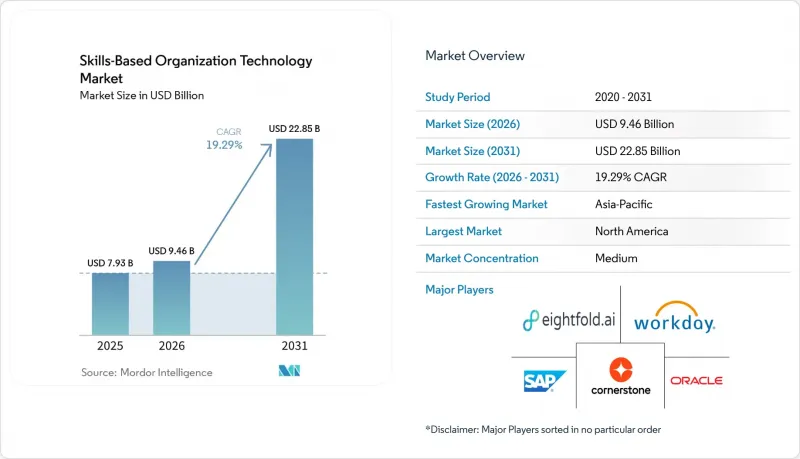
This report is Segmented by Component (Platforms, and Services), Deployment Model (Cloud, On-Premises, and Hybrid), Enterprise Size (Large Enterprises, Small and Medium-Sized Enterprises), Application (Internal Talent Mobility, and More), End-User Industry Vertical (IT and Telecommunications, and More), and Geography. The Market Forecasts are Provided in Terms of Value (USD).
Global Skills-Based Organization Technology Market Trends and Insights
Shift from Job-Based to Skills-Based Operating Models
The move away from job-title-based workforce design remains the strongest driver for the skills-based organization technology market. Workday reported in April 2025 that only 32% of business leaders strongly believed their current workforce skills matched future needs, which keeps pressure on organizations to adopt systems that update capability data continuously.The same study found that 55% of organizations had already started the shift to a skills-based operating model, and another 23% planned to do so within 12 months, which shows how quickly this model is becoming standard practice. As companies begin to inventory skills rather than headcount alone, workforce planning becomes more continuous and less dependent on fixed requisition cycles. This changes procurement behavior because buyers increasingly want platforms that can support redeployment, learning, and planning from one skills layer. The skills-based organization technology market is therefore being shaped by a structural change in how enterprises define work itself.
AI-Enabled Skills Inference and Matching at Scale
AI-based inference has eased a longstanding data problem in the skills-based organization technology market, because self-reported and manager-reported skills data often lack depth and go stale quickly. Modern systems can infer capabilities from signals such as authored content, completed learning, and collaboration patterns, thereby improving coverage and update frequency. Gloat stated in March 2026 that its Loomra engine operates on a skills graph with 2.4 million skill nodes and 18.7 million skill relationships, showing how vendors are building large-scale inference infrastructure for real-time workforce use. Workday has also highlighted the engineering challenge of inferring relevant skills from minimal structured inputs, such as job titles, indicating that low-latency inference is becoming a core product capability rather than an add-on. Better inference matters commercially because it reveals skills that formal taxonomies had missed and makes internal mobility and planning more credible. This strengthens platform value over time, since each new employee action improves the data layer used across the business.
Employee Data Privacy and AI Governance Burden
Privacy and governance remain the most immediate restraints on the skills-based organization technology market. Skills inference systems often analyze passive work signals, such as authored content, project history, and collaboration activity, raising consent and transparency questions when those signals are reused for employment decisions. California's Civil Rights Council finalized automated decision-making system regulations in June 2025, effective October 2025, that require anti-bias testing, record retention, and broad oversight for covered tools. The EU AI Act has also raised scrutiny of employment-related AI systems, increasing documentation, review, and oversight requirements during procurement and deployment. These obligations tend to favor larger vendors that already have legal, engineering, and audit resources in place. They also slow spending recognition because buyers take longer to approve deployments and often widen project scope to include governance controls from the start.
Other drivers and restraints analyzed in the detailed report include:
- Internal Mobility and Retention Prioritization
- Agentic Workflow Demand for Machine-Readable Skills Graphs
- Integration Complexity Across HCM and Learning Systems
For complete list of drivers and restraints, kindly check the Table Of Contents.
Segment Analysis
Platform software held 72.41% of the 2025 skills-based organization technology market share, which confirms that buyers still place the highest value on the core ontology, inference, and decisioning layer. That lead should remain intact because most downstream use cases, including mobility, learning, and planning, depend on a persistent skills graph that can be updated continuously. Within platform software, skills intelligence and ontology platforms form the base layer, while talent intelligence, internal mobility, and workforce planning modules build on top of that foundation. This sequencing matters because many enterprises enter the skills-based organization technology market with a core ontology project and then widen spend after the data layer starts to deliver usable signals.
Services are projected to expand at a CAGR of 22.67% from 2026 to 2031, which reflects the implementation effort required to deploy skills infrastructure across large and distributed workforces. Buyers need support with taxonomy design, change management, governance, and integration, and those needs do not end once the software goes live. Docebo's January 2026 acquisition of 365Talents showed that vendors increasingly want to connect skills identification directly to development actions inside broader learning systems. That move also suggests that services in the skills-based organization technology market will extend beyond setup work and into ongoing operating support. As agent-based capabilities spread, enterprises are also likely to spend more on managed governance, policy configuration, and workflow monitoring. This keeps services structurally important even though platform software remains the main revenue anchor.
Cloud accounted for 68.92% share of the skills-based organization technology market size in 2025, and it is also projected to be the fastest-growing deployment model at a CAGR of 23.83% through 2031. That combination is unusual in enterprise software and shows how strongly real-time inference, ontology updates, and multi-system integration favor cloud architecture. On-premises deployments still matter in regulated settings, but they are harder to maintain when skills data must be refreshed continuously and shared across multiple workflows. For many buyers, the skills-based organization technology market now looks less like a traditional HR software purchase and more like a data-layer decision that requires scale, speed, and update frequency.
Hybrid deployment remains strategically important because some large organizations still need tighter control over where employee data is processed and stored. This is especially relevant in Europe, where sovereign cloud preferences and local compliance obligations can shape platform design and vendor selection. Deutsche Telekom's rollout of its AI-powered Growth Hub across 2025 and 2026 illustrates how large enterprises are pairing global platform ambition with domestic governance requirements. That pattern suggests hybrid will not overtake cloud on volume, but it will hold a durable role in large regulated accounts. Vendors that can support both operational flexibility and local control are better positioned to win multinational programs. This also means deployment choice in the skills-based organization technology market is increasingly tied to governance maturity, not just IT preference.
Complete Report Scope:
- By Component
- Platforms
- Skills Intelligence and Ontology Platforms
- Talent Intelligence and Internal Mobility Platforms
- Workforce Planning and Analytics Platforms
- Services
- Platforms
- By Deployment Model
- Cloud
- On-Premises
- Hybrid
- By Enterprise Size
- Large Enterprises
- Small and Medium-Sized Enterprises
- By Application
- Internal Talent Mobility and Marketplaces
- Skills-Based Recruitment and Talent Acquisition
- Skills-Driven Learning and Capability Development
- Workforce Planning and Scenario Intelligence
- Performance, Succession and Skills Mapping
- By End-User Industry Vertical
- IT and Telecommunications
- Healthcare and Life Sciences
- BFSI
- Manufacturing and Industrial Operations
- Retail and E-Commerce
- Education
- Government and Public Sector
- Energy and Utilities
- Media and Entertainment
- Other End-User Industry Verticals
- By Geography
- North America
- United States
- Canada
- Mexico
- South America
- Brazil
- Argentina
- Chile
- Rest of South America
- Europe
- Germany
- United Kingdom
- France
- Italy
- Spain
- Rest of Europe
- Asia-pacific
- China
- Japan
- India
- Australia
- South Korea
- Singapore
- Rest of Asia-pacific
- Middle East
- Saudi Arabia
- United Arab Emirates
- Turkey
- Rest of Middle East
- Africa
- South Africa
- Egypt
- Nigeria
- Kenya
- Rest of Africa
- North America
Geography Analysis
North America held 41.64% of the skills-based organization technology market share in 2025, making it the largest regional revenue base. The United States remains the core demand center because it combines a dense population of digitally mature enterprises with a long history of investment in HCM and talent software. California's automated decision-making rules, effective from October 2025, have also increased the need for auditable, explainable workforce data in AI-supported employment decisions. Canada and Mexico remain smaller in scale, but Canada follows a similar enterprise adoption path while Mexico is showing demand in manufacturing and shared-services settings.
Europe is a high-opportunity but more compliance-heavy region for the skills-based organization technology market. The EU AI Act has pushed employment-related AI into a stricter governance framework, extending procurement cycles and favoring vendors that can clearly document controls. France and Germany remain the largest enterprise demand pools, supported by large telecom and industrial employers that are formalizing skills data at scale. The UK is also maintaining strong adoption momentum, and Skills England's Annual Skills Report 2026 underscored the importance of structured skills data for closing major competency gaps across the economy.
Asia-Pacific is projected to grow at a CAGR of 27.17% through 2031, making it the fastest-growing region and the strongest growth area for the skills-based organization technology market. Singapore, India, and South Korea are the main demand engines because digital-skills frameworks, maturing HR technology ecosystems, and industrial upgrading are creating stronger use cases for auditable competency data. South America is emerging more gradually, but employer interest is shifting from hiring automation toward skills-led capability development. The Middle East is still earlier in adoption, though capital-backed programs in Saudi Arabia and the United Arab Emirates are creating meaningful enterprise demand tied to national workforce modernization agendas. Africa remains nascent, with South Africa and Kenya as the clearest centers of activity in financial services and telecommunications.
- Eightfold AI Inc.
- Workday, Inc.
- SAP SE
- Oracle Corporation
- Cornerstone OnDemand, Inc.
- Gloat Ltd.
- Beamery Inc.
- Degreed, Inc.
- Fuel50 Limited
- Phenom People, Inc.
- TechWolf BV
- iMocha Inc.
- TalentGuard, Inc.
- Censia, Inc.
- Workera Corp.
- Textkernel B.V.
- 365Talents SAS
- Neobrain SAS
- Reejig Pty Ltd.
- ProFinda Limited
Additional Benefits:
- The market estimate (ME) sheet in Excel format
- 3 months of analyst support
TABLE OF CONTENTS
1 INTRODUCTION
- 1.1 Study Assumptions and Market Definition
- 1.2 Scope of the Study
2 RESEARCH METHODOLOGY
3 EXECUTIVE SUMMARY
4 MARKET LANDSCAPE
- 4.1 Market Overview
- 4.2 Impact of Macroeconomic Factors on the Market
- 4.3 Market Drivers
- 4.3.1 Shift From Job-Based to Skills-Based Operating Models
- 4.3.2 Internal Mobility and Retention Prioritization
- 4.3.3 AI-Enabled Skills Inference and Matching at Scale
- 4.3.4 Regulatory Pressure for Auditable Workforce Data
- 4.3.5 Agentic Workflow Demand for Machine-Readable Skills Graphs
- 4.3.6 Verifiable Credentials and Skills Portability
- 4.4 Market Restraints
- 4.4.1 Employee Data Privacy and AI Governance Burden
- 4.4.2 Integration Complexity Across HCM and Learning Systems
- 4.4.3 Taxonomy Drift From Rapidly Evolving Hybrid Roles
- 4.4.4 Suite Vendor Bundling Compressing Standalone Pricing Power
- 4.5 Industry Value-Chain Analysis
- 4.6 Supply Chain Analysis
- 4.7 Regulatory Landscape
- 4.8 Technological Outlook
- 4.9 Porter's Five Forces Analysis
- 4.9.1 Bargaining Power of Suppliers
- 4.9.2 Bargaining Power of Buyers
- 4.9.3 Threat of New Entrants
- 4.9.4 Threat of Substitutes
- 4.9.5 Intensity of Competitive Rivalry
- 4.10 Pricing Analysis
5 MARKET SIZE AND GROWTH FORECASTS
- 5.1 By Component
- 5.1.1 Platforms
- 5.1.1.1 Skills Intelligence and Ontology Platforms
- 5.1.1.2 Talent Intelligence and Internal Mobility Platforms
- 5.1.1.3 Workforce Planning and Analytics Platforms
- 5.1.2 Services
- 5.1.1 Platforms
- 5.2 By Deployment Model
- 5.2.1 Cloud
- 5.2.2 On-Premises
- 5.2.3 Hybrid
- 5.3 By Enterprise Size
- 5.3.1 Large Enterprises
- 5.3.2 Small and Medium-Sized Enterprises
- 5.4 By Application
- 5.4.1 Internal Talent Mobility and Marketplaces
- 5.4.2 Skills-Based Recruitment and Talent Acquisition
- 5.4.3 Skills-Driven Learning and Capability Development
- 5.4.4 Workforce Planning and Scenario Intelligence
- 5.4.5 Performance, Succession and Skills Mapping
- 5.5 By End-User Industry Vertical
- 5.5.1 IT and Telecommunications
- 5.5.2 Healthcare and Life Sciences
- 5.5.3 BFSI
- 5.5.4 Manufacturing and Industrial Operations
- 5.5.5 Retail and E-Commerce
- 5.5.6 Education
- 5.5.7 Government and Public Sector
- 5.5.8 Energy and Utilities
- 5.5.9 Media and Entertainment
- 5.5.10 Other End-User Industry Verticals
- 5.6 By Geography
- 5.6.1 North America
- 5.6.1.1 United States
- 5.6.1.2 Canada
- 5.6.1.3 Mexico
- 5.6.2 South America
- 5.6.2.1 Brazil
- 5.6.2.2 Argentina
- 5.6.2.3 Chile
- 5.6.2.4 Rest of South America
- 5.6.3 Europe
- 5.6.3.1 Germany
- 5.6.3.2 United Kingdom
- 5.6.3.3 France
- 5.6.3.4 Italy
- 5.6.3.5 Spain
- 5.6.3.6 Rest of Europe
- 5.6.4 Asia-pacific
- 5.6.4.1 China
- 5.6.4.2 Japan
- 5.6.4.3 India
- 5.6.4.4 Australia
- 5.6.4.5 South Korea
- 5.6.4.6 Singapore
- 5.6.4.7 Rest of Asia-pacific
- 5.6.5 Middle East
- 5.6.5.1 Saudi Arabia
- 5.6.5.2 United Arab Emirates
- 5.6.5.3 Turkey
- 5.6.5.4 Rest of Middle East
- 5.6.6 Africa
- 5.6.6.1 South Africa
- 5.6.6.2 Egypt
- 5.6.6.3 Nigeria
- 5.6.6.4 Kenya
- 5.6.6.5 Rest of Africa
- 5.6.1 North America
6 COMPETITIVE LANDSCAPE
- 6.1 Market Concentration
- 6.2 Strategic Moves
- 6.3 Market Share Analysis
- 6.4 Company Profiles (includes Global Level Overview, Market Level Overview, Core Segments, Financials as available, Strategic Information, Market Rank/Share, Products and Services, Recent Developments)
- 6.4.1 Eightfold AI Inc.
- 6.4.2 Workday, Inc.
- 6.4.3 SAP SE
- 6.4.4 Oracle Corporation
- 6.4.5 Cornerstone OnDemand, Inc.
- 6.4.6 Gloat Ltd.
- 6.4.7 Beamery Inc.
- 6.4.8 Degreed, Inc.
- 6.4.9 Fuel50 Limited
- 6.4.10 Phenom People, Inc.
- 6.4.11 TechWolf BV
- 6.4.12 iMocha Inc.
- 6.4.13 TalentGuard, Inc.
- 6.4.14 Censia, Inc.
- 6.4.15 Workera Corp.
- 6.4.16 Textkernel B.V.
- 6.4.17 365Talents SAS
- 6.4.18 Neobrain SAS
- 6.4.19 Reejig Pty Ltd.
- 6.4.20 ProFinda Limited
7 MARKET OPPORTUNITIES AND FUTURE OUTLOOK
- 7.1 White-Space and Unmet-Need Assessment

