PUBLISHER: Mordor Intelligence | PRODUCT CODE: 2119270

PUBLISHER: Mordor Intelligence | PRODUCT CODE: 2119270
ICU Clinical Decision Support Software - Market Share Analysis, Industry Trends & Statistics, Growth Forecasts (2026 - 2031)
According to Mordor Intelligence, the ICU clinical decision support software market size is expected to increase from USD 0.87 billion in 2025 to USD 1 billion in 2025 and reach USD 1.8 billion by 2031, growing at a CAGR of 12.53% over 2025-2031.
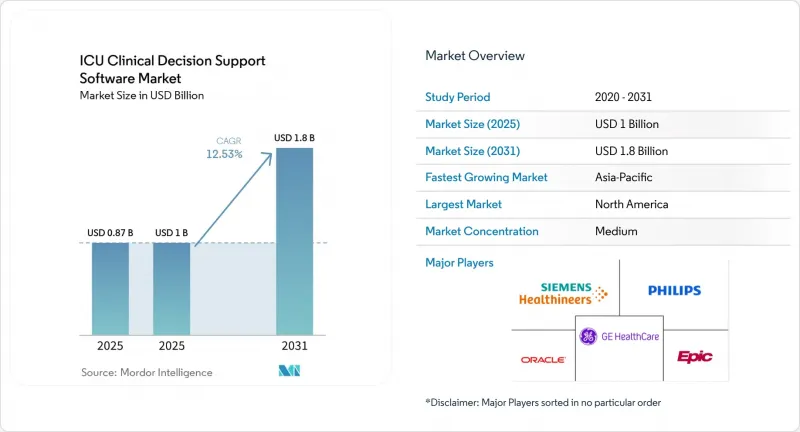
This report is Segmented by Product Type (), Clinical Function (), Technology and Model (), Deployment Mode (), Component (), End User (Public/Private Hospitals, Academic Medical Centers, Others), and Geography (North America, Europe, Asia-Pacific, Middle East, South America).
Global ICU Clinical Decision Support Software Market Trends and Insights
Rising ICU Patient Acuity and Continuous Data Complexity
ICU monitoring can generate more than 1,440 data points per patient each hour from monitors, ventilators, pumps, and laboratory interfaces. Older patients and those with several chronic conditions add to the difficulty of recognizing early changes within those data streams. The ICU clinical decision support software market benefits when platforms combine these inputs into risk indicators that help clinicians direct attention to patients who need it. Etiometry reported that its users achieved a 36% reduction in ICU length of stay and a 41% reduction in readmissions through 2024. Its July 2025 platform update added high-fidelity waveform data from monitors and peripheral devices. This places data quality and the ability to interpret raw physiological signals alongside conventional structured data as important vendor capabilities.
Demand for Early Detection of Sepsis and Patient Deterioration
Early identification of sepsis remains a central use case for ICU clinical decision support software because delayed treatment can worsen clinical outcomes. In April 2026, the FDA cleared Bayesian Health's Sepsis Flagging Devicethrough the 510(k) pathway for adult acute-care settings. The clearance used Prenosis Sepsis ImmunoScore, DEN230036, as the predicate device. The device continuously reviews EHR data and presents a Sepsis Risk High flag when its criteria are met. A 2025 JMIR Medical Informatics study reported that a real-time prediction platform could use dynamic temporal features while retaining clinical interpretability. Sepsis-related quality requirements also make these tools relevant to hospital efforts to document timely care. In 2025, BARMER and Universitatsklinikum Essen established a selective contract for digital sepsis diagnostics under the DigiSep study framework
Alert Fatigue and Clinician Trust Erosion
Alert fatigue can limit adoption when systems issue frequent notifications that do not change clinical decisions. A 2025 AJRCCM abstract found that monthly EHR alert volumes for medical ICU patients varied by nearly 3-fold even when census patterns did not explain the difference. This places greater value on alerts that are specific, timely, and relevant to the current patient context. In May 2024, CLEW Medical received FDA clearance for second-generation predictive models designed to lower false-positive rates. Hospitals are likely to favor systems that support clinician review instead of adding another stream of low-value messages. The ICU clinical decision support software market, therefore, favors vendors that can demonstrate alert performance in local workflows and patient populations.
Other drivers and restraints analyzed in the detailed report include:
- Intensivist Shortages and Expansion of Tele-ICU Care
- AI-Enabled Predictive Risk Stratification
- Cybersecurity, Privacy, and Algorithmic Liability Exposure
For complete list of drivers and restraints, kindly check the Table Of Contents.
Segment Analysis
EHR-embedded ICU decision support modules are forecast to grow at a 12.8% CAGR through 2031. They place guidance inside the workflow where clinicians review orders, notes, and patient records. This can reduce the need to move between separate systems during time-sensitive care in the ICU clinical decision support software market. Integrated ICU clinical decision support software held the largest product share in 2025 because it brings hemodynamic monitoring, medication management, and deterioration prediction into a single deployment. Standalone and vendor-neutral systems retain roles in specialized units and health systems with more than 1 EHR environment.
The boundary between EHR suppliers and specialist vendors is becoming less distinct. Oracle Health made its Clinical AI Agent available for U.S. inpatient and emergency settings in March 2026. Oracle reported that the tool had saved providers more than 200,000 hours, while AtlantiCare reported a 41% reduction in documentation time after deployment. These capabilities can reduce the role of standalone tools, while specialist suppliers respond through validated algorithms, clearances, and local model configuration. A 2026 meta-analysis reported variation between published and real-world performance for Epic clinical decision-support tools, reinforcing the need for local validation.
Patient deterioration prediction accounted for 24.6% of the ICU clinical decision support software market share in 2025. It is often the first function adopted because it can direct attention to patients whose condition may worsen. Sepsis recognition and management was the fastest-growing clinical function through 2031. Its growth is supported by the need to identify deterioration early and document timely treatment. Hemodynamic, ventilator, and medication support remain relevant in cardiac surgery and intensive care workflows.
The ICU clinical decision support software market is moving toward platforms that cover more than 1 clinical function. Etiometry expanded its platform to include a cardiogenic shock tool and reported that the tool was FDA cleared for automated hospital-specific classification. Multi-function coverage can help specialized vendors respond to the broader capabilities of EHR platforms. Infection prevention and antimicrobial stewardship have lower product density, creating an opportunity for suppliers that combine microbiology inputs with dosing models. Sepsis guidelines and hospital quality metrics also guide product development toward functions that hospitals must monitor and report.
Complete Report Scope:
- Market Size and Growth Forecast by Value
- Product Type
- Integrated ICU Clinical Decision Support Software
- Standalone ICU Clinical Decision Support Software
- Vendor-Neutral ICU Clinical Decision Support Software
- EHR-Embedded ICU Decision Support Modules
- Clinical Function
- Patient Deterioration Prediction
- Sepsis Recognition and Management
- Hemodynamic Decision Support
- Ventilator and Respiratory Management
- Medication and Infusion Decision Support
- Infection Prevention and Antimicrobial Stewardship
- Sedation, Delirium and Mobility Management
- Renal Replacement and Fluid Management
- Clinical Documentation and Handover Support
- Discharge, Transfer and Readmission Risk Prediction
- ICU Capacity and Resource Optimization
- By Technology and Model
- Knowledge-Based Clinical Decision Support
- Rule-Based Clinical Decision Support
- Statistical Risk-Scoring Models
- Machine-Learning Clinical Decision Support
- Deep-Learning Clinical Decision Support
- Generative Artificial Intelligence Decision Support
- Hybrid Rules and Artificial Intelligence Models
- By Deployment Mode
- On-Premise Deployment
- Private-Cloud Deployment
- Public-Cloud Deployment
- Hybrid-Cloud Deployment
- Edge and Local Deployment
- Component
- Software Licenses and Subscriptions
- Implementation and Integration Services
- Consulting and Workflow Design Services
- Training and Change-Management Services
- Maintenance, Support and Managed Services
- Data, Model Validation and Clinical Content Services
- By End User
- Hospitals and Health Systems
- Public Hospitals
- Private Hospitals
- Academic Medical Centers
- Integrated Delivery Networks
- Specialty and Tertiary Care Hospitals
- Government and Defense Hospitals
- Tele-ICU and Virtual Care Providers
- By Geography
- North America
- United States
- Canada
- Mexico
- Europe
- Germany
- United Kingdom
- France
- Italy
- Spain
- Rest of Europe
- Asia-Pacific
- China
- Japan
- India
- South Korea
- Australia
- Rest of Asia-Pacific
- Middle East and Africa
- GCC
- South Africa
- Rest of Middle East and Africa
- South America
- Brazil
- Argentina
- Rest of South America
- North America
Geography Analysis
North America held the largest geographic share in 2026. The region combines mature EHR adoption, active FDA engagement, and hospital payment models that reward measurable clinical performance. The ONC HTI-1 rule created transparency and real-world testing requirements, while a 2025 study across 4 Los Angeles safety-net hospitals found that a closed tele-ICU program reduced length of stay in an underserved population. Canada advances more gradually because EHR standards vary across provinces.
Europe was the second-largest region in 2026. Germany, the United Kingdom, and France are major adoption centers because their providers are pursuing validated digital health tools. EU MDR 2017/745 raises the standard for clinical evaluation and post-market monitoring, and in January 2026 the optiSEP project began work on interoperable routine data and decision-support tools for sepsis care in Germany. The 2025 BARMER contract provides a payer-led adoption model for digital sepsis diagnostics. Cybersecurity has become more important after the ChipSoft incident disrupted services in Dutch hospitals.
Asia-Pacific is forecast to be the fastest-growing region through 2031. Specialist shortages, hospital digitization, and public health IT investment support the ICU clinical decision support software market across China, India, South Korea, and Australia. China requires localized clinical validation for AI-based tools, increasing entry barriers for foreign suppliers while supporting local platforms with validated datasets in the ICU clinical decision support software market. GCC countries are also adding first-generation systems through hospital construction and international partnerships. A 2025 study in northern and northeastern Brazil found that tele-ICU support improved outcomes in resource-constrained settings
List of Companies Covered in this Report:
- Epic Systems
- Oracle
- Koninklijke Philips
- GE HealthCare Technologies Inc.
- Siemens Healthineers
- Merative
- Wolters Kluwer
- Change Healthcare
- Meditech
- Zynx Health
- iMDsoft
- Ascom
- Picis Clinical Solutions, Inc.
- Intersystems
- Altera Digital Health
- Medhost
- Optum
- Elsevier B.V.
- CLEW Medical Ltd.
- Pacmed B.V.
- Etiometry Inc.
- AcuteCare.ai
- ehCOS
Additional Benefits:
- The market estimate (ME) sheet in Excel format
- 3 months of analyst support
TABLE OF CONTENTS
1 INTRODUCTION
- 1.1 Study Assumptions and Market Definition
- 1.2 Scope of the Study
2 RESEARCH METHODOLOGY
3 EXECUTIVE SUMMARY
4 MARKET LANDSCAPE
- 4.1 Market Overview
- 4.2 Market Drivers
- 4.2.1 Rising ICU Patient Acuity and Continuous Data Complexity
- 4.2.2 EHR and Medical Device Integration Requirements
- 4.2.3 Demand for Early Detection of Sepsis and Patient Deterioration
- 4.2.4 Intensivist Shortages and Expansion of Tele-ICU Care
- 4.2.5 AI-Enabled Predictive Risk Stratification
- 4.2.6 ICU Workflow Digitization and Outcome-Based Care Pressure
- 4.3 Market Restraints
- 4.3.1 Interoperability and Data-Context Fragmentation
- 4.3.2 Alert Fatigue and Clinician Trust Erosion
- 4.3.3 High Implementation, Validation and Change-Management Costs
- 4.3.4 Cybersecurity, Privacy and Algorithmic Liability Exposure
- 4.4 Supply-Chain Analysis
- 4.5 Regulatory Landscape
- 4.6 Technological Outlook
- 4.7 Porters Five Forces Analysis
5 MARKET SIZE AND GROWTH FORECASTS
- 5.1 Market Size and Growth Forecast by Value
- 5.2 Product Type
- 5.2.1 Integrated ICU Clinical Decision Support Software
- 5.2.2 Standalone ICU Clinical Decision Support Software
- 5.2.3 Vendor-Neutral ICU Clinical Decision Support Software
- 5.2.4 EHR-Embedded ICU Decision Support Modules
- 5.3 Clinical Function
- 5.3.1 Patient Deterioration Prediction
- 5.3.2 Sepsis Recognition and Management
- 5.3.3 Hemodynamic Decision Support
- 5.3.4 Ventilator and Respiratory Management
- 5.3.5 Medication and Infusion Decision Support
- 5.3.6 Infection Prevention and Antimicrobial Stewardship
- 5.3.7 Sedation, Delirium and Mobility Management
- 5.3.8 Renal Replacement and Fluid Management
- 5.3.9 Clinical Documentation and Handover Support
- 5.3.10 Discharge, Transfer and Readmission Risk Prediction
- 5.3.11 ICU Capacity and Resource Optimization
- 5.4 By Technology and Model
- 5.4.1 Knowledge-Based Clinical Decision Support
- 5.4.2 Rule-Based Clinical Decision Support
- 5.4.3 Statistical Risk-Scoring Models
- 5.4.4 Machine-Learning Clinical Decision Support
- 5.4.5 Deep-Learning Clinical Decision Support
- 5.4.6 Generative Artificial Intelligence Decision Support
- 5.4.7 Hybrid Rules and Artificial Intelligence Models
- 5.5 By Deployment Mode
- 5.5.1 On-Premise Deployment
- 5.5.2 Private-Cloud Deployment
- 5.5.3 Public-Cloud Deployment
- 5.5.4 Hybrid-Cloud Deployment
- 5.5.5 Edge and Local Deployment
- 5.6 Component
- 5.6.1 Software Licenses and Subscriptions
- 5.6.2 Implementation and Integration Services
- 5.6.3 Consulting and Workflow Design Services
- 5.6.4 Training and Change-Management Services
- 5.6.5 Maintenance, Support and Managed Services
- 5.6.6 Data, Model Validation and Clinical Content Services
- 5.7 By End User
- 5.7.1 Hospitals and Health Systems
- 5.7.2 Public Hospitals
- 5.7.3 Private Hospitals
- 5.7.4 Academic Medical Centers
- 5.7.5 Integrated Delivery Networks
- 5.7.6 Specialty and Tertiary Care Hospitals
- 5.7.7 Government and Defense Hospitals
- 5.7.8 Tele-ICU and Virtual Care Providers
- 5.8 By Geography
- 5.8.1 North America
- 5.8.1.1 United States
- 5.8.1.2 Canada
- 5.8.1.3 Mexico
- 5.8.2 Europe
- 5.8.2.1 Germany
- 5.8.2.2 United Kingdom
- 5.8.2.3 France
- 5.8.2.4 Italy
- 5.8.2.5 Spain
- 5.8.2.6 Rest of Europe
- 5.8.3 Asia-Pacific
- 5.8.3.1 China
- 5.8.3.2 Japan
- 5.8.3.3 India
- 5.8.3.4 South Korea
- 5.8.3.5 Australia
- 5.8.3.6 Rest of Asia-Pacific
- 5.8.4 Middle East and Africa
- 5.8.4.1 GCC
- 5.8.4.2 South Africa
- 5.8.4.3 Rest of Middle East and Africa
- 5.8.5 South America
- 5.8.5.1 Brazil
- 5.8.5.2 Argentina
- 5.8.5.3 Rest of South America
- 5.8.1 North America
6 COMPETITIVE LANDSCAPE
- 6.1 Market Concentration
- 6.2 Market Share Analysis
- 6.3 Company Profiles (includes Global Level Overview, Market Level Overview, Core Segments, Financials as available, Strategic Information, Market Rank/Share, Products and Services, Recent Developments)
- 6.3.1 Epic Systems Corporation
- 6.3.2 Oracle Corporation
- 6.3.3 Koninklijke Philips N.V.
- 6.3.4 GE HealthCare Technologies Inc.
- 6.3.5 Siemens Healthineers AG
- 6.3.6 Merative
- 6.3.7 Wolters Kluwer N.V.
- 6.3.8 Change Healthcare
- 6.3.9 MEDITECH
- 6.3.10 Zynx Health
- 6.3.11 iMDsoft
- 6.3.12 Ascom Holding AG
- 6.3.13 Picis Clinical Solutions, Inc.
- 6.3.14 InterSystems Corporation
- 6.3.15 Altera Digital Health
- 6.3.16 MEDHOST
- 6.3.17 Optum, Inc.
- 6.3.18 Elsevier B.V.
- 6.3.19 CLEW Medical Ltd.
- 6.3.20 Pacmed B.V.
- 6.3.21 Etiometry Inc.
- 6.3.22 AcuteCare.ai
- 6.3.23 ehCOS
7 MARKET OPPORTUNITIES AND FUTURE OUTLOOK
- 7.1 White-Space and Unmet-Need Assessment

