PUBLISHER: Mordor Intelligence | PRODUCT CODE: 2119273

PUBLISHER: Mordor Intelligence | PRODUCT CODE: 2119273
Virgin Coconut Oil - Market Share Analysis, Industry Trends & Statistics, Growth Forecasts (2026 - 2031)
According to Mordor Intelligence, the virgin coconut oil market was valued at USD 2.75 billion in 2025 and is estimated to grow from USD 2.96 billion in 2026 to USD 4.32 billion by 2031, at a CAGR of 7.80% during the forecast period (2026-2031).
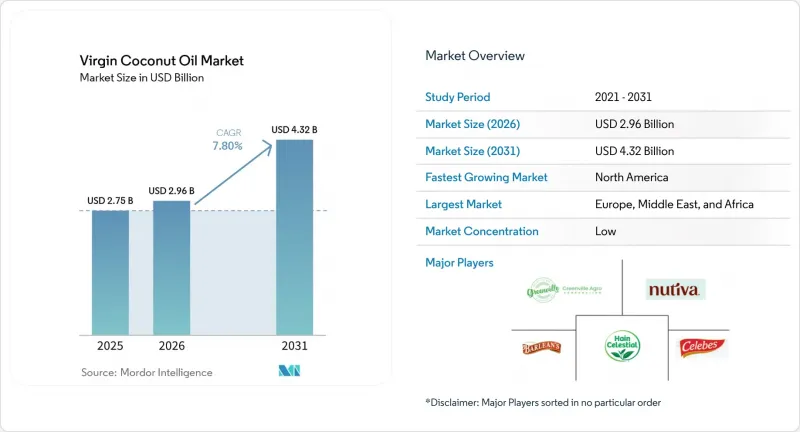
This report is Segmented by Product Type (Organic Virgin Coconut Oil and Conventional Virgin Coconut Oil), by Extraction Method (Cold-Pressed, Expeller-Pressed, Wet-Milled and Fermented, and More), by Packaging Type (Plastic Bottles, and More), by End-User (Industrial, Retail, and More), and by Geography (North America, and More). The Market Forecasts are Provided in Terms of Value (USD) and Volume (Tons).
Global Virgin Coconut Oil Market Trends and Insights
Rising consumer demand for natural and minimally processed oils
Growing consumer preference for natural and minimally processed foods is supporting demand for virgin coconut oil, which is commonly positioned as a natural oil produced through minimal processing while retaining its characteristic flavor and nutritional properties. This preference is reflected in the 2025 IFIC Food & Health Survey, where 28% of Americans identified "minimal or no processing" and 24% identified "natural" as criteria for defining a healthy food . As consumers increasingly associate naturalness and minimal processing with healthier and more authentic food choices, virgin coconut oil benefits from its positioning as a less-refined alternative to conventional refined oils. This trend is encouraging manufacturers and brands to emphasize virgin, unrefined, organic, cold-pressed, and minimally processed attributes, strengthening demand among health-conscious consumers seeking natural cooking and wellness oils.
Increasing adoption of functional foods and wellness products
Growing consumer interest in foods and products that provide benefits beyond basic nutrition is creating new opportunities for virgin coconut oil, particularly as an ingredient in functional foods, wellness products, and nutraceutical formulations. VCO's medium-chain fatty acid profile and naturally occurring bioactive compounds have contributed to its positioning as a functional ingredient, with applications expanding into emulsions, food formulations, and other value-added wellness products. As consumers increasingly seek natural ingredients for everyday diets and wellness routines, manufacturers are developing more value-added VCO products, including nutraceutical and portable formats, broadening the oil's applications beyond conventional cooking.
Substitution by olive, avocado, sunflower, canola, and specialty oils
The availability of a wide range of alternative cooking and specialty oils is a key restraint for the virgin coconut oil market, as consumers can readily switch to products that offer different nutritional profiles, flavors, cooking characteristics, and price points. Olive, avocado, canola, and sunflower oils are commonly used across cooking, baking, frying, and salad dressing applications, while specialty oils provide additional choices for health-focused and premium consumers. The relatively neutral flavor and versatility of canola and sunflower oils make them suitable for everyday cooking, while olive and avocado oils appeal to consumers seeking oils perceived as healthier or premium alternatives. This broad substitution base limits virgin coconut oil's ability to capture a larger share of household oil consumption and increases competitive pressure on brands to differentiate through quality, natural processing, distinctive flavor, sustainability, and functional positioning.
Other drivers and restraints analyzed in the detailed report include:
- Growing emphasis on sustainable and traceable sourcing
- Growth of vegan, plant-based and keto-oriented consumption
- Adulteration and authenticity risk in premium virgin claims
For complete list of drivers and restraints, kindly check the Table Of Contents.
Segment Analysis
Conventional virgin coconut oil accounted for 88.81% of the product type mix in 2025. This share reflects the purchasing needs of food manufacturers, cosmetic formulators, and other large-volume buyers. Conventional supply meets price-sensitive requirements where buyers need consistent bulk availability. The virgin coconut oil market continues to depend on conventional volume as industrial users prioritize supply continuity and agreed specifications. Large processors use this segment to maintain utilization across their extraction and packaging operations.
Organic virgin coconut oil is forecast to grow at a CAGR of 9.83% during 2026-2031. This higher growth rate reflects demand for products that carry recognized certification and a clear sourcing story. European buyers increasingly assess organic credentials, traceability, and social or environmental assurances when selecting coconut oil suppliers. Sri Lanka is relevant to European organic supply, as certified producers serve buyers seeking differentiated products. This segment gives processors an opportunity to earn premium margins, though certification limits the supplier pool and raises compliance requirements.
Cold-pressed oil accounted for 58.12% of the extraction method mix in 2026. Consumers commonly associate this method with minimal processing and retention of natural product characteristics. This perception supports a premium position in natural food, cosmetic, and wellness channels. The virgin coconut oil market rewards suppliers that link cold-pressed production with traceability and clear processing claims. It remains a central extraction method for producers competing on purity and aroma.
Expeller-pressed oil is forecast to grow at a 9.93% CAGR through 2031. This method offers processors a practical route to scaling production while avoiding the profile of fully refined oil. It can suit mid-volume producers that require more throughput than artisanal methods can provide. Wet-milled and fermented methods remain important for smaller Southeast Asian producers, as they require less complex equipment. Centrifugation retains a premium role where clarity and aroma are priorities, particularly in cosmetics and specialty retail.
Complete Report Scope:
- By Product Type
- Organic Virgin Coconut Oil
- Conventional Virgin Coconut Oil
- By Extraction Method
- Cold-Pressed
- Expeller-Pressed
- Wet-Milled and Fermented
- Centrifuged and Separated
- By Packaging Type
- Plastic Bottles
- Glass Jars
- Pouches
- Metal Cans
- Bulk Drums, IBCs and Flexitanks
- By End-User
- Industrial
- Food and Beverage Manufacturers
- Cosmetics and Personal Care Manufacturers
- Pharmaceutical and Nutraceutical Manufacturers
- Food Service and Institutional Buyers
- Retail
- Industrial
- Geography
- North America
- United States
- Canada
- Mexico
- Rest of North America
- Europe
- United Kingdom
- Germany
- France
- Italy
- Spain
- Russia
- Sweden
- Belgium
- Poland
- Netherlands
- Rest of Europe
- Asia-Pacific
- China
- Japan
- India
- Thailand
- Singapore
- Indonesia
- South Korea
- Australia
- New Zealand
- Rest of Asia-Pacific
- South America
- Brazil
- Argentina
- Colombia
- Chile
- Rest of South America
- Middle East and Africa
- United Arab Emirates
- South Africa
- Saudi Arabia
- Nigeria
- Egypt
- Morocco
- Turkey
- Rest of Middle East and Africa
- North America
Geography Analysis
North America held 21.68% of the virgin coconut oil market share in 2025. The region remains a major demand center, supported by well-established natural-product retail, e-commerce, and wellness purchasing. The United States accounts for most regional consumption and import demand. Its dependence on imports makes supply continuity from producing countries important. Premium retail channels can sustain demand during price increases more effectively than price-sensitive industrial customers. Canada provides a smaller but growing retail base, while Mexico plays a role in value-oriented consumption and regional trade flows.
Europe is forecast to grow at a 9.08% CAGR during 2026-2031. Clean-label demand, organic purchasing, and supply-chain compliance are key drivers of this growth. The Netherlands and Germany serve as important entry and re-export hubs for coconut oil in the European market. The United Kingdom, France, Spain, and Italy contribute direct retail demand. Buyers increasingly require suppliers that can support sustainability and origin claims with verifiable records, which favors processors with credible certification and dependable documentation.
The virgin coconut oil market in Asia-Pacific combines major producing countries with growing consumer demand. The Philippines, Indonesia, India, and Thailand remain central to supply, while Australia and New Zealand are established premium import markets. India also faces raw material volatility, as Marico reported a 48% year-over-year rise in copra prices in FY2024. Japan, South Korea, and Singapore provide demand for beauty and functional food formulations. South America, the Middle East, and Africa remain early-stage consumption regions, where premium food retail and modern trade channels are still developing. Philippine producer Axelum has stated that it is pursuing expansion outside the United States, reflecting interest in underserved regions.
- Nutiva Inc.
- The Hain Celestial Group, Inc.
- Barlean's Organic Oils, LLC
- Celebes Coconut Corporation
- Greenville Agro Corporation
- Healthy Traditions, Inc.
- S.C. Global Coco Products Inc.
- Edward & Sons Trading Co.
- Garden of Life LLC
- NOW Foods Group Inc.
- Nature's Way Products, LLC
- Viva Naturals
- Jarrow Formulas Inc.
- Dabur India Limited
- Marico Limited
- Sun Bionaturals Private Limited
- iTi Tropicals, LLC
- Axelum Resources Corp.
- Thai Coconut Public Company Limited
- PT. Harvard Cocopro
- Growrich Manufacturing Inc.
- Spectrum Organic Products, LLC
Additional Benefits:
- The market estimate (ME) sheet in Excel format
- 3 months of analyst support
TABLE OF CONTENTS
1 INTRODUCTION
- 1.1 Study Assumptions and Market Definition
- 1.2 Scope of the Study
2 RESEARCH METHODOLOGY
3 EXECUTIVE SUMMARY
4 MARKET LANDSCAPE
- 4.1 Market Overview
- 4.2 Market Drivers
- 4.2.1 Rising consumer demand for natural and minimally processed oils
- 4.2.2 Expanding use in cosmetics and personal care
- 4.2.3 Increasing adoption of functional foods and wellness products
- 4.2.4 Growing emphasis on sustainable and traceable sourcing
- 4.2.5 Growth of vegan, plant-based and keto-oriented consumption
- 4.2.6 Technological advancements in manufacturing and quality assurance
- 4.3 Market Restraints
- 4.3.1 Substitution by olive, avocado, sunflower, canola, and specialty oils
- 4.3.2 Climate-driven coconut yield and price volatility
- 4.3.3 Adulteration and authenticity risk in premium virgin claims
- 4.3.4 High price relative to conventional coconut and edible oils
- 4.4 Supply Chain Analysis
- 4.5 Regulatory Landscape
- 4.6 Technological Outlook
- 4.7 Porter's Five Forces
- 4.7.1 Threat of New Entrants
- 4.7.2 Bargaining Power of Buyers
- 4.7.3 Bargaining Power of Suppliers
- 4.7.4 Threat of Substitutes
- 4.7.5 Competitive Rivalry
5 MARKET SIZE AND GROWTH FORECASTS (VALUE AND VOLUME)
- 5.1 By Product Type
- 5.1.1 Organic Virgin Coconut Oil
- 5.1.2 Conventional Virgin Coconut Oil
- 5.2 By Extraction Method
- 5.2.1 Cold-Pressed
- 5.2.2 Expeller-Pressed
- 5.2.3 Wet-Milled and Fermented
- 5.2.4 Centrifuged and Separated
- 5.3 By Packaging Type
- 5.3.1 Plastic Bottles
- 5.3.2 Glass Jars
- 5.3.3 Pouches
- 5.3.4 Metal Cans
- 5.3.5 Bulk Drums, IBCs and Flexitanks
- 5.4 By End-User
- 5.4.1 Industrial
- 5.4.1.1 Food and Beverage Manufacturers
- 5.4.1.2 Cosmetics and Personal Care Manufacturers
- 5.4.1.3 Pharmaceutical and Nutraceutical Manufacturers
- 5.4.2 Food Service and Institutional Buyers
- 5.4.3 Retail
- 5.4.1 Industrial
- 5.5 Geography
- 5.5.1 North America
- 5.5.1.1 United States
- 5.5.1.2 Canada
- 5.5.1.3 Mexico
- 5.5.1.4 Rest of North America
- 5.5.2 Europe
- 5.5.2.1 United Kingdom
- 5.5.2.2 Germany
- 5.5.2.3 France
- 5.5.2.4 Italy
- 5.5.2.5 Spain
- 5.5.2.6 Russia
- 5.5.2.7 Sweden
- 5.5.2.8 Belgium
- 5.5.2.9 Poland
- 5.5.2.10 Netherlands
- 5.5.2.11 Rest of Europe
- 5.5.3 Asia-Pacific
- 5.5.3.1 China
- 5.5.3.2 Japan
- 5.5.3.3 India
- 5.5.3.4 Thailand
- 5.5.3.5 Singapore
- 5.5.3.6 Indonesia
- 5.5.3.7 South Korea
- 5.5.3.8 Australia
- 5.5.3.9 New Zealand
- 5.5.3.10 Rest of Asia-Pacific
- 5.5.4 South America
- 5.5.4.1 Brazil
- 5.5.4.2 Argentina
- 5.5.4.3 Colombia
- 5.5.4.4 Chile
- 5.5.4.5 Rest of South America
- 5.5.5 Middle East and Africa
- 5.5.5.1 United Arab Emirates
- 5.5.5.2 South Africa
- 5.5.5.3 Saudi Arabia
- 5.5.5.4 Nigeria
- 5.5.5.5 Egypt
- 5.5.5.6 Morocco
- 5.5.5.7 Turkey
- 5.5.5.8 Rest of Middle East and Africa
- 5.5.1 North America
6 COMPETITIVE LANDSCAPE
- 6.1 Market Concentration
- 6.2 Strategic Moves
- 6.3 Market Ranking Analysis
- 6.4 Company Profiles (includes Global level Overview, Market level overview, Core Segments, Financials as available, Strategic Information, Market Rank/Share for key companies, Products and Services, and Recent Developments)
- 6.4.1 Nutiva Inc.
- 6.4.2 The Hain Celestial Group, Inc.
- 6.4.3 Barlean's Organic Oils, LLC
- 6.4.4 Celebes Coconut Corporation
- 6.4.5 Greenville Agro Corporation
- 6.4.6 Healthy Traditions, Inc.
- 6.4.7 S.C. Global Coco Products Inc.
- 6.4.8 Edward & Sons Trading Co.
- 6.4.9 Garden of Life LLC
- 6.4.10 NOW Foods Group Inc.
- 6.4.11 Nature's Way Products, LLC
- 6.4.12 Viva Naturals
- 6.4.13 Jarrow Formulas Inc.
- 6.4.14 Dabur India Limited
- 6.4.15 Marico Limited
- 6.4.16 Sun Bionaturals Private Limited
- 6.4.17 iTi Tropicals, LLC
- 6.4.18 Axelum Resources Corp.
- 6.4.19 Thai Coconut Public Company Limited
- 6.4.20 PT. Harvard Cocopro
- 6.4.21 Growrich Manufacturing Inc.
- 6.4.22 Spectrum Organic Products, LLC
7 MARKET OPPORTUNITIES AND FUTURE OUTLOOK

