PUBLISHER: Mordor Intelligence | PRODUCT CODE: 2119301

PUBLISHER: Mordor Intelligence | PRODUCT CODE: 2119301
Diamond Jewelry - Market Share Analysis, Industry Trends & Statistics, Growth Forecasts (2026 - 2031)
According to Mordor Intelligence, the diamond jewelry market size was valued at USD 90.12 billion in 2026 and is estimated to reach USD 113.48 billion by 2031, at a CAGR of 4.57% during the forecast period from 2026 to 2031.
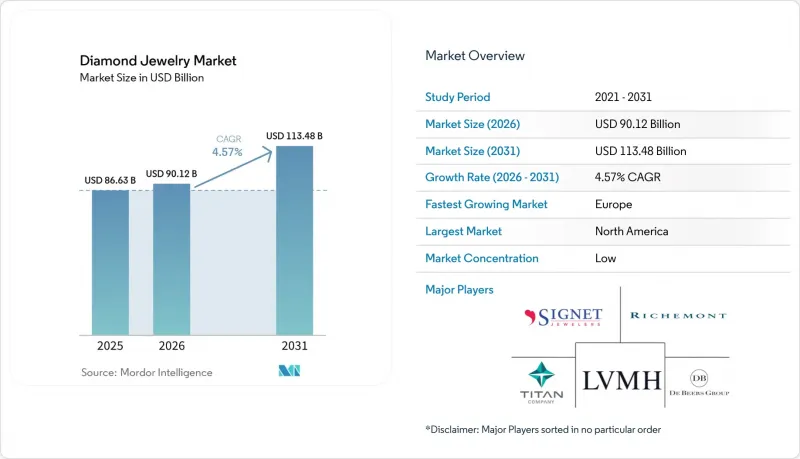
This report is Segmented by Product Type (Rings, Necklaces, Earrings, Bracelets, Pendants, Chains, and Other), Diamond Type (Natural and Lab-Grown), Color Type (Colored and Colorless), Metal Type (Gold, Silver, Platinum, and Other), Distribution Channel (Online Stores and Offline Stores), and Geography (North America, Europe, Asia-Pacific, South America, and Middle East and Africa). Forecasts in Value (USD).
Global Diamond Jewelry Market Trends and Insights
Growing Demand for Bridal and Wedding Jewelry
Bridal purchases continue to support the Diamond jewelry market because a ring is part of most proposal occasions. The Knot reported that nearly 9 in 10 proposers gave a ring during the proposal, while lab-grown center stones represented 61% of U.S. engagement-ring purchases by unit count in 2026. The same study reported average engagement-ring spending of USD 4,600 and an average center stone size of 1.9 carats. Natural diamond sales at U.S. independent jewelers increased 4% in Q4 2025 and 9% in Q1 2026, with demand concentrated in stones of 1 carat or more. In India, bridal and wedding occasions accounted for 86% of natural diamond consumption, while self-gifting and anniversary purchases broadened repeat demand. The Kimberley Process covers more than 99% of global rough diamond trade, making its certification a core trust requirement for retailers serving bridal buyers
Increasing Jewelry Customization
Customization is becoming a standard part of the Diamond jewelry market, especially in mid-priced and premium engagement jewelry. The supplied research indicates that 88% of U.S. couples selected customized engagement rings in 2025, shifting demand from standard catalog products toward tailored designs. Natural Diamond Council research identified nostalgia, self-expression, and vintage styles as major consumer themes, supporting demand for Art Deco cuts, stacked rings, and heirloom-style settings. Lower per-carat lab-grown diamond prices give buyers more budget for metalwork, engraving, and fancy cuts. This makes customized jewelry more accessible across the USD 2,000 to USD 6,000 price range. Brands that combine design consultation with clear diamond information can improve conversion without relying only on promotional pricing.
High Cost of Natural Diamond Jewelry
The cost of natural diamond jewelry remains a constraint because buyers can compare it directly with lower-priced lab-grown stones. The supplied research reported that an unbranded 1-carat round lab-grown diamond cost USD 845 in Q1 2025, compared with USD 3,895 for a comparable natural stone. De Beers identified the 0.3 to 1-carat natural diamond range as the area most affected by synthetic diamond demand. Record gold prices in 2025 increased the total cost of jewelry with gold settings, particularly for buyers with fixed budgets. The challenge is greater in developing retail markets, where resale options for natural diamond jewelry are less formalized. Premium products retain more pricing power, while the mid-priced natural diamond segment faces continuing pressure on purchase volume.
Other drivers and restraints analyzed in the detailed report include:
- Rising Influence of Social Media and Celebrity Culture
- Growing Demand for Sustainable and Ethically Sourced Diamonds
- Competition from Alternative Gemstones
For complete list of drivers and restraints, kindly check the Table Of Contents.
Segment Analysis
Rings held 48.67% of 2025 product value and remained the largest product category in the Diamond jewelry market. Their position reflects the continuing importance of engagement rings across major consumer regions. Necklaces are forecast to grow at a 6.24% CAGR through 2031 as lower lab-grown diamond prices extend access to tennis necklaces, layered pendants, and statement chains. The supplied research showed that tennis bracelets rose from 3.5% of lab-grown diamond product sales in 2020 to 11.9% in 2025. This shift indicates that buyers are using diamonds in more everyday formats, rather than only for an engagement purchase.
Earrings remain an accessible entry format for first-time buyers, particularly in Asia-Pacific. Pendants and chains are increasingly promoted as unisex jewelry, including within the expanding male fine-jewelry category. De Beers introduced its Desert Diamonds Icons campaign in 2026 around the eternity band, tennis bracelet, and halo pendant. These 3 formats accounted for 70% of diamond jewelry acquisitions in the supplied research. De Beers also reported that gifting represented 44% of natural diamond jewelry sales in 2025 and self-purchases represented 31%. The expansion of these occasions supports more balanced product demand across the Diamond jewelry industry.
Lab-grown diamonds held 65.43% of the 2025 diamond-type value in the Diamond jewelry market. Their position rests on lower prices and their broad acceptance in engagement-ring center stones. Natural diamonds are forecast to grow at a faster 6.35% CAGR through 2031, supported by lower supply and premium positioning. De Beers reported that natural diamonds represented 85% of independent jewelers' diamond sales by value in 2025, compared with 15% for lab-grown diamonds. Value patterns therefore differ from purchase-unit patterns across this category.
Natural diamond production is expected to remain constrained as mines close, and producers reduce output. Antwerp World Diamond Centre reported 105 million carats of global production in 2025, down 13% from 2022. De Beers' 2026 production guidance of 21 to 26 million carats reflects the same tighter supply environment. The supplied research also indicated slower sales of lab-grown stones weighing 3 carats or more. That result suggests that larger stones do not always create proportional demand once size is no longer the primary constraint. Natural diamonds can benefit when brands connect rarity and provenance with self-expression rather than relying only on bridal tradition.
Complete Report Scope:
- Product Type
- Rings
- Necklaces
- Earrings
- Bracelets
- Pendants
- Chains
- Other Product Types
- Diamond Type
- Natural
- Lab-Grown
- Color Type
- Colored
- Colorless
- Metal Type
- Gold
- Silver
- Platinum
- Other Metals
- Distribution Channel
- Online Stores
- Offline Stores
- By Geography
- North America
- United States
- Canada
- Mexico
- Rest of North America
- Europe
- Germany
- United Kingdom
- France
- Italy
- Spain
- Netherlands
- Sweden
- Poland
- Belgium
- Rest of Europe
- Asia-Pacific
- China
- India
- Japan
- Australia
- South Korea
- Vietnam
- Indonesia
- Rest of Asia-Pacific
- South America
- Brazil
- Argentina
- Chile
- Peru
- Colombia
- Rest of South America
- Middle East and Africa
- United Arab Emirates
- Saudi Arabia
- South Africa
- Nigeria
- Rest of Middle East and Africa
- North America
Geography Analysis
North America held 38.28% of global value in 2025, making it the largest regional part of the Diamond jewelry market. The United States represented 53% of global natural diamond jewelry demand in the supplied research. U.S. jewelry revenue grew 9% in H1 2026, with natural diamonds gaining through higher average selling prices and lab-grown diamonds gaining through higher unit sales. Signet reported FY2026 sales of USD 6.81 billion, same-store sales growth of 1.3%, and an average unit retail price increase of 7%. De Beers Group was available through 19 retail partners at 30 locations in the United States and Canada in 2025, providing retailers with a traceability-based product proposition.
Europe is forecast to grow at a 5.68% CAGR through 2031, the fastest regional rate in the Diamond jewelry market. Richemont's Jewelry Maisons recorded 8% sales growth in FY2026 to EUR 16.5 billion, equivalent to USD 19.2 billion, and reported double-digit growth in Europe. European platinum jewelry fabrication grew 6% in 2025, marking its fifth consecutive year of growth. Germany, the United Kingdom, France, Italy, and Spain remain important demand centers. Antwerp's 2025 diamond trade totaled USD 19.07 billion, with polished diamonds accounting for 65.6% of the total.
Asia-Pacific remains highly varied across the Diamond jewelry market. India captured 12% of global natural diamond demand in 2025, compared with 5% each for China and Japan. Kalyan Jewellers reported FY2026 revenue of INR 35,743 crore, equivalent to USD 4.2 billion, up 43% year over year. China is seeing stronger natural diamond demand among younger, higher-income buyers, while lab-grown products continue to pressure the natural diamond mid-market. South America has demand centered on branded luxury retail and urban e-commerce, while new trade routes may support more competitive supply. The Middle East and Africa benefit from Dubai's role as a trading hub, and Richemont identified the region as a leading area for wholesale and online growth in FY2026.
- De Beers Group
- Signet Jewelers Limited
- Chow Tai Fook Jewellery Group Limited
- LVMH Moet Hennessy Louis Vuitton SE
- Richemont SA
- Pandora A/S
- Brilliant Earth, Inc.
- Blue Nile, Inc.
- James Allen
- Kalyan Jewellers India Limited
- Titan Company Limited
- Malabar Gold & Diamonds
- Joyalukkas India Pvt. Ltd.
- Graff Diamonds Limited
- Swatch Group
- Harry Winston, Inc.
- Swarovski AG
- ALROSA PJSC
- Rio Tinto Diamonds
- Petra Diamonds Limited
Additional Benefits:
- The market estimate (ME) sheet in Excel format
- 3 months of analyst support
TABLE OF CONTENTS
1 INTRODUCTION
- 1.1 Study Assumptions and Market Definition
- 1.2 Scope of the Study
2 RESEARCH METHODOLOGY
3 EXECUTIVE SUMMARY
4 MARKET LANDSCAPE
- 4.1 Market Overview
- 4.2 Market Drivers
- 4.2.1 Growing Demand for Bridal and Wedding Jewelry
- 4.2.2 Increasing Jewelry Customization
- 4.2.3 Rising Influence of Social Media and Celebrity Culture
- 4.2.4 Growing Demand for Sustainable and Ethically Sourced Diamonds
- 4.2.5 Product Innovation and Contemporary Designs
- 4.2.6 Increasing Preference for Luxury and Premium Products
- 4.3 Market Restraints
- 4.3.1 High Cost of Natural Diamond Jewelry
- 4.3.2 Competition from Alternative Gemstones
- 4.3.3 Consumer Concerns About Authenticity and Transparency
- 4.3.4 Availability of Alternative Imitation Jewelry
- 4.4 Consumer Behavior Analysis
- 4.5 Regulatory Landscape
- 4.6 Technological Outlook
- 4.7 Porter's Five Forces
- 4.7.1 Bargaining Power of Suppliers
- 4.7.2 Bargaining Power of Buyers
- 4.7.3 Threat of New Entrants
- 4.7.4 Threat of Substitutes
- 4.7.5 Competitive Rivalry
5 MARKET SIZE AND GROWTH FORECASTS (VALUE)
- 5.1 Product Type
- 5.1.1 Rings
- 5.1.2 Necklaces
- 5.1.3 Earrings
- 5.1.4 Bracelets
- 5.1.5 Pendants
- 5.1.6 Chains
- 5.1.7 Other Product Types
- 5.2 Diamond Type
- 5.2.1 Natural
- 5.2.2 Lab-Grown
- 5.3 Color Type
- 5.3.1 Colored
- 5.3.2 Colorless
- 5.4 Metal Type
- 5.4.1 Gold
- 5.4.2 Silver
- 5.4.3 Platinum
- 5.4.4 Other Metals
- 5.5 Distribution Channel
- 5.5.1 Online Stores
- 5.5.2 Offline Stores
- 5.6 By Geography
- 5.6.1 North America
- 5.6.1.1 United States
- 5.6.1.2 Canada
- 5.6.1.3 Mexico
- 5.6.1.4 Rest of North America
- 5.6.2 Europe
- 5.6.2.1 Germany
- 5.6.2.2 United Kingdom
- 5.6.2.3 France
- 5.6.2.4 Italy
- 5.6.2.5 Spain
- 5.6.2.6 Netherlands
- 5.6.2.7 Sweden
- 5.6.2.8 Poland
- 5.6.2.9 Belgium
- 5.6.2.10 Rest of Europe
- 5.6.3 Asia-Pacific
- 5.6.3.1 China
- 5.6.3.2 India
- 5.6.3.3 Japan
- 5.6.3.4 Australia
- 5.6.3.5 South Korea
- 5.6.3.6 Vietnam
- 5.6.3.7 Indonesia
- 5.6.3.8 Rest of Asia-Pacific
- 5.6.4 South America
- 5.6.4.1 Brazil
- 5.6.4.2 Argentina
- 5.6.4.3 Chile
- 5.6.4.4 Peru
- 5.6.4.5 Colombia
- 5.6.4.6 Rest of South America
- 5.6.5 Middle East and Africa
- 5.6.5.1 United Arab Emirates
- 5.6.5.2 Saudi Arabia
- 5.6.5.3 South Africa
- 5.6.5.4 Nigeria
- 5.6.5.5 Rest of Middle East and Africa
- 5.6.1 North America
6 COMPETITIVE LANDSCAPE
- 6.1 Market Concentration
- 6.2 Strategic Moves
- 6.3 Market Ranking Analysis
- 6.4 Company Profiles (Includes Global-level Overview, Market-level Overview, Core Segments, Financials, Strategic Info, Market Rank/Share, Products & Services, Recent Developments)
- 6.4.1 De Beers Group
- 6.4.2 Signet Jewelers Limited
- 6.4.3 Chow Tai Fook Jewellery Group Limited
- 6.4.4 LVMH Moet Hennessy Louis Vuitton SE
- 6.4.5 Richemont SA
- 6.4.6 Pandora A/S
- 6.4.7 Brilliant Earth, Inc.
- 6.4.8 Blue Nile, Inc.
- 6.4.9 James Allen
- 6.4.10 Kalyan Jewellers India Limited
- 6.4.11 Titan Company Limited
- 6.4.12 Malabar Gold & Diamonds
- 6.4.13 Joyalukkas India Pvt. Ltd.
- 6.4.14 Graff Diamonds Limited
- 6.4.15 Swatch Group
- 6.4.16 Harry Winston, Inc.
- 6.4.17 Swarovski AG
- 6.4.18 ALROSA PJSC
- 6.4.19 Rio Tinto Diamonds
- 6.4.20 Petra Diamonds Limited
7 MARKET OPPORTUNITIES AND FUTURE OUTLOOK

