PUBLISHER: Mordor Intelligence | PRODUCT CODE: 2119315

PUBLISHER: Mordor Intelligence | PRODUCT CODE: 2119315
Adiponectin Testing - Market Share Analysis, Industry Trends & Statistics, Growth Forecasts (2026 - 2031)
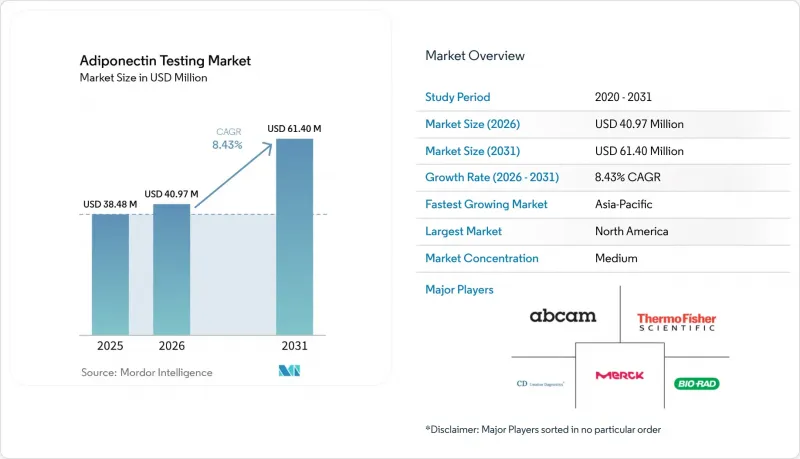
According to Mordor Intelligence, the adiponectin testing market size is expected to increase from USD 38.48 million in 2025 to USD 40.97 million in 2026 and reach USD 61.40 million by 2031, growing at a CAGR of 8.43% over 2026-2031.
This report is Segmented by Product (Assay Kits, Reagents & Consumables, Software), Technology (ELISA, CLIA, Multiplex Immunoassay), Application (Diabetes & Metabolic Syndrome, Obesity, Cardiovascular, Biomarker Discovery), End User (Research Institutes, Pharma & Biotech, Clinical Labs, Hospitals, Cros), and Geography (North America, Europe, Asia Pacific, South America, MEA).
Global Adiponectin Testing Market Trends and Insights
Growing Cardiometabolic Disease Research
The adiponectin testing market draws sustained demand from research on diabetes, obesity, cardiovascular disease, and related metabolic conditions. A March 2026 study of 190 adults with metabolic syndrome found that serum adiponectin declined across higher cardiovascular risk score quartiles. The same study identified adipokine imbalance, including reduced adiponectin, as 1 of 5 independent predictors of cardiovascular risk score and reported 9.48% of total variance explained by this factor. Research involving 3,199 participants in the Study of Health in Pomerania also associated higher adiponectin with a favorable anti-atherogenic lipoprotein profile. As study designs use adiponectin with inflammation markers, lipid measures, and insulin-resistance indicators, laboratories need sensitive and validated formats. That requirement supports demand for higher-value assays rather than standard research kits alone.
Expansion of Obesity and Diabetes Biomarker Studies
The adiponectin testing market is supported by research aimed at earlier identification of diabetes and obesity-related risk. Of the 589 million adults living with diabetes in 2024, 252 million were unaware of their condition. A 2025 study reported that adiponectin was an independent predictor of insulin resistance in visceral obesity-associated type 2 diabetes and identified an inverse association with HOMA-IR. This evidence supports its use in research protocols that assess metabolic risk before overt disease becomes apparent. The adiponectin testing market therefore serves academic and institutional programs that examine obesity, diabetes, and preventive metabolic health. It also serves drug-development workflows as adiponectin advances from a research marker toward a therapeutic area in obesity and type 2 diabetes.
Limited Clinical-Utility Standardization
The adiponectin testing market remains constrained by the lack of globally harmonized reference intervals. This gap makes it difficult to compare results between kits, laboratories, and regions. It also slows adoption by hospital networks that require consistent results for multisite studies. The reported adiponectin paradox in coronary artery disease creates additional uncertainty because elevated concentrations have been associated with higher long-term mortality in some prospective studies. China has established an expert-consensus approach to diabetes risk screening that includes adiponectin, but it remains a national approach rather than an international standard. As a result, demand remains concentrated in research and pharmaceutical-sponsored programs instead of routine diagnostics.
Other drivers and restraints analyzed in the detailed report include:
- Rising Demand for Multiplex Biomarker Panels
- Translation of Adiponectin Testing Into Weight-Management Monitoring
- High Assay Validation and Regulatory Costs
For complete list of drivers and restraints, kindly check the Table Of Contents.
Segment Analysis
Assay Kits accounted for 58.2% of the adiponectin testing market size in 2025. Their position reflects the long use of sandwich ELISA plate-format kits in peer-reviewed adiponectin research. Literature precedent often influences kit selection in academic laboratories, which makes established ELISA formats familiar to researchers. The installed base of microplate readers also continues to support procurement of ELISA-compatible products. These factors give kit suppliers a dependable base across university and institutional laboratories.
Reagents & Consumables are forecast to grow at an 8.6% CAGR from 2026 to 2031. The adiponectin testing industry is seeing greater use of matched antibody pairs, calibrators, and buffers in custom adipokine panels. The validated 2025 immunoaffinity LC-MS/MS workflow shows how biopharma and contract research settings can assemble custom reagent systems instead of purchasing catalog kits. Software & Analysis Solutions remain smaller, but high-throughput laboratories need reproducible data analysis and documentation for regulatory submissions. Suppliers with integrated offerings across reagents, plates, calibrators, and analysis tools are better placed to serve these workflows.
ELISA held 46.5% of the adiponectin testing market size in 2025. Its lead reflects its suitability for serum adiponectin concentrations and the extensive installed base of microplate readers. ELISA also benefits from its broad presence in published research methods. Chemiluminescent Immunoassay represents a separate technology tier with sensitivity advantages for low-concentration measurement. It has relevance in East Asian laboratories where chemiluminescence analyzers are widely used.
Multiplex Immunoassay is forecast to grow at a 9.8% CAGR through 2031, the highest rate among technology types. Pharmaceutical sponsors use these systems to measure adiponectin with leptin, resistin, and inflammatory cytokines in 1 assay run. Meso Scale Diagnostics offers a panel that includes adiponectin with several related biomarkers. This approach reduces sample consumption and supports analysis across large clinical cohorts. The adiponectin testing industry may also see emerging point-of-care biosensors that measure adiponectin and leptin together, although these formats remain early-stage. A 2025 report described a laser-scribed graphene immunosensor with a miniaturized potentiostat and smartphone application for this purpose.
Complete Report Scope:
- By Product
- Assay Kits
- Reagents & Consumables
- Software & Analysis Solutions
- By Technology
- ELISA
- Chemiluminescent Immunoassay (CLIA)
- Multiplex Immunoassay
- Other Technologies
- Diabetes & Metabolic Syndrome Research
- Obesity Research
- Cardiovascular Research
- Biomarker Discovery & Clinical Research
- Other Applications
- By End User
- Research & Academic Institutes
- Pharmaceutical & Biotechnology Companies
- Clinical Laboratories
- Hospitals & Clinics
- Contract Research Organizations (CROs)
- By Geography
- North America
- United States
- Canada
- Mexico
- Europe
- Germany
- United Kingdom
- France
- Italy
- Spain
- Rest of Europe
- Asia-Pacific
- China
- India
- Japan
- South Korea
- Australia
- Rest of Asia-Pacific
- Middle East & Africa
- GCC
- South Africa
- Rest of Middle East and Africa
- South America
- Brazil
- Argentina
- Rest of South America
- North America
Geography Analysis
North America accounted for 42.1% of the global adiponectin testing market share in 2025. The region combines metabolic disease research institutions, National Institutes of Health-funded biomarker programs, pharmaceutical-sponsored trials, contract research organizations, and clinical testing networks. The United States is the largest national setting within this demand base. Its academic centers and biopharma infrastructure generate demand across products and technologies. North America also has a strong need for documented assay performance in regulated research settings.
Europe is the second-largest regional bloc in the adiponectin testing market. Germany, the United Kingdom, and the Netherlands support academic demand for assay kits. Regulation (EU) 2017/746 raises compliance requirements in regulated procurement channels and can favor larger validated manufacturers. The 2026 Study of Health in Pomerania publication included 3,199 participants and illustrates the region's continuing role in population-level adiponectin research. This evidence base supports long-cycle purchasing by academic laboratories.
Asia Pacific is forecast to grow at an 8.2% CAGR between 2026 and 2031. China and Japan serve as separate sources of growth, supported by preventive health activity and clinical research capacity. China's approach to diabetes risk screening has encouraged adiponectin measurement for high-risk groups and established population-specific reference values through latex-enhanced immunoturbidimetry. Japan's comprehensive preventive medical check-up system provides a channel for optional extended metabolic biomarker panels. South Korea adds demand through its active clinical trial sector, including the 2025 multicenter enavogliflozin study in which serum adiponectin increased by 0.98 mg/L versus placebo after 24 weeks. SPRINGER.COM Latin America and the Middle East and Africa remain smaller. They have early demand from research universities, health-system modernization, preventive care programs, and regional distribution networks.
- Bio-Techne
- Thermo Fisher Scientific
- Merck
- Abcam
- Bio-Rad Laboratories
- LabCorp
- Quest Diagnostics
- STRATEC SE
- Randox Laboratories
- Eagle Biosciences, Inc.
- Boster Biological Technology Co., Ltd.
- Assaypro LLC
- RayBiotech Life, Inc.
- Enzo Biochem, Inc.
- BioVendor Group
- AdipoGen Life Sciences, Inc.
- Meso Scale Diagnostics, LLC
- Mediagnost GmbH
- CUSABIO Technology LLC
- Elabscience Bionovation Inc.
- Creative Diagnostics
- Aviva Systems Biology Corporation
- ERBA Diagnostics, Inc.
- Zeus Scientific Inc.
- Trinity Biotech plc
Additional Benefits:
- The market estimate (ME) sheet in Excel format
- 3 months of analyst support
TABLE OF CONTENTS
1 INTRODUCTION
- 1.1 Study Assumptions and Market Definition
- 1.2 Scope of the Study
2 RESEARCH METHODOLOGY
3 EXECUTIVE SUMMARY
4 MARKET LANDSCAPE
- 4.1 Market Overview
- 4.2 Market Drivers
- 4.2.1 Growing Cardiometabolic Disease Research
- 4.2.2 Expansion of Obesity and Diabetes Biomarker Studies
- 4.2.3 Rising Demand for Multiplex Biomarker Panels
- 4.2.4 Translation of Adiponectin Testing Into Weight-Management Monitoring
- 4.2.5 Greater Need for Matrix-Validated Low-Concentration Assays
- 4.3 Market Restraints
- 4.3.1 Limited Clinical-Utility Standardization
- 4.3.2 High Assay Validation and Regulatory Costs
- 4.3.3 Biological Variability Across Patients and Sample Matrices
- 4.3.4 Substitution by Established Cardiometabolic Biomarkers
- 4.4 Value and Supply-Chain Analysis
- 4.5 Regulatory Landscape
- 4.6 Technological Outlook
- 4.7 Porters Five Forces Analysis
- 4.7.1 Threat of New Entrants
- 4.7.2 Bargaining Power of Suppliers
- 4.7.3 Bargaining Power of Buyers
- 4.7.4 Threat of Substitutes
- 4.7.5 Competitive Rivalry
5 Market Segmentation
- 5.1 By Product
- 5.1.1 Assay Kits
- 5.1.2 Reagents & Consumables
- 5.1.3 Software & Analysis Solutions
- 5.2 By Technology
- 5.2.1 ELISA
- 5.2.2 Chemiluminescent Immunoassay (CLIA)
- 5.2.3 Multiplex Immunoassay
- 5.2.4 Other Technologies
- 5.2.5 Diabetes & Metabolic Syndrome Research
- 5.2.6 Obesity Research
- 5.2.7 Cardiovascular Research
- 5.2.8 Biomarker Discovery & Clinical Research
- 5.2.9 Other Applications
- 5.3 By End User
- 5.3.1 Research & Academic Institutes
- 5.3.2 Pharmaceutical & Biotechnology Companies
- 5.3.3 Clinical Laboratories
- 5.3.4 Hospitals & Clinics
- 5.3.5 Contract Research Organizations (CROs)
- 5.4 By Geography
- 5.4.1 North America
- 5.4.1.1 United States
- 5.4.1.2 Canada
- 5.4.1.3 Mexico
- 5.4.2 Europe
- 5.4.2.1 Germany
- 5.4.2.2 United Kingdom
- 5.4.2.3 France
- 5.4.2.4 Italy
- 5.4.2.5 Spain
- 5.4.2.6 Rest of Europe
- 5.4.3 Asia-Pacific
- 5.4.3.1 China
- 5.4.3.2 India
- 5.4.3.3 Japan
- 5.4.3.4 South Korea
- 5.4.3.5 Australia
- 5.4.3.6 Rest of Asia-Pacific
- 5.4.4 Middle East & Africa
- 5.4.4.1 GCC
- 5.4.4.2 South Africa
- 5.4.4.3 Rest of Middle East and Africa
- 5.4.5 South America
- 5.4.5.1 Brazil
- 5.4.5.2 Argentina
- 5.4.5.3 Rest of South America
- 5.4.1 North America
6 Competitive Landscape
- 6.1 Market Concentration
- 6.2 Market Share Analysis
- 6.3 Company Profiles
- 6.3.1 Bio-Techne Corporation
- 6.3.2 Thermo Fisher Scientific Inc.
- 6.3.3 Merck KGaA
- 6.3.4 Abcam plc
- 6.3.5 Bio-Rad Laboratories, Inc.
- 6.3.6 Laboratory Corporation of America Holdings
- 6.3.7 Quest Diagnostics Incorporated
- 6.3.8 STRATEC SE
- 6.3.9 Randox Laboratories Ltd
- 6.3.10 Eagle Biosciences, Inc.
- 6.3.11 Boster Biological Technology Co., Ltd.
- 6.3.12 Assaypro LLC
- 6.3.13 RayBiotech Life, Inc.
- 6.3.14 Enzo Biochem, Inc.
- 6.3.15 BioVendor Group
- 6.3.16 AdipoGen Life Sciences, Inc.
- 6.3.17 Meso Scale Diagnostics, LLC
- 6.3.18 Mediagnost GmbH
- 6.3.19 CUSABIO Technology LLC
- 6.3.20 Elabscience Bionovation Inc.
- 6.3.21 Creative Diagnostics
- 6.3.22 Aviva Systems Biology Corporation
- 6.3.23 ERBA Diagnostics, Inc.
- 6.3.24 Zeus Scientific Inc.
- 6.3.25 Trinity Biotech plc
- 6.4 White-Space and Unmet-Need Assessment
- 6.5 Future Outlook

