PUBLISHER: Mordor Intelligence | PRODUCT CODE: 2119316

PUBLISHER: Mordor Intelligence | PRODUCT CODE: 2119316
Telecom Fraud Management Software - Market Share Analysis, Industry Trends & Statistics, Growth Forecasts (2026 - 2031)
According to Mordor Intelligence, the telecom fraud management software market size is projected to expand from USD 451.11 million in 2025 and USD 500.65 million in 2026 to USD 802.34 million by 2031, registering a CAGR of 9.89% between 2026 to 2031.
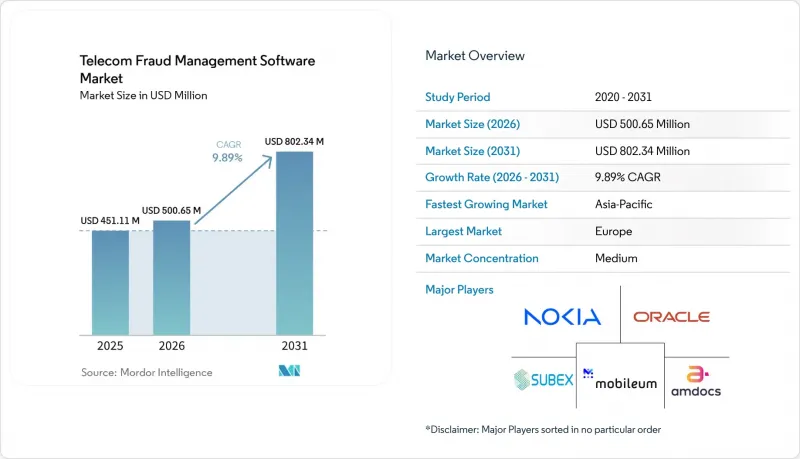
This report is Segmented by Component (Software, and Services), Deployment Mode (Cloud, On-Premises, and Hybrid and Edge), Solution Type (Fraud Analytics and Detection, and More), Fraud Type (International Revenue Share Fraud, SIM Box and Bypass Fraud, and More), Organization Size (Large Enterprises, and SMEs), and Geography. The Market Forecasts are Provided in Terms of Value (USD).
Global Telecom Fraud Management Software Market Trends and Insights
AI and Machine Learning Adoption for Real-Time Fraud Detection
The telecom fraud management software market is benefiting from the widening gap between AI-enabled attacks and legacy rules-based defenses. A 2025 survey by TNS found that 75% of telecom operators used machine learning or AI for fraud detection, up from 38% in 2023, while 53% described themselves as AI beginners. This indicates broad but immature adoption, so operators that begin with narrow automation projects can later require more capable models, orchestration, and analyst support. A 2025 PLOS ONE study reported 93.28% accuracy, 92.08% F1 score, and 94.53% AUC for a graph-attention approach evaluated on telecom fraud data. These results support procuring platforms that learn from relationships across call records and network activity rather than relying solely on static thresholds.
Growth of 5G, VoLTE, IoT, and eSIM Connectivity
The telecom fraud management software market is being shaped by networks that generate more real-time events and introduce new identity and signaling risks. The GLF Fraud Report 2025 stated that 95% of surveyed carriers reported stable or declining traditional voice fraud volumes, but projected up to USD 8 billion in data roaming losses by 2028 due to IoT-related risks. VoLTE requires coordination between SIP signaling and IP Multimedia Subsystem components so that configuration weaknesses can create pathways for interception and service disruption. The ITU-T approved Recommendation X.1456 in April 2025 to provide security guidance for digital financial service applications that use USSD and SIM toolkit mechanisms. The specification work around eSIM, IoT, and digital payments reinforces demand for controls that inspect network, identity, and transaction signals together.
Data Privacy, Data Localization, and Cross-Border Transfer Restrictions
Data sovereignty can delay deployments of telecom fraud management software because effective detection often depends on detailed metadata. Connect Europe stated in its 2024 submission to the European Data Protection Board that the ePrivacy framework provides limited legal certainty regarding fraud-prevention processing and that practices differ across EU member states. This uncertainty complicates cross-border interconnect cases and cloud deployments that process subscriber call records through external providers. The EU e-Evidence Regulation takes effect in 2026 and establishes preservation-request response times of up to 8 hours. India, Indonesia, and South Korea also have domestic requirements that may restrict the movement of subscriber information. Vendors must offer regional processing options and controls that support compliance without leaving critical fraud signals unexamined.
Other drivers and restraints analyzed in the detailed report include:
- Escalating IRSF, Wangiri, Bypass, and Messaging Fraud
- Expansion of Digital Identity, Mobile Money, and Carrier Billing
- Integration Complexity and Legacy OSS/BSS Dependence
For complete list of drivers and restraints, kindly check the Table Of Contents.
Segment Analysis
Software is expected to hold 74.22% of the 2025 telecom fraud management software market share, reflecting demand for platforms that combine analytics, case management, workflow automation, and real-time rules. The software layer also includes specialized signaling decoders and trained models that generic IT services lack. Long-running deployments can create switching costs, as operators tune models using historical call-detail records and local operating patterns. Subex has integrated generative AI into HyperSense, demonstrating how suppliers are adding reasoning capabilities to established software platforms. These features help teams assess alerts using telecom-specific context.
Services are projected to expand at an 11.54% CAGR through 2031. Managed detection, triage, and remediation services address shortages of fraud specialists, particularly among regional carriers. The CFCA survey cited by TNS reported an average dedicated fraud team size of 40.5 employees across carriers and 15 employees among smaller providers. This staffing gap makes Fraud-as-a-Service arrangements relevant in the Telecom Fraud Management Software Market, especially where operators cannot sustain full in-house teams. NIS2 increases management responsibility for security incidents and supports interest in specialist service partners.
On-premises systems are expected to account for 47.88% of the telecom fraud management software market size in 2025. Operators continue to prefer these systems when they need direct access to signaling planes, charging systems, and sensitive subscriber metadata. Tier 1 carriers in Europe often favor local infrastructure because it reduces cross-border data-transfer complexity. Existing infrastructure investments also support the continued use of on-premises platforms. Operators can tailor these systems to live network operations and established assurance processes.
Cloud-native deployments are projected to expand at an 11.47% CAGR through 2031. Consumption-based pricing can lower entry costs for small and medium-sized operators that cannot fund extensive local infrastructure. A 2025 journal study reported that cloud-native microservices can support horizontal scaling and real-time anomaly detection for telecom fraud workloads. Hybrid and edge arrangements are emerging, in which operators require low-latency network analysis alongside centralized analytics. Providers serving the Telecom Fraud Management Software Market can reduce transition burdens by offering connectors across charging systems and cloud analytics.
Complete Report Scope:
- By Component
- Software
- Services
- By Deployment Mode
- Cloud
- On-Premises
- Hybrid and Edge
- By Solution Type
- Fraud Analytics and Detection
- Identity, Authentication, and Subscription Risk
- Revenue Share, Interconnect, and Roaming Protection
- Signaling and Voice Security
- Case Management, Investigation, and Workflow
- Revenue Assurance and Fraud Orchestration
- By Fraud Type
- International Revenue Share Fraud
- Wangiri and Missed-Call Fraud
- SIM Box and Bypass Fraud
- Roaming Fraud and SIM Cloning
- Subscription, Identity, and Account-Takeover Fraud
- Other Frauds Type
- By Organization Size
- Large Enterprises
- Small and Medium-Sized Enterprises
- By Geography
- North America
- United States
- Canada
- Mexico
- South America
- Brazil
- Argentina
- Rest of South America
- Europe
- United Kingdom
- Germany
- France
- Italy
- Rest of Europe
- Asia-Pacific
- China
- India
- Japan
- South Korea
- Rest of Asia-Pacific
- Middle East
- Saudi Arabia
- United Arab Emirates
- Rest of Middle East
- Africa
- South Africa
- Nigeria
- Rest of Africa
- North America
Geography Analysis
Europe is expected to hold 27.89% of the telecom fraud management software market share in 2025. The region faces substantial roaming and interconnect exposure across dense networks of national operators. NIS2 classifies telecommunications as an essential sector and mandates risk management, incident reporting, and accountability. In September 2025, UK operators BT/EE, Three, Virgin Media O2, and Vodafone are expected to launch KYC Match and Age Verify APIs under GSMA Open Gateway. Future spending is likely to focus on analytics, managed services, and compliance integration.
Asia-Pacific is projected to expand at an 11.02% CAGR through 2031. This part of the Telecom Fraud Management Software Market combines large subscriber bases with rapid 5G rollout, mobile money adoption, eSIM adoption, and carrier billing. In 2025, GSMA is expected to document Open Gateway activity in Indonesia, Sri Lanka, and Australia. Australian operators are expected to use Scam Signal for real-time blocking, while Indonesian operators are expected to deploy Number Verify, SIM Swap, and Device Location interfaces for financial-fraud controls. India has high transaction and SIM-authentication exposure, while South Korea has advanced 5G and mobile-payment activity. These conditions are increasing demand for identity, signaling, and real-time analytics platforms.
North America remains a stable demand area, supported by caller-authentication requirements under the Federal Communications Commission's STIR/SHAKEN framework. The U.S. Federal Trade Commission reported USD 12.5 billion in consumer fraud losses during 2024, up 25% from 2023. South America continues to face SIM-box and bypass exposure, while managed services can offer a practical option where operator budgets are constrained. Africa remains a longer-term opportunity due to high mobile money activity and the risk of wholesale bypass.
- Amdocs Limited
- Subex Limited
- Mobileum Inc.
- Nokia Corporation
- Telefonaktiebolaget LM Ericsson
- Oracle Corporation
- IBM Corporation
- SAS Institute Inc.
- Fair Isaac Corporation
- Tata Consultancy Services Limited
- Tech Mahindra Limited
- HCL Technologies Limited
- Huawei Technologies Co., Ltd.
- Syniverse Technologies, LLC
- Enea AB
- Araxxe S.A.
- TEOCO Corporation
- Neural Technologies Limited
Additional Benefits:
- The market estimate (ME) sheet in Excel format
- 3 months of analyst support
TABLE OF CONTENTS
1 INTRODUCTION
- 1.1 Study Assumptions and Market Definition
- 1.2 Scope of the Study
2 RESEARCH METHODOLOGY
3 EXECUTIVE SUMMARY
4 MARKET LANDSCAPE
- 4.1 Market Overview
- 4.2 Market Drivers
- 4.2.1 AI and Machine Learning Adoption for Real-Time Fraud Detection
- 4.2.2 Growth of 5G, VoLTE, IoT, and eSIM Connectivity
- 4.2.3 Escalating IRSF, Wangiri, Bypass, and Messaging Fraud
- 4.2.4 Expansion of Digital Identity, Mobile Money, and Carrier Billing
- 4.2.5 Cloud-Native and Managed Fraud Operations
- 4.2.6 Cross-Network Intelligence for Interconnect and Roaming Risk
- 4.3 Market Restraints
- 4.3.1 Data Privacy, Data Localization, and Cross-Border Transfer Restrictions
- 4.3.2 Integration Complexity and Legacy OSS/BSS Dependence
- 4.3.3 Adversarial Adaptation and Model Drift Across New Fraud Vectors
- 4.3.4 Fraud-Prevention Friction, False Positives, and Customer Experience Risk
- 4.4 Impact of Macroeconomic Factors on the Market
- 4.5 Industry Value Chain Analysis
- 4.6 Regulatory Landscape
- 4.7 Technological Outlook
- 4.7.1 AI, Machine Learning, and Explainable AI
- 4.7.2 Generative AI Investigation Agents and Copilots
- 4.7.3 Graph Analytics, Behavioral Analytics, and Link Analysis
- 4.7.4 Signaling-Layer Analytics Across SS7, Diameter, SIP, GTP, and HTTP/2
- 4.7.5 Edge Analytics and Low-Latency Mitigation
- 4.7.6 Federated Learning and Privacy-Preserving Analytics
- 4.8 Porter's Five Forces Analysis
- 4.8.1 Competitive Rivalry
- 4.8.2 Threat of New Entrants
- 4.8.3 Bargaining Power of Suppliers
- 4.8.4 Bargaining Power of Buyers
- 4.8.5 Threat of Substitutes
5 MARKET SIZE AND GROWTH FORECASTS (VALUE)
- 5.1 By Component
- 5.1.1 Software
- 5.1.2 Services
- 5.2 By Deployment Mode
- 5.2.1 Cloud
- 5.2.2 On-Premises
- 5.2.3 Hybrid and Edge
- 5.3 By Solution Type
- 5.3.1 Fraud Analytics and Detection
- 5.3.2 Identity, Authentication, and Subscription Risk
- 5.3.3 Revenue Share, Interconnect, and Roaming Protection
- 5.3.4 Signaling and Voice Security
- 5.3.5 Case Management, Investigation, and Workflow
- 5.3.6 Revenue Assurance and Fraud Orchestration
- 5.4 By Fraud Type
- 5.4.1 International Revenue Share Fraud
- 5.4.2 Wangiri and Missed-Call Fraud
- 5.4.3 SIM Box and Bypass Fraud
- 5.4.4 Roaming Fraud and SIM Cloning
- 5.4.5 Subscription, Identity, and Account-Takeover Fraud
- 5.4.6 Other Frauds Type
- 5.5 By Organization Size
- 5.5.1 Large Enterprises
- 5.5.2 Small and Medium-Sized Enterprises
- 5.6 By Geography
- 5.6.1 North America
- 5.6.1.1 United States
- 5.6.1.2 Canada
- 5.6.1.3 Mexico
- 5.6.2 South America
- 5.6.2.1 Brazil
- 5.6.2.2 Argentina
- 5.6.2.3 Rest of South America
- 5.6.3 Europe
- 5.6.3.1 United Kingdom
- 5.6.3.2 Germany
- 5.6.3.3 France
- 5.6.3.4 Italy
- 5.6.3.5 Rest of Europe
- 5.6.4 Asia-Pacific
- 5.6.4.1 China
- 5.6.4.2 India
- 5.6.4.3 Japan
- 5.6.4.4 South Korea
- 5.6.4.5 Rest of Asia-Pacific
- 5.6.5 Middle East
- 5.6.5.1 Saudi Arabia
- 5.6.5.2 United Arab Emirates
- 5.6.5.3 Rest of Middle East
- 5.6.6 Africa
- 5.6.6.1 South Africa
- 5.6.6.2 Nigeria
- 5.6.6.3 Rest of Africa
- 5.6.1 North America
6 COMPETITIVE LANDSCAPE
- 6.1 Market Concentration
- 6.2 Strategic Moves
- 6.3 Market Share Analysis
- 6.4 Company Profiles (includes Global Level Overview, Market Level Overview, Core Segments, Financials as available, Strategic Information, Market Rank/Share, Products and Services, Recent Developments)
- 6.4.1 Amdocs Limited
- 6.4.2 Subex Limited
- 6.4.3 Mobileum Inc.
- 6.4.4 Nokia Corporation
- 6.4.5 Telefonaktiebolaget LM Ericsson
- 6.4.6 Oracle Corporation
- 6.4.7 IBM Corporation
- 6.4.8 SAS Institute Inc.
- 6.4.9 Fair Isaac Corporation
- 6.4.10 Tata Consultancy Services Limited
- 6.4.11 Tech Mahindra Limited
- 6.4.12 HCL Technologies Limited
- 6.4.13 Huawei Technologies Co., Ltd.
- 6.4.14 Syniverse Technologies, LLC
- 6.4.15 Enea AB
- 6.4.16 Araxxe S.A.
- 6.4.17 TEOCO Corporation
- 6.4.18 Neural Technologies Limited
7 MARKET OPPORTUNITIES AND FUTURE OUTLOOK
- 7.1 White-Space and Unmet-Need Assessment

