PUBLISHER: Mordor Intelligence | PRODUCT CODE: 2119318

PUBLISHER: Mordor Intelligence | PRODUCT CODE: 2119318
PFAS Adsorbent Regeneration Chemicals - Market Share Analysis, Industry Trends & Statistics, Growth Forecasts (2026 - 2031)
According to Mordor Intelligence, the PFAS adsorbent regeneration chemicals market was valued at USD 176.45 million in 2025 and is estimated to grow from USD 188.71 million in 2026 to reach USD 266.29 million by 2031, at a CAGR of 7.13% during the forecast period (2026-2031).
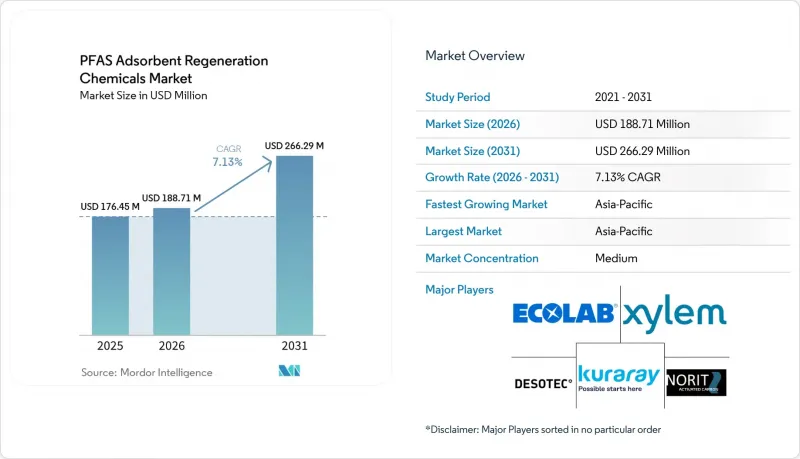
This report is Segmented by Chemical Type (Sodium Hydroxide, Alcohol-Based Chemicals, and More), Adsorbent Type (Granular Activated Carbon, and More), End-Use Industry (Municipal Water Treatment, Industrial Water Treatment, and More), and Geography (Asia-Pacific, North America, Europe, South America, and Middle-East and Africa). The Market Forecasts are Provided in Terms of Value (USD).
Global PFAS Adsorbent Regeneration Chemicals Market Trends and Insights
Regulatory-Driven Adoption of Capture-and-Destroy Treatment
The United States Environmental Protection Agency finalized the National Primary Drinking Water Regulation in April 2024 and set maximum contaminant levels of 4 parts per trillion for perfluorooctanoic acid and perfluorooctane sulfonic acid. The rule also set limits of 10 parts per trillion for perfluorohexane sulfonic acid, perfluorononanoic acid, and hexafluoropropylene oxide dimer acid, commonly called GenX chemicals. These obligations have encouraged utilities to assess regeneration and destruction pathways rather than treat spent granular activated carbon as a disposal-only material. This supports the PFAS adsorbent regeneration chemicals market by tying chemical use to documented treatment and waste-management requirements. Japan's mandatory standards for PFOS and PFOA at 50 nanograms per liter became effective in April 2026 and require water suppliers to test, inspect, and disclose results. European planning is also affected by the proposed universal restriction under the Registration, Evaluation, Authorisation and Restriction of Chemicals framework, whose scientific evaluation is expected to conclude by the end of 2026.
Rising Demand for Short-Chain PFAS Treatment
Standard granular activated carbon filtration relies heavily on hydrophobic interactions, which are less effective for perfluoroalkyl acids with chain lengths below 6 carbons. Ion exchange resins add electrostatic interactions to hydrophobic binding and can therefore improve the removal of both long-chain and short-chain compounds. The resulting regeneration process often uses methanol-brine or ethanol-brine mixtures, which creates demand for tailored chemical inputs and handling of the concentrated stream. Research published in 2025 found that more than 90% of methanol in regenerant solutions could be recovered by rotary evaporation within 4 hours at 50 °C, without detectable PFAS carryover into the recovered solvent. The PFAS adsorbent regeneration chemicals market gains from this transition because resin applications require material-specific regeneration protocols rather than a standard caustic cycle.
Hazardous Handling Requirements for PFAS-Loaded Regenerants
Spent regenerants are concentrated PFAS-bearing liquids produced during solvent-based ion exchange regeneration or alkaline granular activated carbon desorption. Their management requires traceable handling and transfer to facilities permitted to process the waste, which increases the operating burden on treatment providers. Solvent-based waste streams also require appropriate storage and safety controls, raising the capital requirement for on-site regeneration systems. Small and medium utilities may lack staff with hazardous waste expertise or the processing volumes needed to support dedicated handling equipment. These limitations can keep distributed sites reliant on single-use media even when regeneration has lower lifecycle costs. The PFAS adsorbent regeneration chemicals market, therefore, remains more accessible to large operators that can use centralized infrastructure and documented waste logistics.
Other drivers and restraints analyzed in the detailed report include:
- Expansion of Centralized Regeneration Services
- Increasing Cost of Spent Adsorbent Disposal
- Uncertainty Regarding PFAS Destruction Byproducts
For complete list of drivers and restraints, kindly check the Table Of Contents.
Segment Analysis
Sodium hydroxide held 41.86% of the market revenue in 2025. It is used in high-pH granular activated carbon reactivation protocols and during cleaning cycles for ion exchange resins. Alkaline conditions can weaken PFAS binding on charged adsorbent surfaces and support desorption. Alcohol-based chemicals, mainly methanol and ethanol, are used in solvent-based ion exchange regeneration. Their use is tied to installed resin capacity and the need to recover or manage the solvent after treatment.
Proprietary chemical blends are forecast to grow at an 8.57% CAGR through 2031. Their adoption is linked to newer PFAS-selective materials, including cyclodextrin polymers, fluoropolymer sorbents, and molecularly imprinted materials. These materials need regeneration protocols designed for their specific adsorption behavior. A 2024 Nature Communications study found that a fluoropolymer sorbent retained more than 90% PFAS sorption efficiency after 5 regeneration cycles when the appropriate desorption chemistry was used. The PFAS adsorbent regeneration chemicals market is likely to use more engineered blends as these materials progress from pilot projects to full-scale systems.
Complete Report Scope:
- By Chemical Type
- Sodium Hydroxide
- Alcohol-Based Chemicals
- Proprietary Chemical Blends
- Other Chemical Types (Acetone, Salt Solutions, Surfactant-Based Chemicals)
- By Adsorbent Type
- Granular Activated Carbon
- Ion Exchange Resins
- Powdered Activated Carbon
- Other Adsorbent Types (Modified Clay, Bio-Based and Hybrid Adsorbents)
- By End-Use Industry
- Municipal Water Treatment
- Industrial Water Treatment
- Semiconductor Manufacturing
- Other End-Use Industries (Landfill Leachate Treatment, Defense and Aerospace, Mining and Metals, Chemicals and Petrochemicals)
- By Geography
- Asia-Pacific
- China
- India
- Japan
- South Korea
- ASEAN Countries
- Rest of Asia-Pacific
- North America
- United States
- Canada
- Mexico
- Europe
- Germany
- United Kingdom
- France
- Italy
- NORDIC Countries
- Rest of Europe
- South America
- Brazil
- Argentina
- Rest of South America
- Middle-East and Africa
- Saudi Arabia
- South Africa
- Rest of Middle-East and Africa
- Asia-Pacific
Geography Analysis
Asia-Pacific held 39.91% of the market revenue in 2025 and is forecast to expand at an 8.53% CAGR through 2031. Japan's mandatory PFOS and PFOA standards at 50 nanograms per liter became effective in April 2026 and apply to water supply operators through testing, inspection, and disclosure requirements. This supports investment in granular activated carbon reactivation and ion exchange regeneration programs. South Korea extended restrictions on PFOS, PFOA, and perfluorohexane sulfonic acid by mid-2025, while Taiwan faces PFAS wastewater concerns associated with semiconductor operations, and ASEAN countries, including Singapore and Thailand, are at earlier regulatory stages that provide a future pipeline for the PFAS adsorbent regeneration chemicals market.
The North America region is anchored by the U.S. regulatory response to the 2024 drinking water rule and by investment in treatment infrastructure. In February 2026, Calgon Carbon Corporation, a subsidiary of KURARAY CO., LTD., announced a nearly USD 100 million investment in its Columbus, Ohio, plant to add 27 million pounds per year of reactivation capacity, with operations expected to begin in the first quarter of 2028. The expansion is intended to position domestic capacity before the 2031 compliance deadline, while semiconductor fabrication growth in Arizona, New York, and Ohio adds site-specific demand for short-chain PFAS regeneration chemistry in the PFAS adsorbent regeneration chemicals market.
In Europe, the European Union restriction is affecting treatment planning across municipal and industrial sites. The European Union restriction on PFAS-containing firefighting foams was published in October 2025, and the restriction on perfluorohexanoic acid-related substances takes effect in October 2026. DESOTEC expanded its U.S. position through the 2023 acquisition of Evoqua's carbon reactivation business and a 2025 partnership with Sentinel Water Solutions. South America, and Middle-East and Africa remain earlier-stage areas where mining contamination management and municipal investment create selective opportunities for the PFAS adsorbent regeneration chemicals market.
- DESOTEC
- DuPont
- Ecolab Inc.
- Envirogen Group
- JACOBI CARBONS GROUP
- KURARAY CO., LTD.
- Kurita Water Industries Ltd.
- LANXESS
- Norit
- Onterris, Inc.
- Puraffinity
- Puragen
- ResinTech, Inc.
- Xylem
Additional Benefits:
- The market estimate (ME) sheet in Excel format
- 3 months of analyst support
TABLE OF CONTENTS
1 Introduction
- 1.1 Study Assumptions and Market Definition
- 1.2 Scope of the Study
2 Research Methodology
3 Executive Summary
4 Market Landscape
- 4.1 Market Overview
- 4.2 Market Drivers
- 4.2.1 Regulatory-Driven Adoption of Capture-and-Destroy Treatment
- 4.2.2 Expansion of Centralized Regeneration Services
- 4.2.3 Rising Demand for Short-Chain PFAS Treatment
- 4.2.4 Increasing Cost of Spent Adsorbent Disposal
- 4.2.5 Regenerant Recycling and Closed-Loop Solvent Recovery
- 4.2.6 Modular Regeneration Systems for Distributed Treatment Sites
- 4.3 Market Restraints
- 4.3.1 Hazardous Handling Requirements for PFAS-Loaded Regenerants
- 4.3.2 Limited Availability of Specialized Reactivation Capacity
- 4.3.3 Uncertainty Regarding PFAS Destruction Byproducts
- 4.3.4 High Chemical Recovery and Wastewater Treatment Requirements
- 4.4 Value Chain Analysis
- 4.5 Porter's Five Forces Analysis
- 4.5.1 Bargaining Power of Suppliers
- 4.5.2 Bargaining Power of Buyers
- 4.5.3 Threat of New Entrants
- 4.5.4 Threat of Substitutes
- 4.5.5 Competitive Rivalry
5 Market Size and Growth Forecasts (Value)
- 5.1 By Chemical Type
- 5.1.1 Sodium Hydroxide
- 5.1.2 Alcohol-Based Chemicals
- 5.1.3 Proprietary Chemical Blends
- 5.1.4 Other Chemical Types (Acetone, Salt Solutions, Surfactant-Based Chemicals)
- 5.2 By Adsorbent Type
- 5.2.1 Granular Activated Carbon
- 5.2.2 Ion Exchange Resins
- 5.2.3 Powdered Activated Carbon
- 5.2.4 Other Adsorbent Types (Modified Clay, Bio-Based and Hybrid Adsorbents)
- 5.3 By End-Use Industry
- 5.3.1 Municipal Water Treatment
- 5.3.2 Industrial Water Treatment
- 5.3.3 Semiconductor Manufacturing
- 5.3.4 Other End-Use Industries (Landfill Leachate Treatment, Defense and Aerospace, Mining and Metals, Chemicals and Petrochemicals)
- 5.4 By Geography
- 5.4.1 Asia-Pacific
- 5.4.1.1 China
- 5.4.1.2 India
- 5.4.1.3 Japan
- 5.4.1.4 South Korea
- 5.4.1.5 ASEAN Countries
- 5.4.1.6 Rest of Asia-Pacific
- 5.4.2 North America
- 5.4.2.1 United States
- 5.4.2.2 Canada
- 5.4.2.3 Mexico
- 5.4.3 Europe
- 5.4.3.1 Germany
- 5.4.3.2 United Kingdom
- 5.4.3.3 France
- 5.4.3.4 Italy
- 5.4.3.5 NORDIC Countries
- 5.4.3.6 Rest of Europe
- 5.4.4 South America
- 5.4.4.1 Brazil
- 5.4.4.2 Argentina
- 5.4.4.3 Rest of South America
- 5.4.5 Middle-East and Africa
- 5.4.5.1 Saudi Arabia
- 5.4.5.2 South Africa
- 5.4.5.3 Rest of Middle-East and Africa
- 5.4.1 Asia-Pacific
6 Competitive Landscape
- 6.1 Market Concentration
- 6.2 Strategic Moves
- 6.3 Market Share (%)/Ranking Analysis
- 6.4 Company Profiles (includes Global Overview, Market Overview, Core Segments, Financials as available, Strategic Information, Products and Services, and Recent Developments)
- 6.4.1 DESOTEC
- 6.4.2 DuPont
- 6.4.3 Ecolab Inc.
- 6.4.4 Envirogen Group
- 6.4.5 JACOBI CARBONS GROUP
- 6.4.6 KURARAY CO., LTD.
- 6.4.7 Kurita Water Industries Ltd.
- 6.4.8 LANXESS
- 6.4.9 Norit
- 6.4.10 Onterris, Inc.
- 6.4.11 Puraffinity
- 6.4.12 Puragen
- 6.4.13 ResinTech, Inc.
- 6.4.14 Xylem
7 Market Opportunities and Future Outlook
- 7.1 White-Space and Unmet-Need Assessment

