PUBLISHER: Mordor Intelligence | PRODUCT CODE: 2119332

PUBLISHER: Mordor Intelligence | PRODUCT CODE: 2119332
Industrial Fans - Market Share Analysis, Industry Trends & Statistics, Growth Forecasts (2026 - 2031)
According to Mordor Intelligence, the industrial fans market size is projected to expand from USD 6.89 billion in 2025 and USD 7.24 billion in 2026 to USD 9.31 billion by 2031, at a CAGR of 5.15% between 2026 and 2031.
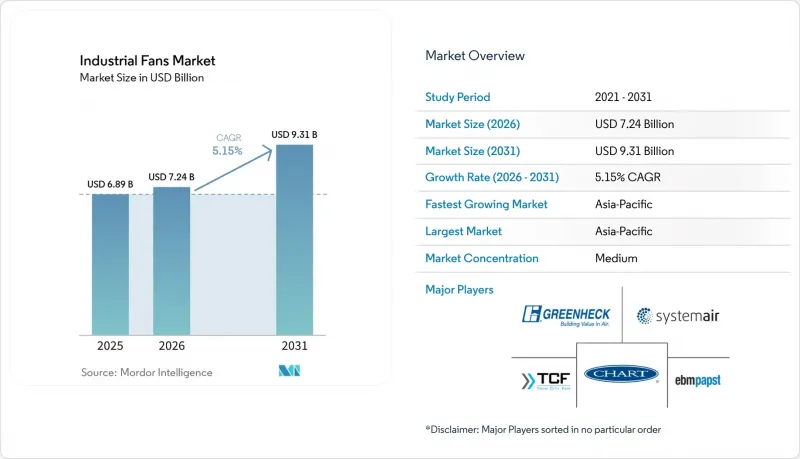
This report is Segmented by Fan Type (Axial, Centrifugal, Mixed Flow), Application (Ventilation, Cooling, Dust Collection, Others), End User (Manufacturing, Mining, Cement, Power, Chemicals, Oil & Gas, Metals, Food & Beverage, Pharma, Water & Wastewater, and Others), and Geography (North America, Europe, Asia-Pacific, South America, and Middle East and Africa). Market Forecasts are Provided in Value (USD).
Global Industrial Fans Market Trends and Insights
Industrial Energy-Efficiency Mandates
Energy regulations are becoming a central factor in industrial fan procurement and replacement planning. EU Ecodesign Regulation EU/2024/1834 applies from July 24, 2026, to fans in the 125 W to 500 kW range. The regulation sets updated efficiency requirements, requires part-load performance information, and includes repairability provisions. The European Commission stated that the rules could reduce electricity use from industrial fans in the European Union by 31 TWh annually by 2030 and deliver EUR 4 billion in annual business savings. Manufacturers now need reliable performance documentation, which favors suppliers that can support product selection, compliance records, and aftermarket parts. The industrial fans market, therefore, has a clearer replacement path in Europe as users assess older units against new operating and documentation requirements.
Air Quality, Worker Safety, and Emissions Compliance
Air-quality and worker-safety requirements support demand for dust extraction, exhaust, and process ventilation equipment. Mining, cement, chemical, and metals facilities need fan systems that manage dust-laden air and support safer operating conditions. The industrial fans market gains from these needs because upgrades are often tied to compliance deadlines rather than optional capacity expansion. Centrifugal equipment remains important in these settings because it is suited to high static pressure, variable process loads, and difficult air streams. In the United States, the cited silica rule strengthens the case for improved mine ventilation and dust-control systems, although the source draft did not provide a qualifying primary government link for the stated implementation detail. This regulatory need also supports replacement demand where installed equipment cannot meet the required airflow, filtration, or extraction performance.
High Initial Cost of Advanced Fan Systems and Installation
Advanced systems with variable frequency drives, sensors, and electronically commutated motors require more upfront capital than conventional induction-motor alternatives. The expense can delay replacement decisions at smaller industrial facilities, even when operating savings support the business case. The issue is especially material for explosion-proof and corrosion-resistant models used in chemical, petrochemical, and offshore settings. These designs require specialized materials and certifications, which increase equipment and installation costs. Financing arrangements for energy-efficiency projects can reduce this barrier, but their availability remains uneven across regions. The industrial fans market can therefore face slower adoption of premium systems where users focus on initial purchase price rather than total operating cost.
Other drivers and restraints analyzed in the detailed report include:
- Smart Ventilation and Industrial Automation Adoption
- Retrofit Demand from Electrification and Variable-Speed Drive Upgrades
- Raw-Material Price Volatility and Supply Risk
For complete list of drivers and restraints, kindly check the Table Of Contents.
Segment Analysis
Centrifugal fans accounted for 57.2% of the industrial fans market in 2025. Their position reflects use in high-pressure, dust-laden, and high-temperature applications, including cement kiln induced-draft systems, chemical scrubber exhausts, and boiler forced-draft circuits. World Cement identifies dust load, high temperature, and process variation as key challenges for cement-plant fans. These conditions require equipment that can maintain performance under demanding operating requirements. The industrial fans market continues to rely on centrifugal designs where simpler alternatives cannot meet the required pressure or process conditions.
Axial fans remain useful for lower-pressure, high-volume duties such as mine ventilation, cooling towers, and large-area air supply, while price competition remains strong in standard product categories. Mixed flow fans are the fastest-growing fan type, with the industrial fans market size for this segment forecast to grow at a 6.4% CAGR through 2031. They combine high volumetric flow with moderate pressure rise, which suits hot-aisle containment and other data-center cooling layouts. ebm-papst is developing motor-integrated fan products for data-center cooling applications and is expanding production capacity in India. New European efficiency requirements also favor fan designs that perform well at part load and work with variable-speed control.
Complete Report Scope:
- By Fan Type
- Axial Fans
- Centrifugal Fans
- Mixed Flow Fans
- By Application
- Ventilation
- Cooling
- Dust Collection
- Other Applications
- By End User
- Manufacturing
- Mining and Minerals
- Cement
- Power Generation
- Chemicals and Petrochemicals
- Oil and Gas
- Metals and Steel
- Food and Beverage
- Pulp and Paper
- Pharmaceuticals
- Water and Wastewater Treatment
- Other End-Use Industries
- By Geography
- North America
- United States
- Canada
- Mexico
- Europe
- Germany
- France
- Italy
- Spain
- United Kingdom
- Poland
- Russia
- Rest of Europe
- Asia-Pacific
- China
- India
- Japan
- South Korea
- Australia
- Indonesia
- Vietnam
- Thailand
- Rest of Asia-Pacific
- South America
- Brazil
- Argentina
- Chile
- Rest of South America
- Middle East and Africa
- Saudi Arabia
- United Arab Emirates
- Egypt
- South Africa
- Morocco
- Rest of Middle East and Africa
- North America
Geography Analysis
Asia-Pacific held 43.1% of the industrial fans market share in 2025 and is forecast to grow at a 7.1% CAGR through 2031. The region combines a large industrial base with new manufacturing and infrastructure activity, and China supports volume demand through cement, steel, chemical, and manufacturing operations. India adds demand from cement, steel, power, pharmaceutical, and chemical projects. Vietnam, Indonesia, and Thailand also receive manufacturing investment across electronics, food processing, and textiles. The industrial fans market in Asia-Pacific, therefore, includes both first-time installations and upgrades of older systems.
North America is the second-largest regional market in the source draft. Its demand is supported by retrofit and aftermarket activity in established industrial facilities, including cooling tower and air-cooled heat-exchanger applications in petrochemical refining and power generation. Howden began production at a North American blade facility in 2026, indicating a commitment to regional supply for these customer groups. Europe is characterized by compliance-led replacement activity under the Ecodesign framework. The industrial fans market size in Europe benefits as operators consider fan efficiency, part-load performance, product documentation, and parts availability in replacement planning.
South America and the Middle East and Africa are smaller regional opportunities, but they remain relevant to suppliers serving process industries. Brazil supports demand through pulp and paper, mining, and food processing, while Chile and Argentina add mining-related requirements, and Saudi Arabia and the United Arab Emirates are developing petrochemical, refinery, desalination, factory, and infrastructure projects, and Systemair stated that its Saudi Arabia factory became operational in late 2025, supporting its local position in the region. South Africa, Morocco, and Egypt provide African demand through mining and expanding manufacturing activity. The industrial fans market in these areas depends heavily on local service capability, product fit for harsh conditions, and access to regional supply.
- Acme Engineering and Manufacturing Corporation
- Air Control Industries Ltd.
- Cincinnati Fan
- Chart Industries, Inc.
- Continental Fan Manufacturing Inc.
- EBARA CORPORATION
- ebm-papst Group
- Elektror Airsystems GmbH
- FlaktGroup
- Greenheck Fan Corporation
- Loren Cook Company
- Soler & Palau Ventilation Group
- Systemair AB
- The New York Blower Company
- TLT-Turbo GmbH
- Twin City Fan Companies, Ltd.
- Ziehl-Abegg SE
Additional Benefits:
- The market estimate (ME) sheet in Excel format
- 3 months of analyst support
TABLE OF CONTENTS
1 INTRODUCTION
- 1.1 Study Assumptions and Market Definition
- 1.2 Scope of the Study
2 RESEARCH METHODOLOGY
3 EXECUTIVE SUMMARY
4 MARKET LANDSCAPE
- 4.1 Market Overview
- 4.2 Market Drivers
- 4.2.1 Industrial Energy-Efficiency Mandates
- 4.2.2 Industrialization and Manufacturing Expansion in Emerging Economies
- 4.2.3 Air-Quality, Worker-Safety, and Emissions Compliance
- 4.2.4 Smart Ventilation and Industrial Automation Adoption
- 4.2.5 Retrofit Demand from Electrification and Variable-Speed Drive Upgrades
- 4.2.6 Fan-System Optimization for Process Heat and Dust-Load Variability
- 4.3 Market Restraints
- 4.3.1 High Initial Cost of Advanced Fan Systems and Installation
- 4.3.2 Raw-Material Price Volatility and Supply Risk
- 4.3.3 Harsh-Environment Fouling and Maintenance Downtime
- 4.3.4 Performance Trade-offs from Noise, Explosion-Proofing, and Space Constraints
- 4.4 Supply-Chain Analysis
- 4.5 Porter's Five Forces Analysis
- 4.5.1 Bargaining Power of Suppliers
- 4.5.2 Bargaining Power of Buyers
- 4.5.3 Threat of New Entrants
- 4.5.4 Threat of Substitutes
- 4.5.5 Competitive Rivalry
- 4.6 Technology Outlook
- 4.7 Regulatory Landscape
- 4.8 Investment Analysis
5 MARKET SIZE AND GROWTH FORECASTS
- 5.1 By Fan Type
- 5.1.1 Axial Fans
- 5.1.2 Centrifugal Fans
- 5.1.3 Mixed Flow Fans
- 5.2 By Application
- 5.2.1 Ventilation
- 5.2.2 Cooling
- 5.2.3 Dust Collection
- 5.2.4 Other Applications
- 5.3 By End User
- 5.3.1 Manufacturing
- 5.3.2 Mining and Minerals
- 5.3.3 Cement
- 5.3.4 Power Generation
- 5.3.5 Chemicals and Petrochemicals
- 5.3.6 Oil and Gas
- 5.3.7 Metals and Steel
- 5.3.8 Food and Beverage
- 5.3.9 Pulp and Paper
- 5.3.10 Pharmaceuticals
- 5.3.11 Water and Wastewater Treatment
- 5.3.12 Other End-Use Industries
- 5.4 By Geography
- 5.4.1 North America
- 5.4.1.1 United States
- 5.4.1.2 Canada
- 5.4.1.3 Mexico
- 5.4.2 Europe
- 5.4.2.1 Germany
- 5.4.2.2 France
- 5.4.2.3 Italy
- 5.4.2.4 Spain
- 5.4.2.5 United Kingdom
- 5.4.2.6 Poland
- 5.4.2.7 Russia
- 5.4.2.8 Rest of Europe
- 5.4.3 Asia-Pacific
- 5.4.3.1 China
- 5.4.3.2 India
- 5.4.3.3 Japan
- 5.4.3.4 South Korea
- 5.4.3.5 Australia
- 5.4.3.6 Indonesia
- 5.4.3.7 Vietnam
- 5.4.3.8 Thailand
- 5.4.3.9 Rest of Asia-Pacific
- 5.4.4 South America
- 5.4.4.1 Brazil
- 5.4.4.2 Argentina
- 5.4.4.3 Chile
- 5.4.4.4 Rest of South America
- 5.4.5 Middle East and Africa
- 5.4.5.1 Saudi Arabia
- 5.4.5.2 United Arab Emirates
- 5.4.5.3 Egypt
- 5.4.5.4 South Africa
- 5.4.5.5 Morocco
- 5.4.5.6 Rest of Middle East and Africa
- 5.4.1 North America
6 COMPETITIVE LANDSCAPE
- 6.1 Market Concentration
- 6.2 Strategic Moves
- 6.3 Market Share Analysis
- 6.4 Company Profiles (includes Global Level Overview, Market Level Overview, Core Segments, Financials as available, Strategic Information, Market Rank/Share, Products and Services, Recent Developments)
- 6.4.1 Acme Engineering and Manufacturing Corporation
- 6.4.2 Air Control Industries Ltd.
- 6.4.3 Cincinnati Fan
- 6.4.4 Chart Industries, Inc.
- 6.4.5 Continental Fan Manufacturing Inc.
- 6.4.6 EBARA CORPORATION
- 6.4.7 ebm-papst Group
- 6.4.8 Elektror Airsystems GmbH
- 6.4.9 FlaktGroup
- 6.4.10 Greenheck Fan Corporation
- 6.4.11 Loren Cook Company
- 6.4.12 Soler & Palau Ventilation Group
- 6.4.13 Systemair AB
- 6.4.14 The New York Blower Company
- 6.4.15 TLT-Turbo GmbH
- 6.4.16 Twin City Fan Companies, Ltd.
- 6.4.17 Ziehl-Abegg SE
7 MARKET OPPORTUNITIES AND FUTURE OUTLOOK
- 7.1 White-Space and Unmet-Need Assessment

