PUBLISHER: Mordor Intelligence | PRODUCT CODE: 2119360

PUBLISHER: Mordor Intelligence | PRODUCT CODE: 2119360
Merchant Acquiring - Market Share Analysis, Industry Trends & Statistics, Growth Forecasts (2026 - 2031)
According to Mordor Intelligence, the merchant acquiring market size is projected to expand from USD 28.86 billion in 2025 and USD 31.69 billion in 2026 to USD 48.92 billion by 2031, registering a CAGR of 9.07% between 2026 to 2031.
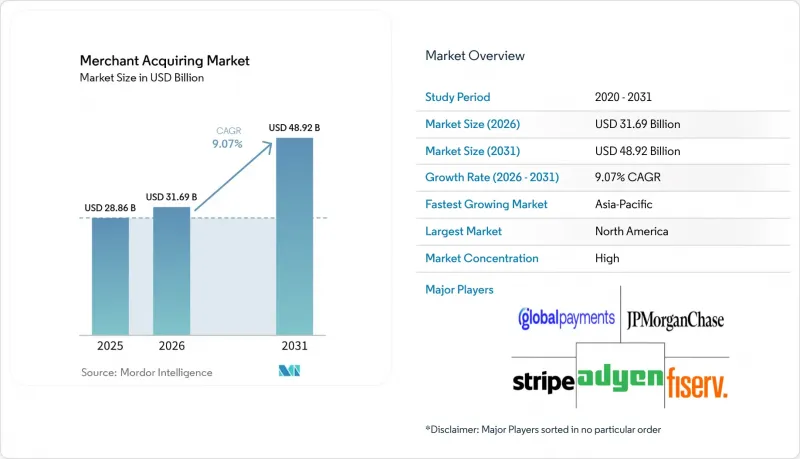
This report is Segmented by Payment Method (Credit Cards, Debit Cards, Digital Wallets, Bank Transfers, BNPL, and More), Merchant Size (Large Enterprises, and SMEs), Channel (POS Solutions, Payment Gateway, MPOS/SoftPOS, and More), End-User Industry (Retail and E-Commerce, Travel and Hospitality, Food and Beverage, and More), and Geography. The Market Forecasts are Provided in Terms of Value (USD).
Global Merchant Acquiring Market Trends and Insights
E-Commerce and Omnichannel Acceptance Expansion
The merchant acquiring market benefits as merchants combine store, online, and mobile payment acceptance within one operating model. A fragmented setup can create separate settlement processes, incomplete customer records, and more difficult payment reconciliation for merchants that sell through several channels. Visa reported that 43% of surveyed merchants accepted real-time payments in 2026, and 83% of those merchants saw a definite increase in use during the preceding year. The same need for unified acceptance increases demand for processors that can manage several payment methods through one back-end system. This puts pressure on providers that still treat online and in-person payments as separate products. It also gives established acquirers an opportunity to retain merchants when they can offer consistent settlement, reporting, and support across channels.
Embedded Payments Through Vertical Software and Marketplaces
Vertical software platforms are becoming a major route to merchants for the merchant acquiring market. These platforms can place payment acceptance inside scheduling, invoicing, dispatch, or commerce tools that merchants already use each day. Fiserv stated in its 2026 ISV playbook that embedded working capital, disbursements, and fraud defense can help platforms deepen merchant adoption beyond stand-alone payment acceptance. The model can reduce the need for a merchant to choose a processor separately from its operating software. It can also have more control over pricing and customer access toward the software platform. Acquirers that supply infrastructure without a clear software distribution strategy may face greater pressure on their share of merchant payment economics.
Interchange and Scheme-Fee Volatility
Interchange and scheme-fee volatility creates uncertainty for acquirers that price merchant services around stable blended rates. In June 2026, a U.S. federal judge approved a USD 38 billion Visa and Mastercard swipe-fee settlement that set a maximum standard consumer rate of 1.25% for 8 years and reduced average fees by 0.1 percentage point for 5 years. The UK Payments System Regulator also retained authority to impose caps on United Kingdom-European Economic Area cross-border interchange fees after a January 2026 High Court decision. These developments can change fee structures across merchant portfolios and reduce the predictability of pass-through revenue. They increase the need for clear merchant communications and flexible pricing controls. The merchant acquiring market also faces added complexity when state, national, and cross-border rules affect the same merchant relationship.
Other drivers and restraints analyzed in the detailed report include:
- Real-Time Account-to-Account Rails and Pay-by-Bank
- Tokenization and Network-Token Authorization Gains
- Card-Not-Present Fraud and Chargeback Liability
For complete list of drivers and restraints, kindly check the Table Of Contents.
Segment Analysis
Credit cards held 34.25% of the merchant acquiring market share in 2025, making them the largest payment method segment. Their position reflects established acceptance networks, consumer loyalty programs, and broad merchant familiarity with card-based processing. Debit cards, digital wallets, e-wallets, bank transfers, and account-to-account payments remain important alternatives across regional payment systems. BNPL is projected to record a 10.20% CAGR through 2031, making it the fastest-growing payment method in the merchant acquiring market. The Federal Reserve reported that BNPL providers originated close to USD 160 billion in consumer credit products during 2025, with pay-in-4 plans representing close to half of issuance and more than 60% of total issuance carrying a 0% annual percentage rate.
BNPL adds a payment option for consumers who want scheduled installments rather than revolving credit, and it can support diverse checkout preferences. Klarna reported that it surpassed 1 million merchants globally in March 2026 after adding 285,000 merchants during 2025. The model is also being used beyond a one-time checkout payment, including recurring expenses and subscription renewals. That wider use can deepen its role in merchant cash-flow planning and customer retention. Acquirers need to support relevant payment methods without creating separate experiences for settlement, reporting, and refunds.
Large enterprises commanded 56.12% of the merchant acquiring market share in 2025. Their substantial transaction volumes, international operations, and complex acceptance need support customized acquiring arrangements. These merchants often require detailed reporting, multi-currency settlement, and sophisticated controls for risk and routing. SMEs are projected to record a 9.65% CAGR through 2031, supported by embedded acquiring within software they use to run their businesses. The merchant acquiring market size for SMEs is supported by tools that bring payment acceptance into invoicing, scheduling, point-of-sale, and online commerce workflows.
Software platforms can reduce the administrative burden of selecting a separate acquirer and integrating payment functions after onboarding. Fiserv stated that embedded financial tools can support more durable merchant relationships than payments alone. Working capital, fraud controls, and disbursements can be useful additions for smaller merchants with uneven cash flow or limited staff. The model also changes the commercial relationship because a software provider may seek a greater share of payment economics as it scales. Acquirers must provide reliable infrastructure while preserving a meaningful role in the merchant relationship.
Complete Report Scope:
- By Payment Method
- Credit Cards
- Debit Cards
- Digital Wallets and E-Wallets
- Bank Transfers and Account-to-Account Payments
- Buy Now, Pay Later (BNPL)
- Other Payment Methods
- By Merchant Size
- Large Enterprises
- Small and Medium Enterprises
- By Channel
- POS Solutions
- Payment Gateway
- mPOS/SoftPOS
- Other Channels
- By End-User Industry
- Retail and E-Commerce
- Travel and Hospitality
- Food and Beverage
- Healthcare
- Transportation and Logistics
- Media and Entertainment
- Other End-User Industries
- By Geography
- North America
- United States
- Canada
- Mexico
- South America
- Brazil
- Argentina
- Rest of South America
- Europe
- United Kingdom
- Germany
- France
- Italy
- Spain
- Rest of Europe
- Asia-Pacific
- China
- India
- Japan
- South Korea
- Australia
- Rest of Asia-Pacific
- Middle East and Africa
- United Arab Emirates
- Saudi Arabia
- South Africa
- Rest of Middle East and Africa
- North America
Geography Analysis
North America held 34.43% of the merchant acquiring market share in 2025. The region has a mature card ecosystem and significant payment volumes, but United States payment network volume expansion has moderated. This moderation increases competition for existing merchant relationships. Stripe entered the U.S. top five in 2026 with more than USD 900 billion in volume and 45% year-over-year expansion, according to the input. Checkout.com received approval for a Merchant Acquirer Limited Purpose Bank charter from the Georgia Department of Banking and Finance in January 2026, allowing it to pursue direct acquiring without a third-party sponsor bank.
Asia-Pacific is projected to record a 10.54% CAGR through 2031, the fastest rate among the geographic segments. China, India, and Southeast Asia are driving payment volumes through widespread adoption of digital wallets and government-backed real-time payment rails, while Australia and Japan represent mature markets with strong contactless payment penetration. The merchant acquiring market across Asia-Pacific increasingly depends on the ability to support diverse wallet ecosystems, real-time payment infrastructure, and alternative payment methods alongside traditional card acceptance. This shift is creating opportunities for acquirers that can provide seamless omnichannel acceptance, localized payment capabilities, and scalable infrastructure across both developed and rapidly digitizing markets.
Europe combines mature cashless markets with countries that continue to convert cash payments to cards and digital methods. The United Kingdom and Nordic countries have intense competition in core acquiring, while France and Spain offer room for payment-volume expansion through e-commerce and cash-to-card conversion. In South America, Brazil's Pix system is changing acceptance economics, and PayPal added Pix support for SMEs in April 2026. The Middle East and Africa combine regulatory modernization with local requirements, while South Africa and Nigeria provide longer-term opportunities shaped by digital adoption and data rules.
- Fiserv, Inc.
- Global Payments Inc.
- JPMorgan Chase & Co.
- Stripe, Inc.
- Adyen N.V.
- PayPal Holdings, Inc.
- Block, Inc.
- Worldline S.A.
- Nexi S.p.A.
- Shift4 Payments, Inc.
- Paysafe Limited
- Checkout.com
- Rapyd Financial Network Ltd.
- PayU Payments Private Limited
- Bank of America Corporation
- Elavon, Inc.
- American Express Company
- Wells Fargo & Company
- Nuvei Technologies
- Moneris Solutions Corporation
Additional Benefits:
- The market estimate (ME) sheet in Excel format
- 3 months of analyst support
TABLE OF CONTENTS
1 INTRODUCTION
- 1.1 Study Assumptions and Market Definition
- 1.2 Scope of the Study
2 RESEARCH METHODOLOGY
3 EXECUTIVE SUMMARY
4 MARKET LANDSCAPE
- 4.1 Market Overview
- 4.2 Market Drivers
- 4.2.1 E-Commerce and Omnichannel Acceptance Expansion
- 4.2.2 Embedded Payments Through Vertical Software and Marketplaces
- 4.2.3 Real-Time Account-to-Account Rails and Pay-by-Bank
- 4.2.4 Tokenization and Network-Token Authorization Gains
- 4.2.5 Merchant Demand for Integrated Risk, Lending, and Analytics
- 4.2.6 Underwriting Data from Software-Led Merchant Distribution
- 4.3 Market Restraints
- 4.3.1 Interchange and Scheme-Fee Volatility
- 4.3.2 Fragmented Cross-Border Licensing and Data Rules
- 4.3.3 Card-Not-Present Fraud and Chargeback Liability
- 4.3.4 Acquiring Margin Compression from Enterprise Pricing
- 4.4 Value Chain Analysis
- 4.5 Regulatory Landscape
- 4.6 Technological Outlook
- 4.7 Porter's Five Forces Analysis
- 4.7.1 Bargaining Power of Suppliers
- 4.7.2 Bargaining Power of Buyers
- 4.7.3 Threat of New Entrants
- 4.7.4 Threat of Substitutes
- 4.7.5 Competitive Rivalry
5 MARKET SIZE AND GROWTH FORECASTS (VALUE)
- 5.1 By Payment Method
- 5.1.1 Credit Cards
- 5.1.2 Debit Cards
- 5.1.3 Digital Wallets and E-Wallets
- 5.1.4 Bank Transfers and Account-to-Account Payments
- 5.1.5 Buy Now, Pay Later (BNPL)
- 5.1.6 Other Payment Methods
- 5.2 By Merchant Size
- 5.2.1 Large Enterprises
- 5.2.2 Small and Medium Enterprises
- 5.3 By Channel
- 5.3.1 POS Solutions
- 5.3.2 Payment Gateway
- 5.3.3 mPOS/SoftPOS
- 5.3.4 Other Channels
- 5.4 By End-User Industry
- 5.4.1 Retail and E-Commerce
- 5.4.2 Travel and Hospitality
- 5.4.3 Food and Beverage
- 5.4.4 Healthcare
- 5.4.5 Transportation and Logistics
- 5.4.6 Media and Entertainment
- 5.4.7 Other End-User Industries
- 5.5 By Geography
- 5.5.1 North America
- 5.5.1.1 United States
- 5.5.1.2 Canada
- 5.5.1.3 Mexico
- 5.5.2 South America
- 5.5.2.1 Brazil
- 5.5.2.2 Argentina
- 5.5.2.3 Rest of South America
- 5.5.3 Europe
- 5.5.3.1 United Kingdom
- 5.5.3.2 Germany
- 5.5.3.3 France
- 5.5.3.4 Italy
- 5.5.3.5 Spain
- 5.5.3.6 Rest of Europe
- 5.5.4 Asia-Pacific
- 5.5.4.1 China
- 5.5.4.2 India
- 5.5.4.3 Japan
- 5.5.4.4 South Korea
- 5.5.4.5 Australia
- 5.5.4.6 Rest of Asia-Pacific
- 5.5.5 Middle East and Africa
- 5.5.5.1 United Arab Emirates
- 5.5.5.2 Saudi Arabia
- 5.5.5.3 South Africa
- 5.5.5.4 Rest of Middle East and Africa
- 5.5.1 North America
6 COMPETITIVE LANDSCAPE
- 6.1 Market Concentration
- 6.2 Strategic Moves
- 6.3 Vendor Positioning Analysis
- 6.4 Company Profiles (includes Global Level Overview, Market Level Overview, Core Segments, Financials as available, Strategic Information, Products and Services, Recent Developments)
- 6.4.1 Fiserv, Inc.
- 6.4.2 Global Payments Inc.
- 6.4.3 JPMorgan Chase & Co.
- 6.4.4 Stripe, Inc.
- 6.4.5 Adyen N.V.
- 6.4.6 PayPal Holdings, Inc.
- 6.4.7 Block, Inc.
- 6.4.8 Worldline S.A.
- 6.4.9 Nexi S.p.A.
- 6.4.10 Shift4 Payments, Inc.
- 6.4.11 Paysafe Limited
- 6.4.12 Checkout.com
- 6.4.13 Rapyd Financial Network Ltd.
- 6.4.14 PayU Payments Private Limited
- 6.4.15 Bank of America Corporation
- 6.4.16 Elavon, Inc.
- 6.4.17 American Express Company
- 6.4.18 Wells Fargo & Company
- 6.4.19 Nuvei Technologies
- 6.4.20 Moneris Solutions Corporation
7 MARKET OPPORTUNITIES AND FUTURE OUTLOOK
- 7.1 White-Space and Unmet-Need Assessment

