PUBLISHER: Mordor Intelligence | PRODUCT CODE: 2119365

PUBLISHER: Mordor Intelligence | PRODUCT CODE: 2119365
Emerging Technology Radar Platforms - Market Share Analysis, Industry Trends & Statistics, Growth Forecasts (2026 - 2031)
According to Mordor Intelligence, the emerging technology radar platforms market size is projected to expand from USD 1.14 billion in 2025 to USD 1.27 billion in 2026, and to USD 2.54 billion by 2031, registering a CAGR of 10.96% between 2026 and 2031.
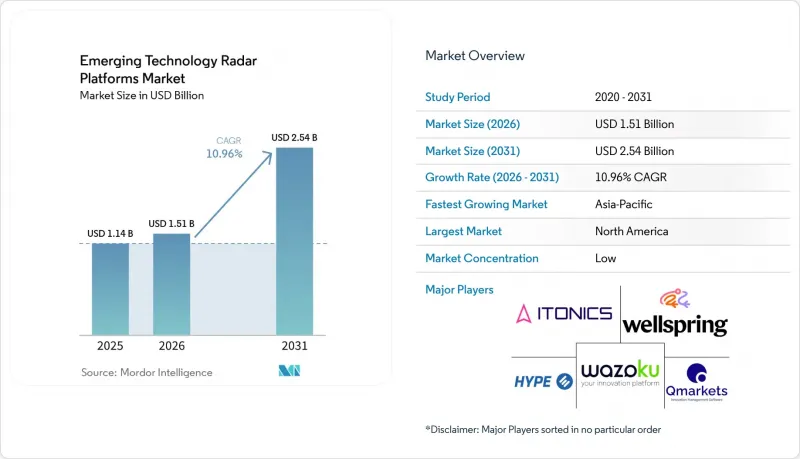
This report is Segmented by Platform Function (Trend and Foresight Intelligence, and More), Deployment Mode (Cloud-Based, Hybrid and More), Organization Size (Large Enterprises, and Small and Medium-Size Enterprises), Application (Research and Development, and More), End User (Energy and Utilities, and More), and Geography. The Market Forecasts are Provided in Terms of Value (USD).
Global Emerging Technology Radar Platforms Market Trends and Insights
Enterprise Demand for Continuous Technology Foresight
Organizations are making technology foresight an ongoing responsibility instead of an annual exercise. This shift changes the buying case for the Emerging Technology Radar Platforms Market because teams need updated evidence when budgets, product plans, and investment choices are reviewed. A platform can give strategy teams a common view of technologies that are advancing, uncertain, or losing relevance. It can also make it easier to document a technology decision for senior management and boards. Continuous updates are most useful where product timing and technology choices directly affect competitive position. The resulting demand favors providers that translate current information into clear, defensible decisions rather than static reports.
AI-Assisted Weak-Signal Detection and Synthesis
AI functions are extending radar platforms beyond basic keyword monitoring and manual review. Research published by VTT Technical Research Center of Finland described a large-scale approach that used language models and 2 indicators, intensity and diffusion, to identify weak signals in a body of nearly 90,000 scientific publications. This approach can help foresight teams examine a wider set of research materials without matching the increase in information volume with an equivalent increase in analyst hiring. ITONICS stated that Prism AI processes more than 50 million signals, including patents, publications, and competitor developments, to create technology radars. The practical value depends on whether the system separates relevant early evidence from signals that are merely new or highly visible. Providers are therefore pairing automated synthesis with source traceability and user review.
Data Provenance, Licensing, and Intellectual Property Constraints
Radar platforms depend on access to publications, patents, company information, and other external records. Licensing terms and data-use controls can increase the cost of maintaining broad coverage, particularly for smaller providers. European procurement teams also assess data rights, privacy, and the handling of proprietary information before approving a multi-source platform. These checks can lengthen sales cycles and make data governance a decisive product requirement. Providers with established data agreements and clear provenance records have a practical advantage when buyers need to validate what a platform can use. The Emerging Technology Radar Platforms Market may therefore see a higher barrier to entry for firms that cannot demonstrate lawful and transparent data practices.
Other drivers and restraints analyzed in the detailed report include:
- Pressure to Reduce Technology Obsolescence and Innovation Cycle Time
- Integration of Patent, Publication, Funding, and Deployment Signals
- High False-Positive Risk in AI-Generated Technology Signals
For complete list of drivers and restraints, kindly check the Table Of Contents.
Segment Analysis
Technology Scouting and Horizon Scanning commanded 38.42% of platform revenue in 2025, giving it the largest Emerging Technology Radar Platforms Market share by platform function. Large R&D and strategy teams had used scouting workflows before newer AI functions became available. This history gave vendors time to connect scouting work with CRM tools, R&D portfolios, and stage-gate processes. The segment remains important because organizations need a disciplined way to identify technologies relevant to their products, operations, and investment plans. Its large share also reflects the practical value of maintaining a repeatable intake process for external technology evidence. It gives organizations a place to capture the source, date, relevance, and owner of a topic before it is elevated into a formal discussion. In the Emerging Technology Radar Platforms Market, this function gives users a practical starting point for comparing external developments against established technical priorities. It also helps teams record why a topic was reviewed, who considered it, and how it moved through an internal decision process. That structure is useful when several units monitor the same subject but require a common view of the available evidence.
Trend and Foresight Intelligence is forecast to grow at a 14.27% CAGR from 2026 to 2031. The function serves executives who need to understand the broader implications of technological developments rather than receive an inventory of signals. It can connect technology movement with questions about business direction, timing, and resource allocation. Patent and Scientific-Literature Intelligence, together with Startup, Company, and Partner Discovery, remains useful for buyers who begin with a specific information need. These functions can become entry points before an organization moves to a broader platform. Regulatory and geopolitical intelligence overlays also add value for energy and defense users monitoring dual-use technologies and approval paths. The Emerging Technology Radar Platforms Market supports this broader use when the platform links a signal to a decision question that users already need to resolve. It can give executives a clearer basis for discussing uncertainty without treating every visible development as an immediate investment case.
Cloud-based deployment held 81.23% of platform subscriptions in 2025, reflecting demand for access across distributed innovation teams. Cloud delivery reduces much of the local infrastructure work and enables users to collaborate on shared radar outputs. This model fits organizations where strategy, R&D, venture, and product teams work in different offices or countries. Planview described a data fabric with more than 60 connectors as part of its Anvi offering, showing the importance of linking a cloud platform with customer systems. As cloud capabilities become common, data depth, signal freshness, and useful synthesis become stronger differentiators than deployment alone. Customers also assess whether a provider can preserve context when many users add comments, update a rating, or attach internal evidence to an external signal. A cloud platform must make those changes understandable without creating several inconsistent versions of the same technology assessment. For the Emerging Technology Radar Platforms Market, common access also allows different functions to work from the same source set rather than circulate separate files. The value remains dependent on permission controls and a clear understanding of which data can be shared.
Hybrid deployment is forecast to grow at a 14.36% CAGR from 2026 to 2031. Financial services, defense, and healthcare organizations may need to keep sensitive data within defined jurisdictions while using cloud-based AI functions for other work. Web-based and on-premises deployments accounted for smaller shares of subscriptions, although on-premises configurations remain relevant for national defense and sovereign AI programs. European buyers can use hybrid models to separate sensitive internal data from less-sensitive external signal processing. Planview introduced its Outcome Intelligence Graph in June 2026 to connect portfolio decisions, resources, and outcomes. The architecture supports accessibility without removing governance controls. In the Emerging Technology Radar Platforms Market, hybrid designs address the practical tension between broad external intelligence and restricted internal information. They allow a customer to decide which content can move to a cloud layer and which content must remain in a controlled setting.
Complete Report Scope:
- By Platform Function
- Technology Scouting and Horizon Scanning
- Trend and Foresight Intelligence
- Patent and Scientific-Literature Intelligence
- Startup, Company, and Partner Discovery
- Other Platform Functions
- By Deployment Mode
- Cloud-Based
- Web-Based
- On-Premises
- Hybrid
- By Organization Size
- Large Enterprises
- Small and Medium-Size Enterprises
- By Application
- Corporate Strategy and Strategic Foresight
- Research and Development
- Corporate Venture Capital and M&A
- Open Innovation and Technology Scouting
- Competitive Intelligence
- Regulatory and Risk Intelligence
- By End User
- Technology and Software
- Manufacturing and Industrial
- Healthcare and Life Sciences
- Financial Services and Insurance
- Energy and Utilities
- Automotive and Mobility
- Aerospace and Defense
- Other End Users
- By Geography
- North America
- United States
- Canada
- Mexico
- South America
- Brazil
- Argentina
- Chile
- Rest of South America
- Europe
- Germany
- United Kingdom
- France
- Italy
- Spain
- Rest of Europe
- Asia-Pacific
- China
- Japan
- India
- South Korea
- Australia
- Rest of Asia-Pacific
- Middle East
- United Arab Emirates
- Saudi Arabia
- Qatar
- Rest of Middle East
- Africa
- South Africa
- Egypt
- Nigeria
- Rest of Africa
- North America
Geography Analysis
North America retained 37.28% of global revenue in 2025, giving the region the largest share of the Emerging Technology Radar Platforms Market and benefiting from buyers with formal innovation, venture, and technology-intelligence responsibilities. Fortune 500 innovation laboratories, corporate venture units, and university technology transfer offices support demand across platform functions. The United States was the largest country within the region because technology scouting and competitive intelligence tools were already established in many organizations. This installed base can make it easier for a vendor to enter a customer's workflow when peers already use similar systems. Canada's publicly funded innovation programs and Mexico's aerospace and automotive supply chain work provide additional sources of demand.
Asia-Pacific is forecast to grow at a 14.81% CAGR from 2026 to 2031. Growth comes from both public technology programs and private-sector demand rather than one single buying pattern, with India's IT services and pharmaceutical companies using foresight tools to identify partnerships in biotechnology and advanced manufacturing. Japan and South Korea have a demand for patent-centered intelligence because electronics and semiconductor organizations need ongoing monitoring of competitors. NEXEA and MyInnovationX unveiled an AI-driven open innovation platform in April 2026 that connected a database of more than 8,000 technology solution providers across Southeast Asia. The development showed that the regional ecosystem was broadening beyond established innovation centers.
Europe accounted for a meaningful share of revenue in 2025, with Germany, the United Kingdom, and France as major markets, supported by industrial R&D spending and established corporate innovation functions. GDPR and the EU AI Act add compliance considerations that favor suppliers with strong data-handling controls and approved data-access arrangements. Bpifrance launched Radar de l'Innovation with Dealroom in April 2025, covering Greentech, industrial startups, Tech for Business, and Deeptech. South America remained smaller but active, with Brazil supporting corporate innovation work through R&D coordination centers in Sao Paulo, while Middle East and Africa presented an emerging opportunity as Saudi Arabia and the UAE developed institutional demand for technology foresight tools.
- Tera
- Trendtracker
- Avantion
- Tolaga Research, Inc.
- Traction Technology, Inc.
- Ezassi, Inc.
- ITONICS Innovation GmbH
- Wazoku Limited
- HYPE Innovation GmbH
- Qmarkets Ltd.
- Brightidea, Inc.
- Wellspring International, Inc.
- IdeaScale, Inc.
- InnovationCast, Inc.
- Planview, Inc.
- Tracxn Technologies Private Limited
- CB Insights, LLC
- StartUs Insights GmbH
- Bloomflow SAS
- Viima Solutions Oy
Additional Benefits:
- The market estimate (ME) sheet in Excel format
- 3 months of analyst support
TABLE OF CONTENTS
1 INTRODUCTION
- 1.1 Study Assumptions and Market Definition
- 1.2 Scope of the Study
2 RESEARCH METHODOLOGY
3 EXECUTIVE SUMMARY
4 MARKET LANDSCAPE
- 4.1 Market Overview
- 4.2 Market Drivers
- 4.2.1 Enterprise Demand for Continuous Technology Foresight
- 4.2.2 AI-Assisted Weak-Signal Detection and Synthesis
- 4.2.3 Pressure to Reduce Technology Obsolescence and Innovation Cycle Time
- 4.2.4 Integration of Patent, Publication, Funding, and Deployment Signals
- 4.2.5 Expansion of Cloud-Based Innovation Workflows Across Distributed Teams
- 4.2.6 Adoption of Explainable Technology Maturity and Momentum Scoring
- 4.3 Market Restraints
- 4.3.1 Data Provenance, Licensing, and Intellectual-Property Constraints
- 4.3.2 High False-Positive Risk in AI-Generated Technology Signals
- 4.3.3 Fragmented Enterprise Data and Difficult Workflow Integration
- 4.3.4 Limited Internal Capacity to Convert Radar Signals into Funded Pilots
- 4.4 Impact of Macroeconomic Factors on the Market
- 4.5 Industry Value-Chain Analysis
- 4.6 Technology Outlook
- 4.7 Regulatory Landscape
- 4.8 Porter's Five Forces Analysis
- 4.8.1 Threat of New Entrants
- 4.8.2 Bargaining Power of Suppliers
- 4.8.3 Bargaining Power of Buyers
- 4.8.4 Threat of Substitutes
- 4.8.5 Intensity of Competitive Rivalry
5 MARKET SIZE AND GROWTH FORECASTS (VALUE)
- 5.1 By Platform Function
- 5.1.1 Technology Scouting and Horizon Scanning
- 5.1.2 Trend and Foresight Intelligence
- 5.1.3 Patent and Scientific-Literature Intelligence
- 5.1.4 Startup, Company, and Partner Discovery
- 5.1.5 Other Platform Functions
- 5.2 By Deployment Mode
- 5.2.1 Cloud-Based
- 5.2.2 Web-Based
- 5.2.3 On-Premises
- 5.2.4 Hybrid
- 5.3 By Organization Size
- 5.3.1 Large Enterprises
- 5.3.2 Small and Medium-Size Enterprises
- 5.4 By Application
- 5.4.1 Corporate Strategy and Strategic Foresight
- 5.4.2 Research and Development
- 5.4.3 Corporate Venture Capital and M&A
- 5.4.4 Open Innovation and Technology Scouting
- 5.4.5 Competitive Intelligence
- 5.4.6 Regulatory and Risk Intelligence
- 5.5 By End User
- 5.5.1 Technology and Software
- 5.5.2 Manufacturing and Industrial
- 5.5.3 Healthcare and Life Sciences
- 5.5.4 Financial Services and Insurance
- 5.5.5 Energy and Utilities
- 5.5.6 Automotive and Mobility
- 5.5.7 Aerospace and Defense
- 5.5.8 Other End Users
- 5.6 By Geography
- 5.6.1 North America
- 5.6.1.1 United States
- 5.6.1.2 Canada
- 5.6.1.3 Mexico
- 5.6.2 South America
- 5.6.2.1 Brazil
- 5.6.2.2 Argentina
- 5.6.2.3 Chile
- 5.6.2.4 Rest of South America
- 5.6.3 Europe
- 5.6.3.1 Germany
- 5.6.3.2 United Kingdom
- 5.6.3.3 France
- 5.6.3.4 Italy
- 5.6.3.5 Spain
- 5.6.3.6 Rest of Europe
- 5.6.4 Asia-Pacific
- 5.6.4.1 China
- 5.6.4.2 Japan
- 5.6.4.3 India
- 5.6.4.4 South Korea
- 5.6.4.5 Australia
- 5.6.4.6 Rest of Asia-Pacific
- 5.6.5 Middle East
- 5.6.5.1 United Arab Emirates
- 5.6.5.2 Saudi Arabia
- 5.6.5.3 Qatar
- 5.6.5.4 Rest of Middle East
- 5.6.6 Africa
- 5.6.6.1 South Africa
- 5.6.6.2 Egypt
- 5.6.6.3 Nigeria
- 5.6.6.4 Rest of Africa
- 5.6.1 North America
6 COMPETITIVE LANDSCAPE
- 6.1 Market Concentration
- 6.2 Strategic Moves
- 6.3 Market Share Analysis
- 6.4 Company Profiles (includes Global Level Overview, Market Level Overview, Core Segments, Financials as available, Strategic Information, Market Rank/Share, Products and Services, Recent Developments)
- 6.4.1 Tera
- 6.4.2 Trendtracker
- 6.4.3 Avantion
- 6.4.4 Tolaga Research, Inc.
- 6.4.5 Traction Technology, Inc.
- 6.4.6 Ezassi, Inc.
- 6.4.7 ITONICS Innovation GmbH
- 6.4.8 Wazoku Limited
- 6.4.9 HYPE Innovation GmbH
- 6.4.10 Qmarkets Ltd.
- 6.4.11 Brightidea, Inc.
- 6.4.12 Wellspring International, Inc.
- 6.4.13 IdeaScale, Inc.
- 6.4.14 InnovationCast, Inc.
- 6.4.15 Planview, Inc.
- 6.4.16 Tracxn Technologies Private Limited
- 6.4.17 CB Insights, LLC
- 6.4.18 StartUs Insights GmbH
- 6.4.19 Bloomflow SAS
- 6.4.20 Viima Solutions Oy
7 MARKET OPPORTUNITIES AND FUTURE OUTLOOK
- 7.1 White-Space and Unmet-Need Assessment

