PUBLISHER: Mordor Intelligence | PRODUCT CODE: 2119384

PUBLISHER: Mordor Intelligence | PRODUCT CODE: 2119384
White Willow Bark Extract - Market Share Analysis, Industry Trends & Statistics, Growth Forecasts (2026 - 2031)
According to Mordor Intelligence, the white willow bark extract market size is projected to be USD 375 million in 2025, USD 391.80 million in 2026, and reach USD 534.80 million by 2031, growing at a CAGR of 6.38% from 2026 to 2031.
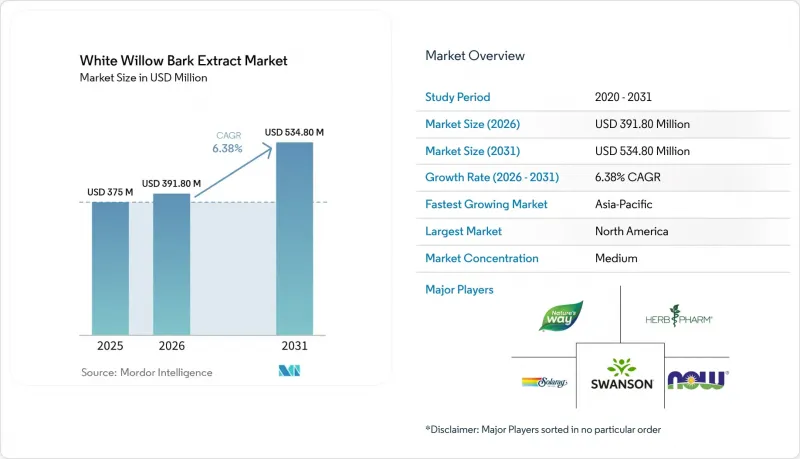
This report is Segmented by Product Form (Capsules, Tablets, Powder, Liquid Extracts), Standardization (15%, 25%, 50% Salicin, High-Salicin, Others), Indication (Arthritis, Low Back Pain, Menstrual Cramps, Muscle Soreness, General Pain), Distribution (Pharmacies, Specialty, Supermarkets, and More), and Geography (North America, Europe, Asia-Pacific, and More). Forecasts are Provided in Value (USD).
Global White Willow Bark Extract Market Trends and Insights
Rising Demand for Natural Pain Relief and Joint-Health Solutions
Concern over the gastrointestinal and cardiovascular effects associated with long-term NSAID use is encouraging some consumers to consider botanical products. The European Medicines Agency recognizes a defined willow bark dry extract as a well-established herbal medicinal product for mild low back pain. The same monograph specifies a daily intake of 240 mg total salicin for the recognized preparation. This recognition supports physician-directed and pharmacy-led recommendations in Europe. The White willow bark extract market can therefore serve consumers looking for a standardized option rather than a general herbal product. The European pathway also gives clinical-use brands a clearer basis for product positioning than mass retail products have.
E-Commerce Expansion for Herbal Supplements
Online channels are changing how consumers find and reorder herbal supplements. iHerb reported USD 2.9 billion in net sales for fiscal 2025, a 19% increase from the prior year, and fulfilled more than 44 million orders globally. The company also reported 370% growth in AutoShip subscription orders. These features favor products with clear information on salicin content, serving size, and intended use. The white willow bark extract market gains access to consumers outside established pharmacy networks through online product discovery and recurring orders. Brands without a clear standardization message face more direct price comparison as online shopping becomes more important. Product pages that explain salicin content, serving size, and quality controls can help a buyer distinguish a standardized extract from a lower-information alternative. This makes the quality narrative part of the sales process rather than a technical detail held only by the supplier.
Salicylate-Sensitivity and Drug-Interaction Safety Constraints
Willow bark products have a contraindication profile that limits their use for some consumers. The European Medicines Agency advises against use by people with salicylate hypersensitivity, certain asthma conditions, peptic ulcers, coagulation disorders, severe liver or kidney impairment, and during the third trimester of pregnancy. These exclusions are especially relevant for older consumers who may take multiple medicines. The White willow bark extract market must support careful labeling and clear consumer information. Brands serving arthritis and joint-health consumers may need pharmacist engagement and monitoring support. These requirements add cost and make broad consumer targeting more difficult. They also mean that product information must be clear enough for consumers and pharmacists to identify when the extract is not appropriate. This places more importance on responsible use information than in categories where a product does not have a comparable salicylate-related warning profile.
Other drivers and restraints analyzed in the detailed report include:
- Standardized Salicin Extracts Enabling Formulation Consistency
- Traceable and Sustainable Willow Sourcing as a Premium Differentiator
- Regulatory Limits on Disease and Analgesic Claims
For complete list of drivers and restraints, kindly check the Table Of Contents.
Segment Analysis
Capsules held 42.56% of the White willow bark extract market share in 2025. This lead reflects the preference for precise, tamper-evident doses in pharmacy-led channels and among consumers managing recurring discomfort. Capsules are particularly suited to standardized salicin extracts because the format allows brands to state a defined amount in each serving.
Powder is forecast to record a CAGR of 7.87% through 2031. The format gives sports nutrition manufacturers more freedom to blend willow bark with other recovery ingredients and to create multi-ingredient products. It also supports contract manufacturing and direct-to-consumer bulk supplement offerings where buyers value flexibility in dosage. Unlike capsules and tablets, powder can serve buyers outside traditional pharmacy and specialty-health retail channels.
The 15% salicin standardized grade held 36.64% of revenue in 2025. It remains widely used in mass-market supplements, pharmacist-recommended products, and joint-health formulas where salicin is combined with other active ingredients. The 25% and 50% grades are becoming more relevant where a stronger concentration can support a smaller serving size or a more focused product position. The White willow bark extract industry also serves cosmetic and specialty nutraceutical buyers that require custom salicin or total-salicylate specifications.
High-salicin standardized extracts are forecast to grow at a CAGR of 8.23% through 2031. Their growth reflects demand from clinical-use formulators and evidence-led consumer brands that seek a more concentrated product with a defined active profile. The European medicinal-use monograph provides an additional reference point for products that are developed for pharmacy or professional channels and need a consistent daily salicin position.
Complete Report Scope:
- By Product Form
- Capsules
- Tablets
- Powder
- Liquid Extracts
- By Active Compound Standardization
- 15% Salicin Standardized
- 25% Salicin Standardized
- 50% Salicin Standardized
- High-Salicin Standardized Extracts
- Other Standardizations
- By Indication
- Arthritis and Joint Discomfort
- Low Back Pain
- Menstrual Cramps
- Muscle Soreness and Sports Recovery
- Other Indications
- By Distribution Channel
- Pharmacies and Drug Stores
- Specialty Health Stores
- Supermarkets and Hypermarkets
- Online E-Commerce Platforms
- Others
- By Geography
- North America
- United States
- Canada
- Mexico
- Europe
- Germany
- United Kingdom
- France
- Italy
- Spain
- Rest of Europe
- Asia-Pacific
- China
- India
- Japan
- Australia
- South Korea
- Rest of Asia-Pacific
- Middle East and Africa
- GCC
- South Africa
- Rest of Middle East and Africa
- South America
- Brazil
- Argentina
- Rest of South America
- North America
Geography Analysis
North America held 37.89% of the White willow bark extract market share in 2025. The region benefits from established supplement distribution, pharmacy networks, and consumer demand for natural pain-management products. U.S. herbal dietary supplement retail sales reached USD 13.2 billion in 2024, after increasing 5.4% from the prior year.
Europe is the most regulated and clinically defined geography for the White willow bark extract market. The European Medicines Agency recognizes a precisely defined dry extract with a daily 240 mg total salicin dose as a well-established medicinal product for mild low back pain.
Asia-Pacific is forecast to expand at a CAGR of 8.12% through 2031. China is a major supply base for standardized salicin extracts and a growing domestic consumer market for botanical pain products. Demand is also linked to India's botanical wellness use, Japan's aging population, and South Korea's functional supplement culture.
- Alchem International Pvt. Ltd.
- Bio-Botanica, Inc.
- Changsha Organic Herb Inc.
- Foodchem International
- Herb Pharm, LLC
- Herbo Nutra
- Hunan Nutramax Inc.
- Martin Bauer Group
- Naturalin Bio-Resources Co., Ltd.
- Nature's Answer
- Nature's Way Products, LLC
- NOW Health Group, Inc.
- Shaanxi Hongda Phytochemistry Co., Ltd.
- Shaanxi Undersun Biomedtech Co., Ltd.
- Solaray
- Swanson Health Products, Inc.
- Xi'an Lyphar Biotech Co., Ltd.
- Xi'an Sost Biological Science & Technology Co., Ltd.
Additional Benefits:
- The market estimate (ME) sheet in Excel format
- 3 months of analyst support
TABLE OF CONTENTS
1 Introduction
- 1.1 Study Assumptions & Market Definition
- 1.2 Scope of the Study
2 Research Methodology
3 Executive Summary
4 Market Landscape
- 4.1 Market Overview
- 4.2 Market Drivers
- 4.2.1 Rising Demand for Natural Pain Relief and Joint-Health Solutions
- 4.2.2 Expansion of Botanical Ingredients in Nutraceutical and Functional Products
- 4.2.3 Growth of Clean-Label and Plant-Based Skin-Care Formulations
- 4.2.4 E-Commerce Expansion for Herbal Supplements
- 4.2.5 Standardized Salicin Extracts Enabling Formulation Consistency
- 4.2.6 Traceable and Sustainable Willow Sourcing as a Premium Differentiator
- 4.3 Market Restraints
- 4.3.1 Salicylate-Sensitivity and Drug-Interaction Safety Constraints
- 4.3.2 Regulatory Limits on Disease and Analgesic Claims
- 4.3.3 Variability in Salicin Content and Botanical Authentication
- 4.3.4 Heavy-Metal and Environmental-Contaminant Risk in Willow Bark
- 4.4 Supply Chain Analysis
- 4.5 Regulatory Landscape
- 4.6 Technological Outlook
- 4.7 Porter's Five Forces
- 4.7.1 Threat of New Entrants
- 4.7.2 Bargaining Power of Suppliers
- 4.7.3 Bargaining Power of Buyers
- 4.7.4 Threat of Substitutes
- 4.7.5 Industry Rivalry
5 Market Size & Growth Forecasts (Value, USD)
- 5.1 By Product Form
- 5.1.1 Capsules
- 5.1.2 Tablets
- 5.1.3 Powder
- 5.1.4 Liquid Extracts
- 5.2 By Active Compound Standardization
- 5.2.1 15% Salicin Standardized
- 5.2.2 25% Salicin Standardized
- 5.2.3 50% Salicin Standardized
- 5.2.4 High-Salicin Standardized Extracts
- 5.2.5 Other Standardizations
- 5.3 By Indication
- 5.3.1 Arthritis and Joint Discomfort
- 5.3.2 Low Back Pain
- 5.3.3 Menstrual Cramps
- 5.3.4 Muscle Soreness and Sports Recovery
- 5.3.5 Other Indications
- 5.4 By Distribution Channel
- 5.4.1 Pharmacies and Drug Stores
- 5.4.2 Specialty Health Stores
- 5.4.3 Supermarkets and Hypermarkets
- 5.4.4 Online E-Commerce Platforms
- 5.4.5 Others
- 5.5 By Geography
- 5.5.1 North America
- 5.5.1.1 United States
- 5.5.1.2 Canada
- 5.5.1.3 Mexico
- 5.5.2 Europe
- 5.5.2.1 Germany
- 5.5.2.2 United Kingdom
- 5.5.2.3 France
- 5.5.2.4 Italy
- 5.5.2.5 Spain
- 5.5.2.6 Rest of Europe
- 5.5.3 Asia-Pacific
- 5.5.3.1 China
- 5.5.3.2 India
- 5.5.3.3 Japan
- 5.5.3.4 Australia
- 5.5.3.5 South Korea
- 5.5.3.6 Rest of Asia-Pacific
- 5.5.4 Middle East and Africa
- 5.5.4.1 GCC
- 5.5.4.2 South Africa
- 5.5.4.3 Rest of Middle East and Africa
- 5.5.5 South America
- 5.5.5.1 Brazil
- 5.5.5.2 Argentina
- 5.5.5.3 Rest of South America
- 5.5.1 North America
6 Competitive Landscape
- 6.1 Market Concentration
- 6.2 Market Share Analysis
- 6.3 Company Profiles {(includes Global level Overview, Market level overview, Core Segments, Financials as available, Strategic Information, Market Rank/Share for key companies, Products & Services, and Recent Developments)}
- 6.3.1 Alchem International Pvt. Ltd.
- 6.3.2 Bio-Botanica, Inc.
- 6.3.3 Changsha Organic Herb Inc.
- 6.3.4 Foodchem International Corporation
- 6.3.5 Herb Pharm, LLC
- 6.3.6 Herbo Nutra
- 6.3.7 Hunan Nutramax Inc.
- 6.3.8 Martin Bauer Group
- 6.3.9 Naturalin Bio-Resources Co., Ltd.
- 6.3.10 Nature's Answer
- 6.3.11 Nature's Way Products, LLC
- 6.3.12 NOW Health Group, Inc.
- 6.3.13 Shaanxi Hongda Phytochemistry Co., Ltd.
- 6.3.14 Shaanxi Undersun Biomedtech Co., Ltd.
- 6.3.15 Solaray
- 6.3.16 Swanson Health Products, Inc.
- 6.3.17 Xi'an Lyphar Biotech Co., Ltd.
- 6.3.18 Xi'an Sost Biological Science & Technology Co., Ltd.
7 Market Opportunities & Future Outlook
- 7.1 White-space & unmet-need assessment

