PUBLISHER: Mordor Intelligence | PRODUCT CODE: 2119565

PUBLISHER: Mordor Intelligence | PRODUCT CODE: 2119565
North America Trade Finance - Market Share Analysis, Industry Trends & Statistics, Growth Forecasts (2026 - 2031)
According to Mordor Intelligence, the North America trade finance market size is expected to grow from USD 6.56 billion in 2025 to USD 6.86 billion in 2026 and is forecast to reach USD 8.59 billion by 2031 at 4.58% CAGR over 2026-2031.
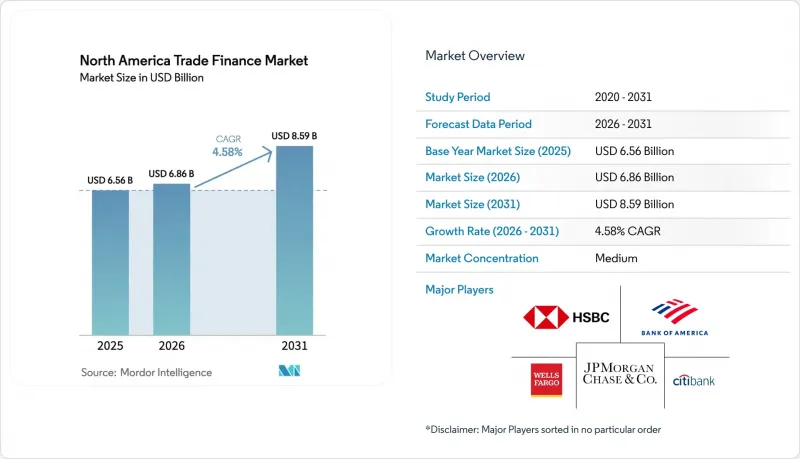
This report is Segmented by Product (Documentary, Non-Documentary), by Service Provider (Banks, and More), by Application (Domestic, International), by Company Size (Large Enterprises, Small and Medium-Sized Enterprises), by Financing Structure (Structured Trade Finance, Non-Structured Trade Finance) and by Country (USA, Canada, Mexico). The Market Forecasts are Provided in Terms of Value (USD).
North America Trade Finance Market Trends and Insights
Cross-border e-commerce expansion
Containerized freight from China to Mexico jumped 59.7% in January 2024, generating immediate demand for inventory finance and embedded payment solutions. Digital payment volumes in the region are set to hit USD 3 trillion in 2024, and platforms such as FedNow are enabling real-time settlement that heightens the need for working-capital tools. Banks are responding with point-of-sale trade finance, illustrated by HSBC's collaboration with TreviPay to offer flexible terms for cross-border sellers. The convergence of e-commerce and trade finance is therefore reshaping revenue models and risk analytics across the North American trade finance market.
Digitization & blockchain adoption
Citi Token Services moved from pilot to live commercial operations, providing 24/7 cross-border liquidity on private chains for multimillion-dollar flows. JPMorgan's ClearTrade automates checks on roughly 28 billion physical documents yearly, cutting turnaround from days to minutes. Participation in consortia such as the Marco Polo Network is widening real-time visibility into receivables, while Mexico's legal recognition of electronic financial documents accelerates digitization. This technology layer is helping the North American trade finance market to counter fraud risk and lower processing costs.
Rising AML/KYC compliance costs
Financial institutions in the region incurred USD 61 billion in compliance outlays during 2024, and 98% reported higher spending year over year. TD Bank's recent settlement under the Bank Secrecy Act highlights the financial penalties involved, which totaled USD 4.6 billion across North America last year. FinCEN's pending rule calls for mandatory enterprise-level risk assessments, pushing smaller lenders to outsource compliance or exit low-margin trade finance lines. Larger banks are adopting AI screening, but the lag in deployment among smaller entities restricts market inclusivity.
Other drivers and restraints analyzed in the detailed report include:
- USMCA + EXIM programmes
- Tokenization of trade-finance assets
- Persistent SME financing gap
For complete list of drivers and restraints, kindly check the Table Of Contents.
Segment Analysis
Documentary products accounted for 55.92% of the North America trade finance market share in 2025, underpinned by letters of credit and collections for cross-border shipments. Non-documentary solutions are projected to expand at 5.12% CAGR as multinationals digitize payables and embrace supply-chain finance. Citi's Digital Bill now reduces receivable monetization from weeks to under an hour, indicating how hybrid offerings merge documentary security with open-account speed. Receivables finance is gaining traction through factoring, proven by Northrim BanCorp's USD 53.9 million purchase of Sallyport Commercial Finance to scale North American factoring volumes.
Guarantees and insurance remain steady on heightened geopolitical risk, with trade credit capacity up 25% since 2019. Asset tokenization is opening an additional path for liquidity, and banks experiment with digital guarantees lodged on private blockchains to accelerate claim processes. Documentary and non-documentary convergence, therefore, underlines the evolving service mix within the North American trade finance market.
Banks held 70.10% share of the North America trade finance market in 2025, thanks to compliance scale and multidecade client links. Fintech-led trade finance companies are expected to outpace at 5.68% CAGR, reflecting agility and niche underwriting. Wells Fargo's integration with TradeSun illustrates incumbent efforts to automate document review and reclaim margin. Insurers carve specialized positions in credit-risk transfer, while platforms such as MODIFI secure USD 100 million from HSBC Innovation Banking to fund SME invoice finance.
Industry consolidation is rising: FIS spent USD 300 million for Demica and Dragonfly to cement supply-chain finance-software scale. Finastra's partnership with CredAble demonstrates how core-banking vendors embed trade finance modules to defend against point solutions. The competitive axis is shifting from balance-sheet depth toward real-time data analytics across the North American trade finance industry.
Complete Report Scope:
- By Product
- Documentary
- Letter of Credit
- Other Documentary Collections
- Non-Documentary
- Receivables Finance (Factoring, Forfaiting, Invoice Discounting)
- Payables/Supply Chain Finance (Reverse Factoring, Dynamic Discounting)
- Direct Lending/Open Account-Based Finance (Trade Loans, Buyer's/Seller's Credit)
- Guarantees (Performance, Bid, Financial Guarantees)
- Insurance Products (Trade Credit Insurance, PRI, ECA Cover)
- Documentary
- By Service Provider
- Banks
- Trade Finance Companies
- Insurance Companies
- Other Service Providers
- By Application
- Domestic
- International
- By Company Size
- Large Enterprises
- Small and Medium-sized Enterprises (SMEs)
- By Financing Structure
- Structured Trade Finance
- Non-Structured Trade Finance
- By Country
- USA
- Canada
- Mexico
List of Companies Covered in this Report:
- JPMorgan Chase & Co.
- Bank of America Corp.
- Citigroup Inc.
- Wells Fargo & Co.
- HSBC Holdings plc
- BNP Paribas S.A.
- Mitsubishi UFJ Financial Group
- Santander Bank N.A.
- Scotiabank
- Standard Chartered plc
- Commerzbank AG
- TD Bank Group
- Royal Bank of Canada
- CIBC
- US Bank
- PNC Financial Services
- Deutsche Bank AG
- Barclays plc
- Credit Agricole CIB
- Societe Generale
Additional Benefits:
- The market estimate (ME) sheet in Excel format
- 3 months of analyst support
TABLE OF CONTENTS
1 Introduction
- 1.1 Study Assumptions & Market Definition
- 1.2 Scope of the Study
2 Research Methodology
3 Executive Summary
4 Market Landscape
- 4.1 Market Overview
- 4.2 Market Drivers
- 4.2.1 Cross-border e-commerce expansion
- 4.2.2 Digitisation & blockchain adoption
- 4.2.3 USMCA + EXIM programmes
- 4.2.4 Tokenisation of trade-finance assets
- 4.2.5 Nearshoring-driven domestic trade
- 4.3 Market Restraints
- 4.3.1 Rising AML/KYC compliance costs
- 4.3.2 Persistent SME financing gap
- 4.3.3 Cyber-attack risk on e-documents
- 4.3.4 Protectionist tariff volatility
- 4.4 Value / Supply-Chain Analysis
- 4.5 Regulatory Landscape
- 4.6 Technological Outlook
- 4.7 Porter's Five Forces
- 4.7.1 Bargaining Power of Buyers
- 4.7.2 Bargaining Power of Suppliers
- 4.7.3 Threat of New Entrants
- 4.7.4 Threat of Substitutes
- 4.7.5 Intensity of Competitive Rivalry
5 Market Size & Growth Forecasts (Value)
- 5.1 By Product
- 5.1.1 Documentary
- 5.1.1.1 Letter of Credit
- 5.1.1.2 Other Documentary Collections
- 5.1.2 Non-Documentary
- 5.1.2.1 Receivables Finance (Factoring, Forfaiting, Invoice Discounting)
- 5.1.2.2 Payables/Supply Chain Finance (Reverse Factoring, Dynamic Discounting)
- 5.1.2.3 Direct Lending/Open Account-Based Finance (Trade Loans, Buyer's/Seller's Credit)
- 5.1.2.4 Guarantees (Performance, Bid, Financial Guarantees)
- 5.1.2.5 Insurance Products (Trade Credit Insurance, PRI, ECA Cover)
- 5.1.1 Documentary
- 5.2 By Service Provider
- 5.2.1 Banks
- 5.2.2 Trade Finance Companies
- 5.2.3 Insurance Companies
- 5.2.4 Other Service Providers
- 5.3 By Application
- 5.3.1 Domestic
- 5.3.2 International
- 5.4 By Company Size
- 5.4.1 Large Enterprises
- 5.4.2 Small and Medium-sized Enterprises (SMEs)
- 5.5 By Financing Structure
- 5.5.1 Structured Trade Finance
- 5.5.2 Non-Structured Trade Finance
- 5.6 By Country
- 5.6.1 USA
- 5.6.2 Canada
- 5.6.3 Mexico
6 Competitive Landscape
- 6.1 Market Concentration
- 6.2 Strategic Moves
- 6.3 Market Share Analysis
- 6.4 Company Profiles (includes Global Level Overview, Market Level Overview, Core Segments, Financials as available, Strategic Information, Market Rank/Share for Key Companies, Products & Services, and Recent Developments)
- 6.4.1 JPMorgan Chase & Co.
- 6.4.2 Bank of America Corp.
- 6.4.3 Citigroup Inc.
- 6.4.4 Wells Fargo & Co.
- 6.4.5 HSBC Holdings plc
- 6.4.6 BNP Paribas S.A.
- 6.4.7 Mitsubishi UFJ Financial Group
- 6.4.8 Santander Bank N.A.
- 6.4.9 Scotiabank
- 6.4.10 Standard Chartered plc
- 6.4.11 Commerzbank AG
- 6.4.12 TD Bank Group
- 6.4.13 Royal Bank of Canada
- 6.4.14 CIBC
- 6.4.15 US Bank
- 6.4.16 PNC Financial Services
- 6.4.17 Deutsche Bank AG
- 6.4.18 Barclays plc
- 6.4.19 Credit Agricole CIB
- 6.4.20 Societe Generale
7 Market Opportunities & Future Outlook
- 7.1 White-space & Unmet-Need Assessment

