PUBLISHER: Mordor Intelligence | PRODUCT CODE: 2119566

PUBLISHER: Mordor Intelligence | PRODUCT CODE: 2119566
Spay And Neuter - Market Share Analysis, Industry Trends & Statistics, Growth Forecasts (2026 - 2031)
According to Mordor Intelligence, the spay and neuter market size in 2026 is estimated at USD 2.83 billion, growing from 2025 value of USD 2.70 billion with 2031 projections showing USD 3.54 billion, growing at 4.63% CAGR over 2026-2031.
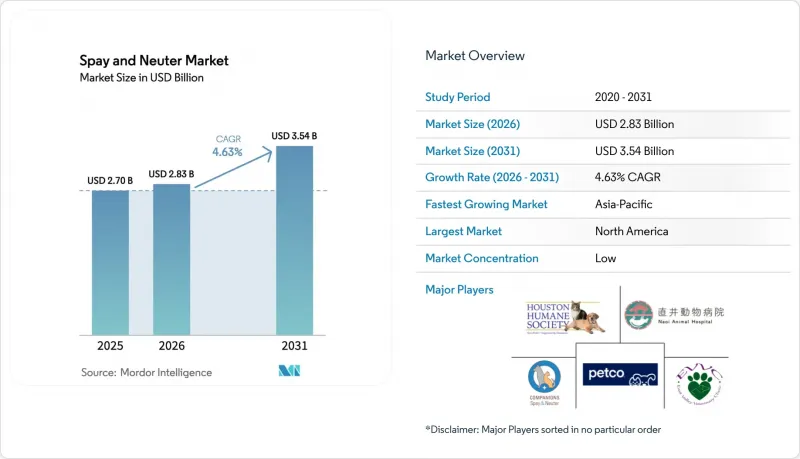
This report is Segmented by Procedure Type (Spay, Neuter, Non-Surgical Sterilization), Animal Type (Dogs, Cats, Other Companion Animals), End User (Veterinary Hospitals, Veterinary Clinics, Animal Shelters & NGOs, Mobile/Community Programs), and Geography (North America, South America, Europe, APAC, Middle East and Africa). The Market Forecasts are Provided in Terms of Value (USD).
Global Spay And Neuter Market Trends and Insights
Rising Companion Animal Ownership & Pet-Humanization
Youthful urban households are choosing pets over larger families, turning sterilization into a routine wellness milestone rather than a one-off public-health duty. China's pet economy touched billions in 2024, with veterinary spending at 28%, while India's dog population almost tripled over the last decade, pushing corporate entrants to scale multi-clinic networks. Higher disposable incomes drive owner willingness to select laparoscopic techniques, laser surgery, and longer-acting analgesics, raising average invoice values and lifting profitability across the spay and neuter market.
Government & NGO Subsidized Spay-Neuter Campaigns
Voucher programs, free-day clinics, and traveling surgical units have become critical volume drivers, particularly for low-income zip codes. Best Friends Animal Society's #SpayTogether initiative has deployed over USD 2 million in funding with the goal of supporting 50,000 spay/neuter surgeries across eight US states, while the organization directly performed 20,673 spay/neuter procedures in 2024[1]. These initiatives also generate predictable case loads that underpin capacity-expansion investments by private practices.
Shortage of Skilled Veterinary Surgeons (Rural)
Shelter surveys show 73% of facilities delaying surgeries because of veterinarian shortages, with 18,648 animals on waiting lists as of 2024. Economic disincentives and lifestyle preferences steer new graduates toward urban posts, creating "veterinary deserts" where travel distances inflate owner drop-off rates. Europe reports 78.5% of its rural areas under-served, compelling NGOs to deploy mobile teams and tele-mentoring to preserve procedure volumes.
Other drivers and restraints analyzed in the detailed report include:
- Mandatory Municipal Sterilization Ordinances
- Rising Veterinary Healthcare Expenditure
- Cultural & Religious Opposition to Sterilization
For complete list of drivers and restraints, kindly check the Table Of Contents.
Segment Analysis
Spay surgeries represented 56.08% of the spay and neuter market size in 2025, reflecting higher pricing for ovariohysterectomies and longer theater time. Neuter procedures contribute steady volume but lower revenue per case, enabling high-throughput clinics to balance margins. Surgical protocols are standardized across corporate chains, allowing predictable inventory management and consistent quality in the spay and neuter market.
Non-surgical alternatives account for a small but rapidly growing share, propelled by Suprelorin implants that provide 6-12 months of reversible infertility with 99% efficacy in field trials. Pipeline innovations in immunocontraceptive vaccines promise single-visit solutions appealing to owners concerned about anesthesia risk. As these options scale, surgical dominance may erode, prompting practices to diversify service menus and retrain staff-yet the spay and neuter market is expected to keep surgical services at its core through 2031.
Complete Report Scope:
- By Procedure Type
- Spay (Ovariohysterectomy)
- Neuter (Orchiectomy)
- Non-surgical Sterilization
- By Animal Type
- Dogs
- Cats
- Other Companion Animals
- By End User
- Veterinary Hospitals
- Veterinary Clinics
- Animal Shelters & NGOs
- Mobile / Community Programs
- By Geography
- North America
- United States
- Canada
- Mexico
- South America
- Brazil
- Argentina
- Rest of South America
- Europe
- Germany
- United Kingdom
- France
- Italy
- Spain
- Russia
- Rest of Europe
- APAC
- China
- India
- Japan
- South Korea
- Australia
- Rest of APAC
- Middle East and Africa
- GCC
- South Africa
- Rest of Middle East and Africa
- North America
Geography Analysis
North America retained 41.74% of global revenue in 2025, fortified by uniform shelter-neuter requirements across 32 states and an extensive corporate clinic footprint. Mars Petcare's 3,000-plus locations in Banfield and VCA networks have standardized post-operative pain protocols and broadened financing options, accelerating premium uptake. Public-private voucher schemes in Texas and California further buttress procedure volumes among price-sensitive demographics.
Asia-Pacific registers the highest 7.86% CAGR, attributed to rising middle-class ownership and government incentives to reduce stray populations. China's veterinary-school enrollment has nearly doubled since 2020, yet supply lags demand, pushing procedure prices upward and sustaining strong profitability for early entrants. In India, Mars Inc.'s stake in Crown Veterinary Services channels capital into modern surgical suites and structured internships, elevating clinical standards and advancing the spay and neuter market.
Europe maintains mature uptake supported by embedded animal-welfare legislation, although procedure growth is incremental. Germany's federal law requiring shelter sterilization pre-adoption stabilizes demand, while Spain's "One Health" strategy bundles sterilization subsidies with rabies-vaccination campaigns, ensuring steady clinic throughput. Latin America and the Middle East/Africa show mixed progress; urban hubs such as Sao Paulo and Johannesburg implement voucher programs, yet rural penetration remains modest due to clinician shortages and cultural hesitancy.
- Banfield Pet Hospital
- VCA Animal Hospitals
- BluePearl Specialty & Emergency Pet Hospital
- PetVet Care Centers
- VetCor
- Independent Vets of Australia
- Covetrus
- Anicura
- Pets at Home Vet Group
- Thrive Pet Healthcare
- Mission Veterinary Partners
- IVC Evidensia
- CVS Group plc
- Linnaeus Group (Mars)
- Neogen
- ASPCA Spay/Neuter Alliance
- Humane Society Spay/Neuter Clinics
- Emancipet
- Vetco (Petco)
- Independent Vets of Australia
- Anicura
Additional Benefits:
- The market estimate (ME) sheet in Excel format
- 3 months of analyst support
TABLE OF CONTENTS
1 Introduction
- 1.1 Study Assumptions & Market Definition
- 1.2 Scope of the Study
2 Research Methodology
3 Executive Summary
4 Market Landscape
- 4.1 Market Overview
- 4.2 Market Drivers
- 4.2.1 Rising companion animal ownership & pet-humanization
- 4.2.2 Government & NGO subsidized spay-neuter campaigns
- 4.2.3 Mandatory municipal sterilization ordinances
- 4.2.4 Rising veterinary healthcare expenditure
- 4.2.5 Breakthrough non-surgical sterilant pipelines
- 4.2.6 Corporate chain bundled low-cost surgery packages
- 4.3 Market Restraints
- 4.3.1 Shortage of skilled veterinary surgeons (rural)
- 4.3.2 Cultural & religious opposition to sterilization
- 4.3.3 Post-operative complication concerns among owners
- 4.3.4 COVID-19 backlog delaying elective procedures
- 4.4 Value / Supply-Chain Analysis
- 4.5 Regulatory Landscape
- 4.6 Technological Outlook
- 4.7 Porter's Five Forces Analysis
- 4.7.1 Bargaining Power of Buyers
- 4.7.2 Bargaining Power of Suppliers
- 4.7.3 Threat of New Entrants
- 4.7.4 Threat of Substitutes
- 4.7.5 Intensity of Competitive Rivalry
5 Market Size & Growth Forecasts (Value)
- 5.1 By Procedure Type
- 5.1.1 Spay (Ovariohysterectomy)
- 5.1.2 Neuter (Orchiectomy)
- 5.1.3 Non-surgical Sterilization
- 5.2 By Animal Type
- 5.2.1 Dogs
- 5.2.2 Cats
- 5.2.3 Other Companion Animals
- 5.3 By End User
- 5.3.1 Veterinary Hospitals
- 5.3.2 Veterinary Clinics
- 5.3.3 Animal Shelters & NGOs
- 5.3.4 Mobile / Community Programs
- 5.4 By Geography
- 5.4.1 North America
- 5.4.1.1 United States
- 5.4.1.2 Canada
- 5.4.1.3 Mexico
- 5.4.2 South America
- 5.4.2.1 Brazil
- 5.4.2.2 Argentina
- 5.4.2.3 Rest of South America
- 5.4.3 Europe
- 5.4.3.1 Germany
- 5.4.3.2 United Kingdom
- 5.4.3.3 France
- 5.4.3.4 Italy
- 5.4.3.5 Spain
- 5.4.3.6 Russia
- 5.4.3.7 Rest of Europe
- 5.4.4 APAC
- 5.4.4.1 China
- 5.4.4.2 India
- 5.4.4.3 Japan
- 5.4.4.4 South Korea
- 5.4.4.5 Australia
- 5.4.4.6 Rest of APAC
- 5.4.5 Middle East and Africa
- 5.4.5.1 GCC
- 5.4.5.2 South Africa
- 5.4.5.3 Rest of Middle East and Africa
- 5.4.1 North America
6 Competitive Landscape
- 6.1 Market Concentration
- 6.2 Strategic Moves
- 6.3 Market Share Analysis
- 6.4 Company Profiles (includes Global level Overview, Market level overview, Core Segments, Financials as available, Strategic Information, Market Rank/Share for key companies, Products & Services, and Recent Developments)
- 6.4.1 Banfield Pet Hospital
- 6.4.2 VCA Animal Hospitals
- 6.4.3 BluePearl Specialty & Emergency Pet Hospital
- 6.4.4 PetVet Care Centers
- 6.4.5 VetCor
- 6.4.6 Independent Vets of Australia
- 6.4.7 Covetrus
- 6.4.8 Anicura
- 6.4.9 Pets at Home Vet Group
- 6.4.10 Thrive Pet Healthcare
- 6.4.11 Mission Veterinary Partners
- 6.4.12 IVC Evidensia
- 6.4.13 CVS Group plc
- 6.4.14 Linnaeus Group (Mars)
- 6.4.15 Neogen Corporation
- 6.4.16 ASPCA Spay/Neuter Alliance
- 6.4.17 Humane Society Spay/Neuter Clinics
- 6.4.18 Emancipet
- 6.4.19 Vetco (Petco)
- 6.4.20 Independent Vets of Australia
- 6.4.21 Anicura
7 Market Opportunities & Future Outlook
- 7.1 White-space & Unmet-Need Assessment

