PUBLISHER: Mordor Intelligence | PRODUCT CODE: 2119568

PUBLISHER: Mordor Intelligence | PRODUCT CODE: 2119568
Europe Power Transistor - Market Share Analysis, Industry Trends & Statistics, Growth Forecasts (2026 - 2031)
According to Mordor Intelligence, the Europe power transistor market size was valued at USD 5.77 billion in 2025 and estimated to grow from USD 6.08 billion in 2026 to reach USD 7.92 billion by 2031, at a CAGR of 5.41% during the forecast period (2026-2031).
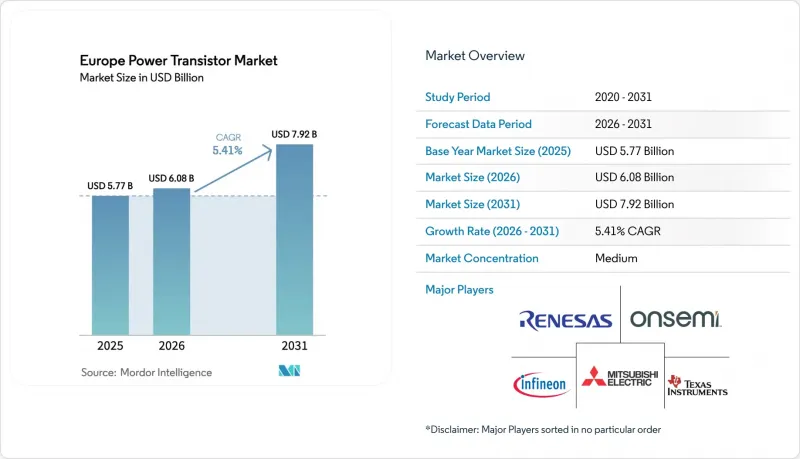
This report is Segmented by Product (FETs, Igbts, Mosfets, and WBG Transistors), Material (Silicon, Sic, Gan, Gaas, and More), Type (BJT, MOSFET, and More), Packaging (Discrete, Modules, and More), Power Rating (Low, Medium, and More), End-User (Automotive, Industrial, and More), Application (Inverters, Motor Control, and More), and Country. The Market Forecasts are Provided in Terms of Value (USD).
Europe Power Transistor Market Trends and Insights
EV-Related Demand Surge for SiC MOSFETs
European automakers increasingly specify silicon-carbide MOSFET traction inverters because these devices raise drivetrain efficiency and add 5-8% driving range compared with silicon IGBTs. Euro 7 emissions rules accelerate the switch as manufacturers pursue every kilowatt-hour saved. Infineon has expanded SiC capacity in Austria and Italy, signaling clear confidence that the Europe power transistor market will keep absorbing higher volumes through 2030. As charging infrastructure migrates toward 800 V architectures, demand for 1 200 V SiC devices should intensify, locking in medium-term growth.
Renewable Energy and Smart-Grid Build-Out
The REPowerEU plan targets 1,236 GW of renewables by 2030, requiring roughly EUR 300 billion (USD 330 billion) in grid upgrades that rely on efficient high-voltage switching. High-power IGBT and SiC modules enable multi-gigawatt HVDC links such as Statnett's interconnectors, which reinforce cross-border power flow and stabilize variable generation. Grid codes rewarding lower switching losses push utilities toward wide-bandgap devices, cementing long-term demand in the European power transistor market.
SiC Substrate Supply Bottlenecks
Lead times for 150 mm SiC wafers stretch to 52 weeks, constraining device output and dampening near-term revenue. Chinese vendors control 35% of global substrate capacity, leaving European fabs exposed to trade policy shocks. Infineon and STMicroelectronics signed multi-year take-or-pay deals and are co-investing in local boule growth, yet meaningful volumes will not arrive before 2027, keeping a lid on the Europe power transistor market's upside.
Other drivers and restraints analyzed in the detailed report include:
- 5G Infrastructure Roll-Outs Across Europe
- Data-Center PUE Mandates Favor High-Efficiency Transistors
- Premium Pricing of Wide-Band-Gap Devices
For complete list of drivers and restraints, kindly check the Table Of Contents.
Segment Analysis
IGBT modules generated the largest slice of the Europe power transistor market size with 29.31% revenue in 2025. Their dominance stems from entrenched use in variable-speed drives, solar inverters, and rail traction systems that value rugged high-voltage performance. The modules pair multiple dies with optimised thermal paths, squeezing more power per cubic centimeter and fulfilling EU energy-efficiency rules. Discrete IGBTs still sell into retrofit drives, but OEMs increasingly migrate toward integrated modules that simplify assembly and improve reliability.
Wide-bandgap transistors record the quickest 7.38% CAGR and will chip away at incumbent modules, especially where every percentage-point loss impacts system economics, such as EV fast chargers. The hybrid landscape encourages vendors to co-package SiC MOSFETs with driver ICs, pushing integration advantages further. As module makers adopt direct-bonded-copper substrates and sintered silver die-attach, thermal cycles improve, extending lifetime metrics demanded by automotive traction warranties.
Silicon retained 56.78% of 2025 revenue owing to its mature 200 mm fabs and cost leadership, but its share will steadily erode as designers chase higher temperature and frequency operation. Gallium nitride, growing at 6.26% CAGR, is the preferred choice for high-frequency power supplies and 5G radios where its 600 V devices outperform silicon super-junction MOSFETs. The Europe power transistor market share of SiC is also advancing as 1 200 V MOSFETs unlock EV platforms targeting 800 V battery stacks.
Strategic-autonomy policy has funneled PERTE Chip funds into Spanish and French pilot lines for GaN epitaxy, while Germany backs SiC boule growth to ease import reliance. These programs aim to shorten learning curves, drive wafer-cost parity with silicon, and reinforce local supply. Gallium arsenide and emerging oxides will remain niche, serving defense phased-array and niche scientific instrumentation.
MOSFETs commanded 49.35% revenue in 2025. Their gate-charge efficiency and linear voltage scaling suit everything from smartphone PMICs to 350 kW traction inverters, safeguarding a broad install base. The Europe power transistor market continues to lean on MOSFET innovation, notably trench structures that cut RDS(on) below 3 mΩ.
Heterojunction bipolar transistors, advancing at 5.75% CAGR, ride the 5G tailwind where GaN HBTs deliver high gain at C-band. Bipolar junction transistors retain footholds in harsh linear regulators and welding inverters. As ISO 26262 tightens diagnostic demands, FET architectures with predictable failure modes, like normally-off SiC JFETs, pique automotive interest.
Complete Report Scope:
- By Product
- Low-Voltage FETs
- High-Voltage FETs
- Discrete IGBT
- IGBT Modules
- Super-Junction MOSFETs
- RF and Microwave Transistors
- Wide-Bandgap Power Transistors (SiC, GaN)
- By Material
- Silicon
- Silicon Carbide (SiC)
- Gallium Nitride (GaN)
- Gallium Arsenide (GaAs)
- Other Materials
- By Type
- Bipolar Junction Transistor (BJT)
- Field-Effect Transistor (MOSFET, JFET)
- Heterojunction Bipolar Transistor (HBT)
- By Packaging
- Discrete Devices
- Power Modules
- Power ICs / Integrated Power Stages
- By Power Rating
- Low Power (<40 V)
- Medium Power (40-600 V)
- High Power (> 600 V)
- By End-User Industry
- Automotive and EV/HEV
- Consumer Electronics and Mobile
- Industrial Automation and Motor Drives
- Energy and Power (Renewables, Smart Grid)
- Data Centers and HPC
- Telecom and 5G Infrastructure
- Aerospace and Defense
- By Application
- Inverters and Converters
- Motor Control and Drives
- Power Supplies and Adapters
- Battery Charging and BMS
- RF Power Amplifiers
- Lighting and Display Drivers
- By Country
- Germany
- United Kingdom
- France
- Italy
- Spain
- Nordics (Denmark, Sweden, Norway, Finland)
- Rest of Europe
List of Companies Covered in this Report:
- Infineon Technologies AG
- STMicroelectronics N.V.
- ON Semiconductor Corporation
- Nexperia B.V.
- ROHM Co., Ltd.
- Toshiba Electronic Devices and Storage Corporation
- Mitsubishi Electric Corporation
- Vishay Intertechnology, Inc.
- Renesas Electronics Corporation
- Texas Instruments Incorporated
- Analog Devices, Inc.
- IXYS LLC
- Littelfuse, Inc.
- Microchip Technology Inc.
- Wolfspeed, Inc.
- GeneSiC Semiconductor LLC
- UnitedSiC LLC
- Semikron Danfoss GmbH and Co. KG
- Dialog Semiconductor Limited
- Alpha and Omega Semiconductor Limited
Additional Benefits:
- The market estimate (ME) sheet in Excel format
- 3 months of analyst support
TABLE OF CONTENTS
1 INTRODUCTION
- 1.1 Study Assumptions and Market Definition
- 1.2 Scope of the Study
2 RESEARCH METHODOLOGY
3 EXECUTIVE SUMMARY
4 MARKET LANDSCAPE
- 4.1 Market Overview
- 4.2 Market Drivers
- 4.2.1 EV-related demand surge for SiC MOSFETs
- 4.2.2 Renewable energy and smart-grid build-out
- 4.2.3 5G infrastructure roll-outs across Europe
- 4.2.4 EU Green-Taxonomy financing levers WBG uptake
- 4.2.5 ISO 26262 functional-safety push to higher-voltage designs
- 4.2.6 Data-center PUE mandates favour high-efficiency transistors
- 4.3 Market Restraints
- 4.3.1 SiC substrate supply bottlenecks
- 4.3.2 Premium pricing of wide-band-gap devices
- 4.3.3 EU eco-design labels elongate consumer-electronics replacement cycles
- 4.3.4 Gallium export-control volatility in EU-China trade
- 4.4 Industry Value Chain Analysis
- 4.5 Regulatory Landscape
- 4.6 Technological Outlook
- 4.7 The Impact of Macroeconomic Factors on the Market
- 4.8 Porter's Five Forces Analysis
- 4.8.1 Threat of New Entrants
- 4.8.2 Threat of Substitutes
- 4.8.3 Bargaining Power of Suppliers
- 4.8.4 Bargaining Power of Buyers
- 4.8.5 Competitive Rivalry
5 MARKET SIZE AND GROWTH FORECASTS (VALUE)
- 5.1 By Product
- 5.1.1 Low-Voltage FETs
- 5.1.2 High-Voltage FETs
- 5.1.3 Discrete IGBT
- 5.1.4 IGBT Modules
- 5.1.5 Super-Junction MOSFETs
- 5.1.6 RF and Microwave Transistors
- 5.1.7 Wide-Bandgap Power Transistors (SiC, GaN)
- 5.2 By Material
- 5.2.1 Silicon
- 5.2.2 Silicon Carbide (SiC)
- 5.2.3 Gallium Nitride (GaN)
- 5.2.4 Gallium Arsenide (GaAs)
- 5.2.5 Other Materials
- 5.3 By Type
- 5.3.1 Bipolar Junction Transistor (BJT)
- 5.3.2 Field-Effect Transistor (MOSFET, JFET)
- 5.3.3 Heterojunction Bipolar Transistor (HBT)
- 5.4 By Packaging
- 5.4.1 Discrete Devices
- 5.4.2 Power Modules
- 5.4.3 Power ICs / Integrated Power Stages
- 5.5 By Power Rating
- 5.5.1 Low Power (< 40 V)
- 5.5.2 Medium Power (40-600 V)
- 5.5.3 High Power (> 600 V)
- 5.6 By End-User Industry
- 5.6.1 Automotive and EV/HEV
- 5.6.2 Consumer Electronics and Mobile
- 5.6.3 Industrial Automation and Motor Drives
- 5.6.4 Energy and Power (Renewables, Smart Grid)
- 5.6.5 Data Centers and HPC
- 5.6.6 Telecom and 5G Infrastructure
- 5.6.7 Aerospace and Defense
- 5.7 By Application
- 5.7.1 Inverters and Converters
- 5.7.2 Motor Control and Drives
- 5.7.3 Power Supplies and Adapters
- 5.7.4 Battery Charging and BMS
- 5.7.5 RF Power Amplifiers
- 5.7.6 Lighting and Display Drivers
- 5.8 By Country
- 5.8.1 Germany
- 5.8.2 United Kingdom
- 5.8.3 France
- 5.8.4 Italy
- 5.8.5 Spain
- 5.8.6 Nordics (Denmark, Sweden, Norway, Finland)
- 5.8.7 Rest of Europe
6 COMPETITIVE LANDSCAPE
- 6.1 Market Concentration
- 6.2 Strategic Moves
- 6.3 Market Share Analysis
- 6.4 Company Profiles {(includes Global level Overview, Market level overview, Core Segments, Financials as available, Strategic Information, Market Rank/Share for key companies, Products and Services, and Recent Developments)}
- 6.4.1 Infineon Technologies AG
- 6.4.2 STMicroelectronics N.V.
- 6.4.3 ON Semiconductor Corporation
- 6.4.4 Nexperia B.V.
- 6.4.5 ROHM Co., Ltd.
- 6.4.6 Toshiba Electronic Devices and Storage Corporation
- 6.4.7 Mitsubishi Electric Corporation
- 6.4.8 Vishay Intertechnology, Inc.
- 6.4.9 Renesas Electronics Corporation
- 6.4.10 Texas Instruments Incorporated
- 6.4.11 Analog Devices, Inc.
- 6.4.12 IXYS LLC
- 6.4.13 Littelfuse, Inc.
- 6.4.14 Microchip Technology Inc.
- 6.4.15 Wolfspeed, Inc.
- 6.4.16 GeneSiC Semiconductor LLC
- 6.4.17 UnitedSiC LLC
- 6.4.18 Semikron Danfoss GmbH and Co. KG
- 6.4.19 Dialog Semiconductor Limited
- 6.4.20 Alpha and Omega Semiconductor Limited
7 MARKET OPPORTUNITIES AND FUTURE OUTLOOK
- 7.1 White-space and Unmet-Need Assessment

