PUBLISHER: Mordor Intelligence | PRODUCT CODE: 2119579

PUBLISHER: Mordor Intelligence | PRODUCT CODE: 2119579
Surfing Equipment - Market Share Analysis, Industry Trends & Statistics, Growth Forecasts (2026 - 2031)
According to Mordor Intelligence, the surfing equipment market size is expected to grow from USD 4.62 billion in 2025 to USD 4.85 billion in 2026 and is forecast to reach USD 6.19 billion by 2031 at 4.99% CAGR over 2026-2031.
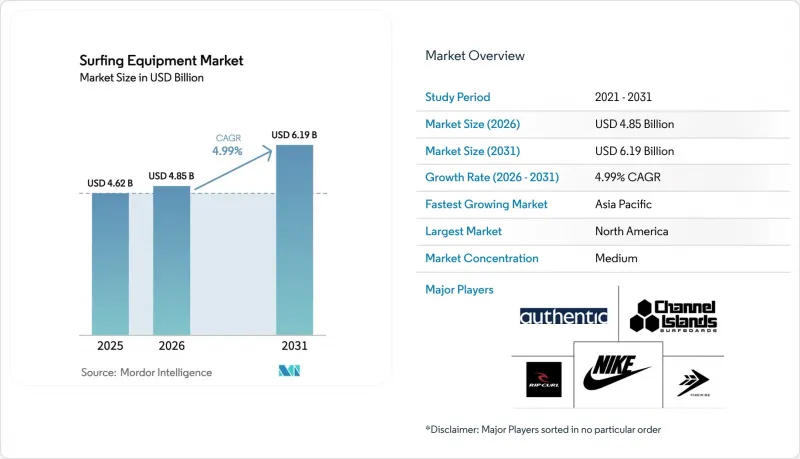
This report is Segmented by Product Type (Surfing Boards, Apparel, and More), End User (Adult and Kids/Children), Category (Mass and Premium), Distribution Channel (Online Retail Stores and Offline Retail Stores), and Geography (North America, Europe, Asia-Pacific, South America, and Middle East and Africa). The Market Forecasts are Provided in Terms of Value (USD).
Global Surfing Equipment Market Trends and Insights
Rising Popularity of Surfing as a Sport and Lifestyle
Surfing's inclusion in the Olympic program not only validated its competitive pathways but also broadened its media coverage. This elevation transformed surfboards and branded apparel into coveted lifestyle symbols, extending their allure far beyond the traditional surfer demographic. As the sport's popularity surges, local tournaments flourish, and amateur surfers flock to summer camps, driving up the demand for surfing equipment. For instance, the International Surfers Association reported in 2023 that there are approximately 23 million surfers worldwide. Brands have shifted their marketing focus, targeting urban fitness enthusiasts who now see surfing as a desirable addition to their gym and running club routines. This shift is evident in the rising demand for premium boards, as newcomers prioritize gear that marries performance with aesthetic appeal. Furthermore, lifestyle content on social media amplifies this trend, with surf influencers gaining global traction, seamlessly translating cultural exposure into heightened product demand.
Technological advancements in surfboard materials and design
Surfing gear is transforming, thanks to material innovations that boost performance, durability, and sustainability. Innovations like carbon-fiber masts, titanium core fuselages, and recyclable bio-resins are not only cutting weight by 15-20% but also enhancing flex precision and strength. Take, for example, Armstrong Foils' Quad C-Beam carbon composite masts. They allow for the creation of thinner, faster foils that don't skimp on durability, catering to riders who navigate diverse wave conditions. Furthermore, advancements in digital shaping and CAD technologies are making semi-custom boards more affordable, democratizing access to high-end gear. Wetsuit manufacturers are now turning to eco-friendly materials, such as natural rubber and limestone neoprene, striking a balance between warmth, flexibility, and a reduced environmental impact. Fin designs are now leveraging carbon fiber and honeycomb structures, enhancing maneuverability. With sustainable practices like using recycled cores and biobased resins, the industry is resonating with surfers' eco-conscious values. This not only makes advanced, eco-friendly equipment more accessible but also propels the sport into a greener future.
Limited number of surfing facilities and low participation Rates
Although online interest in surfing continues to rise, a significant portion of the global population resides far from surfable coastlines, limiting direct participation in the sport. Artificial wave parks have emerged as a potential solution; however, their high capital requirements and operational complexities confine their development to premium resorts and affluent urban areas. This exclusivity restricts accessibility for broader demographics. In developing nations, government spending is often directed toward critical infrastructure projects, leaving limited resources for investments in costly wave pools. As a result, the growth of local demand for surfing equipment, such as surfboards and wetsuits, remains constrained. These factors collectively hinder the widespread adoption of surfing, despite its growing popularity in digital and social media spaces.
Other drivers and restraints analyzed in the detailed report include:
- Expansion of surf schools and training programs
- Growth of coastal tourism and surf destinations
- High cost of surfing equipment
For complete list of drivers and restraints, kindly check the Table Of Contents.
Segment Analysis
In 2025, the board segment dominated the surfing equipment market, accounting for 69.78% of total revenue. This dominance is attributed to shorter replacement cycles, the trend of maintaining multiple boards for different breaks, and ongoing material upgrades that sustain demand. Highlighting the market's nuances, North Foils unveiled its 2025 range in July 2024, featuring wing, prone, and kite foils. This move underscores the growing demand for specialized boards in sub-disciplines, as consumers increasingly seek equipment tailored to specific surfing styles and conditions. Furthermore, the industry's pivot towards lighter carbon constructions has driven up average selling prices, allowing the board segment to maintain its share even as other categories broaden. The combination of innovation and adaptability ensures the board segment remains a cornerstone of the surfing equipment market.
Apparel is projected to grow at a 5.45% CAGR through 2031, paralleling surfing's evolution into mainstream streetwear. Items like branded rash guards, UV tops, and lifestyle tees resonate with both dedicated surfers and casual beachgoers, emphasizing a coastal lifestyle. These products not only cater to functional needs, such as UV protection and comfort, but also serve as a medium for self-expression and identity. Although the unit economics of apparel diverge from hard goods, brands find apparel margins appealing, blending fashion trends with technical functionality. Consequently, the surfing equipment market witnesses a harmonious interplay between boards and apparel, with the prestige of hard goods enhancing the brand equity of soft goods. This synergy allows brands to expand their consumer base while reinforcing their market presence across multiple product categories.
In 2025, adults accounted for 71.88% of sales in the surfing equipment market, underscoring their consistent purchasing power and driving technical demands that fuel Research and Development. Experienced riders, often owning multiple boards tailored to varying wave conditions, further bolster repeat purchases. These riders prioritize performance and durability, leading to a preference for premium materials that enhance their surfing experience. This demand for high-quality products significantly contributes to the segment's elevated average selling price, making adults a key demographic in the market.
Children's gear, witnessing a 5.36% CAGR, underscores surf camps and national federations' success in engaging the youth. Parents, viewing surfing as a blend of fitness and ocean literacy, frequently upgrade gear to match their children's growth. Highlighting this trend, the National Federation of State High School Associations (NFHS) noted a rise in high school surfing participation, jumping from 1,428 students in 2023 to 1,588 in 2024. This increase reflects growing interest and accessibility for younger demographics. Furthermore, rental programs serve as gateways, introducing young surfers to the market. These programs allow children to build confidence and skills before transitioning to ownership, fostering a deeper connection to the sport and paving the way for lifelong loyalty to the surfing equipment industry.
Complete Report Scope:
- By Product Type
- Surfing Boards
- Apparel
- Footwear
- Protective Guards and Accessories
- By End User
- Adult
- Kids/Children
- By Category
- Mass
- Premium
- By Distribution Channel
- Offline Retail Stores
- Online Retail Stores
- By Geography
- North America
- United States
- Canada
- Mexico
- Rest of North America
- Europe
- Germany
- United Kingdom
- Italy
- France
- Spain
- Netherlands
- Poland
- Belgium
- Sweden
- Rest of Europe
- Asia-Pacific
- China
- India
- Japan
- Australia
- Indonesia
- South Korea
- Thailand
- Singapore
- Rest of Asia-Pacific
- South America
- Brazil
- Argentina
- Colombia
- Chile
- Peru
- Rest of South America
- Middle East and Africa
- North America
Geography Analysis
In 2025, North America accounted for 37.28% of global revenue, driven by a long-standing surf culture, premier surf breaks, and affluent coastal residents willing to invest in premium lighter composites and plant-based foam wetsuits. California and Hawaii's consistent year-round swells stabilize sales, bolstered by media spotlight on the World Surf League, which keeps the sport in the public eye and attracts new participants. Established infrastructure allows specialty retailers to provide board repairs, rentals, and demo fleets, reinforcing the demand for replacements and ensuring customer loyalty. As surfing gains popularity, equipment demand surges. For instance, the Sports and Fitness Industry Association reported a rise in surfers from 3.99 million in 2023 to 4.23 million in 2024, highlighting the growing interest in the sport.
Europe melds historic surf hubs in France, Portugal, and Spain with colder markets like the UK and Scandinavia, which lean on wetsuit advancements to cater to their specific needs. French tourism rebounded to 100 million arrivals in 2024, boosting board and suit rentals along the Atlantic and giving a lift to the surfing equipment market. This increase in tourism not only supports local surf shops but also encourages the adoption of surfing as a recreational activity among visitors. Moreover, European policies promoting greener materials amplify the demand for bio-based wetsuits and recycled board cores, aligning with the region's sustainability goals and consumer preferences for eco-friendly products.
Asia-Pacific is on the rise, projecting a 5.95% CAGR through 2031. Countries like Indonesia, the Philippines, and Thailand are actively marketing their beaches to regional tourists, leveraging their natural resources to attract both beginners and experienced surfers. Government-sponsored surf festivals and clinics led by influencers are boosting domestic participation, nurturing local board-building startups, and creating a supportive ecosystem for the surfing industry. Although current market penetration lags behind America and Europe, the region's vast demographic potential, coupled with increasing disposable incomes and growing interest in outdoor activities, positions it as a burgeoning hub for future surfing equipment customers.
- Authentic Brands Group
- Rip Curl Group Pty Ltd
- Nike Inc
- Channel Islands Surfboards Inc
- Firewire Surfboards, LLC
- VF Corporation
- O'Neill
- Patagonia, Inc.
- Decathlon SA
- Global Surf Industries(GSI)
- Vegas Enterprises Pty Ltd
- Lost Enterprises
- NSP International
- JS Industries
- Haydenshapes Surfboards
- Catch Surf
- Lightning Bolt Surf Company
- Wedge Brands LLC
- Fin Control Systems Pty Ltd
- Marquee Brands LLC
Additional Benefits:
- The market estimate (ME) sheet in Excel format
- 3 months of analyst support
TABLE OF CONTENTS
1 INTRODUCTION
- 1.1 Study Assumptions and Market Definition
- 1.2 Scope of the Study
2 RESEARCH METHODOLOGY
3 EXECUTIVE SUMMARY
4 MARKET LANDSCAPE
- 4.1 Market Overview
- 4.2 Market Drivers
- 4.2.1 Rising popularity of surfing as a sport and lifestyle
- 4.2.2 Technological advancements in surfboard materials and design
- 4.2.3 Expansion of surf schools and training programs
- 4.2.4 Growth of coastal tourism and surf destinations
- 4.2.5 Influence of social media and surfing influencers
- 4.2.6 Increasing participation in competitive surfing events
- 4.3 Market Restraints
- 4.3.1 Limited number of surfing facilities and low participation rates in certain regions
- 4.3.2 Decline in water bodies and natural resources
- 4.3.3 High cost of surfing equipment
- 4.3.4 Seasonal and weather dependency
- 4.4 Consumer Behaviour Analysis
- 4.5 Regulatory Outlook
- 4.6 Porter's Five Forces Analysis
- 4.6.1 Bargaining Power of Suppliers
- 4.6.2 Bargaining Power of Buyers
- 4.6.3 Threat of New Entrants
- 4.6.4 Threat of Substitutes
- 4.6.5 Degree of Competition
5 MARKET SIZE AND GROWTH FORECASTS (VALUE)
- 5.1 By Product Type
- 5.1.1 Surfing Boards
- 5.1.2 Apparel
- 5.1.3 Footwear
- 5.1.4 Protective Guards and Accessories
- 5.2 By End User
- 5.2.1 Adult
- 5.2.2 Kids/Children
- 5.3 By Category
- 5.3.1 Mass
- 5.3.2 Premium
- 5.4 By Distribution Channel
- 5.4.1 Offline Retail Stores
- 5.4.2 Online Retail Stores
- 5.5 By Geography
- 5.5.1 North America
- 5.5.1.1 United States
- 5.5.1.2 Canada
- 5.5.1.3 Mexico
- 5.5.1.4 Rest of North America
- 5.5.2 Europe
- 5.5.2.1 Germany
- 5.5.2.2 United Kingdom
- 5.5.2.3 Italy
- 5.5.2.4 France
- 5.5.2.5 Spain
- 5.5.2.6 Netherlands
- 5.5.2.7 Poland
- 5.5.2.8 Belgium
- 5.5.2.9 Sweden
- 5.5.2.10 Rest of Europe
- 5.5.3 Asia-Pacific
- 5.5.3.1 China
- 5.5.3.2 India
- 5.5.3.3 Japan
- 5.5.3.4 Australia
- 5.5.3.5 Indonesia
- 5.5.3.6 South Korea
- 5.5.3.7 Thailand
- 5.5.3.8 Singapore
- 5.5.3.9 Rest of Asia-Pacific
- 5.5.4 South America
- 5.5.4.1 Brazil
- 5.5.4.2 Argentina
- 5.5.4.3 Colombia
- 5.5.4.4 Chile
- 5.5.4.5 Peru
- 5.5.4.6 Rest of South America
- 5.5.5 Middle East and Africa
- 5.5.1 North America
6 COMPETITIVE LANDSCAPE
- 6.1 Market Concentration
- 6.2 Strategic Moves
- 6.3 Market Share Analysis
- 6.4 Company Profiles (Includes Global-level Overview, Market-level Overview, Core Segments, Financials, Strategic Info, Market Rank/Share, Products and Services, Recent Developments)
- 6.4.1 Authentic Brands Group
- 6.4.2 Rip Curl Group Pty Ltd
- 6.4.3 Nike Inc
- 6.4.4 Channel Islands Surfboards Inc
- 6.4.5 Firewire Surfboards, LLC
- 6.4.6 VF Corporation
- 6.4.7 O'Neill
- 6.4.8 Patagonia, Inc.
- 6.4.9 Decathlon SA
- 6.4.10 Global Surf Industries(GSI)
- 6.4.11 Vegas Enterprises Pty Ltd
- 6.4.12 Lost Enterprises
- 6.4.13 NSP International
- 6.4.14 JS Industries
- 6.4.15 Haydenshapes Surfboards
- 6.4.16 Catch Surf
- 6.4.17 Lightning Bolt Surf Company
- 6.4.18 Wedge Brands LLC
- 6.4.19 Fin Control Systems Pty Ltd
- 6.4.20 Marquee Brands LLC
7 MARKET OPPORTUNITIES AND FUTURE OUTLOOK

