PUBLISHER: Mordor Intelligence | PRODUCT CODE: 2119585

PUBLISHER: Mordor Intelligence | PRODUCT CODE: 2119585
Machinery Rental And Leasing - Market Share Analysis, Industry Trends & Statistics, Growth Forecasts (2026 - 2031)
According to Mordor Intelligence, the machinery rental and leasing market size in 2026 is estimated at USD 142.73 billion, growing from 2025 value of USD 136.12 billion with 2031 projections showing USD 181.04 billion, growing at 4.86% CAGR over 2026-2031.
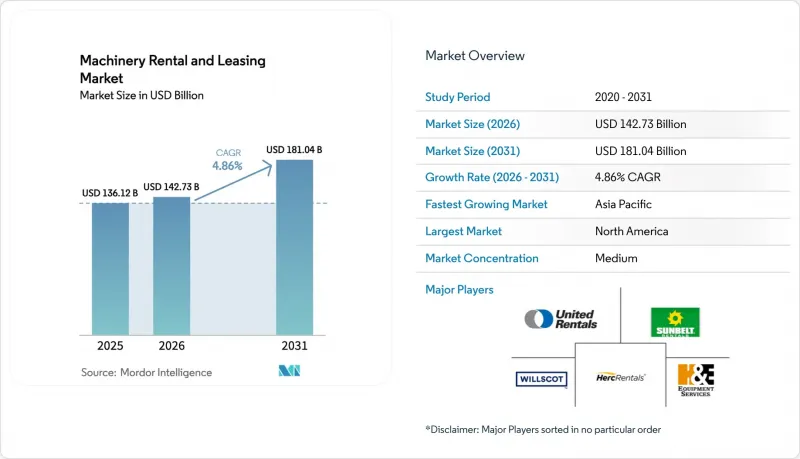
This report is Segmented by Service Type (Rental and Leasing), Equipment Type (Construction Equipment and More), Customer Type (Small and Medium Enterprises and More), Mode of Rental (Online and Offline), and Geography (North America, South America, and More). The Market Forecasts are Provided in Terms of Value (USD).
Global Machinery Rental And Leasing Market Trends and Insights
Rise of Infrastructure Megaprojects Drives Equipment Demand
A federal investment package in the United States and a climate transition program across the European Union extend equipment orders well into the next decade. China's Belt and Road Initiative, attracting massive revenue in cumulative capital, deepens rental penetration across Southeast and Central Asia. Rental fleets absorb project-specific demand spikes more efficiently than owner-operators because specialized machinery can be redeployed at the project closeout stage. Contractors in California, Texas, and Florida tap rental agreements to execute in state-level road and bridge projects scheduled for completion by 2028 . High utilization in megaproject corridors strengthens pricing power for fleet operators and reinforces the equipment-as-a-service narrative that pairs availability with guaranteed uptime.
High Equipment Ownership Cost Accelerates Rent-Versus-Buy Decisions
Since 2022, prices for new earth-moving and lifting machinery have significantly increased. This spike is largely attributed to rising costs in steel, electronics, and freight, which have inflated OEM material bills. Concurrently, parts shortages have driven maintenance expenses higher each year. This trend is eroding the profitability of low utilization rates, a norm in cyclical construction. Rental contracts have become a strategic move, allowing fleet operators to sidestep risks associated with technology obsolescence and capital lock-in. These operators frequently refresh their assets on a large scale. Instead of making substantial investments in single units, contractors are now opting for rentals. This shift grants them immediate access to cutting-edge electric and autonomous models, all integrated with IoT diagnostics. Consequently, there's been a notable increase in rental penetration, especially among midsize builders and specialty trades, who are navigating tight project-cycle milestones.
Persistent Supply-Chain Volatility Inflates Fleet Acquisition Costs
OEM lead times have significantly increased due to shortages in steel, microchips, and hydraulic components. As a result, invoice prices have risen considerably compared to previous levels. Rental companies are delaying fleet refresh cycles, causing machines to age beyond their optimal reliability. While operators are trying to mitigate rising maintenance costs through rate adjustments, the competitive market limits the extent of recovery. Some operators are adopting strategies such as placing bulk orders or diversifying their supplier base in regions like India and Mexico, but freight bottlenecks are reducing the effectiveness of these measures. Despite strong demand indicators, these challenges are putting pressure on profit margins and delaying expansion into new geographic areas.
Other drivers and restraints analyzed in the detailed report include:
- SME Demand for Short-Cycle Capex Flexibility Intensifies
- Digital Platforms Transform Customer Acquisition and Fleet Optimization
- Rising Interest Rates Increase Fleet Financing Expenses
For complete list of drivers and restraints, kindly check the Table Of Contents.
Segment Analysis
The machinery rental and leasing market size attributed to rental services was fairly high in 2024. Rental keeps leadership because contractors value the short-term alignment of payments with project cash flows, also accounting for 72.88% market share in 2025. High churn fleets enable providers to redeploy assets regionally, which sustains high utilization and supports consistent returns even when construction cycles soften.
Leasing gains traction, generating an exponential growth by 2031, with a CAGR of 5.06% through 2031, as manufacturers, energy companies, and logistics operators lock in multi-year equipment access under predictable cost structures. Accounting rule changes that place operating leases on balance sheets no longer sway the rent-versus-lease decision as strongly, shifting selection criteria toward uptime guarantees, technology refresh provisions, and embedded maintenance. Hybrid Equipment-as-a-Service contracts blur legacy boundaries by fusing rental flexibility with the multiyear continuity inherent in leasing.
Construction equipment accounted for 40.76% of global revenue in 2025. Fleet providers stock excavators, aerial work platforms, and tower cranes aligned to public-works timetables in the United States and Europe.
Nevertheless, material-handling equipment revenue is set to grow significantly by 2031 due to e-commerce fulfillment expansion. The segment's 5.08% CAGR reflects warehouse automation rollouts where robotic pallet movers and telescopic handlers are essential yet episodically utilized, making rental the rational choice. Logistic center saturation across the Midwest United States and coastal China sustains steady month-to-month utilization, smoothing seasonal peaks often seen in construction.
Complete Report Scope:
- By Service Type
- Rental
- Leasing
- By Equipment Type
- Construction Equipment
- Industrial Equipment
- Agricultural Equipment
- Material Handling Equipment
- By Customer Type
- Small and Medium Enterprises (SMEs)
- Large Corporations
- Government Agencies
- Individual Users
- By Mode of Rental
- Online
- Offline
- By Geography
- North America
- United States
- Canada
- Rest of North America
- South America
- Brazil
- Argentina
- Rest of South America
- Europe
- Germany
- United Kingdom
- France
- Italy
- Spain
- Russia
- Rest of Europe
- Asia Pacific
- China
- India
- Japan
- South Korea
- Rest of Asia Pacific
- Middle East and Africa
- United Arab Emirates
- Saudi Arabia
- South Africa
- Turkey
- Rest of Middle East and Africa
- North America
Geography Analysis
North America contributed significantly to global revenue in 2025, representing 35.21% of the machinery rental and leasing market. Sustained federal infrastructure disbursements and private housing refurbishments underpin robust utilization. United Rentals alone recorded vast rental revenue, anchoring capacity expansion and setting regional rate benchmarks. Canada's resource extraction rebound adds steady demand for earth-moving equipment, particularly in Alberta oil sands and British Columbia mining operations.
Asia-Pacific will expand exponentially by 2031, with a 5.03% CAGR. China's domestic rental turnover grew significantly in 2024, propelled by Belt and Road logistics construction and rapid urban redevelopment of tier-two cities. India's National Infrastructure Pipeline targets roads, airports, and metro rail through 2030, elevating demand for cranes, concrete pumps, and compaction machinery. ASEAN member states also invest in port and renewable projects that lean on rental fleets for specialized lifting and piling equipment .
Europe generated a massive revenue in 2024 with stable, policy-driven growth. The EU Green Deal funnels funds into offshore wind foundations, grid modernization, and hydrogen pilot plants, each requiring bespoke lifting and on-site power solutions that favor rental over ownership. Stricter carbon disclosure rules encourage fleet operators to adopt electric mini excavators that can be rotated across multiple users, spreading the premium acquisition cost while meeting urban emission caps.
- United Rentals Inc.
- Ashtead Group plc (Sunbelt Rentals)
- Herc Holdings Inc. (Herc Rentals)
- H&E Equipment Services Inc.
- WillScot Mobile Mini Holdings Corp.
- Ahern Rentals
- Aggreko plc
- Maxim Crane Works
- Caterpillar (The Cat Rental Store)
- Finning International
- Kiloutou SAS
- Loxam Group
- Aktio Corporation
- Kanamoto Co., Ltd.
- Byrne Equipment Rental
- Coates Hire
- EquipmentShare
- BigRentz Inc.
- Custom Truck One Source Inc.
- Alta Equipment Group Inc.
- McGrath Rentcorp
- Sunstate Equipment Co.
- Speedy Hire plc
- United Equipment Hire (NZ)
Additional Benefits:
- The market estimate (ME) sheet in Excel format
- 3 months of analyst support
TABLE OF CONTENTS
1 Introduction
- 1.1 Study Assumptions and Market Definition
- 1.2 Scope of the Study
2 Research Methodology
3 Executive Summary
4 Market Landscape
- 4.1 Market Overview
- 4.2 Market Drivers
- 4.2.1 Rise of Infrastructure Megaprojects (IIJA, EU Green Deal, Belt-And-Road)
- 4.2.2 High Equipment Ownership Cost Drives Rent-Vs-Buy Shift
- 4.2.3 Surging Demand for Short-Cycle Capex Flexibility Among SMEs
- 4.2.4 Digital Rental Platforms Expanding Addressable Customer Base
- 4.2.5 Equipment-As-A-Service (EAAS) Bundling Maintenance and Analytics
- 4.2.6 ESG Pressure to Optimize Utilization and Lower Scope-3 Emissions
- 4.3 Market Restraints
- 4.3.1 Persistent Supply-Chain Volatility Inflating Fleet Capex
- 4.3.2 Rising Interest Rates Lifting Financing Costs for Rental Fleets
- 4.3.3 Secondary Equipment Glut Depressing Residual Values
- 4.3.4 Data-Security and Cyber-Risk in Telematics-Heavy Fleets
- 4.4 Value / Supply-Chain Analysis
- 4.5 Regulatory Landscape
- 4.6 Technological Outlook
- 4.7 Porter's Five Forces
- 4.7.1 Threat of New Entrants
- 4.7.2 Bargaining Power of Buyers
- 4.7.3 Bargaining Power of Suppliers
- 4.7.4 Threat of Substitutes
- 4.7.5 Competitive Rivalry
5 Market Size and Growth Forecasts (Value (USD))
- 5.1 By Service Type
- 5.1.1 Rental
- 5.1.2 Leasing
- 5.2 By Equipment Type
- 5.2.1 Construction Equipment
- 5.2.2 Industrial Equipment
- 5.2.3 Agricultural Equipment
- 5.2.4 Material Handling Equipment
- 5.3 By Customer Type
- 5.3.1 Small and Medium Enterprises (SMEs)
- 5.3.2 Large Corporations
- 5.3.3 Government Agencies
- 5.3.4 Individual Users
- 5.4 By Mode of Rental
- 5.4.1 Online
- 5.4.2 Offline
- 5.5 By Geography
- 5.5.1 North America
- 5.5.1.1 United States
- 5.5.1.2 Canada
- 5.5.1.3 Rest of North America
- 5.5.2 South America
- 5.5.2.1 Brazil
- 5.5.2.2 Argentina
- 5.5.2.3 Rest of South America
- 5.5.3 Europe
- 5.5.3.1 Germany
- 5.5.3.2 United Kingdom
- 5.5.3.3 France
- 5.5.3.4 Italy
- 5.5.3.5 Spain
- 5.5.3.6 Russia
- 5.5.3.7 Rest of Europe
- 5.5.4 Asia Pacific
- 5.5.4.1 China
- 5.5.4.2 India
- 5.5.4.3 Japan
- 5.5.4.4 South Korea
- 5.5.4.5 Rest of Asia Pacific
- 5.5.5 Middle East and Africa
- 5.5.5.1 United Arab Emirates
- 5.5.5.2 Saudi Arabia
- 5.5.5.3 South Africa
- 5.5.5.4 Turkey
- 5.5.5.5 Rest of Middle East and Africa
- 5.5.1 North America
6 Competitive Landscape
- 6.1 Market Concentration
- 6.2 Strategic Moves
- 6.3 Market Share Analysis
- 6.4 Company Profiles (Includes Global Level Overview, Market Level Overview, Core Segments, Financials as Available, Strategic Information, Market Rank/Share for Key Companies, Products and Services, SWOT Analysis, and Recent Developments)
- 6.4.1 United Rentals Inc.
- 6.4.2 Ashtead Group plc (Sunbelt Rentals)
- 6.4.3 Herc Holdings Inc. (Herc Rentals)
- 6.4.4 H&E Equipment Services Inc.
- 6.4.5 WillScot Mobile Mini Holdings Corp.
- 6.4.6 Ahern Rentals
- 6.4.7 Aggreko plc
- 6.4.8 Maxim Crane Works
- 6.4.9 Caterpillar (The Cat Rental Store)
- 6.4.10 Finning International
- 6.4.11 Kiloutou SAS
- 6.4.12 Loxam Group
- 6.4.13 Aktio Corporation
- 6.4.14 Kanamoto Co., Ltd.
- 6.4.15 Byrne Equipment Rental
- 6.4.16 Coates Hire
- 6.4.17 EquipmentShare
- 6.4.18 BigRentz Inc.
- 6.4.19 Custom Truck One Source Inc.
- 6.4.20 Alta Equipment Group Inc.
- 6.4.21 McGrath Rentcorp
- 6.4.22 Sunstate Equipment Co.
- 6.4.23 Speedy Hire plc
- 6.4.24 United Equipment Hire (NZ)
7 Market Opportunities & Future Outlook
- 7.1 White-space & Unmet-Need Assessment

