PUBLISHER: Mordor Intelligence | PRODUCT CODE: 2119604

PUBLISHER: Mordor Intelligence | PRODUCT CODE: 2119604
Artificial Intelligence In Ultrasound Imaging - Market Share Analysis, Industry Trends & Statistics, Growth Forecasts (2026 - 2031)
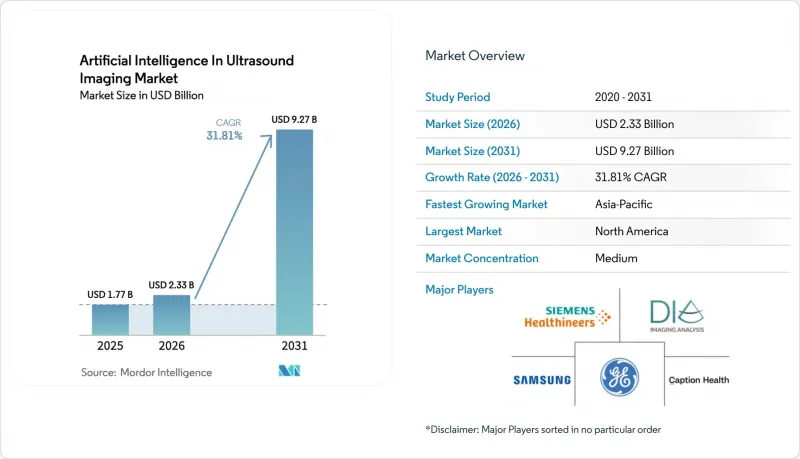
According to Mordor Intelligence, the AI in ultrasound imaging market size in 2026 is estimated at USD 2.33 billion, growing from 2025 value of USD 1.77 billion with 2031 projections showing USD 9.27 billion, growing at 31.81% CAGR over 2026-2031.
This report Segments the Industry Into by Solution (Hardware, Software, Services), by Technology (Machine Learning, and More), by Device Type (Cart, Compact, and More), by Imaging Type (2D, and More), by Application (Cardiology, and More), by End Users (Hospitals, Diagnostic Centers, and More), and Geography. The Market Sizes and Forecasts are Provided in Terms of Value (USD).
Global Artificial Intelligence In Ultrasound Imaging Market Trends and Insights
Rise in Chronic Diseases & Aging Population
Cardiovascular conditions remain the leading global cause of mortality, while diabetes prevalence is climbing in developing economies . These demographics create permanent demand for imaging that can be performed outside tertiary centers. AI-guided ultrasound lets non-specialists conduct diagnostic-grade scans, multiplying capacity without a proportional increase in radiologists. Chronic-disease pathways benefit because longitudinal monitoring becomes feasible at the bedside, improving adherence to value-based-care metrics and generating recurring software revenue for vendors.
Radiologist Workload Pressures & Staffing Shortages
Imaging volumes outstrip workforce growth. The American College of Radiology cites persistent staffing gaps across rural and urban hospitals . Sonographers are retiring at 60.8 years on average, earlier than the general labor forc. AI reduces interpretation time by automating measurements and triaging normal studies, freeing experts for complex tasks. Emergency departments benefit first, where delays directly affect outcomes.
High Procurement & Maintenance Costs
Budget constraints remain the top adoption barrier, particularly for independent clinics. Department heads cite funding gaps despite proven efficacy. Total cost of ownership spans cloud compute fees, license renewals, and staff training. Nonetheless, cross-modality platforms show 451% five-year ROI once scaled across CT, MRI, and ultrasound, and vendors now offer subscription or outcome-linked pricing to soften upfront hits.
Other drivers and restraints analyzed in the detailed report include:
- Government Incentives & Funding for AI Health Tech
- Rapid POCUS Adoption with Integrated AI
- Mounting Data-Privacy and Cybersecurity Concerns
For complete list of drivers and restraints, kindly check the Table Of Contents.
Segment Analysis
Software accounted for 54.67% of the AI in ultrasound imaging market share in 2025. Vendors focus on interoperable algorithms that sit on legacy probes, minimizing capital expenditure. The services line, growing at 33.18% CAGR, reflects rising demand for workflow integration, user training, and algorithm-performance optimization. Health systems seek proof that deployment improves throughput and revenue capture, shifting negotiations toward outcome-based contracts. Meanwhile, hardware makers embed on-device AI accelerators to reduce latency, yet buyers still gravitate to software-first stacks that remain brand-agnostic.
Over the forecast horizon, the AI in ultrasound imaging market will see layered platform ecosystems. Market leaders have opened software development kits that let third parties release specialty plug-ins. Butterfly Network's Garden AI program exemplifies this move, encouraging cardiovascular, obstetric, and liver-disease modules on a single handheld chassis. Services revenue rises in parallel because each algorithm iteration requires continuous validation, reporting, and clinician retraining.
Machine-learning models held 42.74% revenue in 2025 thanks to proven gains in automated ejection-fraction measurement and nodule detection. Context-aware computing, projected to grow 33.05% CAGR, builds on this foundation by interpreting ambient data such as patient vitals and provider workflow, then tailoring real-time cues. Natural-language processing adds dictation and auto-reporting, reducing paperwork load, while advanced computer vision handles 3-D reconstructions in labor-intensive specialties.
Context-aware engines resonate strongly in emergency rooms where triage speed is critical. AI cues adapt to trauma protocols, highlighting free fluid in the abdomen during FAST exams. Such specificity pushes adoption deeper into critical-care pathways and expands the overall AI in ultrasound imaging market. Vendors combining multiple modalities-vision, NLP, and signal processing-create high switching costs, an essential moat as more entrants crowd the space.
Complete Report Scope:
- By Solution
- Hardware
- Software
- Services
- By Technology
- Machine Learning
- Natural Language Processing
- Computer Vision
- Context-Aware Computing
- Other Technologies
- By Device Type
- Cart / Trolley-based
- Compact / Laptop
- Handheld / Probe-based
- Wearable & Patch Ultrasound
- By Imaging Mode
- 2-D
- Doppler & Color Flow
- 3-D / 4-D & Volumetric
- Elastography
- Contrast-Enhanced Ultrasound
- By Application
- Cardiology (Echocardiography)
- Obstetrics & Gynecology
- Gastroenterology / Hepatology
- Musculoskeletal & Sports Medicine
- Oncology
- Other Applications
- By End User
- Hospitals
- Diagnostic Imaging Centers
- Ambulatory & Physician Clinics
- Point-of-Care Settings (ICU, ED)
- Home-care Ecosystem
- By Geography
- North America
- United States
- Canada
- Mexico
- Europe
- Germany
- United Kingdom
- France
- Italy
- Spain
- Rest of Europe
- Asia-Pacific
- China
- Japan
- India
- South Korea
- Australia
- Rest of Asia-Pacific
- Middle East
- GCC
- South Africa
- Rest of Middle East
- South America
- Brazil
- Argentina
- Rest of South America
- North America
Geography Analysis
North America retained 47.62% share in 2025, bolstered by CMS reimbursement for AI echocardiography and a streamlined FDA approval framework. Leading health systems bundle AI ultrasound into cardiovascular centers of excellence, emphasizing outcome-based purchasing. Venture capital flows remain strong, but workforce shortages sustain the need for automation, thereby reinforcing future capital spending.
Asia-Pacific is the fastest-growing block with a 33.74% CAGR outlook. China's Healthy China 2030 plan and India's Ayushman Bharat initiative earmark funds for maternal-fetal diagnostics, while South Korea offers R&D tax credits for local AI developers. Cross-border partnerships, such as UltraSight's alliance with SELVAS Healthcare to distribute cardiac AI throughout Southeast Asia, exemplify go-to-market tactics that marry international algorithms with local channel expertise.
Europe pursues measured expansion rooted in ethical governance. The AI Act's risk-classification scheme compels vendors to document datasets and bias-mitigation efforts, but it also gives health systems confidence to procure at scale. Germany and the Nordic countries champion national ultrasound registries that feed back into AI model retraining, forming a virtuous cycle of quality assurance. Collectively, these trends consolidate the AI in ultrasound imaging market across advanced and emerging economies alike.
- Siemens Healthineers
- GE Healthcare
- Koninklijke Philips
- Samsung Group
- Butterfly Network Inc.
- Qure.ai
- DiA Imaging Analysis
- Exo Imaging (Medo)
- Caption Health (GE)
- EchoNous Inc.
- Clarius Mobile Health
- Ultromics
- Sonio
- Viz.ai
- Aidoc
- RapidAI
- Riverain Technologies
- DeepSight Technology
- DESKi
- Ultrasound AI Inc.
- EchoPixel
Additional Benefits:
- The market estimate (ME) sheet in Excel format
- 3 months of analyst support
TABLE OF CONTENTS
1 Introduction
- 1.1 Study Assumptions & Market Definition
- 1.2 Scope of the Study
2 Research Methodology
3 Executive Summary
4 Market Landscape
- 4.1 Market Overview
- 4.2 Market Drivers
- 4.2.1 Rise in chronic diseases & aging population
- 4.2.2 Radiologist workload pressures & staffing shortages
- 4.2.3 Government incentives & funding for AI health tech
- 4.2.4 Rapid POCUS adoption with integrated AI
- 4.2.5 CMS reimbursement codes for AI echocardiography software
- 4.2.6 Cloud-native AI platforms enabling tele-ultrasound in LMICs
- 4.3 Market Restraints
- 4.3.1 High procurement & maintenance costs
- 4.3.2 Mounting data-privacy and cybersecurity concerns
- 4.3.3 Clinician skepticism & training gaps
- 4.3.4 Regulatory ambiguity for AI-guided home ultrasound
- 4.4 Value / Supply-Chain Analysis
- 4.5 Regulatory Landscape
- 4.6 Technological Outlook
- 4.7 Porter's Five Forces Analysis
- 4.7.1 Threat of New Entrants
- 4.7.2 Bargaining Power of Buyers
- 4.7.3 Bargaining Power of Suppliers
- 4.7.4 Threat of Substitutes
- 4.7.5 Intensity of Competitive Rivalry
5 Market Size & Growth Forecasts (Value)
- 5.1 By Solution
- 5.1.1 Hardware
- 5.1.2 Software
- 5.1.3 Services
- 5.2 By Technology
- 5.2.1 Machine Learning
- 5.2.2 Natural Language Processing
- 5.2.3 Computer Vision
- 5.2.4 Context-Aware Computing
- 5.2.5 Other Technologies
- 5.3 By Device Type
- 5.3.1 Cart / Trolley-based
- 5.3.2 Compact / Laptop
- 5.3.3 Handheld / Probe-based
- 5.3.4 Wearable & Patch Ultrasound
- 5.4 By Imaging Mode
- 5.4.1 2-D
- 5.4.2 Doppler & Color Flow
- 5.4.3 3-D / 4-D & Volumetric
- 5.4.4 Elastography
- 5.4.5 Contrast-Enhanced Ultrasound
- 5.5 By Application
- 5.5.1 Cardiology (Echocardiography)
- 5.5.2 Obstetrics & Gynecology
- 5.5.3 Gastroenterology / Hepatology
- 5.5.4 Musculoskeletal & Sports Medicine
- 5.5.5 Oncology
- 5.5.6 Other Applications
- 5.6 By End User
- 5.6.1 Hospitals
- 5.6.2 Diagnostic Imaging Centers
- 5.6.3 Ambulatory & Physician Clinics
- 5.6.4 Point-of-Care Settings (ICU, ED)
- 5.6.5 Home-care Ecosystem
- 5.7 By Geography
- 5.7.1 North America
- 5.7.1.1 United States
- 5.7.1.2 Canada
- 5.7.1.3 Mexico
- 5.7.2 Europe
- 5.7.2.1 Germany
- 5.7.2.2 United Kingdom
- 5.7.2.3 France
- 5.7.2.4 Italy
- 5.7.2.5 Spain
- 5.7.2.6 Rest of Europe
- 5.7.3 Asia-Pacific
- 5.7.3.1 China
- 5.7.3.2 Japan
- 5.7.3.3 India
- 5.7.3.4 South Korea
- 5.7.3.5 Australia
- 5.7.3.6 Rest of Asia-Pacific
- 5.7.4 Middle East
- 5.7.4.1 GCC
- 5.7.4.2 South Africa
- 5.7.4.3 Rest of Middle East
- 5.7.5 South America
- 5.7.5.1 Brazil
- 5.7.5.2 Argentina
- 5.7.5.3 Rest of South America
- 5.7.1 North America
6 Competitive Landscape
- 6.1 Market Concentration
- 6.2 Market Share Analysis
- 6.3 Company Profiles (includes Global level Overview, Market level overview, Core Segments, Financials as available, Strategic Information, Market Rank/Share for key companies, Products & Services, and Recent Developments)
- 6.3.1 Siemens Healthineers
- 6.3.2 GE HealthCare
- 6.3.3 Koninklijke Philips N.V.
- 6.3.4 Samsung Medison
- 6.3.5 Butterfly Network Inc.
- 6.3.6 Qure.ai
- 6.3.7 DiA Imaging Analysis
- 6.3.8 Exo Imaging (Medo)
- 6.3.9 Caption Health (GE)
- 6.3.10 EchoNous Inc.
- 6.3.11 Clarius Mobile Health
- 6.3.12 Ultromics
- 6.3.13 Sonio
- 6.3.14 Viz.ai
- 6.3.15 Aidoc
- 6.3.16 RapidAI
- 6.3.17 Riverain Technologies
- 6.3.18 DeepSight Technology
- 6.3.19 DESKi
- 6.3.20 Ultrasound AI Inc.
- 6.3.21 EchoPixel
7 Market Opportunities & Future Outlook
- 7.1 White-space & Unmet-Need Assessment

