PUBLISHER: Mordor Intelligence | PRODUCT CODE: 2119607

PUBLISHER: Mordor Intelligence | PRODUCT CODE: 2119607
Preclinical CRO - Market Share Analysis, Industry Trends & Statistics, Growth Forecasts (2026 - 2031)
According to Mordor Intelligence, the preclinical CRO market size is estimated at USD 8.20 billion in 2026, and is expected to reach USD 11.74 billion by 2031, at a CAGR of 7.45% during the forecast period (2026-2031).
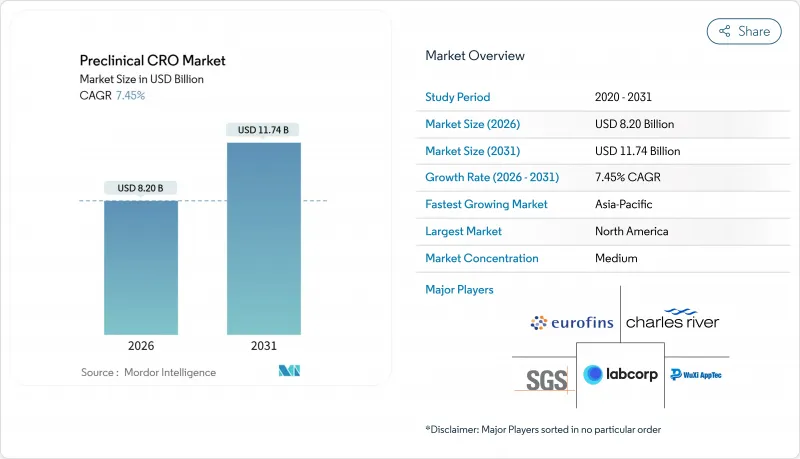
This report is Segmented by Service (Toxicology Testing, Bioanalysis & DMPK Studies, Safety Pharmacology, and Other Services), Mode Type (Patient Derived Organoid (PDOs) Models, Patient-Derived Xenograft (PDX) Models, and In-Silico / AI-Driven Models), End Users (Biopharma & Pharma Companies, and More), and Geography (North America, and More). The Market Forecasts are Provided in Terms of Value (USD).
Global Preclinical CRO Market Trends and Insights
Increasing R&D Expenditure in Drug Discovery
Pharmaceutical R&D budgets soared in 2025, with Pfizer committing USD 10.7-11.7 billion yet shuttering internal toxicology labs to redirect spending toward digital pathology capabilities. CROs absorbed 35-40% of toxicology workflows as oncology and rare-disease sponsors pursued episodic preclinical packages rather than maintaining fixed in-house capacity. NIH extramural funding reached USD 22.3 billion, with 18% earmarked for IND-enabling research that necessitates GLP-compliant endpoints from external partners. Small biotechs filed 62% of U.S. INDs in 2024, further insulating the preclinical CRO market from downturns in large-pharma pipelines. The resulting demand shift has strengthened CRO bargaining power on pricing and schedule priority.
Expansion of Preclinical Pipelines
More than 8,200 active preclinical programs were in play during 2025, including 1,450 cell and gene therapy candidates, up 22% from 2023. EMA's revised ATMP guideline now mandates two-species vector shedding studies, effectively doubling workloads for gene-therapy CRO groups. GLP-1 receptor agonists and APOE4-targeted drugs added 340 new pipeline entries, each requiring multi-species toxicology and CNS penetration assays. Chinese sponsors alone initiated 1,100 programs and are partnering with Western CROs to secure dual-market data packages, creating back-to-back study requests for the same compound series. The broadened pipeline has compressed GLP capacity, prompting CROs to fast-track facility expansions.
Lack of Standardization and Data Interoperability
SEND validation errors affected 38% of 2024 IND submissions, forcing resubmissions and adding 30-60 days to FDA review times. Proprietary LIMS platforms hinder data merging across CRO partners, imposing 15-20% budget overruns on sponsors who must reconcile histopathology and clinical pathology datasets manually. Only 12 of the top 20 CROs joined Pistoia Alliance's FAIR Preclinical Data initiative by mid-2026, prolonging metadata fragmentation. Consolidation to preferred-provider panels has therefore intensified as sponsors aim to contain integration overhead.
Other drivers and restraints analyzed in the detailed report include:
- Cost and Time Efficiency from Outsourcing
- Adoption of AI-Enabled In-Silico Models
- Stringent Regulatory and Animal-Welfare Compliance
For complete list of drivers and restraints, kindly check the Table Of Contents.
Segment Analysis
Toxicology testing delivered a 40.55% preclinical CRO market share in 2025, reflecting its obligatory role in IND-enabling packages under ICH M3(R2). Repeat-dose studies in two species remain standard, even as organ-on-chip tools displace some exploratory work. Safety pharmacology, however, is racing ahead at a 12.25% CAGR, buoyed by rising cardiovascular liability concerns and a surge in hERG channel and QT interval investigations. The preclinical CRO market size for safety pharmacology is forecast to double by 2031 as more sponsors run conscious telemetered dog studies for kinase inhibitors. Bioanalysis and DMPK remain pivotal for complex modalities such as antibody-drug conjugates, where intact antibody and payload quantification demand specialized LC-MS/MS expertise. Integrated "IND-Ready" bundles continue to gain traction, embedding formulation and DMPK services into fixed-price toxicology packages that simplify procurement for biopharma sponsors.
The rise of organ-on-chip platforms introduces hybrid workflows: sponsors screen multiple leads on microphysiological systems, advance the most promising into GLP studies, and reduce late attrition. The FDA-qualified Liver-Chip now replaces some exploratory hepatotoxicity studies, yet full animal packages remain mandatory for global filings, limiting immediate substitution potential. Genotoxicity work is partially shifting to in-silico QSAR, but regulators still insist on confirmatory Ames and micronucleus tests, preserving a stable revenue floor for wet-lab assays.
Complete Report Scope:
- By Service
- Toxicology Testing
- Bioanalysis & DMPK Studies
- Safety Pharmacology
- Other Services
- By Model Type
- Patient-Derived Organoid (PDO) Models
- Patient-Derived Xenograft (PDX) Models
- In-silico / AI-Driven Models
- By End User
- Biopharma & Pharma Companies
- Academic & Research Institutes
- Other End Users
- By Geography
- North America
- United States
- Canada
- Mexico
- Europe
- Germany
- United Kingdom
- France
- Italy
- Spain
- Rest of Europe
- Asia-Pacific
- China
- Japan
- India
- South Korea
- Australia
- Rest of Asia-Pacific
- Middle East & Africa
- GCC
- South Africa
- Rest of Middle East & Africa
- South America
- Brazil
- Argentina
- Rest of South America
- North America
Geography Analysis
North America accounted for 45.13% of 2025 revenue, buoyed by FDA proximity, AAALAC-certified infrastructure, and the ability to initiate studies within four to six weeks of contract signature. The region's dominance is reinforced by rapid ethical review processes compared with Europe, where stricter animal-use audits delay starts. Nonetheless, preclinical CRO market size in Asia-Pacific is forecast to climb at a 10.81% CAGR through 2031, reflecting China's duty-free import policies and India's alignment with ICH guidelines. WuXi AppTec expanded its Suzhou campus by 12,000 square meters in 2025, a move that allows more than 600 IND-ready studies annually for a global clientele.
Europe remains indispensable for large-animal cardiovascular pharmacology. Labcorp's acquisition of a U.K. facility added capacity for conscious telemetered dog studies, which often become rate-limiting for kinase inhibitor programs. South America and the Middle East & Africa sit at earlier adoption stages; however, Brazil's AAALAC-accredited Sao Paulo site, opened in 2025, signals nascent regional momentum.
Cross-border demand is reshaping site strategy. Many Western sponsors run exploratory work in Asia-Pacific for cost reasons but conduct pivotal GLP studies in North America or Europe to ease audits. This dual-sourcing model puts pressure on CROs to maintain consistent data standards across regions.
- Altasciences Company Inc.
- BioDuro-Sundia
- Charles River
- Crown Bioscience
- Envigo (part of Inotiv)
- Eurofins
- ICON
- Inotiv Inc.
- ITR Laboratories Canada Inc.
- LabCorp
- MedPace
- NorthEast BioAnalytical Laboratories LLC
- Parexel International
- PharmaLegacy Laboratories
- Pharmaron
- SGS
- Syngene International
- Thermo Fisher Scientific Inc. (PPD)
- WuXi App Tec
Additional Benefits:
- The market estimate (ME) sheet in Excel format
- 3 months of analyst support
TABLE OF CONTENTS
1 Introduction
- 1.1 Study Assumptions & Market Definition
- 1.2 Scope of the Study
2 Research Methodology
3 Executive Summary
4 Market Landscape
- 4.1 Market Overview
- 4.2 Market Drivers
- 4.2.1 Increasing R&D expenditure in drug discovery
- 4.2.2 Expansion of preclinical pipelines
- 4.2.3 Cost & time efficiency from outsourcing
- 4.2.4 Adoption of AI-enabled in-silico models
- 4.2.5 Demand for CRO capabilities in advanced therapies
- 4.3 Market Restraints
- 4.3.1 Lack of standardization & data interoperability
- 4.3.2 Stringent regulatory & animal-welfare compliance
- 4.3.3 Shortage of skilled in-vivo pharmacology talent
- 4.4 Regulatory Landscape
- 4.5 Technological Outlook
- 4.6 Porter's Five Forces
- 4.6.1 Threat of New Entrants
- 4.6.2 Bargaining Power of Buyers
- 4.6.3 Bargaining Power of Suppliers
- 4.6.4 Threat of Substitutes
- 4.6.5 Industry Rivalry
5 Market Size & Growth Forecasts (Value, USD)
- 5.1 By Service
- 5.1.1 Toxicology Testing
- 5.1.2 Bioanalysis & DMPK Studies
- 5.1.3 Safety Pharmacology
- 5.1.4 Other Services
- 5.2 By Model Type
- 5.2.1 Patient-Derived Organoid (PDO) Models
- 5.2.2 Patient-Derived Xenograft (PDX) Models
- 5.2.3 In-silico / AI-Driven Models
- 5.3 By End User
- 5.3.1 Biopharma & Pharma Companies
- 5.3.2 Academic & Research Institutes
- 5.3.3 Other End Users
- 5.4 By Geography
- 5.4.1 North America
- 5.4.1.1 United States
- 5.4.1.2 Canada
- 5.4.1.3 Mexico
- 5.4.2 Europe
- 5.4.2.1 Germany
- 5.4.2.2 United Kingdom
- 5.4.2.3 France
- 5.4.2.4 Italy
- 5.4.2.5 Spain
- 5.4.2.6 Rest of Europe
- 5.4.3 Asia-Pacific
- 5.4.3.1 China
- 5.4.3.2 Japan
- 5.4.3.3 India
- 5.4.3.4 South Korea
- 5.4.3.5 Australia
- 5.4.3.6 Rest of Asia-Pacific
- 5.4.4 Middle East & Africa
- 5.4.4.1 GCC
- 5.4.4.2 South Africa
- 5.4.4.3 Rest of Middle East & Africa
- 5.4.5 South America
- 5.4.5.1 Brazil
- 5.4.5.2 Argentina
- 5.4.5.3 Rest of South America
- 5.4.1 North America
6 Competitive Landscape
- 6.1 Market Concentration
- 6.2 Market Share Analysis
- 6.3 Company Profiles (includes Global level Overview, Market level overview, Core Segments, Financials as available, Strategic Information, Market Rank/Share for key companies, Products & Services, and Recent Developments)
- 6.3.1 Altasciences Company Inc.
- 6.3.2 BioDuro-Sundia
- 6.3.3 Charles River Laboratories
- 6.3.4 Crown Bioscience Inc.
- 6.3.5 Envigo (part of Inotiv)
- 6.3.6 Eurofins Scientific
- 6.3.7 ICON plc
- 6.3.8 Inotiv Inc.
- 6.3.9 ITR Laboratories Canada Inc.
- 6.3.10 Labcorp Drug Development (Covance)
- 6.3.11 Medpace Holdings Inc.
- 6.3.12 NorthEast BioAnalytical Laboratories LLC
- 6.3.13 Parexel International Corporation
- 6.3.14 PharmaLegacy Laboratories
- 6.3.15 Pharmaron
- 6.3.16 SGS SA
- 6.3.17 Syngene International
- 6.3.18 Thermo Fisher Scientific Inc. (PPD)
- 6.3.19 WuXi AppTec
7 Market Opportunities & Future Outlook
- 7.1 White-space & Unmet-need Assessment

