PUBLISHER: Mordor Intelligence | PRODUCT CODE: 2119621

PUBLISHER: Mordor Intelligence | PRODUCT CODE: 2119621
Europe Ventilation Equipment - Market Share Analysis, Industry Trends & Statistics, Growth Forecasts (2026 - 2031)
According to Mordor Intelligence, the Europe ventilation equipment market size is expected to grow from USD 5.28 billion in 2025 to USD 5.59 billion in 2026 and is forecast to reach USD 7.43 billion by 2031 at 5.86% CAGR over 2026-2031.
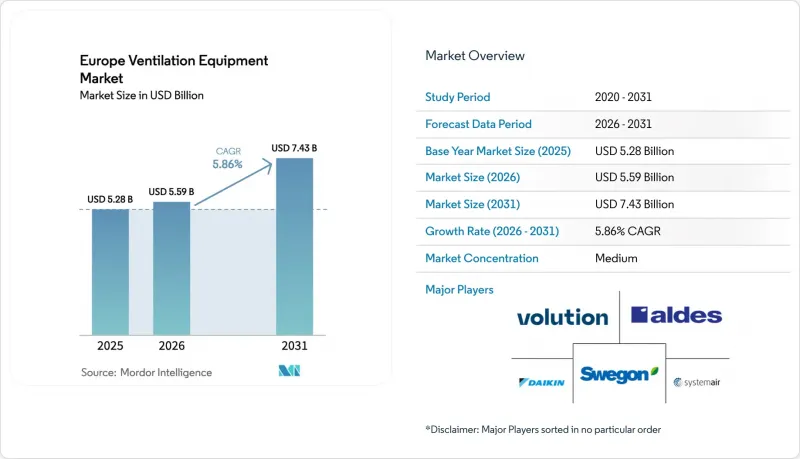
This report is Segmented by Equipment Type (Supply/Exhaust Ventilation Systems, Balanced HRV/ERV Units, and More), Ventilation Mechanism (Centralised Ducted Systems, and More), Technology (HRV, ERV, and More), End-User Industry (Residential Buildings, and More), Application Area (Living and Sleeping Spaces, Wet Rooms, and More), and Country. The Market Forecasts are Provided in Terms of Value (USD).
Europe Ventilation Equipment Market Trends and Insights
Tightening EPBD-Mandated Energy-Efficiency Standards
The revised EPBD requires nearly zero-energy buildings from 2030, obliging designers to specify mechanical ventilation with heat-recovery efficiencies >=75%. Germany enforces the rule aggressively, with federal states mandating heat-recovery systems in multifamily projects exceeding four units. Renovation-wave provisions that target a 3% annual performance gain favor decentralized MVHR units, which avoid intrusive ductwork modifications. Compliance with EN 15251 and ISO 16814 supports uptake of balanced HRV/ERV equipment capable of documenting energy savings for regulatory reporting. As a result, the European ventilation equipment market is pivoting toward high-efficiency units across both residential and commercial segments.
Post-COVID Focus on Indoor Air Quality in Workplaces
Updated ECDC guidance raises minimum ventilation rates to 10 L/s-person, prompting capacity upgrades in existing offices. Large German employers such as SAP and Siemens have added variable-air-volume systems connected to occupancy sensors, valuing real-time air-quality data over pure energy metrics. IoT-integrated ventilation that reports particulate, CO2, and humidity levels is becoming standard rather than premium. Suppliers that bundle analytics dashboards with equipment gain preference, reinforcing digitization across the European ventilation equipment market.
Shortage of Certified Installers and Commissioning Engineers
The sector lacks roughly 40,000 qualified technicians, extending project schedules by eight weeks on average and raising installed costs by 25-30%. Germany experiences the deepest gap, but shortages are visible across Northern Europe. Complex HRV balancing and digital commissioning require specialist skills that current training pipelines cannot supply. Manufacturers respond with plug-and-play units and remote-commissioning apps, yet the constraint continues to moderate growth in the European ventilation equipment market.
Other drivers and restraints analyzed in the detailed report include:
- Electrification Driving Heat-Recovery Ventilation Demand
- Rapid Retrofit Wave for Mould Mitigation in Social Housing
- Volatile Raw-Material Prices Inflating Fan/Motor Costs
For complete list of drivers and restraints, kindly check the Table Of Contents.
Segment Analysis
Balanced HRV/ERV units accounted for 46.25% of the European ventilation equipment market size in 2025 as EPBD compliance drove adoption across construction and retrofit. Range/cooker hoods are projected to grow at a 7.22% CAGR, spurred by kitchen upgrades and expanding hospitality footprints.
Strong policy alignment means HRV/ERV will continue to anchor product mixes, with Daikin's 2024 purchase of Robert Heath adding technical depth to its portfolio. Unidirectional fans remain indispensable for directional airflow in data centers, while supply/exhaust systems sustain industrial demand. These trends reinforce value migration toward energy-recovery technologies within the European ventilation equipment market.
Centralized ducted systems captured a 55.15% share of the European ventilation equipment market size in 2025, mainly in new commercial builds. Hybrid mixed-mode ventilation is set to expand at a 6.88% CAGR as building-management software optimizes between natural and mechanical modes under EN 16798 guidelines.
Operators prioritize flexibility; hybrid solutions cut energy use in mild seasons yet uphold IAQ during high occupancy. Decentralized units thrive in historic or social-housing retrofits where ducts are impractical. Together, these patterns diversify channel demand and support the sustained expansion of the European ventilation equipment market.
Complete Report Scope:
- By Equipment Type
- Supply/Exhaust Ventilation Systems
- Balanced HRV/ERV Units
- Unidirectional Fans (Axial, Centrifugal, Roof)
- Range/Cooker Hoods
- By Ventilation Mechanism
- Centralised Ducted Systems
- Decentralised Room Units
- Hybrid (Mixed-Mode) Solutions
- By Technology
- Heat-Recovery Ventilation (HRV)
- Energy-Recovery Ventilation (ERV)
- Positive-Input Ventilation (PIV)
- Mechanical Extract Ventilation (MEV)
- By End-User Industry
- Residential Buildings
- Commercial and Institutional Buildings
- Industrial Facilities
- Agriculture and Controlled-Environment
- By Application Area
- Living and Sleeping Spaces
- Wet Rooms (Kitchens, Bathrooms)
- Process/Clean-Room and Data Centres
- Greenhouses and Livestock Housing
- By Country
- Germany
- United Kingdom
- France
- Italy
- Spain
- Netherlands
- Belgium
- Rest of Europe
List of Companies Covered in this Report:
- Systemair AB
- Volution Group plc
- Aldes Aeraulique S.A.
- Daikin Industries Ltd.
- Swegon AB
- FlaktGroup Holding GmbH
- TROX GmbH
- Helios Ventilatoren GmbH + Co KG
- Zehnder Group AG
- Lindab International AB
- Soler and Palau Sistemas de Ventilacion S.L.U.
- Rosenberg Ventilatoren GmbH
- Blauberg Ventilatoren GmbH
- Nuaire Ltd.
- Dantherm Group A/S
- Brink Climate Systems B.V.
- Vostermans Ventilation B.V.
- KCVENTS Industrial Ventilation Co., Ltd.
- Vent-Axia Ltd.
- VENTS Joint-Stock Company
- Airbox Lufttechnik GmbH
- EXHAUSTO A/S
Additional Benefits:
- The market estimate (ME) sheet in Excel format
- 3 months of analyst support
TABLE OF CONTENTS
1 INTRODUCTION
- 1.1 Study Assumptions and Market Definition
- 1.2 Scope of the Study
2 RESEARCH METHODOLOGY
3 EXECUTIVE SUMMARY
4 MARKET LANDSCAPE
- 4.1 Market Overview
- 4.2 Market Drivers
- 4.2.1 Tightening EPBD-mandated energy-efficiency standards
- 4.2.2 Rapid retrofit wave for mould-mitigation in social housing
- 4.2.3 Post-COVID focus on indoor air quality (IAQ) in workplaces
- 4.2.4 Electrification driving heat-recovery ventilation demand
- 4.2.5 Shift to decentralised MVHR in renovation projects
- 4.2.6 Growing data-centre cooling loads requiring precision ventilation
- 4.3 Market Restraints
- 4.3.1 Shortage of certified installers and commissioning engineers
- 4.3.2 Volatile raw-material prices inflating fan/motor costs
- 4.3.3 Building-fabric fire-safety rules limiting duct layouts
- 4.3.4 Cross-draft risks in hybrid natural-mechanical designs
- 4.4 Industry Value Chain Analysis
- 4.5 Regulatory Landscape
- 4.6 Technological Outlook
- 4.7 Porter's Five Forces Analysis
- 4.7.1 Bargaining Power of Suppliers
- 4.7.2 Bargaining Power of Consumers
- 4.7.3 Threat of New Entrants
- 4.7.4 Threat of Substitutes
- 4.7.5 Intensity of Competitive Rivalry
- 4.8 Distribution Channel Analysis
- 4.9 Impact of Macroeconomic Trends on the Market
5 MARKET SIZE AND GROWTH FORECASTS (VALUES)
- 5.1 By Equipment Type
- 5.1.1 Supply/Exhaust Ventilation Systems
- 5.1.2 Balanced HRV/ERV Units
- 5.1.3 Unidirectional Fans (Axial, Centrifugal, Roof)
- 5.1.4 Range/Cooker Hoods
- 5.2 By Ventilation Mechanism
- 5.2.1 Centralised Ducted Systems
- 5.2.2 Decentralised Room Units
- 5.2.3 Hybrid (Mixed-Mode) Solutions
- 5.3 By Technology
- 5.3.1 Heat-Recovery Ventilation (HRV)
- 5.3.2 Energy-Recovery Ventilation (ERV)
- 5.3.3 Positive-Input Ventilation (PIV)
- 5.3.4 Mechanical Extract Ventilation (MEV)
- 5.4 By End-User Industry
- 5.4.1 Residential Buildings
- 5.4.2 Commercial and Institutional Buildings
- 5.4.3 Industrial Facilities
- 5.4.4 Agriculture and Controlled-Environment
- 5.5 By Application Area
- 5.5.1 Living and Sleeping Spaces
- 5.5.2 Wet Rooms (Kitchens, Bathrooms)
- 5.5.3 Process/Clean-Room and Data Centres
- 5.5.4 Greenhouses and Livestock Housing
- 5.6 By Country
- 5.6.1 Germany
- 5.6.2 United Kingdom
- 5.6.3 France
- 5.6.4 Italy
- 5.6.5 Spain
- 5.6.6 Netherlands
- 5.6.7 Belgium
- 5.6.8 Rest of Europe
6 COMPETITIVE LANDSCAPE
- 6.1 Market Concentration
- 6.2 Strategic Moves
- 6.3 Market Share Analysis
- 6.4 Company Profiles (includes Global level Overview, Market level Overview, Core Segments, Financials as available, Strategic Information, Market Rank/Share, Products and Services, Recent Developments)
- 6.4.1 Systemair AB
- 6.4.2 Volution Group plc
- 6.4.3 Aldes Aeraulique S.A.
- 6.4.4 Daikin Industries Ltd.
- 6.4.5 Swegon AB
- 6.4.6 FlaktGroup Holding GmbH
- 6.4.7 TROX GmbH
- 6.4.8 Helios Ventilatoren GmbH + Co KG
- 6.4.9 Zehnder Group AG
- 6.4.10 Lindab International AB
- 6.4.11 Soler and Palau Sistemas de Ventilacion S.L.U.
- 6.4.12 Rosenberg Ventilatoren GmbH
- 6.4.13 Blauberg Ventilatoren GmbH
- 6.4.14 Nuaire Ltd.
- 6.4.15 Dantherm Group A/S
- 6.4.16 Brink Climate Systems B.V.
- 6.4.17 Vostermans Ventilation B.V.
- 6.4.18 KCVENTS Industrial Ventilation Co., Ltd.
- 6.4.19 Vent-Axia Ltd.
- 6.4.20 VENTS Joint-Stock Company
- 6.4.21 Airbox Lufttechnik GmbH
- 6.4.22 EXHAUSTO A/S
7 MARKET OPPORTUNITIES AND FUTURE OUTLOOK
- 7.1 White-space and Unmet-Need Assessment

