PUBLISHER: Mordor Intelligence | PRODUCT CODE: 2119622

PUBLISHER: Mordor Intelligence | PRODUCT CODE: 2119622
Processor - Market Share Analysis, Industry Trends & Statistics, Growth Forecasts (2026 - 2031)
According to Mordor Intelligence, the processor market size was valued at USD 132.73 billion in 2025 and estimated to grow from USD 139.61 billion in 2026 to reach USD 179.8 billion by 2031, at a CAGR of 5.19% during the forecast period (2026-2031).
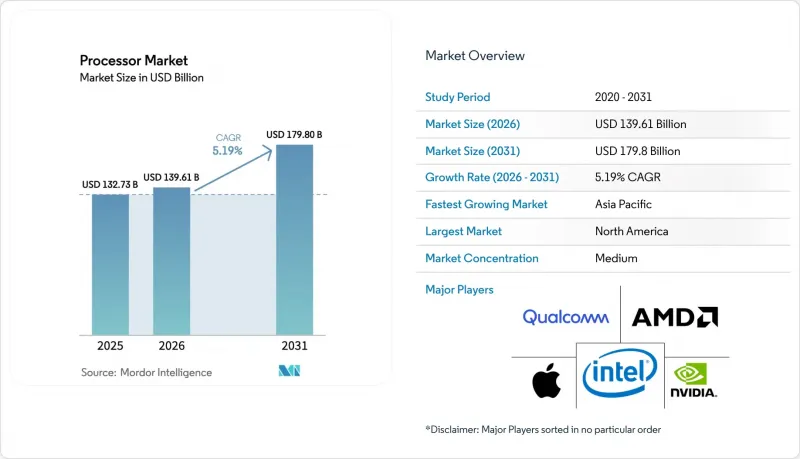
This report is Segmented by Product Type (CPU, Client, Server, APU, Smartphone, Tablet, Smart Television, and More), Micro-Architecture (x86, Arm, RISC-V, and Power), Fabrication Node (More Than 10 Nm, 7-10 Nm, and More), End-Use Application (Consumer Electronics, Data Center and Cloud, Industrial and IoT Edge, and More), and Geography. The Market Forecasts are Provided in Terms of Value (USD).
Global Processor Market Trends and Insights
Growing adoption of cloud, AI and big-data workloads
Hyperscalers now design and deploy custom chips that lift performance-per-dollar versus merchant silicon. AWS Trainium2 improves AI training cost efficiency by 30-40% compared with GPU instances, while Google's Ironwood TPU hits 4,614 TFLOPS per chip and scales to 42.5 exaflops per pod. The resulting USD 45 billion custom-chip opportunity is eroding margins for traditional CPU vendors as cloud operators internalize silicon design. Data-sovereignty mandates in Europe and parts of Asia are reinforcing regional processor preferences, further segmenting demand patterns.
Rising penetration of smartphones
Application processors now ship with dedicated NPUs as handset makers push on-device AI. Apple's A18 Pro integrates matrix coprocessors, and Qualcomm's Snapdragon 8 Gen 4 targets a 40% performance uplift through NPU advancements. The monolithic integration of 5G modems has cut the bill-of-materials cost by 15-20% and lifted battery efficiency. Slower replacement cycles shift emphasis to sustained efficiency, pushing leading-edge nodes below 5 nm into volume for premium tiers.
Talent shortage in advanced node design
Chipmakers face difficulty hiring engineers qualified for 3 nm and below. Intel reported 3,000 open roles despite USD 200,000 starting packages, and TSMC moved 1,000 Taiwanese staff to Arizona to train local hires. Academia's slower curriculum cycles add a 5-7 year skills lag, especially in verification, critical as chiplet counts soar. Visa caps in the U.S. further tighten supply, prompting companies to relocate design centers to India and Southeast Asia.
Other drivers and restraints analyzed in the detailed report include:
- Expanding edge-computing deployments
- Government incentives for semiconductor capacity
- Geopolitical export controls on EDA/IP
For complete list of drivers and restraints, kindly check the Table Of Contents.
Segment Analysis
CPUs retained 63.70% of the processor market share in 2025, yet APUs' 6.32% CAGR underscores demand for unified CPU-GPU fabrics that handle AI inference locally. The processor market size for APUs is projected to increase in tandem with rising creator workloads that need on-chip graphics acceleration. Smartphone SoCs branch into automotive and IoT, extending their lifetime value, while smart-TV processors ride 8 K content and AI upscaling tailwinds. Commodity pressure on tablets persists as phone-class silicon narrows the performance delta.
Apple's M-series exemplifies a shift toward shared-memory architectures that erase PCIe bottlenecks, while Intel's Core Ultra integrates a 48 TOPS NPU to preserve x86 relevance in AI PCs. Specialty categories, smartwatch, AR/VR, and automotive, gain share from regulatory pushes on safety and assisted driving. Certification paths such as ISO 26262 lengthen development by up to 24 months but allow premium pricing and higher margin retention.
x86 still dominates the processor market, holding 54.10% in 2025, but ARM and RISC-V architectures thrive on efficiency and licensing flexibility. Processor market size for ARM cores benefits from hyperscaler adoption: AWS Graviton4 and Google Axion yield up to 60% better energy efficiency over equivalent x86 instances. Intel's AMX extensions aim to offset the gap but hinge on a two-year software-enablement curve.
RISC-V's 6.47% CAGR rests on openness; SiFive and GlobalFoundries bring automotive-grade designs that challenge Power architecture's niche in high-reliability systems. However, tooling gaps delay mainstream workloads by three to five years. Regulatory shifts that favor export-control-free IP accelerate pilot deployments, hinting at deeper market penetration after 2028.
Complete Report Scope:
- By Product Type
- CPU
- Client (Desktop and Laptop)
- Server
- APU
- Smartphone
- Tablet
- Smart Television
- Smart Speakers
- Other (Smartwatch, Notebook, AR/VR, Automotive)
- By Micro-Architecture
- x86
- Arm
- RISC-V
- Power
- By Fabrication Node
- More than 10 nm
- 7-10 nm
- 5-6 nm
- Equal to and less than 4 nm
- By End-Use Application
- Consumer Electronics
- Data Center and Cloud
- Industrial and IoT Edge
- Automotive and ADAS
- Aerospace and Defense
- By Geography
- North America
- United States
- Canada
- Mexico
- South America
- Brazil
- Argentina
- Rest of South America
- Europe
- Germany
- United Kingdom
- France
- Italy
- Spain
- Russia
- Rest of Europe
- Asia-Pacific
- China
- Japan
- India
- South Korea
- South-East Asia
- Rest of Asia-Pacific
- Middle East and Africa
- Middle East
- Saudi Arabia
- United Arab Emirates
- Turkey
- Rest of Middle East
- Africa
- South Africa
- Nigeria
- Rest of Africa
- Middle East
- North America
Geography Analysis
North America controlled 41.75% of the processor market share in 2025, thanks to the CHIPS Act funding and hyperscaler concentration. Volume ramped at TSMC Arizona's 4 nm line in early 2025, supplying Apple and NVIDIA, while Intel pledged USD 100 billion through 2029 for foundry expansion. Talent gaps and visa limits remain structural impediments, forcing companies to import expertise from Asia.
Asia-Pacific posts the fastest 8.25% CAGR as China's indigenous designs and India's USD 10 billion incentives build regional self-reliance. Japan's TSMC-JASM fab and South Korea's System Semiconductor Vision 2030 further tilt global output eastward. Export controls restrict high-end EDA flows to Chinese firms, spurring RISC-V adoption in domestic designs.
Europe sustains growth via the EUR 43 billion Chips Act that backs GlobalFoundries' Dresden expansion and Intel's prospective Magdeburg fab. Automotive processors form the continent's core demand, aligning with a robust Tier-1 supply chain. Environmental and GDPR rules steer OEMs toward regionally located fabs despite higher labor costs.
The Middle East and Africa enter assembly-and-test segments using sovereign investment funds, but advanced fabrication remains nascent.
- Advanced Micro Devices Inc. (AMD)
- Intel Corporation
- Qualcomm Technologies Inc.
- Apple Inc.
- NVIDIA Corporation
- MediaTek Inc.
- Samsung Electronics Co. Ltd.
- Huawei Technologies Co. Ltd. (HiSilicon)
- Broadcom Inc.
- Marvell Technology Group Ltd.
- UNISOC (Shanghai) Technologies Co. Ltd.
- Texas Instruments Inc.
- Renesas Electronics Corporation
- NXP Semiconductors N.V.
- STMicroelectronics N.V.
- VIA Technologies Inc.
- SiFive Inc.
- Ampere Computing LLC
- Alibaba Pingtouge (T-Head)
- Esperanto Technologies Inc.
Additional Benefits:
- The market estimate (ME) sheet in Excel format
- 3 months of analyst support
TABLE OF CONTENTS
1 INTRODUCTION
- 1.1 Study Assumptions and Market Definition
- 1.2 Scope of the Study
2 RESEARCH METHODOLOGY
3 EXECUTIVE SUMMARY
4 MARKET LANDSCAPE
- 4.1 Market Overview
- 4.2 Market Drivers
- 4.2.1 Rising penetration of smartphones
- 4.2.2 Growing adoption of cloud, AI and big-data workloads
- 4.2.3 Expanding edge-computing deployments
- 4.2.4 Government incentives for semiconductor capacity
- 4.2.5 AI-optimized instruction-set extensions (e.g., AMX, SVE2)
- 4.2.6 Chiplet-based heterogeneous integration cost savings
- 4.3 Market Restraints
- 4.3.1 Talent shortage in advanced node design
- 4.3.2 Geopolitical export controls on EDA/IP
- 4.3.3 Thermal design limits in sub-3 nm nodes
- 4.3.4 Supply-chain emissions compliance costs
- 4.4 Impact of Macroeconomic Factors
- 4.5 Regulatory Landscape
- 4.6 Technology Outlook
- 4.7 Industry Supply Chain Analysis
- 4.8 Porter's Five Forces Analysis
- 4.8.1 Bargaining Power of Suppliers
- 4.8.2 Bargaining Power of Consumers
- 4.8.3 Threat of New Entrants
- 4.8.4 Threat of Substitutes
- 4.8.5 Intensity of Competitive Rivalry
5 MARKET SIZE AND GROWTH FORECASTS (VALUE)
- 5.1 By Product Type
- 5.1.1 CPU
- 5.1.2 Client (Desktop and Laptop)
- 5.1.3 Server
- 5.1.4 APU
- 5.1.5 Smartphone
- 5.1.6 Tablet
- 5.1.7 Smart Television
- 5.1.8 Smart Speakers
- 5.1.9 Other (Smartwatch, Notebook, AR/VR, Automotive)
- 5.2 By Micro-Architecture
- 5.2.1 x86
- 5.2.2 Arm
- 5.2.3 RISC-V
- 5.2.4 Power
- 5.3 By Fabrication Node
- 5.3.1 More than 10 nm
- 5.3.2 7-10 nm
- 5.3.3 5-6 nm
- 5.3.4 Equal to and less than 4 nm
- 5.4 By End-Use Application
- 5.4.1 Consumer Electronics
- 5.4.2 Data Center and Cloud
- 5.4.3 Industrial and IoT Edge
- 5.4.4 Automotive and ADAS
- 5.4.5 Aerospace and Defense
- 5.5 By Geography
- 5.5.1 North America
- 5.5.1.1 United States
- 5.5.1.2 Canada
- 5.5.1.3 Mexico
- 5.5.2 South America
- 5.5.2.1 Brazil
- 5.5.2.2 Argentina
- 5.5.2.3 Rest of South America
- 5.5.3 Europe
- 5.5.3.1 Germany
- 5.5.3.2 United Kingdom
- 5.5.3.3 France
- 5.5.3.4 Italy
- 5.5.3.5 Spain
- 5.5.3.6 Russia
- 5.5.3.7 Rest of Europe
- 5.5.4 Asia-Pacific
- 5.5.4.1 China
- 5.5.4.2 Japan
- 5.5.4.3 India
- 5.5.4.4 South Korea
- 5.5.4.5 South-East Asia
- 5.5.4.6 Rest of Asia-Pacific
- 5.5.5 Middle East and Africa
- 5.5.5.1 Middle East
- 5.5.5.1.1 Saudi Arabia
- 5.5.5.1.2 United Arab Emirates
- 5.5.5.1.3 Turkey
- 5.5.5.1.4 Rest of Middle East
- 5.5.5.2 Africa
- 5.5.5.2.1 South Africa
- 5.5.5.2.2 Nigeria
- 5.5.5.2.3 Rest of Africa
- 5.5.5.1 Middle East
- 5.5.1 North America
6 COMPETITIVE LANDSCAPE
- 6.1 Market Concentration
- 6.2 Strategic Moves
- 6.3 Market Share Analysis
- 6.4 Company Profiles (includes Global level Overview, Market level overview, Core Segments, Financials as available, Strategic Information, Market Rank/Share for key companies, Products and Services, and Recent Developments)
- 6.4.1 Advanced Micro Devices Inc. (AMD)
- 6.4.2 Intel Corporation
- 6.4.3 Qualcomm Technologies Inc.
- 6.4.4 Apple Inc.
- 6.4.5 NVIDIA Corporation
- 6.4.6 MediaTek Inc.
- 6.4.7 Samsung Electronics Co. Ltd.
- 6.4.8 Huawei Technologies Co. Ltd. (HiSilicon)
- 6.4.9 Broadcom Inc.
- 6.4.10 Marvell Technology Group Ltd.
- 6.4.11 UNISOC (Shanghai) Technologies Co. Ltd.
- 6.4.12 Texas Instruments Inc.
- 6.4.13 Renesas Electronics Corporation
- 6.4.14 NXP Semiconductors N.V.
- 6.4.15 STMicroelectronics N.V.
- 6.4.16 VIA Technologies Inc.
- 6.4.17 SiFive Inc.
- 6.4.18 Ampere Computing LLC
- 6.4.19 Alibaba Pingtouge (T-Head)
- 6.4.20 Esperanto Technologies Inc.
7 MARKET OPPORTUNITIES AND FUTURE OUTLOOK
- 7.1 White-space and Unmet-need Assessment

