PUBLISHER: Mordor Intelligence | PRODUCT CODE: 2119623

PUBLISHER: Mordor Intelligence | PRODUCT CODE: 2119623
Furnace Filters - Market Share Analysis, Industry Trends & Statistics, Growth Forecasts (2026 - 2031)
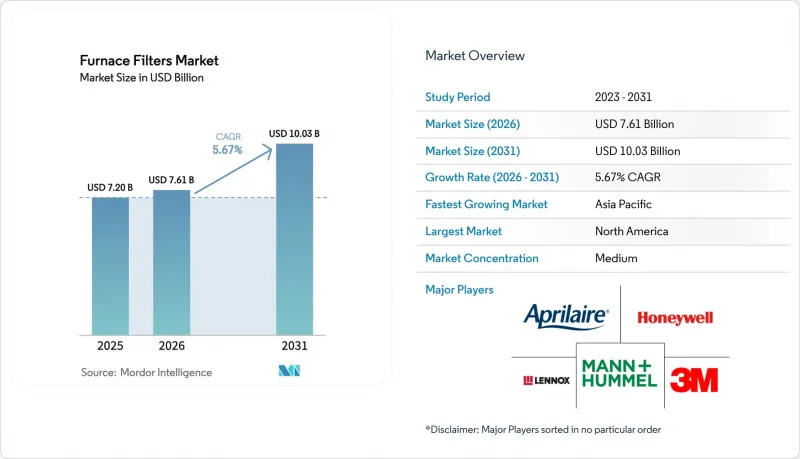
According to Mordor Intelligence, the furnace filters market size was valued at USD 7.2 billion in 2025 and estimated to grow from USD 7.61 billion in 2026 to reach USD 10.03 billion by 2031, at a CAGR of 5.67% during the forecast period (2026-2031).
This report is Segmented by Furnace Type (Gas, Oil and More), MERV Rating (MERV 1-4, MERV 5-8 and More), End User (Residential, Commercial and More), Distribution Channel (Offline Retail, Online Direct-To-Consumer and More), Filter Media (Fiberglass, Pleated Synthetic and More), and Geography (United States, Canada and More). Market Size and Forecasts are Provided in USD.
Global Furnace Filters Market Trends and Insights
Growing Focus on Indoor Air Quality (IAQ)
ASHRAE Standard 241 formalized pathogen-control benchmarks that compel commercial buildings to install MERV 13-plus filters capable of removing nearly 90% of sub-micron particles. U.S. healthcare facilities already follow OSHA guidance that specifies MERV 13 or higher, a requirement now influencing residential buyers who increasingly link filtration to respiratory health. Wild-fire smoke episodes across the western United States further demonstrate the limitations of legacy MERV 8 products, prompting rapid upgrade cycles. Pharmaceutical production in India and China also fuels demand for high-efficiency media that meet clean-room thresholds. As IAQ awareness rises, building owners view premium filters less as discretionary purchases and more as risk-mitigation tools.
Surge in Energy-Efficient HVAC Retrofits
Federal and state decarbonization incentives encourage property owners to swap dated packaged units for variable-refrigerant-flow and heat-pump systems. These retrofits specify deeper 4-inch media filters that retain MERV 13 performance without excessive pressure drop. Massachusetts regulations now require a 70% enthalpy-recovery ratio in ventilation systems, indirectly lifting demand for low-resistance filters that protect energy gains. As older buildings align with new energy codes, contractors bundle premium filters into rebate-eligible upgrade kits, generating multi-year pull-through revenue for filter suppliers.
High Life-Cycle Maintenance Cost
MERV 13 filters cost roughly three to four times more than fiberglass options and load faster, raising annual replacement outlays for households to beyond USD 200. In commercial towers with dozens of air handlers, filter procurement and labor fees reach thousands per year. Elevated energy draw-15-20% higher fan power at comparable airflow-further inflates operating budgets. While subscription platforms smooth monthly payments, total cost often rises versus retail channels, limiting upgrade rates in emerging economies where capital preservation outweighs IAQ priorities.
Other drivers and restraints analyzed in the detailed report include:
- Stricter IAQ and MERV Mandates in Building Codes
- Heat-Pump Conversions Requiring Higher-Grade Filters
- Raw-Material Price Volatility (Synthetic Media)
For complete list of drivers and restraints, kindly check the Table Of Contents.
Segment Analysis
Gas furnaces accounted for 45.38% of the furnace filters market in 2025, underpinned by a vast installed base across North American homes. In contrast, the furnace filters market size linked to heat pump or hybrid systems is projected to grow at an 8.05% CAGR, reflecting electrification incentives that narrow operating-cost gaps. Oil furnaces persist only in geographies lacking pipeline gas, while electric resistance units occupy small niches.
Year-round heat pump operation mandates deeper MERV 13 media to avoid airflow penalties, raising unit revenue per install. Gas models retain standard 1-inch pleated filters, but regulatory convergence will gradually lift their efficiency requirements. As the EPA phases out R-410A, contractors stress system cleanliness, reinforcing demand for premium filters that capture installation debris and safeguard compressors.
With a 37.92% share in 2025, MERV 5-8 filters remain common in low-risk residential settings; however, the furnace filters market size for MERV 13-16 and HEPA products is advancing at a 9.42% CAGR through 2031. Smoke events and pandemic-era health messaging make higher ratings the de facto choice for new builds.
Wild-fire prone regions adopt specialty media engineered to maintain efficiency despite extreme particle loading. Healthcare and clean-manufacturing customers set procurement baselines at MERV 13, a threshold now filtering into retail offerings. Mid-range MERV 9-12 options serve cost-conscious users upgrading in steps, though policy tightening could compress this transitional category.
Complete Report Scope:
- By Furnace Type
- Gas
- Oil
- Electric Resistance
- Heat-Pump / Hybrid
- By MERV Rating
- MERV 1-4
- MERV 5-8
- MERV 9-12
- MERV 13-16 and HEPA
- By End User
- Residential
- Commercial
- Industrial
- By Distribution Channel
- Offline Retail (DIY Stores, HVAC Wholesalers)
- Online Direct-to-Consumer
- Subscription Services
- By Filter Media
- Fiberglass
- Pleated Synthetic
- Electrostatic
- By Geography
- North America
- United States
- Canada
- Mexico
- Europe
- Germany
- France
- United Kingdom
- Italy
- Rest of Europe
- Asia-Pacific
- China
- Japan
- India
- South Korea
- Rest of Asia-Pacific
- South America
- Brazil
- Argentina
- Rest of South America
- Middle East and Africa
- Middle East
- Saudi Arabia
- UAE
- Turkey
- Africa
- South Africa
- Nigeria
- Rest of Africa
- Middle East
- North America
Geography Analysis
North America generated 36.72% of global revenue in 2025, buoyed by stringent energy codes that require MERV 13 filters in new construction and major retrofits. Wild-fire smoke across California, Oregon, and British Columbia shortens replacement cycles and lifts unit volumes. The region also leads subscription adoption, as brands like FilterBuy dominate automated delivery programs.
Asia-Pacific is the fastest-growing territory with a 7.74% CAGR through 2031. India's HVAC market is trending toward USD 30 billion by 2030, creating substantial downstream pull for filter suppliers aligned with the Production Linked Incentive scheme. China's control of more than one-quarter of global heat-pump sales sets filtration standards that ripple worldwide. Japan and South Korea impose strict IAQ limits in dense urban high-rises, cementing MERV 13-plus adoption.
Europe posts steady gains on the back of Green Deal energy directives and escalating carbon tariffs. Sweden's steel-frame mandate signals the bloc's wider push for recyclable materials, while Germany advances subsidy programs for heat-pump retrofits. The Middle East and Africa begin to surface on supplier radars as Saudi Arabia's Vision 2030 funds large-scale building projects requiring advanced HVAC systems.
- Honeywell International Inc.
- 3M Company (Filtrete)
- Nordic Pure LLC
- Rheem Manufacturing Company
- FilterBuy Inc.
- Lennox International Inc.
- AprilAire LLC
- MANN+HUMMEL GmbH
- AAF International (Daikin)
- Camfil AB
- Parker-Hannifin Corp.
- Freudenberg Filtration Technologies SE
- Donaldson Company Inc.
- Koch Filter Corporation
- General Filters Inc.
- KOOL-IT Filtration
- Glasfloss Industries
- PureFilters Canada Inc.
Additional Benefits:
- The market estimate (ME) sheet in Excel format
- 3 months of analyst support
TABLE OF CONTENTS
1 INTRODUCTION
- 1.1 Study Assumptions and Market Definition
- 1.2 Scope of the Study
2 RESEARCH METHODOLOGY
3 EXECUTIVE SUMMARY
4 MARKET LANDSCAPE
- 4.1 Market Overview
- 4.2 Market Drivers
- 4.2.1 Growing focus on indoor air quality (IAQ)
- 4.2.2 Surge in energy-efficient HVAC retrofits
- 4.2.3 Stricter IAQ and MERV mandates in building codes
- 4.2.4 Heat-pump conversions requiring higher-grade filters (under-the-radar)
- 4.2.5 Wild-fire smoke events boosting replacement frequency (under-the-radar)
- 4.2.6 Subscription e-commerce filter services driving volume (under-the-radar)
- 4.3 Market Restraints
- 4.3.1 High life-cycle maintenance cost
- 4.3.2 Raw-material price volatility (synthetic media)
- 4.3.3 Mini-split adoption (filterless HVAC) (under-the-radar)
- 4.3.4 Sustainability push against disposable filters (under-the-radar)
- 4.4 Value / Supply-Chain Analysis
- 4.5 Technological Outlook
- 4.6 Regulatory Landscape
- 4.7 Porter's Five Forces Analysis
- 4.7.1 Bargaining Power of Suppliers
- 4.7.2 Bargaining Power of Consumers
- 4.7.3 Threat of New Entrants
- 4.7.4 Threat of Substitutes
- 4.7.5 Intensity of Competitive Rivalry
- 4.8 Stakeholder Analysis
- 4.9 Distribution Channel Analysis
- 4.10 Consumer Preference Analysis
5 MARKET SIZE AND GROWTH FORECASTS (VALUE)
- 5.1 By Furnace Type
- 5.1.1 Gas
- 5.1.2 Oil
- 5.1.3 Electric Resistance
- 5.1.4 Heat-Pump / Hybrid
- 5.2 By MERV Rating
- 5.2.1 MERV 1-4
- 5.2.2 MERV 5-8
- 5.2.3 MERV 9-12
- 5.2.4 MERV 13-16 and HEPA
- 5.3 By End User
- 5.3.1 Residential
- 5.3.2 Commercial
- 5.3.3 Industrial
- 5.4 By Distribution Channel
- 5.4.1 Offline Retail (DIY Stores, HVAC Wholesalers)
- 5.4.2 Online Direct-to-Consumer
- 5.4.3 Subscription Services
- 5.5 By Filter Media
- 5.5.1 Fiberglass
- 5.5.2 Pleated Synthetic
- 5.5.3 Electrostatic
- 5.6 By Geography
- 5.6.1 North America
- 5.6.1.1 United States
- 5.6.1.2 Canada
- 5.6.1.3 Mexico
- 5.6.2 Europe
- 5.6.2.1 Germany
- 5.6.2.2 France
- 5.6.2.3 United Kingdom
- 5.6.2.4 Italy
- 5.6.2.5 Rest of Europe
- 5.6.3 Asia-Pacific
- 5.6.3.1 China
- 5.6.3.2 Japan
- 5.6.3.3 India
- 5.6.3.4 South Korea
- 5.6.3.5 Rest of Asia-Pacific
- 5.6.4 South America
- 5.6.4.1 Brazil
- 5.6.4.2 Argentina
- 5.6.4.3 Rest of South America
- 5.6.5 Middle East and Africa
- 5.6.5.1 Middle East
- 5.6.5.1.1 Saudi Arabia
- 5.6.5.1.2 UAE
- 5.6.5.1.3 Turkey
- 5.6.5.2 Africa
- 5.6.5.2.1 South Africa
- 5.6.5.2.2 Nigeria
- 5.6.5.2.3 Rest of Africa
- 5.6.5.1 Middle East
- 5.6.1 North America
6 COMPETITIVE LANDSCAPE
- 6.1 Market Concentration
- 6.2 Strategic Moves
- 6.3 Market Share Analysis
- 6.4 Company Profiles (includes Global level Overview, Market level overview, Core Segments, Financials as available, Strategic Information, Market Rank/Share for key companies, Products and Services, and Recent Developments)
- 6.4.1 Honeywell International Inc.
- 6.4.2 3M Company (Filtrete)
- 6.4.3 Nordic Pure LLC
- 6.4.4 Rheem Manufacturing Company
- 6.4.5 FilterBuy Inc.
- 6.4.6 Lennox International Inc.
- 6.4.7 AprilAire LLC
- 6.4.8 MANN+HUMMEL GmbH
- 6.4.9 AAF International (Daikin)
- 6.4.10 Camfil AB
- 6.4.11 Parker-Hannifin Corp.
- 6.4.12 Freudenberg Filtration Technologies SE
- 6.4.13 Donaldson Company Inc.
- 6.4.14 Koch Filter Corporation
- 6.4.15 General Filters Inc.
- 6.4.16 KOOL-IT Filtration
- 6.4.17 Glasfloss Industries
- 6.4.18 PureFilters Canada Inc.
7 MARKET OPPORTUNITIES AND FUTURE OUTLOOK
- 7.1 White-Space and Unmet-Need Assessment

