PUBLISHER: Mordor Intelligence | PRODUCT CODE: 2119626

PUBLISHER: Mordor Intelligence | PRODUCT CODE: 2119626
Analytical Instrumentation In Life Science - Market Share Analysis, Industry Trends & Statistics, Growth Forecasts (2026 - 2031)
According to Mordor Intelligence, the analytical instrumentation in life science market size is expected to grow from USD 20.45 billion in 2025 to USD 22.01 billion in 2026 and is forecast to reach USD 31.72 billion by 2031 at 7.60% CAGR over 2026-2031.
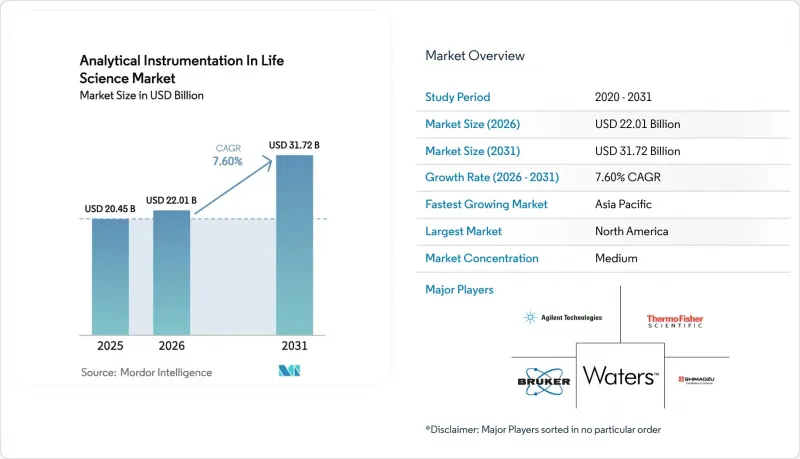
This report is Segmented by Type of Product (Chromatographs (Gas Chromatographs, and More), Spectrometer, Liquid Analyzer, and Analytical X-Ray Instrumentation and Analytical Microscopes, and More), End User Vertical (Biopharmaceutical and Nutraceutical (Biologics Manufacturers, and More), and Pharmaceutical), and Geography. The Market Forecasts are Provided in Terms of Value (USD).
Global Analytical Instrumentation In Life Science Market Trends and Insights
Surge in demand for analytical instrumentation in pharmaceutical manufacturing
The FDA's 2025 update to 21 CFR 211.110 formalizes expectations for continuous processing, elevating process-analytical-technology (PAT) systems from optional enhancements to essential control tools. Harmonized ICH Q2(R2) and Q14 guidelines allow platform methods to be validated across multiple products, shrinking timelines and creating sustained pull for multi-attribute chromatography and mass-spectrometry solutions. Manufacturers now rely on real-time attribute measurements to release batches in hours rather than days, a shift that materially increases the installed base of high-performance instruments across development and commercial sites.
Expansion of cell and gene therapy pipeline
Regulators now highlight empty-capsid control and post-translational-modification monitoring as critical quality attributes for viral vectors, pushing biopharma firms toward orbitrap-class mass spectrometry and high-resolution chromatography. Samsung Biologics reduced protein variant analysis from 6-8 weeks to 1-2 weeks by integrating LC-MS/MS with multiplexed workflows, demonstrating the productivity gains attached to next-generation platforms. As global gene-therapy trials multiply, demand for sensitive, high-throughput characterization tools cements spectrometers as pivotal growth engines in the analytical instrumentation in life science market.
High initial cost
Capital budgets remain tightly controlled; 64% of laboratories report difficulty approving new instrument purchases, and consumables can consume up to 80% of lifetime costs. Instrument-as-a-service models and shared-facility consortia are emerging to offset cash-flow barriers, while miniaturized handheld spectrometers projected to reach USD 4 billion by 2030 offer tailored, lower-priced alternatives for niche assays.
Other drivers and restraints analyzed in the detailed report include:
- Regulatory push for in-line PAT in continuous manufacturing
- Growing public-private funding in omics and biomarker research
- Shortage of skilled analytical chemists and data scientists
For complete list of drivers and restraints, kindly check the Table Of Contents.
Segment Analysis
The spectrometer category contributed USD 7.1 billion to the analytical instrumentation in life science market size in 2025 and is set to grow at an 8.06% CAGR through 2031. Liquid chromatographs preserved a 66.85% slice of chromatography revenue, but ion chromatographs now register 8.1% growth on the back of trace-impurity testing mandates. Orbitrap Astral Zoom debuted in 2025 with 35% faster scan rates, enabling real-time peptide-mapping of complex biologics and cementing high-resolution MS as the preferred platform for cell-therapy analytics. Gas-chromatography vendors respond to helium shortages by integrating hydrogen-safety interlocks and nitrogen-switch kits, limiting carrier-gas costs for QC labs. Micro-XRF instruments gain traction for non-destructive elemental mapping in controlled-release tablet coatings, extending their reach beyond traditional materials science. Novel gas analyzers oriented toward bioprocess monitoring now post 8.92% annual growth, reflecting the shift toward continuous biomanufacturing workflows that rely on in-line CO2 and O2 analytics.
Second-generation spectrometers further reduce acquisition costs per data point, widening adoption in mid-tier firms without diluting analytical power. As instrument throughput rises, consumable vendors bundle ultralow-void columns and high-capacity trapping cartridges, creating a holistic ecosystem that enhances vendor lock-in. The analytical instrumentation in life science market therefore benefits from hardware, software, and reagent co-development that optimizes complete workflows rather than isolated instrument performance.
Complete Report Scope:
- By Type of Product
- Chromatographs
- Gas Chromatographs (GC)
- Liquid Chromatographs (HPLC, UHPLC)
- Ion Chromatographs
- Spectrometer (Mass, Elemental Analysis and Molecular Analysis)
- Mass Spectrometry
- LC-MS
- GC-MS
- MALDI-TOF
- Elemental Analysis
- ICP-MS
- ICP-OES
- Molecular Analysis
- FT-IR
- Raman
- UV-Vis
- Mass Spectrometry
- Gas Analyzer
- Laser-Based Gas Analyzers
- Electrochemical Gas Analyzers
- Photoacoustic Gas Analyzers
- Liquid Analyzer
- pH/ORP Analyzers
- Dissolved Oxygen (DO) Analyzers
- Conductivity and Total Organic Carbon (TOC) Analyzers
- Analytical X-ray Instrumentation and Analytical Microscopes
- X-ray Diffraction (XRD)
- X-ray Fluorescence (XRF)
- Electron Microscopes (SEM, TEM)
- Atomic Force Microscopes (AFM)
- Chromatographs
- By End User Vertical
- Biopharmaceutical and Nutraceutical
- Biologics Manufacturers
- Nutraceutical Producers
- Pharmaceutical
- Active Pharmaceutical Ingredient (API) Manufacturers
- Contract Research and Manufacturing Organizations (CROs/CDMOs)
- Biopharmaceutical and Nutraceutical
- By Geography
- North America
- United States
- Canada
- Mexico
- Europe
- Germany
- United Kingdom
- France
- Nordics
- Rest of Europe
- South America
- Brazil
- Rest of South America
- Asia-Pacific
- China
- Japan
- India
- South-East Asia
- Rest of Asia-Pacific
- Middle East and Africa
- Middle East
- Gulf Cooperation Council Countries
- Turkey
- Rest of Middle East
- Africa
- South Africa
- Rest of Africa
- Middle East
- North America
Geography Analysis
North America retained 38.95% of 2025 revenue behind its advanced biomanufacturing infrastructure and earliest adoption of continuous-processing guidance. The region's regulatory rigor drives consistent upgrades to high-resolution instruments, and domestic stimulus packages direct USD-scale investments toward on-shore manufacturing resilience.
Asia-Pacific is the fastest-growing territory, operating at a 9.03% CAGR to 2031 as CDMOs scale capacity and governments offer tax incentives for single-use bioreactors and PAT equipment. India's generics sector and Singapore's biologics corridor draw multinational firms that demand standardized QC platforms compatible with global filings, lifting the analytical instrumentation in life science market across the region. China's CRO industry exceeded CNY 64.77 billion in 2023 and continues to import premium LC-MS and UHPLC systems to service complex molecule pipelines.
Europe holds steady growth as PIC/S alignment simplifies multinational instrument validation. Waters' USD 45 million Longbridge plant triples local orbitrap component capacity, underscoring sustained European demand for precision manufacturing inputs. South America is an emerging buyer base; Shimadzu's Mexico subsidiary seeks 150% sales growth by 2028, signalling regional appetite for tier-one instruments. Middle East and Africa remain early-stage but attract pilot-scale investments tied to vaccine self-sufficiency programs, foreshadowing incremental instrument shipments aligned to GMP facility buildouts.
- Thermo Fisher Scientific Inc.
- Agilent Technologies Inc.
- Waters Corporation
- Shimadzu Corporation
- Bruker Corporation
- Danaher Corporation (SCIEX and Pall)
- PerkinElmer Inc.
- Mettler Toledo International Inc.
- Sartorius AG
- Merck KGaA (MilliporeSigma)
- Bio-Rad Laboratories Inc.
- Malvern Panalytical Ltd.
- Metrohm AG
- JASCO Corporation
- JEOL Ltd.
- LECO Corporation
- Anton Paar GmbH
- HORIBA Ltd.
- Tecan Group Ltd.
- Hitachi High-Tech Corporation
Additional Benefits:
- The market estimate (ME) sheet in Excel format
- 3 months of analyst support
TABLE OF CONTENTS
1 INTRODUCTION
- 1.1 Study Assumptions and Market Definition
- 1.2 Scope of the Study
2 RESEARCH METHODOLOGY
3 EXECUTIVE SUMMARY
4 MARKET LANDSCAPE
- 4.1 Market Overview
- 4.2 Market Drivers
- 4.2.1 Surge in Demand of Analytical Instrumentation in Pharmaceutical Industry
- 4.2.2 Expansion of Cell and Gene Therapy Pipeline Necessitating High-Resolution Characterization
- 4.2.3 Regulatory Push for In-Line Process Analytical Technology (PAT) in Continuous Manufacturing
- 4.2.4 Growing Public-Private Funding in Omics and Biomarker Research
- 4.2.5 Rising Potency of Novel Drug Modalities Requiring Ultra-Sensitive Detection
- 4.2.6 Accelerated Adoption of High-Throughput Screening by Asian CDMOs
- 4.3 Market Restraints
- 4.3.1 High Initial Cost
- 4.3.2 Shortage of Skilled Analytical Chemists and Data Scientists
- 4.3.3 Data Integrity and Validation Compliance Burden (ALCOA+ requirements)
- 4.3.4 Complex Preventive Maintenance Leading to Higher Downtime Costs
- 4.4 Industry Ecosystem Analysis
- 4.5 Technology Snapshot
- 4.5.1 Automation and Miniaturization in Analytical Instruments
- 4.5.2 AI/ML-assisted Spectral Interpretation
- 4.5.3 Multi-Omics Data Integration Platforms
- 4.6 Porter's Five Forces Analysis
- 4.6.1 Bargaining Power of Buyers/Consumers
- 4.6.2 Bargaining Power of Suppliers
- 4.6.3 Threat of New Entrants
- 4.6.4 Threat of Substitute Products
- 4.6.5 Intensity of Competitive Rivalry
5 MARKET SIZE AND GROWTH FORECASTS (VALUES)
- 5.1 By Type of Product
- 5.1.1 Chromatographs
- 5.1.1.1 Gas Chromatographs (GC)
- 5.1.1.2 Liquid Chromatographs (HPLC, UHPLC)
- 5.1.1.3 Ion Chromatographs
- 5.1.2 Spectrometer (Mass, Elemental Analysis and Molecular Analysis)
- 5.1.2.1 Mass Spectrometry
- 5.1.2.1.1 LC-MS
- 5.1.2.1.2 GC-MS
- 5.1.2.1.3 MALDI-TOF
- 5.1.2.2 Elemental Analysis
- 5.1.2.2.1 ICP-MS
- 5.1.2.2.2 ICP-OES
- 5.1.2.3 Molecular Analysis
- 5.1.2.3.1 FT-IR
- 5.1.2.3.2 Raman
- 5.1.2.3.3 UV-Vis
- 5.1.2.1 Mass Spectrometry
- 5.1.3 Gas Analyzer
- 5.1.3.1 Laser-Based Gas Analyzers
- 5.1.3.2 Electrochemical Gas Analyzers
- 5.1.3.3 Photoacoustic Gas Analyzers
- 5.1.4 Liquid Analyzer
- 5.1.4.1 pH/ORP Analyzers
- 5.1.4.2 Dissolved Oxygen (DO) Analyzers
- 5.1.4.3 Conductivity and Total Organic Carbon (TOC) Analyzers
- 5.1.5 Analytical X-ray Instrumentation and Analytical Microscopes
- 5.1.5.1 X-ray Diffraction (XRD)
- 5.1.5.2 X-ray Fluorescence (XRF)
- 5.1.5.3 Electron Microscopes (SEM, TEM)
- 5.1.5.4 Atomic Force Microscopes (AFM)
- 5.1.1 Chromatographs
- 5.2 By End User Vertical
- 5.2.1 Biopharmaceutical and Nutraceutical
- 5.2.1.1 Biologics Manufacturers
- 5.2.1.2 Nutraceutical Producers
- 5.2.2 Pharmaceutical
- 5.2.2.1 Active Pharmaceutical Ingredient (API) Manufacturers
- 5.2.2.2 Contract Research and Manufacturing Organizations (CROs/CDMOs)
- 5.2.1 Biopharmaceutical and Nutraceutical
- 5.3 By Geography
- 5.3.1 North America
- 5.3.1.1 United States
- 5.3.1.2 Canada
- 5.3.1.3 Mexico
- 5.3.2 Europe
- 5.3.2.1 Germany
- 5.3.2.2 United Kingdom
- 5.3.2.3 France
- 5.3.2.4 Nordics
- 5.3.2.5 Rest of Europe
- 5.3.3 South America
- 5.3.3.1 Brazil
- 5.3.3.2 Rest of South America
- 5.3.4 Asia-Pacific
- 5.3.4.1 China
- 5.3.4.2 Japan
- 5.3.4.3 India
- 5.3.4.4 South-East Asia
- 5.3.4.5 Rest of Asia-Pacific
- 5.3.5 Middle East and Africa
- 5.3.5.1 Middle East
- 5.3.5.1.1 Gulf Cooperation Council Countries
- 5.3.5.1.2 Turkey
- 5.3.5.1.3 Rest of Middle East
- 5.3.5.2 Africa
- 5.3.5.2.1 South Africa
- 5.3.5.2.2 Rest of Africa
- 5.3.5.1 Middle East
- 5.3.1 North America
6 COMPETITIVE LANDSCAPE
- 6.1 Market Concentration
- 6.2 Strategic Moves (M&A, Partnerships, Product Launches)
- 6.3 Market Share Analysis
- 6.4 Company Profiles {(includes Global level Overview, Market level overview, Core Segments, Financials as available, Strategic Information, Market Rank/Share for key companies, Products and Services, and Recent Developments)}
- 6.4.1 Thermo Fisher Scientific Inc.
- 6.4.2 Agilent Technologies Inc.
- 6.4.3 Waters Corporation
- 6.4.4 Shimadzu Corporation
- 6.4.5 Bruker Corporation
- 6.4.6 Danaher Corporation (SCIEX and Pall)
- 6.4.7 PerkinElmer Inc.
- 6.4.8 Mettler Toledo International Inc.
- 6.4.9 Sartorius AG
- 6.4.10 Merck KGaA (MilliporeSigma)
- 6.4.11 Bio-Rad Laboratories Inc.
- 6.4.12 Malvern Panalytical Ltd.
- 6.4.13 Metrohm AG
- 6.4.14 JASCO Corporation
- 6.4.15 JEOL Ltd.
- 6.4.16 LECO Corporation
- 6.4.17 Anton Paar GmbH
- 6.4.18 HORIBA Ltd.
- 6.4.19 Tecan Group Ltd.
- 6.4.20 Hitachi High-Tech Corporation
7 MARKET OPPORTUNITIES AND FUTURE OUTLOOK
- 7.1 White-Space and Unmet-Need Assessment
- 7.2 Emerging Opportunities in Point-of-Need Microfluidic Analyzers
- 7.3 Integration of Real-Time Release Testing (RTRT)
- 7.4 Digital Twin and Predictive Maintenance for Analytical Labs

