PUBLISHER: Mordor Intelligence | PRODUCT CODE: 2119631

PUBLISHER: Mordor Intelligence | PRODUCT CODE: 2119631
US Conducted Energy Weapons - Market Share Analysis, Industry Trends & Statistics, Growth Forecasts (2026 - 2031)
According to Mordor Intelligence, the conducted energy weapons market size in the United States is projected to reach USD 980.34 million by 2031, reflecting a 5.57% CAGR over the forecast period, from USD 747.75 million in 2026.
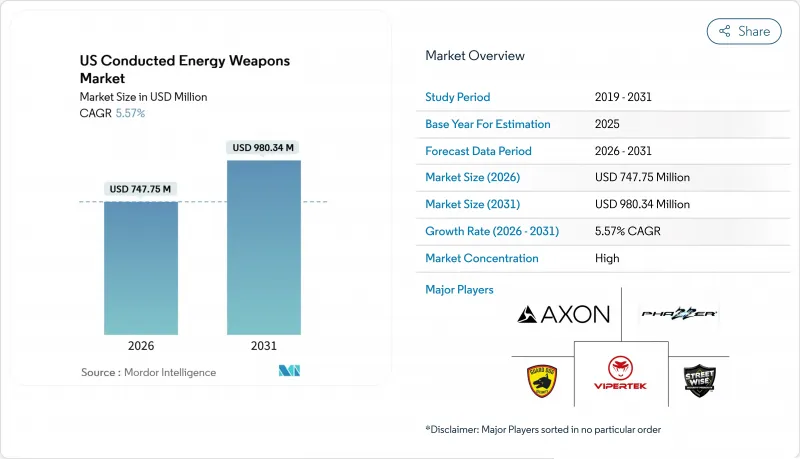
This report is Segmented by Type (Stun Gun, Taser, and Stun Baton), Equipment Type (Weapon and Cartridges), End-User (Law Enforcement Agencies and Personal Use). The Market Forecasts are Provided in Terms of Value (USD).
US Conducted Energy Weapons Market Trends and Insights
Federal De-escalation Grants Fueling LE Procurement
The Law Enforcement De-Escalation Training Act of 2022 links federal funding to alternative-force training, effectively positioning CEWs as compliant tools in grant-eligible purchase plans. JAG guidelines classify standalone weapons as "generally unallowable," so agencies increasingly buy training-and-hardware bundles that satisfy eligibility rules. Axon reported TASER segment revenue of USD 238 million for Q3 2024, a 17% year-over-year increase, driven by upgrades to TASER 10 packages that include VR simulators and Evidence.com subscriptions. The COPS Office Body-Worn Camera program further reinforces this pattern by subsidizing systems that synchronize weapon data with video evidence. As a result, agency refresh cycles shorten despite municipal budget headwinds, sustaining the conducted energy weapons market.
Rising Civilian Demand for Non-Lethal Self-Defense Devices
Personal-use sales are rising at a 6.78% CAGR through 2031, nearly a percentage point faster than institutional procurement. Google Trends reported a 23% surge in searches for "self-defense stun guns with flashlights" between April and August 2025, confirming heightened safety concerns in urban and suburban areas. Budget-friendly Vipertek VTS-880 units sell for USD 15.99, while SABRE's premium rechargeable models reach USD 199 and promote NIJ-compliant microcoulomb ratings. Forty-nine states allow civilian ownership; only Rhode Island bans CEWs outright, and Hawaii requires permits, adding complexity for national retailers. This fragmentation contrasts with Axon's dominance in policing, creating a white space for brands that can navigate regulatory variance while offering transparent performance metrics.
Litigation and Liability Cost Escalation
More than 1,000 deaths following CEW exposure have been cataloged by the Congressional Research Service, keeping wrongful-death suits in the spotlight and pushing insurers to raise municipal premiums. High-profile cases such as Keenan Anderson in 2023 intensified scrutiny, prompting directives that mandate medical exams and rapid data uploads after each use. Axon acknowledged "elevated legal expenses" during its Q3 2024 call, although it argues that robust training mitigates the risk. Smaller rivals have thinner balance sheets, which reduces their resilience to protracted litigation and consolidates market power among established players. Rising liability costs, therefore, dampen the overall growth of the conducted energy weapons market even as they entrench incumbent dominance.
Other drivers and restraints analyzed in the detailed report include:
- Smart CEWs with Data Analytics and AI Capabilities
- Integration with Body-Worn Cameras and Evidence Ecosystems
- Municipal Budget Constraints on LE Equipment Spend
For complete list of drivers and restraints, kindly check the Table Of Contents.
Segment Analysis
Tasers account for 54.67% of 2025 revenue, reflecting long-standing agency preference for ranged incapacitation platforms that integrate with cloud evidence systems. This share stems chiefly from Axon's TASER 10 upgrade wave, which boosted CEW revenue by 17% in Q3 2024. In contrast, stun batons are projected to register the fastest growth at a 5.97% CAGR, driven by corrections officers who require a reliable drive-stun capability without the logistical burden of cartridge usage. Baton Rouge PD's 2024 policy review endorses weekly function tests and capped exposure, reinforcing preference for contact devices in inmate transfer corridors.
Stun guns occupy the budget-friendly middle ground for civilians. Vipertek's VTS-880 integrates flashlight and alarm functions at USD 15.99, appealing to buyers in 49 permissive states. SABRE's rechargeable models, rated at 1.820 microcoulombs, command a premium price of USD 199 by leveraging their law enforcement pedigree. As NIJ pushes performance metrics beyond voltage claims, informed consumers are shifting evaluations toward charge delivery effectiveness, a trend that may alter future category shares.
Complete Report Scope:
- By Type
- Stun Gun
- Taser
- Stun Baton
- By Equipment Type
- Weapon
- Cartridges
- By End-User
- Law Enforcement Agencies
- Personal Use
List of Companies Covered in this Report:
- SABRE - Security Equipment Corp.
- Streetwise Security Products
- Axon Enterprise, Inc.
- Vipertek
- Guard Dog Security
- PhaZZer LLC
- Stun & Run Self Defense LLC
- Byrna Technologies Inc.
- P.S. PRODUCTS, INC.
- Accredited Security, LLC
Additional Benefits:
- The market estimate (ME) sheet in Excel format
- 3 months of analyst support
TABLE OF CONTENTS
1 INTRODUCTION
- 1.1 Study Assumptions and Market Definition
- 1.2 Scope of the Study
2 RESEARCH METHODOLOGY
3 EXECUTIVE SUMMARY
4 MARKET LANDSCAPE
- 4.1 Market Overview
- 4.2 Market Drivers
- 4.2.1 Federal de-escalation grants fuelling LE procurement
- 4.2.2 Rising civilian demand for non-lethal self-defense devices
- 4.2.3 Smart CEWs with data analytics and AI capabilities
- 4.2.4 State-level legalization expanding retail addressable market
- 4.2.5 Wearable CEWs for corrections and prisoner transport
- 4.2.6 Integration with body-worn cameras and evidence ecosystems
- 4.3 Market Restraints
- 4.3.1 Litigation and liability cost escalation
- 4.3.2 Municipal budget constraints on LE equipment spend
- 4.3.3 Patchwork state/local regulations limiting civilian sales
- 4.3.4 Public scrutiny calling for CEW bans/moratoria
- 4.4 Value Chain Analysis
- 4.5 Regulatory Landscape
- 4.6 Technological Outlook
- 4.7 Porter's Five Forces Analysis
- 4.7.1 Threat of New Entrants
- 4.7.2 Bargaining Power of Suppliers
- 4.7.3 Bargaining Power of Buyers
- 4.7.4 Threat of Substitutes
- 4.7.5 Intensity of Competitive Rivalry
5 MARKET SIZE AND GROWTH FORECASTS (VALUE)
- 5.1 By Type
- 5.1.1 Stun Gun
- 5.1.2 Taser
- 5.1.3 Stun Baton
- 5.2 By Equipment Type
- 5.2.1 Weapon
- 5.2.2 Cartridges
- 5.3 By End-User
- 5.3.1 Law Enforcement Agencies
- 5.3.2 Personal Use
6 COMPETITIVE LANDSCAPE
- 6.1 Market Concentration
- 6.2 Strategic Moves
- 6.3 Market Share Analysis
- 6.4 Company Profiles (includes Global level Overview, Market level overview, Core Segments, Financials as available, Strategic Information, Market Rank/Share for key companies, Products and Services, and Recent Developments)
- 6.4.1 SABRE - Security Equipment Corp.
- 6.4.2 Streetwise Security Products
- 6.4.3 Axon Enterprise, Inc.
- 6.4.4 Vipertek
- 6.4.5 Guard Dog Security
- 6.4.6 PhaZZer LLC
- 6.4.7 Stun & Run Self Defense LLC
- 6.4.8 Byrna Technologies Inc.
- 6.4.9 P.S. PRODUCTS, INC.
- 6.4.10 Accredited Security, LLC
7 MARKET OPPORTUNITIES AND FUTURE OUTLOOK
- 7.1 White-space and Unmet-need Assessment

