PUBLISHER: Mordor Intelligence | PRODUCT CODE: 2119649

PUBLISHER: Mordor Intelligence | PRODUCT CODE: 2119649
India Aroma Chemicals - Market Share Analysis, Industry Trends & Statistics, Growth Forecasts (2026 - 2031)
According to Mordor Intelligence, the India aroma chemicals market size was valued at USD 323.62 million in 2025 and estimated to grow from USD 341.13 million in 2026 to reach USD 444.52 million by 2031, at a CAGR of 5.41% during the forecast period (2026-2031).
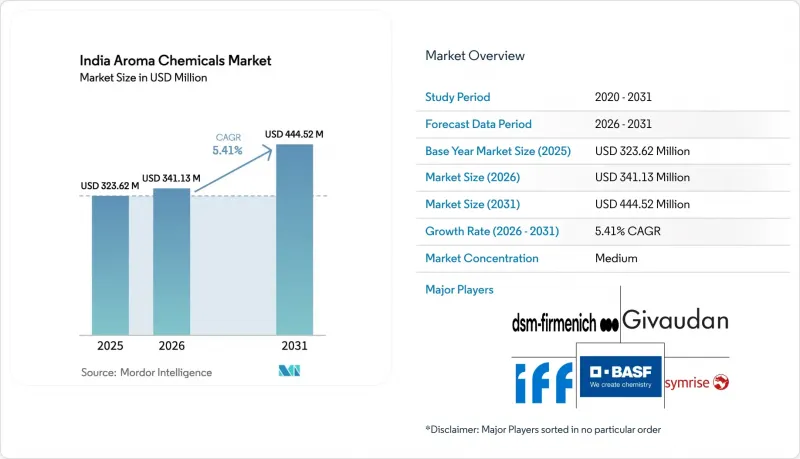
This report is Segmented by Type (Terpenes, Benzenoids, Musk Chemicals, and Other Types) and Application (Soaps and Detergents, Cosmetics and Toiletries, Fine Fragrances, Household Products, Food and Beverage, and Other Applications). The Market Forecasts are Provided in Terms of Value (USD).
India Aroma Chemicals Market Trends and Insights
Rising Demand from Fine-Fragrance Formulators
India's fine-fragrance segment is growing at a 6.25% CAGR through 2030, outrunning other end uses as affluent consumers trade up to niche scents. Luxury beauty revenue is expected to reach USD 1.6 billion by 2028, signaling considerable headroom for complex aroma profiles requiring specialty terpenes, musks, and captive aldehydes. Givaudan's South Asia arm recorded 20.9% like-for-like growth in 2024, while its Fragrance Ingredients division expanded 11.1%, underscoring sustained downstream pull for captive intermediates. Mass players like Hindustan Unilever also emphasize fragrance-led SKU renovations, allowing domestic chemical suppliers to scale volume while moving up the value curve.
Rapid Growth of Natural and "Clean-Label" Personal-Care Brands
Clean-label momentum places biodegradable, botanically derived inputs over fossil-based synthetics in shampoos, lotions, and deodorants. Hindustan Unilever aims for 100% biodegradable ingredients by 2030, reshaping raw-material specifications and accelerating demand for terpene isolates from Indian flora. Symrise reached 95% biologically sourced raw materials in 2024, proving that large-scale natural supply chains can meet stringent quality thresholds. Indian extraction houses leverage abundant lemongrass, palmarosa, and mint feedstocks, positioning the India aroma chemicals market to capture premium volumes as global formulators search for traceable supply.
Volatile Petrochemical Feedstock Prices
Crude-linked raw materials dictate cost curves for benzenoids and aldehydes, creating margin pressure when oil spikes. Although India plans to raise petrochemical capacity from 257 MMTPA to 310 MMTPA by 2028, near-term fluctuations continue to unsettle working-capital cycles, especially for smaller processors lacking long-term contracts. Integrated players with captive naphtha crackers in Gujarat enjoy relative insulation and can leverage scale economies to sustain exports.
Other drivers and restraints analyzed in the detailed report include:
- Expansion of Multifunctional Home-Care Product Lines
- Growing Adoption in Functional Foods and Beverages
- Tightened Allergen-Labelling Rules in Europe and North America
For complete list of drivers and restraints, kindly check the Table Of Contents.
Segment Analysis
The India aroma chemicals market size for terpenes exceeded two-thirds of the overall value in 2025, reflecting dependable access to lemongrass, palmarosa, and mint crops in Uttar Pradesh, Rajasthan, and Tamil Nadu. Scale in steam distillation plus backward linkages with essential-oil exporters reduces unit costs, enabling competitive pricing in both domestic and overseas tenders. Benzenoids remain integral for volume exports, leveraging Gujarat's refinery integration for toluene and benzene derivatives. Musk chemicals command higher margins because of consistent performance in fine fragrances, and their 5.94% CAGR signals the wallet shift toward premium olfactory compounds. Atul Ltd extends its portfolio with perfumery-grade geraniol isolated from palmarosa, illustrating synergy between natural extraction and synthetic upgrades.
Price-sensitive soap formulators still drive bulk terpene orders, yet emerging biotech routes for rare lactones could tilt value toward specialty molecules over time. ISO-driven quality norms plus Bureau of Indian Standards benchmarks reinforce India's export credibility, sustaining market access to Europe, the United States, and Japan. Forward integration into reaction-controlled derivatives such as linalyl acetate helps hedge raw-material volatility and deepens customer stickiness.
Complete Report Scope:
- By Type
- Terpenes
- Benzenoids
- Musk Chemicals
- Other Types
- By Application
- Soaps and Detergents
- Cosmetics and Toiletries
- Fine Fragrances
- Household Products
- Food and Beverage
- Other Applications
List of Companies Covered in this Report:
- Anuvi Chemicals Limited
- Atul Ltd.
- BASF
- dsm-firmenich
- Eternis
- Givaudan
- Hindustan Mint and Agro Products Pvt. Ltd.
- International Flavors & Fragrances Inc.
- Kalpsutra Chemicals Pvt., Ltd.
- Kelkar Foods and Fragrances
- ORIENTAL AROMATICS LTD
- Privi Speciality Chemicals Limited
- Robertet
- Symrise
- Takasago International Corporation
- The Anthea Group
Additional Benefits:
- The market estimate (ME) sheet in Excel format
- 3 months of analyst support
TABLE OF CONTENTS
1 Introduction
- 1.1 Study Assumptions and Market Definition
- 1.2 Scope of the Study
2 Research Methodology
3 Executive Summary
4 Market Landscape
- 4.1 Market Overview
- 4.2 Market Drivers
- 4.2.1 Rising demand from fine-fragrance formulators
- 4.2.2 Rapid growth of natural and "clean-label" personal-care brands
- 4.2.3 Expansion of multifunctional home-care product lines
- 4.2.4 Growing adoption of aroma chemicals in functional foods and beverages
- 4.2.5 Synthetic-biology production scaling rare aroma molecules
- 4.3 Market Restraints
- 4.3.1 Volatile petrochemical feedstock prices
- 4.3.2 Tightened allergen-labelling rules in Europe and North America
- 4.3.3 Supply-chain risk for natural precursors
- 4.4 Value Chain Analysis
- 4.5 Porter's Five Forces
- 4.5.1 Bargaining Power of Suppliers
- 4.5.2 Bargaining Power of Buyers
- 4.5.3 Threat of New Entrants
- 4.5.4 Threat of Substitutes
- 4.5.5 Degree of Competition
5 Market Size and Growth Forecasts (Value)
- 5.1 By Type
- 5.1.1 Terpenes
- 5.1.2 Benzenoids
- 5.1.3 Musk Chemicals
- 5.1.4 Other Types
- 5.2 By Application
- 5.2.1 Soaps and Detergents
- 5.2.2 Cosmetics and Toiletries
- 5.2.3 Fine Fragrances
- 5.2.4 Household Products
- 5.2.5 Food and Beverage
- 5.2.6 Other Applications
6 Competitive Landscape
- 6.1 Market Concentration
- 6.2 Strategic Moves
- 6.3 Market Share (%)/Ranking Analysis
- 6.4 Company Profiles (includes Global level Overview, Market level overview, Core Segments, Financials as available, Strategic Information, Market Rank/Share for key companies, Products and Services, and Recent Developments)
- 6.4.1 Anuvi Chemicals Limited
- 6.4.2 Atul Ltd.
- 6.4.3 BASF
- 6.4.4 dsm-firmenich
- 6.4.5 Eternis
- 6.4.6 Givaudan
- 6.4.7 Hindustan Mint and Agro Products Pvt. Ltd.
- 6.4.8 International Flavors & Fragrances Inc.
- 6.4.9 Kalpsutra Chemicals Pvt., Ltd.
- 6.4.10 Kelkar Foods and Fragrances
- 6.4.11 ORIENTAL AROMATICS LTD
- 6.4.12 Privi Speciality Chemicals Limited
- 6.4.13 Robertet
- 6.4.14 Symrise
- 6.4.15 Takasago International Corporation
- 6.4.16 The Anthea Group
7 Market Opportunities and Future Outlook
- 7.1 White-Space and Unmet-Need Assessment
- 7.2 Technological Advancements and Future Outlook

