PUBLISHER: Mordor Intelligence | PRODUCT CODE: 2119652

PUBLISHER: Mordor Intelligence | PRODUCT CODE: 2119652
Server Operating System - Market Share Analysis, Industry Trends & Statistics, Growth Forecasts (2026 - 2031)
According to Mordor Intelligence, server operating system market size market size in 2026 is estimated at USD 24.14 billion, growing from 2025 value of USD 22.28 billion with 2031 projections showing USD 36.03 billion, growing at 8.34% CAGR over 2026-2031.
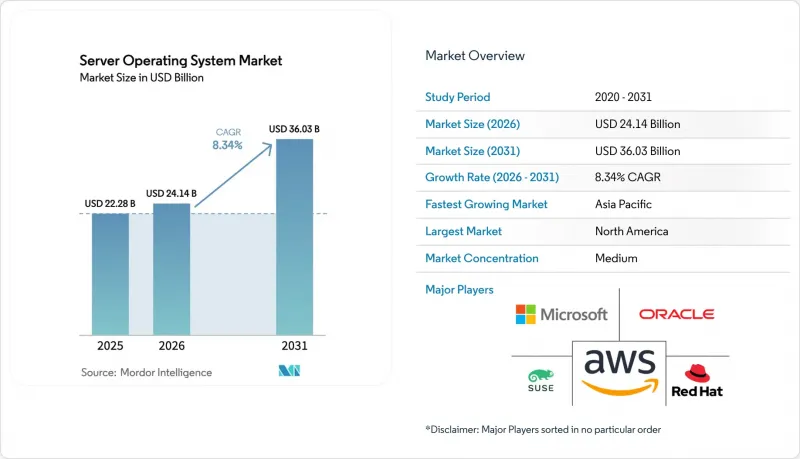
Server Operating System Market by Component (Software and Service), License Model (Commercial Proprietary and More), Type (Windows, Linux, and More), Server Architecture (x86/X64 and More), Virtualization Status (Virtual Server and More), Deployment Mode (Cloud, On-Premise, and Hybrid), Enterprise Size (Large Enterprises and Small and Medium-Sized Enterprises), Industry Vertical (IT and Telecom, BFSI, and More), and Geography.
Global Server Operating System Market Trends and Insights
Cloud-first enterprise refresh cycles
Organizations are modernizing infrastructure beyond hardware replacement, choosing operating systems that deliver cloud parity on-premises. Windows Server 2025 brings native Azure Arc integration and hot-patch updates, cutting downtime and smoothing workload mobility Microsoft Corporation. Healthcare provider Kaleida Health projects USD 5-10 million in annual savings from hypervisor consolidation and software-defined infrastructure. Vendors court these needs; Red Hat now packages Enterprise Linux AI on Azure to simplify hybrid AI deployment Red Hat. Enterprises expect a single control plane, automated lifecycle management, and predictable cost models. The result is sustained demand for solutions that harmonize licensing, telemetry, and security across multi-location estates in the server operating system market.
Hyperscale data-center build-outs
Cloud providers keep raising capital intensity; Microsoft has earmarked USD 80 billion for AI-ready facilities, while Google plans USD 75 billion over the same horizon. Scale drives operating system redesign so that tens of thousands of nodes appear as one logical computer. Power capping, silicon accelerators, and telemetry APIs are embedded at the kernel level to extract every kilowatt. Warehousing compute at this magnitude spurs new distributions tailored to ARM and custom silicon, widening the addressable base of the server operating system market. Nuclear and renewable energy alliances highlight cost pressure, making energy-aware scheduling in the OS a competitive differentiator.
High migration and downtime costs
Moving mission-critical workloads can consume over USD 15,000 per terabyte when testing, staff retraining, and service windows are included, according to Hitachi Data Systems. Legacy application dependencies make direct upgrades risky, pushing some firms to virtualization wrappers. The CentOS sunset underscored exposure: 26% of scanned Linux servers needed replacement within months. Professional services surge as enterprises seek staged cut-overs that limit business disruption. Cost sensitivity slows near-term churn, tempering expansion of the server operating system market.
Other drivers and restraints analyzed in the detailed report include:
- Edge and 5G micro-data-center rollout
- AI/ML workload proliferation
- Rising zero-day vulnerabilities
For complete list of drivers and restraints, kindly check the Table Of Contents.
Segment Analysis
Software dominated with 61.85% revenue in 2025, anchored by subscription licensing and continuous update streams, and it remains the economic foundation of the server operating system market. Enterprises favor predictable operating expense profiles and direct tie-ins with cloud consoles, which strengthens vendor lock-in yet simplifies procurement. Vendors integrate telemetry, policy engines, and cost governance features, blurring traditional OS boundaries and expanding wallet share.Services record an 10.58% CAGR to 2031 as hybrid estates multiply. Migration from CentOS, mainframe offload projects, and edge rollouts all call for advisory, design, and managed services. Providers build packaged engagements that bundle licenses, tuning, and regulatory mapping. As operating environments scale to multicloud and edge, specialized managed service offerings become essential, sustaining momentum for the server operating system market.
Commercial proprietary licenses claimed 39.10% share in 2025, reflecting Windows Server's hold on directory-centric workloads. However, subscription SaaS models top growth at 9.82% CAGR as enterprises trade capital expenditure for pay-as-you-go utility. Vendors like Red Hat refine per-core and per-node tiers that scale linearly with workload peaks.Community distributions lose ground following CentOS 7 end-of-life, steering production users toward supported variants. Enterprises cite compliance attestations and indemnification as justification for paid Linux. The evolution underscores how consumption-based pricing increasingly defines value in the server operating system market.
Linux held a 44.25% share in 2025 on strength in container, cloud, and HPC tasks. Windows enjoys a 9.62% CAGR through 2031, bolstered by ARM64 support and deep Azure integration. UNIX continues a secular decline as proprietary RISC hardware ages out, though pockets remain in telecom billing and financial trading.Workload alignment drives choice: Linux dominates cloud-native microservices, while Windows keeps traction in ERP and identity services. Emerging distributions tuned for AI pipelines and edge autonomy diversify options, extending competitive contours within the server operating system market.
Complete Report Scope:
- By Component
- Software
- Services
- By License Model
- Commercial Proprietary
- Paid Linux Distribution
- Community Linux Distribution (Free)
- Subscription-based SaaS OS
- By Type
- Windows
- Linux
- UNIX
- Others
- By Server Architecture
- x86/x64
- ARM
- RISC-V
- POWER
- Others
- By Virtualization Status
- Virtual Server
- Physical Server
- Containerised Environment
- By Deployment Mode
- Cloud
- On-premise
- Hybrid
- By Enterprise Size
- Large Enterprises
- Small and Medium-sized Enterprises (SMEs)
- By Industry Vertical
- IT and Telecom
- BFSI
- Manufacturing
- Retail and E-Commerce
- Government
- Healthcare
- Media and Entertainment
- Other Industry Verticals
- By Geography
- North America
- United States
- Canada
- Mexico
- South America
- Brazil
- Argentina
- Chile
- Rest of South America
- Europe
- Germany
- United Kingdom
- France
- Italy
- Spain
- Russia
- Rest of Europe
- Asia-Pacific
- China
- India
- Japan
- South Korea
- Malaysia
- Singapore
- Australia
- Rest of Asia-Pacific
- Middle East and Africa
- Middle East
- United Arab Emirates
- Saudi Arabia
- Turkey
- Rest of Middle East
- Africa
- South Africa
- Nigeria
- Rest of Africa
- Middle East
- North America
Geography Analysis
North America led with 36.25% revenue in 2025, backed by hyperscale investments from Microsoft, Google, and AWS. Microsoft alone budgeted USD 80 billion for next-generation AI facilities. Canada's forthcoming efficiency rules for computer room air conditioners emphasize sustainable infrastructure. Mexican manufacturing expansion adds industrial server demand, further anchoring regional leadership in the server operating system market.
Asia-Pacific delivers the fastest 11.02% CAGR to 2031. China's cloud sector is on track to surpass CNY 1 trillion by 2025. South Korean MSP revenue gains and GPU server sales, which touched KRW 5.1 trillion in 2024 for 72.7% growth, underscore AI's pull-through effect. Japanese audit tooling and security compliance reinforce demand for hardened platforms. Regional policy pushes domestic ISAs, making multiarc OS support a prerequisite, broadening adoption opportunities in the server operating system market.
Europe witnesses steady uptake as the Energy Efficiency Directive obliges operators above 100 kW IT load to publish energy KPIs by September 2024. Operators adopt OS telemetry extensions to meet mandatory reporting. Germany, France, and the United Kingdom drive enterprise refresh cycles, while Eastern members explore sovereign open-source stacks. Regulatory alignment shapes purchasing criteria, sustaining consistent growth for the server operating system market.
- Microsoft Corporation
- Red Hat Inc. (IBM Corporation)
- SUSE Group
- Oracle Corporation
- Amazon Web Services Inc.
- Canonical Ltd.
- Google LLC
- Huawei Technologies Co. Ltd.
- Alibaba Cloud Computing Co. Ltd.
- Dell Technologies Inc.
- Hewlett Packard Enterprise Co.
- Fujitsu Ltd.
- Lenovo Group Ltd.
- Cisco Systems Inc.
- NEC Corp.
- Inspur Group Co. Ltd.
- Super Micro Computer Inc.
- VMware Inc.
- Parallels International (virtuozzo)
- Joyent Inc.
- Nutanix Inc.
- FreeBSD Foundation
- Percona LLC
- OpenBSD Project
- Rocky Enterprise Software Foundation
Additional Benefits:
- The market estimate (ME) sheet in Excel format
- 3 months of analyst support
TABLE OF CONTENTS
1 INTRODUCTION
- 1.1 Study Assumptions and Market Definition
- 1.2 Scope of the Study
2 RESEARCH METHODOLOGY
3 EXECUTIVE SUMMARY
4 MARKET LANDSCAPE
- 4.1 Market Overview
- 4.2 Market Drivers
- 4.2.1 Cloud-first enterprise refresh cycles
- 4.2.2 Hyperscale data-center build-outs
- 4.2.3 Edge and 5G micro-data-center rollout
- 4.2.4 AI/ML workload proliferation
- 4.2.5 RISC-V server OS tool-chains mature
- 4.2.6 Cyber-insurance compliance hardening
- 4.3 Market Restraints
- 4.3.1 High migration and downtime costs
- 4.3.2 Rising zero-day vulnerabilities
- 4.3.3 CentOS EOL license uncertainty
- 4.3.4 Energy-efficiency regulations
- 4.4 Industry Value Chain Analysis
- 4.5 Regulatory Landscape
- 4.6 Technological Outlook
- 4.7 Industry Attractiveness - Porter's Five Forces Analysis
- 4.7.1 Bargaining Power of Buyers
- 4.7.2 Bargaining Power of Suppliers
- 4.7.3 Threat of New Entrants
- 4.7.4 Threat of Substitutes
- 4.7.5 Intensity of Competitive Rivalry
- 4.8 Impact of Macroeconomic Factors on the Market
5 MARKET SIZE AND GROWTH FORECASTS (VALUES)
- 5.1 By Component
- 5.1.1 Software
- 5.1.2 Services
- 5.2 By License Model
- 5.2.1 Commercial Proprietary
- 5.2.2 Paid Linux Distribution
- 5.2.3 Community Linux Distribution (Free)
- 5.2.4 Subscription-based SaaS OS
- 5.3 By Type
- 5.3.1 Windows
- 5.3.2 Linux
- 5.3.3 UNIX
- 5.3.4 Others
- 5.4 By Server Architecture
- 5.4.1 x86/x64
- 5.4.2 ARM
- 5.4.3 RISC-V
- 5.4.4 POWER
- 5.4.5 Others
- 5.5 By Virtualization Status
- 5.5.1 Virtual Server
- 5.5.2 Physical Server
- 5.5.3 Containerised Environment
- 5.6 By Deployment Mode
- 5.6.1 Cloud
- 5.6.2 On-premise
- 5.6.3 Hybrid
- 5.7 By Enterprise Size
- 5.7.1 Large Enterprises
- 5.7.2 Small and Medium-sized Enterprises (SMEs)
- 5.8 By Industry Vertical
- 5.8.1 IT and Telecom
- 5.8.2 BFSI
- 5.8.3 Manufacturing
- 5.8.4 Retail and E-Commerce
- 5.8.5 Government
- 5.8.6 Healthcare
- 5.8.7 Media and Entertainment
- 5.8.8 Other Industry Verticals
- 5.9 By Geography
- 5.9.1 North America
- 5.9.1.1 United States
- 5.9.1.2 Canada
- 5.9.1.3 Mexico
- 5.9.2 South America
- 5.9.2.1 Brazil
- 5.9.2.2 Argentina
- 5.9.2.3 Chile
- 5.9.2.4 Rest of South America
- 5.9.3 Europe
- 5.9.3.1 Germany
- 5.9.3.2 United Kingdom
- 5.9.3.3 France
- 5.9.3.4 Italy
- 5.9.3.5 Spain
- 5.9.3.6 Russia
- 5.9.3.7 Rest of Europe
- 5.9.4 Asia-Pacific
- 5.9.4.1 China
- 5.9.4.2 India
- 5.9.4.3 Japan
- 5.9.4.4 South Korea
- 5.9.4.5 Malaysia
- 5.9.4.6 Singapore
- 5.9.4.7 Australia
- 5.9.4.8 Rest of Asia-Pacific
- 5.9.5 Middle East and Africa
- 5.9.5.1 Middle East
- 5.9.5.1.1 United Arab Emirates
- 5.9.5.1.2 Saudi Arabia
- 5.9.5.1.3 Turkey
- 5.9.5.1.4 Rest of Middle East
- 5.9.5.2 Africa
- 5.9.5.2.1 South Africa
- 5.9.5.2.2 Nigeria
- 5.9.5.2.3 Rest of Africa
- 5.9.5.1 Middle East
- 5.9.1 North America
6 COMPETITIVE LANDSCAPE
- 6.1 Market Concentration
- 6.2 Strategic Moves
- 6.3 Market Share Analysis
- 6.4 Company Profiles (includes Global level Overview, Market level overview, Core Segments, Financials as available, Strategic Information, Market Rank/Share for key companies, Products and Services, and Recent Developments)
- 6.4.1 Microsoft Corporation
- 6.4.2 Red Hat Inc. (IBM Corporation)
- 6.4.3 SUSE Group
- 6.4.4 Oracle Corporation
- 6.4.5 Amazon Web Services Inc.
- 6.4.6 Canonical Ltd.
- 6.4.7 Google LLC
- 6.4.8 Huawei Technologies Co. Ltd.
- 6.4.9 Alibaba Cloud Computing Co. Ltd.
- 6.4.10 Dell Technologies Inc.
- 6.4.11 Hewlett Packard Enterprise Co.
- 6.4.12 Fujitsu Ltd.
- 6.4.13 Lenovo Group Ltd.
- 6.4.14 Cisco Systems Inc.
- 6.4.15 NEC Corp.
- 6.4.16 Inspur Group Co. Ltd.
- 6.4.17 Super Micro Computer Inc.
- 6.4.18 VMware Inc.
- 6.4.19 Parallels International (virtuozzo)
- 6.4.20 Joyent Inc.
- 6.4.21 Nutanix Inc.
- 6.4.22 FreeBSD Foundation
- 6.4.23 Percona LLC
- 6.4.24 OpenBSD Project
- 6.4.25 Rocky Enterprise Software Foundation
7 MARKET OPPORTUNITIES AND FUTURE TRENDS
- 7.1 White-Space and Unmet-Need Assessment

