PUBLISHER: Mordor Intelligence | PRODUCT CODE: 2119661

PUBLISHER: Mordor Intelligence | PRODUCT CODE: 2119661
Global Dental Liners And Bases - Market Share Analysis, Industry Trends & Statistics, Growth Forecasts (2026 - 2031)
According to Mordor Intelligence, dental liners and bases market size in 2026 is estimated at USD 1.63 billion, growing from 2025 value of USD 1.56 billion with 2031 projections showing USD 2.05 billion, growing at 4.68% CAGR over 2026-2031.
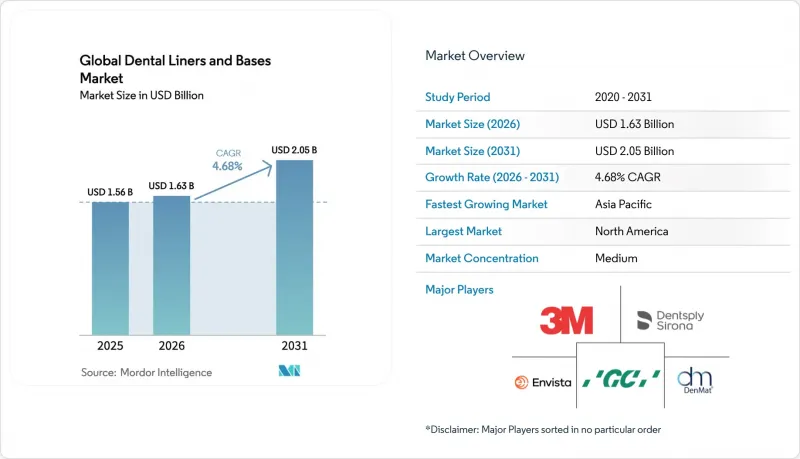
This report is Segmented by Product Type (Liners, Bases), Material (Glass Ionomer, Zinc Oxide Eugenol, Calcium Hydroxide, Resin-Modified Glass Ionomer, Others), End User (Hospitals, Dental Clinics, Others), and Geography (North America, Europe, Asia-Pacific, South America, Middle East and Africa). The Market Forecasts are Provided in Terms of Value (USD).
Global Dental Liners And Bases Market Trends and Insights
Rising Prevalence of Dental Caries and Restorative Procedures
Age-standardised incidence for permanent-tooth decay climbed from 28,154 per 100,000 in 1990 to 29,896 in 2021 and is projected to reach 30,414 by 2030. The persistent disease burden drives liner utilisation because deep carious lesions mandate pulp-protective barriers before composite placement. Low- and middle-income countries contribute the sharpest case growth, yet high-income regions sustain procedure value through premium material adoption. Clinical trial data show that ion-releasing liners cut secondary-caries risk in posterior restorations over a three-year horizon. Health ministries are therefore endorsing liner use in public-sector treatment guidelines, reinforcing volume demand.
Growing Geriatric Edentulous Population
People aged 65 years and older now retain more natural teeth yet present with complex dentin changes that heighten restorative failure risk. A cross-sectional assessment of oral-frailty symptoms in seniors underscores the need for advanced pulp-capping agents during full-mouth rehabilitation. National insurance schemes across Europe and Japan reimburse liners in vital-pulp therapy, widening clinical usage. Bio-active formulations that trigger secondary-dentin formation align with preventive geriatrics, and their adoption is directly linked to lower retreatment outlays in long-term-care facilities.
Cytotoxicity and Solubility Concerns with Legacy Chemistries
In-vitro studies reveal that resin-modified calcium-hydroxide products show concentration-dependent cytotoxicity against human pulp cells. Solubility issues plague older formulations, leading to marginal gaps and restoration failure. The European Medical Device Regulation now enforces expanded biocompatibility dossiers, compelling product reformulations that inflate development spend. Clinicians in paediatric dentistry are especially cautious, driving a gradual phase-out of high-solubility liners in favour of silica-reinforced alternatives
Other drivers and restraints analyzed in the detailed report include:
- Technological Breakthroughs in Bio-Active RMGI Chemistries
- Shift Toward Minimally Invasive Ion-Releasing Protocols
- Limited Reimbursement in Cost-Sensitive Economies
For complete list of drivers and restraints, kindly check the Table Of Contents.
Segment Analysis
Liners held 58.02% revenue in 2025 and maintain a 5.07% CAGR as they underpin nearly every deep-cavity restoration. This dominance reflects strict adherence to pulp-protection standards and the widespread clinical emphasis on thin-film barriers under composite resins. The dental liners and bases market size attributed to liners accounted for USD 0.91 billion in 2025, and higher viscosity variants are entering chairside CAD/CAM catalogues. Bases fulfil bulk build-up roles in extensive lesions, yet many new materials combine liner and base functionality, blurring categorical boundaries. Manufacturers therefore promote multi-purpose kits that reduce inventory points for clinics, streamlining procurement.
Second-generation liners embed antibacterial quaternary-ammonium monomers, and early studies indicate 28% lower secondary-caries recurrence versus conventional calcium-hydroxide products. As digital workflow adoption rises, liner dispensers equipped with RFID chips help track expiration and usage, linking material management to electronic health records. These workflow efficiencies reinforce demand for premium liners within the dental liners and bases market.
Complete Report Scope:
- By Product Type
- Liners
- Bases
- By Material
- Glass Ionomer
- Zinc Oxide Eugenol
- Calcium Hydroxide
- Resin-Modified Glass Ionomer
- Others (Biodentine, bio-active)
- By End User
- Hospitals
- Dental Clinics
- Others
- By Geography
- North America
- United States
- Canada
- Mexico
- Europe
- Germany
- United Kingdom
- France
- Italy
- Spain
- Rest of Europe
- Asia-Pacific
- China
- India
- Japan
- South Korea
- Australia
- Rest of Asia-Pacific
- South America
- Brazil
- Argentina
- Rest of South America
- Middle East and Africa
- GCC
- South Africa
- Rest of Middle East and Africa
- North America
Geography Analysis
North America commanded 41.88% revenue in 2025, supported by insurance coverage and early adoption of bio-active chemistries. The dental liners and bases market size for the region stood at USD 0.65 billion in 2025. The United States contributes the bulk share, buoyed by Medicare Part B expansions that reimburse restorative procedures when medically linked.
Asia-Pacific is the fastest-growing cluster at 6.03% CAGR. Rising middle-class expenditure, dental-tourism hubs in Thailand and India, and widespread private-practice investment in CAD/CAM platforms underpin momentum. China's domestic manufacturers increase resin-modified glass ionomer output, trimming lead times for clinics. Japan's super-aged society drives demand for biocompatible liners compatible with polypharmacy constraints. South-East Asian ministries scale school-sealant programmes, indirectly stimulating liner education campaigns that raise practitioner familiarity.
Europe shows resilient yet regulatory-tempered growth. The European Chemicals Agency proposal to tighten silica exposure limits compels process retrofits across liner plants, creating transitional supply tightness. Latin America and the Middle East & Africa record emerging-market gains, buttressed by dental tourism packages that bundle premium liners with implant services for international patients.
- 3M
- Dentsply Sirona
- GC Corporation
- Ivoclar Vivadent
- VOCO
- Coltene Holding
- Shofu Inc.
- BISCO
- Septodont
- Kerr (Envista Holdings)
- SDI
- Pulpdent Corporation
- Kuraray Noritake Dental
- Prime Dental Mfg.
- Dyadent Group Intl.
- DMG Chemisch-Pharmazeutische Fabrik
- DenMat Holdings
- Parkell
- Tokuyama Dental
Additional Benefits:
- The market estimate (ME) sheet in Excel format
- 3 months of analyst support
TABLE OF CONTENTS
1 Introduction
- 1.1 Study Assumptions & Market Definition
- 1.2 Scope of the Study
2 Research Methodology
3 Executive Summary
4 Market Landscape
- 4.1 Market Overview
- 4.2 Market Drivers
- 4.2.1 Rising prevalence of dental caries & restorative procedures
- 4.2.2 Growing geriatric edentulous population
- 4.2.3 Technological advances in bio-active & RMGI materials
- 4.2.4 Shift to minimally-invasive ion-releasing liner systems
- 4.2.5 Dental tourism packages upgrading to premium liners/bases
- 4.2.6 Chairside CAD/CAM-optimised flowable liner workflows
- 4.3 Market Restraints
- 4.3.1 Cytotoxicity & solubility concerns for legacy materials
- 4.3.2 Limited reimbursement in cost-sensitive economies
- 4.3.3 Emerging nanomaterial regulatory hurdles
- 4.3.4 Supply-chain volatility of specialty glass powders
- 4.4 Value / Supply-Chain Analysis
- 4.5 Regulatory Landscape
- 4.6 Technological Outlook
- 4.7 Porter's Five Forces
- 4.7.1 Threat of New Entrants
- 4.7.2 Bargaining Power of Suppliers
- 4.7.3 Bargaining Power of Buyers
- 4.7.4 Threat of Substitutes
- 4.7.5 Competitive Rivalry
5 Market Size & Growth Forecasts (Value)
- 5.1 By Product Type
- 5.1.1 Liners
- 5.1.2 Bases
- 5.2 By Material
- 5.2.1 Glass Ionomer
- 5.2.2 Zinc Oxide Eugenol
- 5.2.3 Calcium Hydroxide
- 5.2.4 Resin-Modified Glass Ionomer
- 5.2.5 Others (Biodentine, bio-active)
- 5.3 By End User
- 5.3.1 Hospitals
- 5.3.2 Dental Clinics
- 5.3.3 Others
- 5.4 By Geography
- 5.4.1 North America
- 5.4.1.1 United States
- 5.4.1.2 Canada
- 5.4.1.3 Mexico
- 5.4.2 Europe
- 5.4.2.1 Germany
- 5.4.2.2 United Kingdom
- 5.4.2.3 France
- 5.4.2.4 Italy
- 5.4.2.5 Spain
- 5.4.2.6 Rest of Europe
- 5.4.3 Asia-Pacific
- 5.4.3.1 China
- 5.4.3.2 India
- 5.4.3.3 Japan
- 5.4.3.4 South Korea
- 5.4.3.5 Australia
- 5.4.3.6 Rest of Asia-Pacific
- 5.4.4 South America
- 5.4.4.1 Brazil
- 5.4.4.2 Argentina
- 5.4.4.3 Rest of South America
- 5.4.5 Middle East and Africa
- 5.4.5.1 GCC
- 5.4.5.2 South Africa
- 5.4.5.3 Rest of Middle East and Africa
- 5.4.1 North America
6 Competitive Landscape
- 6.1 Market Concentration
- 6.2 Market Share Analysis
- 6.3 Company Profiles (includes Global level Overview, Market level overview, Core Segments, Financials as available, Strategic Information, Market Rank/Share for key companies, Products & Services, and Recent Developments)
- 6.3.1 3M Company
- 6.3.2 Dentsply Sirona
- 6.3.3 GC Corporation
- 6.3.4 Ivoclar Vivadent
- 6.3.5 VOCO GmbH
- 6.3.6 Coltene Holding AG
- 6.3.7 Shofu Inc.
- 6.3.8 BISCO Inc.
- 6.3.9 Septodont Holding
- 6.3.10 Kerr (Envista Holdings)
- 6.3.11 SDI Limited
- 6.3.12 Pulpdent Corporation
- 6.3.13 Kuraray Noritake Dental
- 6.3.14 Prime Dental Mfg.
- 6.3.15 Dyadent Group Intl.
- 6.3.16 DMG Chemisch-Pharmazeutische Fabrik
- 6.3.17 DenMat Holdings
- 6.3.18 Parkell Inc.
- 6.3.19 Tokuyama Dental
7 Market Opportunities & Future Outlook
- 7.1 White-space & Unmet-Need Assessment

