PUBLISHER: Mordor Intelligence | PRODUCT CODE: 2119666

PUBLISHER: Mordor Intelligence | PRODUCT CODE: 2119666
Medical Foam - Market Share Analysis, Industry Trends & Statistics, Growth Forecasts (2026 - 2031)
According to Mordor Intelligence, the medical foam market size was valued at USD 32.85 billion in 2025 and estimated to grow from USD 35.18 billion in 2026 to reach USD 49.51 billion by 2031, at a CAGR of 7.08% during the forecast period (2026-2031).
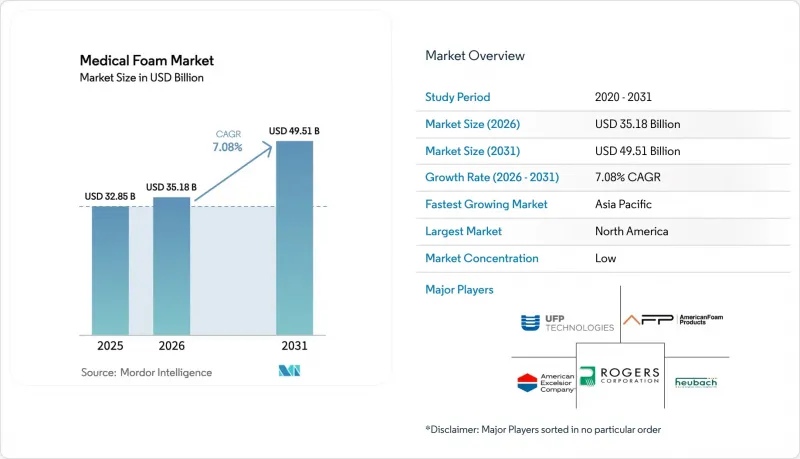
This report is Segmented by Foam Type (Flexible Foam, Rigid Foam, Spray Foam), Product (Polyurethane (PU), Polystyrene (PS), Polyolefin, Polyvinyl Chloride (PVC), Other Products), Application (Bedding and Cushioning, Medical Packaging, and More), and Geography (North America, Europe, Asia-Pacific, Middle East and Africa, South America). The Market Forecasts are Provided in Terms of Value (USD).
Global Medical Foam Market Trends and Insights
Rising Geriatric Population and Chronic Disease Prevalence
Polyurethane dressings cut pressure-ulcer incidence by 35% compared with conventional gauze, lowering hospitalization length and after-care costs. Elderly patients experience pressure-ulcer rates of 10-25%, prompting hospitals and home-health operators to prioritise mattresses that redistribute load effectively. Medicare coverage determinations L38902 and L37166 reimburse advanced foam dressings, reinforcing adoption in long-term-care and outpatient settings. Demographic ageing therefore creates a multi-year volume runway for vendors supplying bed, seat and heel-protection products across care environments.
Rapid Adoption of Medical-grade Foams in Sterile Packaging
ISO 11607-1:2019 prescribes that materials must safeguard terminally sterilised devices until point of use, favouring closed-cell foams with repeatable microbial-barrier performance. Pharmaceutical cold-chain networks simultaneously need insulation that maintains 2-8 °C profiles. DS Smith's TailorTemp solution keeps temperature ranges intact for 36 hours while cutting CO2 emissions 40% versus expanded polystyrene, demonstrating how design can converge performance and sustainability dssmith.com. Demand spans orthopaedic implants to cardiology kits where vibration dampening, puncture resistance and ease of sterilisation matter.
Volatile Isocyanate and Polyol Prices
Toluene diisocyanate and methylene diphenyl diisocyanate underpin most polyurethane medical foams and track petroleum price swings, squeezing margins when contract prices lag feedstock inflation. Manufacturers hedge risk through dual-supplier strategies and bio-content initiatives that diversify feedstocks away from fossil-derived inputs.
Other drivers and restraints analyzed in the detailed report include:
- Home-Health Boom Driving Demand for Pressure-Relief Bedding
- Government Incentives for Advanced Wound-Care Materials
- Stringent VOC and Phthalate Emission Regulations
For complete list of drivers and restraints, kindly check the Table Of Contents.
Segment Analysis
Flexible grades held 51.02% of 2025 revenue, reflecting widespread use in hospital mattresses, OR table pads and wound dressings where contour conformity is paramount. Rising home-health demand anchors stable volumes, while incremental gains stem from the sensor-integration trend in next-generation cushions. Spray technologies accounted for a smaller baseline but are forecast to post a 8.62% CAGR as portable applicators and two-component chemistries allow clinicians to cast in-situ liners and bespoke limb sockets. Growing practitioner familiarity, faster curing and lower volatile-emission variants accelerate their penetration in orthotics laboratories and point-of-care fittings.
Innovation cycles favour spray foams containing blocked isocyanate systems that eliminate occupational hazards and enable room-temperature skin contact. Investment by raw-material suppliers in equipment training broadens the installer base, supporting market entry in ambulatory centres. Meanwhile, rigid foams remain indispensable where dimensional stability outranks flexibility, for instance within imaging-equipment housings or cold-chain pallet shippers. Volume growth, however, parallels overall device-manufacturing output rather than showing breakout expansion.
Complete Report Scope:
- By Foam Type
- Flexible Foam
- Rigid Foam
- Spray Foam
- By Product
- Polyurethane (PU)
- Polystyrene (PS)
- Polyolefin
- Polyvinyl Chloride (PVC)
- Other Products
- By Application
- Bedding & Cushioning
- Medical Packaging
- Medical Devices & Components
- Prosthetics & Wound Care
- Other Applications
- By Geography
- North America
- United States
- Canada
- Mexico
- Europe
- Germany
- United Kingdom
- France
- Italy
- Spain
- Rest of Europe
- Asia-Pacific
- China
- Japan
- India
- Australia
- South Korea
- Rest of Asia-Pacific
- Middle East & Africa
- GCC
- South Africa
- Rest of Middle East & Africa
- South America
- Brazil
- Argentina
- Rest of South America
- North America
Geography Analysis
North America holds a 33.21% revenue lead on the strength of integrated chemical supply chains, device-manufacturing clusters and reimbursement mechanisms that reward clinical efficacy. Medicare coverage for advanced dressings and therapeutic mattresses underpins predictable purchasing budgets. Multinationals operate manufacturing footprints across the United States and Canada, ensuring rapid fulfilment and regulatory alignment.
Europe mirrors North America in technical standards but surpasses it in environmental policy intensity. The forthcoming Packaging and Packaging Waste Regulation obliges medical-device makers to engineer recyclability into product lifecycles, a shift that expands opportunities for low-density polyolefin solutions. Regional health systems favour cost-effectiveness studies, hence vendors that document reduced dressing-change frequency or shorter rehabilitation turnarounds gain bidding advantages.
Asia-Pacific is advancing at a 9.28% CAGR, powered by capacity expansions at regional polyurethane plants which shorten lead times and reduce import costs. Public-hospital modernisation programmes in China and India direct investments toward pressure-relief bedding and negative-pressure wound-therapy kits, both foam-intensive categories. Governments simultaneously encourage localised sourcing to build supply-chain resilience, prompting raw-material suppliers to establish propylene-glycol and polyol plants within the region dow.com. Middle East & Africa and South America remain nascent yet promising, with hospital-construction pipelines and regulatory reforms laying groundwork for faster uptake of advanced care materials over the coming decade.
- American Excelsior Company
- American Foam Products
- Heubach Corporation
- General Plastics Manufacturing Company Inc.
- UFP Technologies Inc.
- FXI
- Rogers Corporation
- Dow
- Huntsman International LLC
- 3M
- Rempac Foam LLC
- VPC Group
- Recticel NV
- Sekisui Chemical Co. Ltd.
- BASF
- Covestro
- Carpenter Co.
- Armacell International
- Foamtec Medical
- ConvaTec Group plc
- Smiths Group
Additional Benefits:
- The market estimate (ME) sheet in Excel format
- 3 months of analyst support
TABLE OF CONTENTS
1 Introduction
- 1.1 Study Assumptions & Market Definition
- 1.2 Scope of the Study
2 Research Methodology
3 Executive Summary
4 Market Landscape
- 4.1 Market Overview
- 4.2 Market Drivers
- 4.2.1 Rising Geriatric Population and Chronic Disease Prevalence
- 4.2.2 Rapid Adoption of Medical-grade Foams in Sterile Packaging
- 4.2.3 Home-Health Boom Driving Demand for Pressure-Relief Bedding
- 4.2.4 Government Incentives for Advanced Wound-Care Materials
- 4.2.5 AI-guided Design of Foam Micro-Cell Structures for Personalised Prosthetics
- 4.2.6 Pharmaceutical Cold-Chain Mandates for Reusable Cryogenic Foam Shippers
- 4.3 Market Restraints
- 4.3.1 Volatile Isocyanate and Polyol Prices
- 4.3.2 Stringent VOC and Phthalate Emission Regulations
- 4.3.3 PFAS "forever-chemical" Scrutiny on Fluorinated Foam Additives
- 4.3.4 Recycling Bottlenecks for Multi-Material Medical Foams
- 4.4 Porter's Five Forces Analysis
- 4.4.1 Threat of New Entrants
- 4.4.2 Bargaining Power of Buyers
- 4.4.3 Bargaining Power of Suppliers
- 4.4.4 Threat of Substitutes
- 4.4.5 Intensity of Competitive Rivalry
5 Market Size & Growth Forecasts (Value in USD)
- 5.1 By Foam Type
- 5.1.1 Flexible Foam
- 5.1.2 Rigid Foam
- 5.1.3 Spray Foam
- 5.2 By Product
- 5.2.1 Polyurethane (PU)
- 5.2.2 Polystyrene (PS)
- 5.2.3 Polyolefin
- 5.2.4 Polyvinyl Chloride (PVC)
- 5.2.5 Other Products
- 5.3 By Application
- 5.3.1 Bedding & Cushioning
- 5.3.2 Medical Packaging
- 5.3.3 Medical Devices & Components
- 5.3.4 Prosthetics & Wound Care
- 5.3.5 Other Applications
- 5.4 By Geography
- 5.4.1 North America
- 5.4.1.1 United States
- 5.4.1.2 Canada
- 5.4.1.3 Mexico
- 5.4.2 Europe
- 5.4.2.1 Germany
- 5.4.2.2 United Kingdom
- 5.4.2.3 France
- 5.4.2.4 Italy
- 5.4.2.5 Spain
- 5.4.2.6 Rest of Europe
- 5.4.3 Asia-Pacific
- 5.4.3.1 China
- 5.4.3.2 Japan
- 5.4.3.3 India
- 5.4.3.4 Australia
- 5.4.3.5 South Korea
- 5.4.3.6 Rest of Asia-Pacific
- 5.4.4 Middle East & Africa
- 5.4.4.1 GCC
- 5.4.4.2 South Africa
- 5.4.4.3 Rest of Middle East & Africa
- 5.4.5 South America
- 5.4.5.1 Brazil
- 5.4.5.2 Argentina
- 5.4.5.3 Rest of South America
- 5.4.1 North America
6 Competitive Landscape
- 6.1 Market Concentration
- 6.2 Market Share Analysis
- 6.3 Company Profiles (includes Global-level Overview, Market-level Overview, Core Segments, Financials as available, Strategic Information, Market Rank/Share for key companies, Products & Services, Recent Developments)
- 6.3.1 American Excelsior Company
- 6.3.2 American Foam Products
- 6.3.3 Heubach Corporation
- 6.3.4 General Plastics Manufacturing Company Inc.
- 6.3.5 UFP Technologies Inc.
- 6.3.6 FXI
- 6.3.7 Rogers Corporation
- 6.3.8 Dow
- 6.3.9 Huntsman International LLC
- 6.3.10 3M
- 6.3.11 Rempac Foam LLC
- 6.3.12 VPC Group
- 6.3.13 Recticel NV
- 6.3.14 Sekisui Chemical Co. Ltd.
- 6.3.15 BASF SE
- 6.3.16 Covestro AG
- 6.3.17 Carpenter Co.
- 6.3.18 Armacell International
- 6.3.19 Foamtec Medical
- 6.3.20 ConvaTec Group plc
- 6.3.21 Smith & Nephew plc
7 Market Opportunities & Future Outlook
- 7.1 White-space & Unmet-Need Assessment

