PUBLISHER: Mordor Intelligence | PRODUCT CODE: 2119676

PUBLISHER: Mordor Intelligence | PRODUCT CODE: 2119676
Online Fine Art - Market Share Analysis, Industry Trends & Statistics, Growth Forecasts (2026 - 2031)
According to Mordor Intelligence, the online fine art market size stood at USD 14.1 billion in 2026 and is projected to reach USD 18.99 billion by 2031, advancing at a 6.13% CAGR.
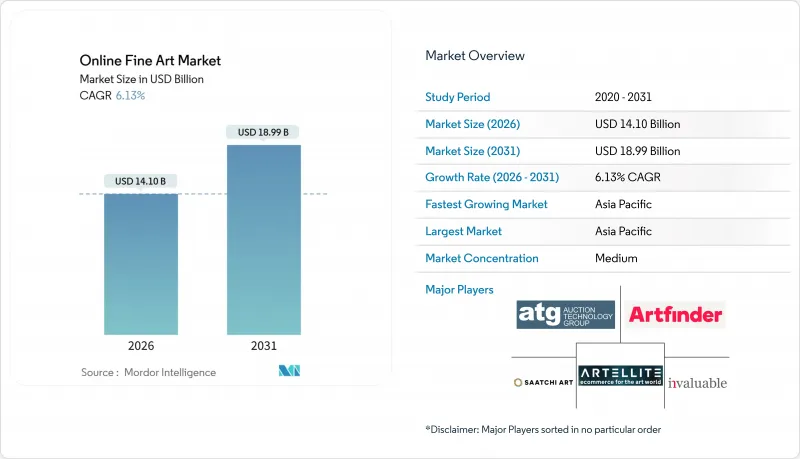
This report is Segmented by Price Range (Less Than USD 5k, USD 5k-50k, USD 50k-250k, USD 250k-1m, and Above USD 1m), Channel (Dealers 1P and 3P Platforms, Auctions Online-Only, and Hybrid), Medium (Paintings, Sculptures, Photography, Digital/NFT Art, and Others), Sector (Post-War and Contemporary, Modern, and More), and Geography. The Market Forecasts are Provided in Terms of Value (USD).
Global Online Fine Art Market Trends and Insights
Rising Convenience and Cross-Border Accessibility
Online bidding platforms remove geographic and temporal barriers, letting collectors in Seoul, Sao Paulo, and Singapore vie for pieces housed in London or New York. Christie's logged 82% of first-half 2024 bids online, proving that the digital channel deepens the buyer pool and drives more efficient price discovery. Integrated multi-currency settlement tools, transparent import-duty calculations, and last-mile logistics have eased the friction that once deterred international art buyers. Hong Kong's zero-tariff regime further positions it as an entrepot for mainland Chinese and Southeast Asian collectors. Cross-border momentum also widens supply because sellers recognize they can reach global demand without consigning to a physical sale. As a result, participants in the online fine art market allocate larger budgets to digital marketing campaigns targeting regions with foreign-exchange gains.
NFT and Blockchain-Enabled Provenance
Immutable ledgers help close long-standing provenance gaps by recording each ownership transfer on-chain, which reduces forgery risk and supports fractional securitization. Ethereum's 2022 move to proof-of-stake cut transaction energy usage by over 99%, softening ESG pushback and paving the way for institutional adoption. Adobe, Microsoft, and BBC backed the C2PA standard in 2024, embedding cryptographic metadata within image files to prove authenticity. Artsy began issuing blockchain certificates for select galleries in 2025, enabling buyers to track exhibition history digitally. These advances shift blockchain from a speculative NFT toy toward a compliance tool that mainstream collectors can accept. They also accelerate liquidity because asset-backed tokens can be traded more rapidly than physical consignments.
Cyber-Fraud and Data-Breach Concerns
The USD 114 million Incase phishing theft in 2024 exposed email spoofing vulnerabilities targeting high-value transfers. Sotheby's faced a counterfeit wine suit the same year, illustrating reputational hazards when authentication fails. Wire transactions favoured for high-ticket art lack standardized tokenization, and the Payment Card Industry mandate does not cover them completely. Insurance premiums have risen, and platforms now push multi-factor authentication and blockchain escrow. The Art Loss Register opened an API in 2025 for real-time stolen-work checks, but adoption is voluntary, leaving coverage gaps.
Other drivers and restraints analyzed in the detailed report include:
- Social-Media-Driven Discovery and Influencer Sales
- Increasing Art-as-Investment Returns
- Re-Opening of Physical Galleries and Auctions
For complete list of drivers and restraints, kindly check the Table Of Contents.
Segment Analysis
The online fine art market size for works under USD 5,000 commanded 47.19% of 2025 revenue, fuelled by impulse purchases and social-media discovery. Platforms drive margins through high-frequency processing, even if take-rates are modest. The USD 5,000-50,000 tier captures collectors upgrading their portfolios, while the USD 50,000-250,000 bracket attracts advisors who demand documented provenance and condition reports. The USD 250,000-1 million tier is forecast to log a 7.21% CAGR, signifying capital migration from equities and real estate toward portable cultural assets. Above USD 1 million, private-sale desks and premier auction houses still dominate because sellers prefer discretionary marketing and guaranteed minimums over public listings.
Collectors demonstrate willingness to bypass starter segments entirely by allocating directly into mid-six-figure works, reflecting wealth creation among technology entrepreneurs and finance professionals. Online fine art market share concentration increases as price bands rise because fewer platforms possess the trust to mediate million-dollar transfers. AI-driven valuation tools, condition-report video walkthroughs, and escrow protocols will decide which digital vendors succeed in the high-end arena.
Online-only auctions generated 52.22% of 2025 revenue and underpin the online fine art market size through competitive bidding and transparent price discovery. Christie's harvested USD 2.1 billion in first-half 2024 sales even amid macro headwinds, underscoring sustained adoption. Third-party dealer platforms, including Artsy and Artnet, are projected to advance by 6.54% CAGR, outpacing auction houses by folding thousands of galleries into a single search interface. These aggregators harness network effects, while first-party gallery sites face rising customer-acquisition costs.
Hybrid auctions blend in-room excitement with real-time online bids, yet they require costly audiovisual setups and multilingual staff. Dealer platforms employ machine-learning curation that surfaces works tailored to browsing history, raising conversion rates but potentially limiting exposure to new styles. As the online fine art industry moves toward embedded finance, integrations with payment providers and logistics firms will further compress purchase friction.
Complete Report Scope:
- By Price Range
- Less Than USD 5k
- USD 5k - 50k
- USD 50k - 250k
- USD 250k - 1m
- Above USD 1m
- By Channel
- Dealers (1P and 3P Platforms)
- Auctions (Online-Only and Hybrid)
- By Medium
- Paintings
- Sculptures
- Photography
- Digital/NFT Art
- Others, Medium
- By Sector
- Post-War and Contemporary
- Modern
- Impressionist and Post-Impressionist
- Old Masters
- Other Sectors
- By Geography
- North America
- United States
- Canada
- Mexico
- South America
- Brazil
- Rest of South America
- Europe
- Germany
- United Kingdom
- France
- Italy
- Rest of Europe
- Asia Pacific
- China
- Japan
- South Korea
- Singapore
- Hong Kong
- Rest of Asia Pacific
- Middle East
- United Arab Emirates
- Saudi Arabia
- Rest of Middle East
- Africa
- South Africa
- Rest of Africa
- North America
Geography Analysis
Asia Pacific, commanding 39.57% of the 2025 revenue, is set to lead the online fine art market with a projected CAGR of 7.34% through 2031. The region's growth is driven by increasing digital adoption, rising disposable incomes, and a growing interest in fine art among younger demographics. Hong Kong, benefiting from a zero-tariff regime, solidifies its status as a free-port hub, attracting significant art trade and auction activities.
Meanwhile, Singapore and Seoul are emerging as notable secondary nodes, leveraging their strategic locations, robust infrastructure, and supportive government policies to foster growth in the art market. Gulf sovereign funds, spurred by initiatives like Saudi Arabia's Vision 2030 and the UAE's diversification agenda, are channeling investments into flagship museum projects and new auction facilities. These efforts aim to position the region as a global cultural hub. A testament to the region's institutional confidence, Sotheby's wrapped up a USD 1 billion build-out in Abu Dhabi in December 2025, further cementing the Middle East's growing prominence in the global art market.
North America stands as a seasoned stalwart; U.S. collectors represented 42% of global art expenditures in 2024. The region benefits from a well-established art ecosystem, including a high concentration of galleries, auction houses, and collectors. While Europe grapples with macroeconomic challenges evident as London's auction market dipped 26% in 2024, it still boasts a rich expertise and stringent provenance laws, which continue to attract high-value transactions. The region's historical significance and cultural heritage also contribute to its resilience in the art market. Though South America and Africa are emerging markets stymied by limited payment systems and currency fluctuations, Brazil's digital-centric galleries and South Africa's contemporary art scene hint at a promising future. In Brazil, the rise of online platforms has enabled greater accessibility to fine art, while South Africa's vibrant contemporary art scene is gaining international recognition, supported by a growing number of art fairs and exhibitions.
- Auction Technology Group plc
- Artfinder Ltd.
- Artellite Ltd.
- Saatchi Art, Inc.
- Invaluable LLC
- Christie's International plc
- Artnet AG
- The Artling Pte Ltd.
- Artsy, Inc.
- William Doyle Galleries, Inc.
- Catawiki B.V.
- Kooness Srl
- Sotheby's Inc.
- SINGULART
- Phillips Auctioneers LLC
- Bonhams and Butterfields Auctioneers Corporation
- 1stDibs.com, Inc.
- Ugallery, Inc.
- Rise Art Ltd.
- Ocula Limited
Additional Benefits:
- The market estimate (ME) sheet in Excel format
- 3 months of analyst support
TABLE OF CONTENTS
1 INTRODUCTION
- 1.1 Study Assumptions and Market Definition
- 1.2 Scope of the Study
2 RESEARCH METHODOLOGY
3 EXECUTIVE SUMMARY
4 MARKET LANDSCAPE
- 4.1 Market Overview
- 4.2 Market Drivers
- 4.2.1 Rising Convenience and Cross-Border Accessibility
- 4.2.2 Increasing Art-as-Investment Returns
- 4.2.3 NFT and Blockchain-Enabled Provenance
- 4.2.4 Social-Media-Driven Discovery and Influencer Sales
- 4.2.5 Fractional Ownership Platforms Widening Investor Base
- 4.2.6 AI-Powered Curation Boosting Conversion Rates
- 4.3 Market Restraints
- 4.3.1 Cyber-Fraud and Data-Breach Concerns
- 4.3.2 Re-Opening of Physical Galleries and Auctions
- 4.3.3 Cross-Border Cultural-Property Export Restrictions
- 4.3.4 Blockchain Energy Footprint and ESG Backlash
- 4.4 Industry Value-Chain Analysis
- 4.5 Regulatory Landscape
- 4.6 Technological Outlook (Blockchain, AI, XR)
- 4.7 Impact of Macroeconomic Factors on the Market
- 4.8 Porter's Five Forces Analysis
- 4.8.1 Bargaining Power of Buyers
- 4.8.2 Bargaining Power of Suppliers
- 4.8.3 Threat of New Entrants
- 4.8.4 Threat of Substitutes
- 4.8.5 Competitive Rivalry
- 4.9 Key Market Trends and Share of Online Art in Overall Art Industry
- 4.10 Role of Social Media in the Online Art Industry
- 4.11 Analysis of New Online Buyers and Their Preferences
- 4.12 Emerging Role of NFTs and Fractional Ownership
5 MARKET SIZE AND GROWTH FORECASTS (VALUE)
- 5.1 By Price Range
- 5.1.1 Less Than USD 5k
- 5.1.2 USD 5k - 50k
- 5.1.3 USD 50k - 250k
- 5.1.4 USD 250k - 1m
- 5.1.5 Above USD 1m
- 5.2 By Channel
- 5.2.1 Dealers (1P and 3P Platforms)
- 5.2.2 Auctions (Online-Only and Hybrid)
- 5.3 By Medium
- 5.3.1 Paintings
- 5.3.2 Sculptures
- 5.3.3 Photography
- 5.3.4 Digital/NFT Art
- 5.3.5 Others, Medium
- 5.4 By Sector
- 5.4.1 Post-War and Contemporary
- 5.4.2 Modern
- 5.4.3 Impressionist and Post-Impressionist
- 5.4.4 Old Masters
- 5.4.5 Other Sectors
- 5.5 By Geography
- 5.5.1 North America
- 5.5.1.1 United States
- 5.5.1.2 Canada
- 5.5.1.3 Mexico
- 5.5.2 South America
- 5.5.2.1 Brazil
- 5.5.2.2 Rest of South America
- 5.5.3 Europe
- 5.5.3.1 Germany
- 5.5.3.2 United Kingdom
- 5.5.3.3 France
- 5.5.3.4 Italy
- 5.5.3.5 Rest of Europe
- 5.5.4 Asia Pacific
- 5.5.4.1 China
- 5.5.4.2 Japan
- 5.5.4.3 South Korea
- 5.5.4.4 Singapore
- 5.5.4.5 Hong Kong
- 5.5.4.6 Rest of Asia Pacific
- 5.5.5 Middle East
- 5.5.5.1 United Arab Emirates
- 5.5.5.2 Saudi Arabia
- 5.5.5.3 Rest of Middle East
- 5.5.6 Africa
- 5.5.6.1 South Africa
- 5.5.6.2 Rest of Africa
- 5.5.1 North America
6 COMPETITIVE LANDSCAPE
- 6.1 Market Concentration
- 6.2 Strategic Moves
- 6.3 Market Share Analysis
- 6.4 Company Profiles (includes Global Level Overview, Market Level Overview, Core Segments, Financials as Available, Strategic Information, Market Rank/Share for Key Companies, Products and Services, and Recent Developments)
- 6.4.1 Auction Technology Group plc
- 6.4.2 Artfinder Ltd.
- 6.4.3 Artellite Ltd.
- 6.4.4 Saatchi Art, Inc.
- 6.4.5 Invaluable LLC
- 6.4.6 Christie's International plc
- 6.4.7 Artnet AG
- 6.4.8 The Artling Pte Ltd.
- 6.4.9 Artsy, Inc.
- 6.4.10 William Doyle Galleries, Inc.
- 6.4.11 Catawiki B.V.
- 6.4.12 Kooness Srl
- 6.4.13 Sotheby's Inc.
- 6.4.14 SINGULART
- 6.4.15 Phillips Auctioneers LLC
- 6.4.16 Bonhams and Butterfields Auctioneers Corporation
- 6.4.17 1stDibs.com, Inc.
- 6.4.18 Ugallery, Inc.
- 6.4.19 Rise Art Ltd.
- 6.4.20 Ocula Limited
7 MARKET OPPORTUNITIES AND FUTURE OUTLOOK
- 7.1 White-Space and Unmet-Need Assessment

