PUBLISHER: Mordor Intelligence | PRODUCT CODE: 2119744

PUBLISHER: Mordor Intelligence | PRODUCT CODE: 2119744
Wholesale Voice Carrier - Market Share Analysis, Industry Trends & Statistics, Growth Forecasts (2026 - 2031)
According to Mordor Intelligence, wholesale voice carrier market size in 2026 is estimated at USD 44.53 billion, growing from 2025 value of USD 40.26 billion with 2031 projections showing USD 73.63 billion, growing at 10.58% CAGR over 2026-2031.
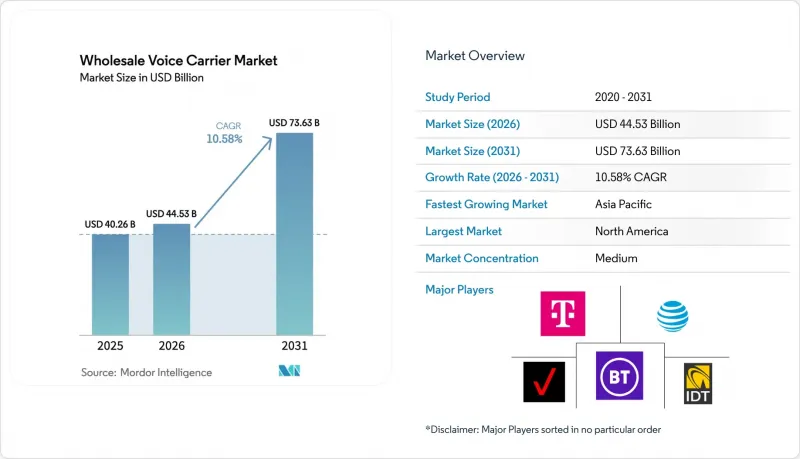
This report is Segmented by Service (Voice Termination, Interconnect Billing, and Fraud Management), Technology (VoIP and Traditional Switching), End User (Tier-1 and Tier-2 Telcos, OTT and CPaaS Providers, and More), and Geography.
Global Wholesale Voice Carrier Market Trends and Insights
Rapid Migration from TDM to SIP and VoIP Trunking
Mandatory phase-outs of PSTN networks, such as the 2027 switch-off timetable set by Ofcom in the United Kingdom, compel operators to decommission legacy exchanges and invest in IP cores.The transition compresses maintenance costs, enables flexible capacity scaling, and supports feature expansion even as carriers temporarily operate parallel systems that elevate opex. Early adopters leverage improved latency and advanced codec support to differentiate on call quality, while lagging providers confront regulatory penalties and higher churn risk.
Cloud-based Communication (UCaaS / CPaaS) Uptake
Enterprise preference for unified cloud platforms shifts wholesale demand from fixed trunks to API-centric voice enablement. Operators that expose programmable voice, recording, and analytics capabilities through white-label CPaaS offerings gain new revenue while safeguarding traffic volumes. Funding milestones, such as IntelePeer's USD 110 million growth investment, signal heightened capital flow toward providers that bridge traditional termination with cloud-native orchestration.
Heightened Fraud (CLI Spoofing, Robocalls)
Escalating vishing attacks that generated USD 1.2 billion in losses during 2024 undermine consumer trust and trigger stricter compliance mandates. Wholesale carriers invest heavily in analytics-driven fraud detection, yet must balance protection costs against thin per-minute margins. International fraud, estimated at USD 17 billion annually, includes False Answer Supervision and Traffic Pumping schemes that erode profitability while damaging brand reputation.
Other drivers and restraints analyzed in the detailed report include:
- Emerging Voice-over-5G Roaming Agreements
- AI-enabled Dynamic Least-cost Routing Boosts Margins
- Declining Voice ARPU due to OTT Substitution
For complete list of drivers and restraints, kindly check the Table Of Contents.
Segment Analysis
Voice Termination accounted for 45.78% of revenue in 2025, maintaining its role as the cornerstone of inter-carrier exchange. However, Fraud Management delivers the swiftest expansion at 13.55% CAGR to 2031 as enterprises demand authenticated caller identities and regulators mandate robocall mitigation. Higher-margin Premium CLI products outperform commoditized Standard Best-Effort traffic thanks to guaranteed delivery and origin validation. Interconnect Billing splits between customizable on-premise modules preferred by large incumbents and SaaS suites adopted by smaller operators seeking opex flexibility. The wholesale voice carrier market benefits when revenue-assurance platforms integrate machine-learning pattern recognition, enabling predictive blocking of anomalous traffic bursts.
Fraud Management momentum stems from regulatory frameworks such as STIR/SHAKEN in North America, compelling carriers to certify calling party numbers before termination. Leading vendors package signaling firewalls with real-time analytics dashboards that flag suspicious answer-seizure ratios. As these capabilities mature, smaller solution providers encounter entry barriers while established players consolidate share through end-to-end fraud stacks. For carriers, premium anti-fraud service uptake supports average-revenue-per-minute lift that partially offsets unit price compression in the wider wholesale voice carrier market.
Complete Report Scope:
- By Service
- Voice Termination
- Premium (CLI Guaranteed)
- Standard (Best-Effort)
- Interconnect Billing
- On-premise Solutions
- SaaS-based Solutions
- Fraud Management
- Revenue-Assurance and Analytics
- Signalling-Based Firewalls
- Voice Termination
- By Technology
- VoIP
- SIP (IMS)
- H.323 and Other Protocols
- Traditional Switching (TDM)
- VoIP
- By End User
- Tier-1 and Tier-2 Telcos
- Mobile Virtual Network Operators (MVNO)
- OTT and CPaaS Providers
- Enterprises and BPOs
- By Geography
- North America
- United States
- Canada
- Mexico
- South America
- Brazil
- Argentina
- Rest of South America
- Europe
- Germany
- United Kingdom
- France
- Italy
- Spain
- Russia
- Rest of Europe
- Asia Pacific
- China
- Japan
- South Korea
- India
- Australia
- Rest of Asia Pacific
- Middle East and Africa
- Saudi Arabia
- United Arab Emirates
- South Africa
- Rest of Middle East and Africa
- North America
Geography Analysis
Europe maintained a 27.95% revenue share in 2025, underpinned by robust cross-border interconnection regulations and widespread fiber backbones. Market maturity prompts a pivot toward efficiency and value-added services, illustrated by Deutsche Telekom's EUR 115.8 billion revenue and 6.2% EBITDA uplift in 2024.Consolidation discussions between major incumbents such as Orange and Telefonica underline a strategic need to counter hyperscale cloud rivals and OTT disruptors.
Asia Pacific delivers the fastest regional trajectory at 13.72% CAGR through 2031, propelled by soaring 5G subscriptions, rising enterprise digitization, and inter-regional trade flows. The GSMA values the mobile economy contribution at USD 880 billion in 2024, with China alone recording RMB 1.74 trillion telecommunications revenue and double-digit growth in cloud and big-data services. Such momentum enlarges the wholesale voice carrier market size across the region as operators deploy standalone 5G cores that require new interconnect and roaming frameworks.
North America exhibits technological leadership but slower traffic growth. The region enforces stringent STIR/SHAKEN frameworks, compelling carriers to invest in call authentication before termination. Verizon's USD 20 billion purchase of Frontier Communications extends fiber reach across 25 states and consolidates voice and broadband assets. Latin America presents divergent strategies: Telefonica accelerates divestments in Argentina, Chile, and Mexico to refocus capital on higher-return European markets while maintaining selective presence where regulatory conditions support profitability.
- Verizon
- AT&T
- BT
- Deutsche Telekom
- Tata Communications
- Telefonica
- Lumen Technologies
- Orange
- Vodafone
- IDT Corporation
- BICS
- iBASIS
- Telia Carrier (Arelion)
- PCCW Global
- Sparkle
- China Telecom Global
- NTT Communications
- PLDT Global
- Telin
- Tofane Global
Additional Benefits:
- The market estimate (ME) sheet in Excel format
- 3 months of analyst support
TABLE OF CONTENTS
1 INTRODUCTION
- 1.1 Study Assumptions and Market Definition
- 1.2 Scope of the Study
2 RESEARCH METHODOLOGY
3 EXECUTIVE SUMMARY
4 MARKET LANDSCAPE
- 4.1 Market Overview
- 4.2 Market Drivers
- 4.2.1 Rapid migration from TDM to SIP and VoIP trunking
- 4.2.2 Cloud-based communication (UCaaS / CPaaS) uptake
- 4.2.3 Emerging voice-over-5G roaming agreements
- 4.2.4 AI-enabled dynamic least-cost routing boosts margins
- 4.2.5 Blockchain-based inter-carrier settlements reduce disputes
- 4.3 Market Restraints
- 4.3.1 Heightened fraud (CLI spoofing, robocalls)
- 4.3.2 Declining voice ARPU due to OTT substitution
- 4.3.3 STIR/SHAKEN compliance costs for carriers
- 4.3.4 eSIM driven fall in international roaming minutes
- 4.4 Value Chain Analysis
- 4.5 Regulatory Landscape
- 4.6 Technological Outlook
- 4.7 Porter's Five Forces Analysis
- 4.7.1 Threat of New Entrants
- 4.7.2 Bargaining Power of Buyers
- 4.7.3 Bargaining Power of Suppliers
- 4.7.4 Threat of Substitutes
- 4.7.5 Intensity of Competitive Rivalry
5 MARKET SIZE AND GROWTH FORECASTS (VALUE)
- 5.1 By Service
- 5.1.1 Voice Termination
- 5.1.1.1 Premium (CLI Guaranteed)
- 5.1.1.2 Standard (Best-Effort)
- 5.1.2 Interconnect Billing
- 5.1.2.1 On-premise Solutions
- 5.1.2.2 SaaS-based Solutions
- 5.1.3 Fraud Management
- 5.1.3.1 Revenue-Assurance and Analytics
- 5.1.3.2 Signalling-Based Firewalls
- 5.1.1 Voice Termination
- 5.2 By Technology
- 5.2.1 VoIP
- 5.2.1.1 SIP (IMS)
- 5.2.1.2 H.323 and Other Protocols
- 5.2.2 Traditional Switching (TDM)
- 5.2.1 VoIP
- 5.3 By End User
- 5.3.1 Tier-1 and Tier-2 Telcos
- 5.3.2 Mobile Virtual Network Operators (MVNO)
- 5.3.3 OTT and CPaaS Providers
- 5.3.4 Enterprises and BPOs
- 5.4 By Geography
- 5.4.1 North America
- 5.4.1.1 United States
- 5.4.1.2 Canada
- 5.4.1.3 Mexico
- 5.4.2 South America
- 5.4.2.1 Brazil
- 5.4.2.2 Argentina
- 5.4.2.3 Rest of South America
- 5.4.3 Europe
- 5.4.3.1 Germany
- 5.4.3.2 United Kingdom
- 5.4.3.3 France
- 5.4.3.4 Italy
- 5.4.3.5 Spain
- 5.4.3.6 Russia
- 5.4.3.7 Rest of Europe
- 5.4.4 Asia Pacific
- 5.4.4.1 China
- 5.4.4.2 Japan
- 5.4.4.3 South Korea
- 5.4.4.4 India
- 5.4.4.5 Australia
- 5.4.4.6 Rest of Asia Pacific
- 5.4.5 Middle East and Africa
- 5.4.5.1 Saudi Arabia
- 5.4.5.2 United Arab Emirates
- 5.4.5.3 South Africa
- 5.4.5.4 Rest of Middle East and Africa
- 5.4.1 North America
6 COMPETITIVE LANDSCAPE
- 6.1 Market Concentration
- 6.2 Strategic Moves
- 6.3 Market Share Analysis
- 6.4 Company Profiles (includes Global level Overview, Market level overview, Core Segments, Financials as available, Strategic Information, Market Rank/Share for key companies, Products and Services, and Recent Developments)
- 6.4.1 Verizon
- 6.4.2 AT&T
- 6.4.3 BT
- 6.4.4 Deutsche Telekom
- 6.4.5 Tata Communications
- 6.4.6 Telefonica
- 6.4.7 Lumen Technologies
- 6.4.8 Orange
- 6.4.9 Vodafone
- 6.4.10 IDT Corporation
- 6.4.11 BICS
- 6.4.12 iBASIS
- 6.4.13 Telia Carrier (Arelion)
- 6.4.14 PCCW Global
- 6.4.15 Sparkle
- 6.4.16 China Telecom Global
- 6.4.17 NTT Communications
- 6.4.18 PLDT Global
- 6.4.19 Telin
- 6.4.20 Tofane Global
7 MARKET OPPORTUNITIES AND FUTURE OUTLOOK
- 7.1 White-space and Unmet-need Assessment

