PUBLISHER: Mordor Intelligence | PRODUCT CODE: 2119773

PUBLISHER: Mordor Intelligence | PRODUCT CODE: 2119773
Mirrorless Camera - Market Share Analysis, Industry Trends & Statistics, Growth Forecasts (2026 - 2031)
According to Mordor Intelligence, the mirrorless camera market size was valued at USD 5.02 billion in 2025 and estimated to grow from USD 5.32 billion in 2026 to reach USD 7.12 billion by 2031, at a CAGR of 6.00% during the forecast period (2026-2031).
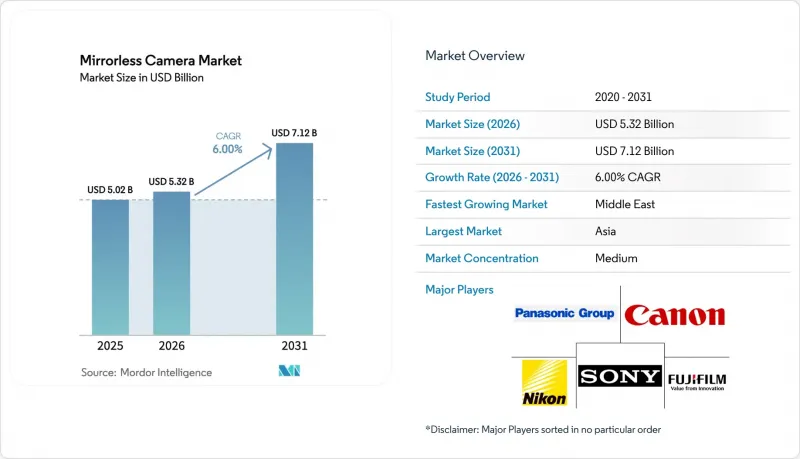
This report is Segmented by Lens Type (Built-in/Static Lens, and Interchangeable Lens), End-User (Professional, Prosumer/Enthusiast, and More), Video Resolution (Up To 4K, 4K - 6K, and Above 6K/8K), Price Point (Entry-Level (Less Than USD 1000), Mid-Range, and High-End), Distribution Channel (Offline Retail, and Online Retail), and Geography. The Market Forecasts are Provided in Terms of Value (USD).
Global Mirrorless Camera Market Trends and Insights
Booming Demand for 4K/6K Hybrid-shooting Models Among Content Creators
The creator economy now expects 4K and 6K recording as standard, prompting brands to design bodies that switch seamlessly between stills and video. Canon's EOS R1, announced in May 2024, brings oversampled 8K capture, high frame-rate 4K, and refined subject-tracking autofocus to meet these expectations. Such specifications explain why above-6K/8K models post a 10.4% CAGR. Nikon's acquisition of RED Digital Cinema adds cinema-grade codecs and sensor expertise, broadening Z-mount appeal for professional video creators. As content platforms prioritize UHD delivery, buyers future-proof their equipment, accelerating refresh cycles across North America and Europe.
Surging Adoption of Full-Frame Bodies by Wedding and Event Professionals
European wedding photographers are migrating from DSLRs to full-frame mirrorless units that deliver silent shutters, superb low-light performance, and dual card redundancy. The EU USB-C mandate triggered accelerated DSLR retirement, pushing demand toward new mirrorless lines. Professionals tolerate premium pricing because lighter bodies reduce fatigue during 10-hour events, and clients expect instant RAW-to-social turnaround. This dynamic lifts high-end segment revenue and sets visible equipment standards that prosumers then emulate.
Flagship-Smartphone Computational Photography Cannibalising Entry-Level Sales
Premium smartphones now stack dozens of exposures in milliseconds, rivalling APS-C sensor output for casual use. CIPA's January 2025 statistics show compact camera shipments rebounding 11%, while entry-level mirrorless units inch forward only 5%, a gap attributed to smartphone convenience. In high-penetration APAC markets, shoppers skip sub-USD 1,000 cameras, forcing brands to steer users into pricier mid-range lines where hardware advantages remain obvious.
Other drivers and restraints analyzed in the detailed report include:
- Corporate and Education Sector Shift to Mirrorless for Live-Streaming Set-ups
- Government Film-Incentive Programs Fuelling High-End Purchases
- Supply-Chain Volatility in CMOS and IBIS Components Affecting ASPs
For complete list of drivers and restraints, kindly check the Table Of Contents.
Segment Analysis
Interchangeable bodies yielded 86.80% of mirrorless camera market revenue in 2025. They dominate because professionals demand optical flexibility across sports, portrait, and cinema assignments. Built-in lens cameras, while only a niche today, achieve 9.08% CAGR on the back of compact premium concepts such as Fujifilm's GFX100RF, a 102 MP large-format unit with an integrated 35 mm F4 optic announced in March 2025. Canon's pledge to add 15 RF optics in 2024 illustrates how a vibrant lens roadmap deepens switching costs and shortens refresh cycles.
Interchangeable systems also attract third-party makers like Sigma, which release RF and Z-mount primes that expand creative options and nudge owners to upgrade bodies to exploit faster AF and stabilization algorithms. Yet built-in lens design gains may lure travelers and vloggers who prize simplicity, hinting at future convergence where single-optic bodies serve as high-end everyday companions alongside workhorse interchangeable rigs.
Prosumers controlled 47.10% of 2025 revenue, reflecting enthusiasts who spend thousands yet shun full commercial workflows. They flock to cameras that bundle flagship autofocus, dual card slots, and 10-bit internal video at approachable prices, anchoring the mid-range where the mirrorless camera market size shows its deepest pool of buyers. Professional users grow at 6.22% CAGR because filmmakers, wedding shooters, and broadcast crews retire ENG camcorders in favor of compact systems capable of RAW video.
Nikon's product surveys highlight content creators under 35 as the prime adoption vector; they prioritize aesthetics, weight, and direct-to-stream workflows. Meanwhile, casual hobbyists drift toward phones, squeezing the low end. Brands therefore market accessories-vertical grips, context-aware menus, AI subject tracking-to persuade prosumers that stepping up to USD 2,000 bodies secures professional-grade reliability without studio overhead.
Complete Report Scope:
- By Lens Type
- Built-in/Static Lens
- Interchangeable Lens
- By End-User
- Professional (Commercial Studios, Media Houses)
- Prosumer/Enthusiast
- Amateur/Hobbyist
- By Video Resolution
- Up to 4K
- 4K - 6K
- Above 6K/8K
- By Price Point
- Entry-Level (Less than USD 1000)
- Mid-Range (USD 1000 - USD 3000)
- High-End (Above USD 3000)
- By Distribution Channel
- Offline Retail (Brand and Specialty Stores)
- Online Retail
- By Geography
- North America
- United States
- Canada
- Mexico
- Europe
- Germany
- United Kingdom
- France
- Nordics
- Rest of Europe
- South America
- Brazil
- Rest of South America
- Asia-Pacific
- China
- Japan
- India
- South-East Asia
- Rest of Asia-Pacific
- Middle East and Africa
- Middle East
- Gulf Cooperation Council Countries
- Turkey
- Rest of Middle East
- Africa
- South Africa
- Rest of Africa
- Middle East
- North America
Geography Analysis
Asia accounted for 35.80% of global revenue in 2025, anchored by Japanese manufacturing and a resurgent Chinese consumer base. Tourism rebound across the region lifted shipment volumes, with camera units transported to duty-free zones as souvenirs for global travelers. Regional award programs such as Japan's BCN Awards underline fierce domestic rivalry, where Sony and Nikon captured incremental share in 2025.
Europe holds roughly one-quarter of worldwide shipments and experiences a regulatory inflection after the December 2024 USB-C mandate rendered legacy DSLR chargers obsolete. Professional wedding photographers accelerated mirrorless upgrades to capitalize on silent shutters and social-media friendly workflows, cementing full-frame dominance. Sustainability metrics also sway European buyers, who value lower energy consumption in mirrorless bodies compared with DSLR equivalents.
The Middle East delivers the fastest 9.54% CAGR through 2031. Government rebates that reimburse equipment purchases for qualifying productions motivate local rental houses and studios to stock the latest high-end systems. These policies align with broader diversification goals in Saudi Arabia and the UAE, building creative clusters that attract Netflix, Amazon, and local broadcasters.
North America encounters price headwinds from tariff escalations, forcing brands to reassess supply roots and possibly adopt regional assembly to protect margins. Education and corporate live-streaming demand partially offsets consumer softness. South America lags amid steep optics duties and currency volatility, which hinder adoption despite deep social-media creator communities that aspire to professional gear.
- Canon Inc.
- Sony Group Corp.
- Nikon Corp.
- FUJIFILM Holdings Corp.
- Panasonic Holdings Corp.
- OM Digital Solutions Corp.
- Leica Camera AG
- Ricoh Co. Ltd. (Pentax)
- Sigma Corp.
- Hasselblad AB
- Blackmagic Design Pty Ltd.
- SZ DJI Technology Co. Ltd.
- GoPro Inc.
- Phase One A/S
- Sharp Corp. (8K Mirrorless)
- Z CAM Ltd.
- Eastman Kodak Co.
- Samsung Electronics Co. Ltd.
- Xiaomi Corp. (Concept APS-C)
- RED Digital Cinema LLC
Additional Benefits:
- The market estimate (ME) sheet in Excel format
- 3 months of analyst support
TABLE OF CONTENTS
1 INTRODUCTION
- 1.1 Study Assumptions and Market Definition
- 1.2 Scope of the Study
2 RESEARCH METHODOLOGY
3 EXECUTIVE SUMMARY
4 MARKET LANDSCAPE
- 4.1 Market Overview
- 4.2 Market Drivers
- 4.2.1 Booming Demand for 4K/6K Hybrid-shooting Models Among Content Creators
- 4.2.2 Surging Adoption of Full-Frame Bodies by Wedding and Event Professionals in Europe
- 4.2.3 Corporate and Education Sector Shift to Mirrorless for Live-Streaming Set-ups (North America)
- 4.2.4 Government Film-Incentive Programs Fuelling High-End Purchases (Middle East)
- 4.2.5 Rapid Lens-Road-Map Expansion by Japanese OEMs Accelerating Upgrade Cycles
- 4.2.6 Transition of Broadcast Broadcasters from ENG Camcorders to Mirrorless Systems (Asia)
- 4.3 Market Restraints
- 4.3.1 Flagship-Smartphone Computational Photography Cannibalising Entry-Level Sales
- 4.3.2 Supply-chain Volatility in CMOS and IBIS Components Affecting ASPs
- 4.3.3 Steep Learning-Curve Limiting Adoption by First-Time Hobbyists
- 4.3.4 Import Tariff Escalations on Optics in South America
- 4.4 Industry Ecosystem Analysis
- 4.5 Regulatory and Technological Outlook
- 4.6 Porter's Five Forces Analysis
- 4.6.1 Bargaining Power of Buyers
- 4.6.2 Bargaining Power of Suppliers
- 4.6.3 Threat of New Entrants
- 4.6.4 Threat of Substitutes
- 4.6.5 Intensity of Competitive Rivalry
- 4.7 Pricing Analysis
- 4.8 Investment Analysis
5 MARKET SIZE AND GROWTH FORECASTS (VALUES)
- 5.1 By Lens Type
- 5.1.1 Built-in/Static Lens
- 5.1.2 Interchangeable Lens
- 5.2 By End-User
- 5.2.1 Professional (Commercial Studios, Media Houses)
- 5.2.2 Prosumer/Enthusiast
- 5.2.3 Amateur/Hobbyist
- 5.3 By Video Resolution
- 5.3.1 Up to 4K
- 5.3.2 4K - 6K
- 5.3.3 Above 6K/8K
- 5.4 By Price Point
- 5.4.1 Entry-Level (Less than USD 1000)
- 5.4.2 Mid-Range (USD 1000 - USD 3000)
- 5.4.3 High-End (Above USD 3000)
- 5.5 By Distribution Channel
- 5.5.1 Offline Retail (Brand and Specialty Stores)
- 5.5.2 Online Retail
- 5.6 By Geography
- 5.6.1 North America
- 5.6.1.1 United States
- 5.6.1.2 Canada
- 5.6.1.3 Mexico
- 5.6.2 Europe
- 5.6.2.1 Germany
- 5.6.2.2 United Kingdom
- 5.6.2.3 France
- 5.6.2.4 Nordics
- 5.6.2.5 Rest of Europe
- 5.6.3 South America
- 5.6.3.1 Brazil
- 5.6.3.2 Rest of South America
- 5.6.4 Asia-Pacific
- 5.6.4.1 China
- 5.6.4.2 Japan
- 5.6.4.3 India
- 5.6.4.4 South-East Asia
- 5.6.4.5 Rest of Asia-Pacific
- 5.6.5 Middle East and Africa
- 5.6.5.1 Middle East
- 5.6.5.1.1 Gulf Cooperation Council Countries
- 5.6.5.1.2 Turkey
- 5.6.5.1.3 Rest of Middle East
- 5.6.5.2 Africa
- 5.6.5.2.1 South Africa
- 5.6.5.2.2 Rest of Africa
- 5.6.5.1 Middle East
- 5.6.1 North America
6 COMPETITIVE LANDSCAPE
- 6.1 Market Concentration
- 6.2 Strategic Moves (M&A, Launches, Partnerships)
- 6.3 Market Share Analysis
- 6.4 Company Profiles (includes Global-level Overview, Market-level Overview, Core Segments, Financials, Strategic Information, Market Rank/Share, Products and Services, Recent Developments)
- 6.4.1 Canon Inc.
- 6.4.2 Sony Group Corp.
- 6.4.3 Nikon Corp.
- 6.4.4 FUJIFILM Holdings Corp.
- 6.4.5 Panasonic Holdings Corp.
- 6.4.6 OM Digital Solutions Corp.
- 6.4.7 Leica Camera AG
- 6.4.8 Ricoh Co. Ltd. (Pentax)
- 6.4.9 Sigma Corp.
- 6.4.10 Hasselblad AB
- 6.4.11 Blackmagic Design Pty Ltd.
- 6.4.12 SZ DJI Technology Co. Ltd.
- 6.4.13 GoPro Inc.
- 6.4.14 Phase One A/S
- 6.4.15 Sharp Corp. (8K Mirrorless)
- 6.4.16 Z CAM Ltd.
- 6.4.17 Eastman Kodak Co.
- 6.4.18 Samsung Electronics Co. Ltd.
- 6.4.19 Xiaomi Corp. (Concept APS-C)
- 6.4.20 RED Digital Cinema LLC
7 MARKET OPPORTUNITIES AND FUTURE OUTLOOK
- 7.1 White-Space and Unmet-Need Assessment

