PUBLISHER: Mordor Intelligence | PRODUCT CODE: 2119818

PUBLISHER: Mordor Intelligence | PRODUCT CODE: 2119818
China Copper - Market Share Analysis, Industry Trends & Statistics, Growth Forecasts (2026 - 2031)
According to Mordor Intelligence, China copper market size in 2026 is estimated at 13.56 Million tons, growing from 2025 value of 12.88 Million tons with 2031 projections showing 17.54 Million tons, growing at 5.28% CAGR over 2026-2031.
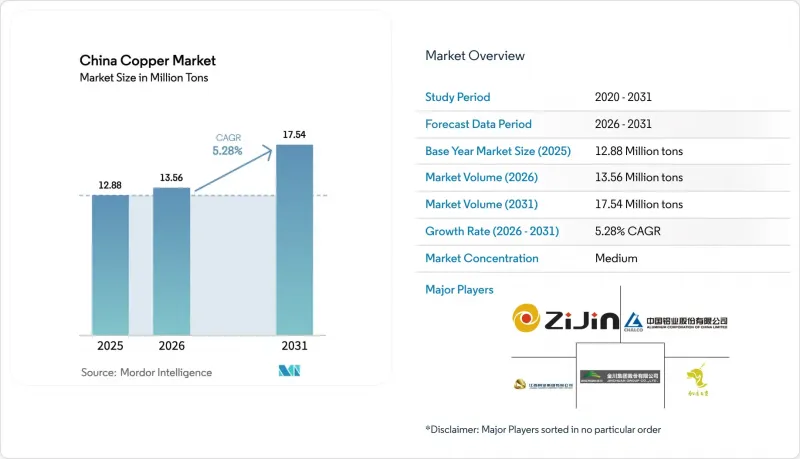
This report is Segmented by Source (Primary Mine-Derived and Secondary Recycled), End-User Industry (Automotive and Heavy Equipment, Construction, Electrical and Electronics, Industrial, and Other End-User Industries (Consumer Products, Medical Devices, Etc. )). The Market Forecasts are Provided in Terms of Volume (tons).
China Copper Market Trends and Insights
Surging Demand From Renewable Energy and Grid Expansion
A nationwide pivot toward clean-energy generation is placing copper at the heart of China's electrical-infrastructure rollout. Each kilometer of a new ultra high voltage (UHV) line embeds about 6 tons of refined copper, and 38 such lines were already in service by April 2024, linking renewable-rich western deserts to coastal load centers. The ongoing Gansu-Zhejiang +-800 kV link alone consumes over 14,000 tons of copper and transmits 36 Billion kWh annually, more than half stemming from wind and solar plants. Solar and onshore wind capacity, which together target 1,200 GW by 2030, require copper-heavy cabling, inverters, transformers, and switchgear that extend well beyond classical demand models. Because grid investments are locked in through multi-year state plans, they shelter the China Copper market from short-term construction slumps while anchoring floor prices for refined metal.
Rapid Build-out of Domestic EV and Battery Manufacturing
Battery-electric vehicles average close to 70 kg of copper per unit, covering wiring harnesses, rotors, and battery-pack connectors. Even if industry roadmaps halve intensity to 38 kg by 2030 through design efficiencies, absolute tonnage will still rise on surging output. China manufactured 958.7 Million vehicles in 2023, up 35.8% yearly, and continues to scale dedicated assembly lines in Shanghai, Guangzhou, and Changzhou. Charging networks amplify demand: every additional megawatt of charging capacity deploys 20 to 40 tons of copper in conductors, switchgear, and thermal-management loops. Vertical integration inside automakers' supply chains ensures that a large portion of copper sourcing and processing remains domestic, lending visibility to long-term offtake agreements for smelters.
Tightening Sulphur-dioxide and Carbon-emission Caps on Smelters
Updated environmental standards restrict SO2 to 6.3 lb/h and tighten particulate and lead limits for primary smelters, obliging operators to retrofit scrubbers and electrostatic precipitators at high capital cost . Provincial regulators have also curbed petroleum-coke firing, eliminating 12 Million tons of annual fuel imports and forcing a switch to cleaner natural gas. Compliance timelines of two years risk near-term output cuts among mid-tier smelters, lowering domestic cathode supply just as consumption scales. Government quotas on new capacity now require applicants to hold equity stakes in upstream mines, slowing project approvals and concentrating market power among existing state-owned incumbents.
Other drivers and restraints analyzed in the detailed report include:
- Accelerating Deployment of AI-ready Data-centres
- Government-backed Western Region Infrastructure Push
- Persistent Copper-concentrate Deficit and Low TC/RCs
For complete list of drivers and restraints, kindly check the Table Of Contents.
Segment Analysis
Primary copper commanded 84.19% of the China Copper market in 2025 as smelters leveraged consistent ore flows from Jiangxi Copper and Zijin Mining as well as long-term offtake agreements with Chilean and Peruvian producers. The China Copper market size for primary material is expected to track a 5.04% CAGR through 2031, supported by UHV grid projects and electric vehicle (EV) battery-foil expansions. Although smaller, secondary copper is set to gain share at a 6.35% CAGR, helped by a January 2025 tariff cut on recycled-copper imports to 0% and city-level scrap-collection pilots targeting 400,000 tons of annual recycled output by 2025 . Growing circular-economy mandates and rising treatment-charge stress encourage smelters to substitute concentrates with scrap, allowing secondary flows to dilute overall feedstock risk. Recyclers have invested in automated dismantling lines that lift recovery rates on wire harnesses and air-conditioner coils, narrowing the quality gap with virgin cathode.
Complete Report Scope:
- By Source
- Primary (Mine-derived)
- Secondary (Recycled)
- By End-user Industry
- Automotive and Heavy Equipment
- Construction
- Electrical and Electronics
- Industrial
- Other End-user Industries (Consumer Products, Medical Devices, etc.)
List of Companies Covered in this Report:
- Aluminum Corporation of China Limited (CHALCO)
- China Daye Non-Ferrous Metals Mining Limited
- CMOC
- Jiangxi Copper Corporation
- Jinchuan Group Co., Ltd.
- MMG Australia Limited
- Tongling Non-ferrous Metals Group Holding Co., Ltd.
- Zijin Mining Group Co., Ltd.
Additional Benefits:
- The market estimate (ME) sheet in Excel format
- 3 months of analyst support
TABLE OF CONTENTS
1 Introduction
- 1.1 Study Assumptions & Market Definition
- 1.2 Scope of the Study
2 Research Methodology
3 Executive Summary
4 Market Landscape
- 4.1 Market Overview
- 4.2 Market Drivers
- 4.2.1 Surging Demand From Renewable Energy and Grid Expansion
- 4.2.2 Rapid Build-out of Domestic EV and Battery Manufacturing
- 4.2.3 Accelerating Deployment of AI-ready Data-centres
- 4.2.4 Government-backed Western Region Infrastructure Push
- 4.2.5 Upscaling of Smart Factory Automation in Coastal Provinces
- 4.3 Market Restraints
- 4.3.1 Tightening Sulphur-dioxide and Carbon-emission Caps on Smelters
- 4.3.2 Persistent Copper-concentrate Deficit and Low TC/RCs
- 4.3.3 Rising Competition from Aluminium-substitution in 1 kV Cabling
- 4.4 Value Chain Analysis
- 4.5 Porter's Five Forces
- 4.5.1 Threat of New Entrants
- 4.5.2 Bargaining Power of Buyers
- 4.5.3 Bargaining Power of Suppliers
- 4.5.4 Threat of Substitutes
- 4.5.5 Degree of Competition
5 Market Size & Growth Forecasts (Volume)
- 5.1 By Source
- 5.1.1 Primary (Mine-derived)
- 5.1.2 Secondary (Recycled)
- 5.2 By End-user Industry
- 5.2.1 Automotive and Heavy Equipment
- 5.2.2 Construction
- 5.2.3 Electrical and Electronics
- 5.2.4 Industrial
- 5.2.5 Other End-user Industries (Consumer Products, Medical Devices, etc.)
6 Competitive Landscape
- 6.1 Market Concentration
- 6.2 Strategic Moves
- 6.3 Market Share(%)/Ranking Analysis
- 6.4 Company Profiles (includes Global level Overview, Market level overview, Core Segments, Financials as available, Strategic Information, Market Rank/Share, Products & Services, Recent Developments)
- 6.4.1 Aluminum Corporation of China Limited (CHALCO)
- 6.4.2 China Daye Non-Ferrous Metals Mining Limited
- 6.4.3 CMOC
- 6.4.4 Jiangxi Copper Corporation
- 6.4.5 Jinchuan Group Co., Ltd.
- 6.4.6 MMG Australia Limited
- 6.4.7 Tongling Non-ferrous Metals Group Holding Co., Ltd.
- 6.4.8 Zijin Mining Group Co., Ltd.
7 Market Opportunities & Future Outlook
- 7.1 White-space & Unmet-need Assessment
- 7.2 Rising Demand in High-End Applications

