PUBLISHER: Mordor Intelligence | PRODUCT CODE: 2119843

PUBLISHER: Mordor Intelligence | PRODUCT CODE: 2119843
Electric Blankets - Market Share Analysis, Industry Trends & Statistics, Growth Forecasts (2026 - 2031)
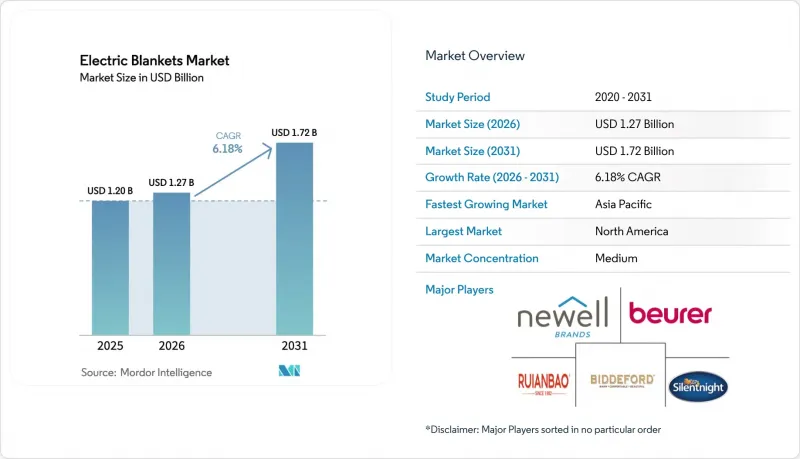
According to Mordor Intelligence, the electric blankets market size is expected to grow from USD 1.20 billion in 2025 to USD 1.27 billion in 2026 and is forecast to reach USD 1.72 billion by 2031 at 6.18% CAGR over 2026-2031.
This report Segments Into by Type (Over Blankets, Under Blankets, and More), by Size (Single, Queen, and More), by Material (Polyester, Cotton, and More), by End-User (Household, Commercial), by Distribution Channel (Offline, Online), and Geography (North America, Europe, and More). The Market Forecasts are Provided in Terms of Value (USD)
Global Electric Blankets Market Trends and Insights
Rising Demand For Energy-Efficient Heating Solutions
Escalating energy tariffs are reshaping household behaviour. Consumers increasingly swap full-room systems for targeted warmth that costs only a fraction to run. Operating an electric blanket through the night now often totals less than the price of running central heating for one hour. That saving directly supports national emission-reduction goals by curbing residential power draw. Brands have responded with zonal thermostats and automatic shut-off timers that tailor heat output to user routines and avoid unnecessary energy loss. These attributes reinforce the appeal of the electric blankets market during winter spikes and in regions facing volatile utility bills.
Technological Advancements and Smart Features
The arrival of Wi-Fi modules, voice-assistant links, and learning algorithms is repositioning blankets as integral parts of connected sleep ecosystems. The Internet of Things Advisory Board has identified smart home integration as a key growth vector, with particular emphasis on interoperability standards that enable seamless integration with existing home automation systems . Dual-zone control lets partners keep individual comfort settings without wasting power. Adherence to open interoperability standards ensures a blanket can pair with existing smart-home hubs and sleep-tracking applications, which refine heat cycles in line with circadian patterns. Remote firmware updates extend product life by adding features post-purchase, a service model that deepens brand loyalty in mature segments of the electric blankets market.
Safety Concerns and Product Reliability
The 2022 revision of IEC 60335-2-17 tightened limits for overheat protection, leakage current, and controller accuracy. Compliance boosts consumer trust yet adds cost and lengthens development cycles. Brands counter hesitation by highlighting automatic shut-off functions, low-EMF wiring, and multistage safety testing on packaging and online listings. Transparent certifications under schemes such as UL 964 or the Japanese PSE label differentiate legitimate products from low-quality imports, a distinction vital to safeguarding the reputation of the electric blankets market.
Other drivers and restraints analyzed in the detailed report include:
- Health and Therapeutic Benefits
- Expansion into emerging markets
- High Product Prices and Limited Awareness In Emerging Markets
For complete list of drivers and restraints, kindly check the Table Of Contents.
Segment Analysis
Over Blankets held 45.10% of the electric blankets market in 2025 by offering portable warmth for beds, sofas, and vehicles. Their intuitive plug-and-play design keeps replacement cycles brisk, notably in climates with pronounced winter seasons. Under Blankets, projected at a 6.88% CAGR through 2031, satisfy rising interest in sleep-centric products that draw minimal power and provide uniform heat all night. Heated Throws add aesthetic flair for modern living rooms, whereas Electric Pads maintain a niche for targeted muscle relief.
Growing awareness of sleep hygiene shifts buyer attention toward Under Blankets that integrate pressure sensors, quilted toppers, and low-EMF wiring. These upgrades guard against hot spots and enhance nightly rest quality, reinforcing the premium narrative. Brands market each model within broader smart-bed ecosystems, encouraging users to synchronise heat schedules with lighting and audio cues, a trend that strengthens recurring sales inside the electric blankets market. The IEC 60335-2-17:2022 standard has introduced specific requirements for control elements and overheating protection, driving innovation in safety features across all product types International Electrotechnical Commission .
Queen models captured 37.81% of the electric blankets market size in 2025, reflecting bed-frame norms across North America and Europe. Dual controllers let couples fine-tune temperatures on each side, cutting disputes and reinforcing perceived value. Single blankets, however, are expanding fastest at a 7.95% CAGR through 2031. Solo urban dwellers, students, and seniors appreciate compact options that fit smaller rooms and lower energy bills.
Manufacturers are responding with storage-efficient designs and multi-functional features that enhance the value proposition in space-constrained environments. These smaller formats are increasingly designed with senior-specific features, including simplified controls, higher safety margins, and therapeutic heat distribution patterns that address age-related circulatory issues. King sizes retain premium cachet by adding multi-zone regulation and app dashboards that justify higher prices, while Full sizes preserve relevance as flexible solutions for guest rooms and transitional households.
Complete Report Scope:
- By Type
- Over Blankets
- Under Blankets
- Electric Pads
- Heated Throws
- Heated Mattress Pads
- By Size
- Single
- Full
- Queen
- King
- By Material
- Polyester
- Cotton
- Fleece
- Faux Fur
- Wool
- Acrylic
- By End-user
- Household
- Single-family Homes
- Senior-Living Facilities
- Student Housing
- Commercial
- Hospitality (Hotels, Resorts, Rentals)
- Healthcare (Hospitals, Nursing Homes, Clinics)
- Transportation (Airlines, Rail, Coach)
- Household
- By Distribution Channel
- Offline
- Specialty Bedding Stores
- Mass-Merchandisers & Department Stores
- Supermarkets / Hypermarkets
- Online
- Offline
- By Geography
- North America
- Canada
- United States
- Mexico
- South America
- Brazil
- Peru
- Chile
- Argentina
- Rest of South America
- Asia-Pacific
- India
- China
- Japan
- Australia
- South Korea
- South-East Asia (Singapore, Malaysia, Thailand, Indonesia, Vietnam, Philippines)
- Rest of Asia-Pacific
- Europe
- United Kingdom
- Germany
- France
- Spain
- Italy
- BENELUX (Belgium, Netherlands, Luxembourg)
- NORDICS (Denmark, Finland, Iceland, Norway, Sweden)
- Rest of Europe
- Middle East & Africa
- United Arab Emirates
- Saudi Arabia
- South Africa
- Nigeria
- Rest of Middle East & Africa
- North America
Geography Analysis
North America retained 49.05% of 2025 revenue thanks to cold winters, high discretionary incomes, and seasoned distribution networks. Growth centres on feature-rich models that integrate with smart-home hubs rather than on first-time purchases. Strict compliance with UL 964 requirements sustains consumer trust and influences global design standards. Canada shares these traits, with longer heating seasons elevating the energy-efficiency pitch. Mexico records sharper unit growth, centered in metropolitan zones where middle-class buyers adopt modern comfort technologies.
Asia-Pacific charts the steepest trajectory, expanding at a 12.13% CAGR through 2031. Japanese consumers expect high technical precision and elect products bearing the PSE mark, which protects incumbents but rewards exporters able to meet the bar. India's northern belt sees quick penetration as rural electrification improves and e-commerce fills retail gaps. South Korea's early embrace of home automation makes connected blankets commonplace, while Australia exhibits concentrated demand during winter months marked by elevated electricity tariffs. Emerging Southeast Asian economies gradually adopt blankets as air-conditioning costs drive interest in targeted warmth for cooler evenings.
Europe features sophisticated buyers who favor natural materials and robust safety assurances. The United Kingdom headlines adoption, buoyed by the notable price gap between whole-home heating and blanket use. Germany's consumers gravitate to precision engineering, reinforcing domestic champions such as Beurer. Nordic nations show high per-capita usage given protracted cold seasons, whereas Southern European markets depend more on hospitality acquisitions that offset milder domestic climates. Central and Eastern Europe present new room for growth as disposable incomes rise and renovation programs retrofit legacy heating infrastructure.
- Sunbeam Products / Newell Brands Inc.
- Beurer GmbH
- Rainbow Group (Ningbo)
- Biddeford Blankets LLC
- Silentnight Group Ltd.
- Homefront (Andrews UK)
- Dreamland (Lakeland)
- Morphy Richards
- Perfect Fit Industries LLC
- KODEN International
- Bedsure / A Bear Down Brands
- Xiaomi Inc.
- Medline Industries LP
- Hudson's Bay Company
- Argos Ltd.
- Kohl's Corp.
- Microlife Corporation
- Woolrich Inc.
- Slumberdown
- Imetec*
Additional Benefits:
- The market estimate (ME) sheet in Excel format
- 3 months of analyst support
TABLE OF CONTENTS
1 Introduction
- 1.1 Study Assumptions & Market Definition
- 1.2 Scope of the Study
2 Research Methodology
3 Executive Summary
4 Market Landscape
- 4.1 Market Overview
- 4.2 Market Drivers
- 4.2.1 Rising Demand for Energy-Efficient Heating Solutions
- 4.2.2 Technological Advancements and Smart Features
- 4.2.3 Health and Therapeutic Benefits
- 4.2.4 Expansion into Emerging Markets
- 4.2.5 Seasonal Demand and Cold Climates
- 4.3 Market Restraints
- 4.3.1 Safety Concerns and Product Reliability
- 4.3.2 High Product Prices and Limited Awareness in Emerging Markets
- 4.3.3 Competition from Alternative Heating Solutions
- 4.3.4 Seasonal Demand Cycles
- 4.3.5 Fluctuating Raw Material Prices and Supply-Chain Disruptions
- 4.4 Value / Supply-Chain Analysis
- 4.5 Regulatory Outlook
- 4.6 Technological Outlook
- 4.7 Porter's Five Forces
- 4.7.1 Threat of New Entrants
- 4.7.2 Bargaining Power of Buyers
- 4.7.3 Bargaining Power of Suppliers
- 4.7.4 Threat of Substitutes
- 4.7.5 Intensity of Competitive Rivalry
5 Market Size & Growth Forecasts
- 5.1 By Type
- 5.1.1 Over Blankets
- 5.1.2 Under Blankets
- 5.1.3 Electric Pads
- 5.1.4 Heated Throws
- 5.1.5 Heated Mattress Pads
- 5.2 By Size
- 5.2.1 Single
- 5.2.2 Full
- 5.2.3 Queen
- 5.2.4 King
- 5.3 By Material
- 5.3.1 Polyester
- 5.3.2 Cotton
- 5.3.3 Fleece
- 5.3.4 Faux Fur
- 5.3.5 Wool
- 5.3.6 Acrylic
- 5.4 By End-user
- 5.4.1 Household
- 5.4.1.1 Single-family Homes
- 5.4.1.2 Senior-Living Facilities
- 5.4.1.3 Student Housing
- 5.4.2 Commercial
- 5.4.2.1 Hospitality (Hotels, Resorts, Rentals)
- 5.4.2.2 Healthcare (Hospitals, Nursing Homes, Clinics)
- 5.4.2.3 Transportation (Airlines, Rail, Coach)
- 5.4.1 Household
- 5.5 By Distribution Channel
- 5.5.1 Offline
- 5.5.1.1 Specialty Bedding Stores
- 5.5.1.2 Mass-Merchandisers & Department Stores
- 5.5.1.3 Supermarkets / Hypermarkets
- 5.5.2 Online
- 5.5.1 Offline
- 5.6 By Geography
- 5.6.1 North America
- 5.6.1.1 Canada
- 5.6.1.2 United States
- 5.6.1.3 Mexico
- 5.6.2 South America
- 5.6.2.1 Brazil
- 5.6.2.2 Peru
- 5.6.2.3 Chile
- 5.6.2.4 Argentina
- 5.6.2.5 Rest of South America
- 5.6.3 Asia-Pacific
- 5.6.3.1 India
- 5.6.3.2 China
- 5.6.3.3 Japan
- 5.6.3.4 Australia
- 5.6.3.5 South Korea
- 5.6.3.6 South-East Asia (Singapore, Malaysia, Thailand, Indonesia, Vietnam, Philippines)
- 5.6.3.7 Rest of Asia-Pacific
- 5.6.4 Europe
- 5.6.4.1 United Kingdom
- 5.6.4.2 Germany
- 5.6.4.3 France
- 5.6.4.4 Spain
- 5.6.4.5 Italy
- 5.6.4.6 BENELUX (Belgium, Netherlands, Luxembourg)
- 5.6.4.7 NORDICS (Denmark, Finland, Iceland, Norway, Sweden)
- 5.6.4.8 Rest of Europe
- 5.6.5 Middle East & Africa
- 5.6.5.1 United Arab Emirates
- 5.6.5.2 Saudi Arabia
- 5.6.5.3 South Africa
- 5.6.5.4 Nigeria
- 5.6.5.5 Rest of Middle East & Africa
- 5.6.1 North America
6 Competitive Landscape
- 6.1 Market Concentration
- 6.2 Strategic Moves
- 6.3 Market Share Analysis
- 6.4 Company Profiles (includes Global level Overview, Market level overview, Core Segments, Financials as available, Strategic Information, Market Rank/Share for key companies, Products & Services, and Recent Developments)
- 6.4.1 Sunbeam Products / Newell Brands Inc.
- 6.4.2 Beurer GmbH
- 6.4.3 Rainbow Group (Ningbo)
- 6.4.4 Biddeford Blankets LLC
- 6.4.5 Silentnight Group Ltd.
- 6.4.6 Homefront (Andrews UK)
- 6.4.7 Dreamland (Lakeland)
- 6.4.8 Morphy Richards
- 6.4.9 Perfect Fit Industries LLC
- 6.4.10 KODEN International
- 6.4.11 Bedsure / A Bear Down Brands
- 6.4.12 Xiaomi Inc.
- 6.4.13 Medline Industries LP
- 6.4.14 Hudson's Bay Company
- 6.4.15 Argos Ltd.
- 6.4.16 Kohl's Corp.
- 6.4.17 Microlife Corporation
- 6.4.18 Woolrich Inc.
- 6.4.19 Slumberdown
- 6.4.20 Imetec*
7 Market Opportunities & Future Outlook
- 7.1 White-space & Unmet-Need Assessment

