PUBLISHER: Mordor Intelligence | PRODUCT CODE: 2119844

PUBLISHER: Mordor Intelligence | PRODUCT CODE: 2119844
Kids And Nursery Furniture - Market Share Analysis, Industry Trends & Statistics, Growth Forecasts (2026 - 2031)
According to Mordor Intelligence, kids and nursery furniture market size in 2026 is estimated at USD 35.58 billion, growing from 2025 value of USD 33.62 billion with 2031 projections showing USD 47.27 billion, growing at 5.84% CAGR over 2026-2031.
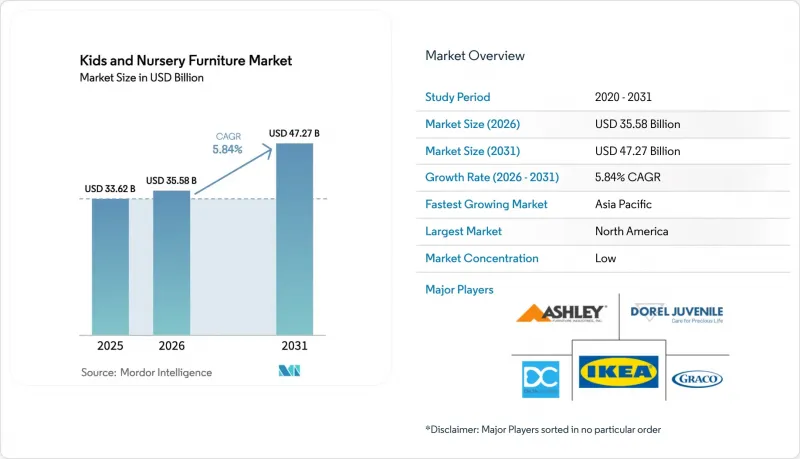
This report is Segmented by Product (Kids Tables, Kids Chairs, Cribs and Cots, Organizers and Storage, and More), by Material (Wood, Metal, and More), by Price Range (Economy, Mid-Range, and Premium), by Distribution Channel (Offline, and Online), by Geography (North America, South America, Europe, Asia-Pacific, and Middle East & Africa). The Market Forecasts are Provided in Terms of Value (USD).
Global Kids And Nursery Furniture Market Trends and Insights
Surge in D2C Brands Offering Customizable Nursery Sets
Digital-native brands are compressing traditional retail mark-ups by shipping directly to households and using social media for micro-targeting. Their online configurators let parents mix finishes, fabrics, and safety add-ons before checkout, boosting attachment rates for matching dressers and storage. Global incumbents are now rolling out their headless-commerce sites with AI-driven style advice, aiming to recapture margin leakage to start-ups.
Multi-Functional, Space-Saving Furniture Innovations
High-density city living is driving demand for convertible designs that fold, stack, or reconfigure as children grow. A modular crib-to-desk system showcased at global trade fairs in 2024 demonstrated 40% space savings and a 35% lifecycle cost reduction versus buying six single-purpose items. Manufacturers that fail to embed convertibility into new catalog launches are losing up to 15% unit share in top-tier cities such as Shanghai and Paris. The kids and nursery furniture market increasingly rewards producers that patent hinge mechanisms and telescopic rails, allowing quick transitions without tools.
Raw Material Price Volatility Challenges
Lumber prices swung up to 25% in 2024, eroding margins for furniture makers locked into fixed contracts. Leading timber supplier Weyerhaeuser recorded a 7.2% revenue decline in 2024 as softwood pricing eased alongside weaker construction demand. Firms without hedging programs saw gross-margin compression of 3-5 points and accelerated their move toward engineered panels and recycled composites that offer steadier cost bases. Larger players are forging multi-year offtake agreements with sawmills to stabilize input costs.
Other drivers and restraints analyzed in the detailed report include:
- Sustainable Materials Driving Premium Segment Growth
- Millennial and Gen Z Parenting Preferences
- Second-Hand and Rental Platform Disruption
For complete list of drivers and restraints, kindly check the Table Of Contents.
Segment Analysis
Kids chairs, including highchairs and gliders, are on course for the strongest 6.08% CAGR through 2031. Height-adjustable trays, posture-support inserts, and Bluetooth-enabled weight sensors differentiate premium launches, lifting average selling prices by 25-30%. Cribs and cots retained 31.72% of kids and the nursery furniture market share in 2025 amid ongoing improvements in sleep-monitoring add-ons and toddler-bed conversion kits. Organizers and storage units are rising fastest in high-rent metros where every square foot counts, while change tables and specialty nursing seats remain smaller but profitable niches.
Industry makers who positioned chairs as long-term companions-converting from infant feeding to junior study seating-extended product lifespans to 7-10 years and reduced replacement churn. That strategy aligns with the kids and nursery furniture market's emphasis on sustainability because parents perceive multi-phase use as waste reduction.
Wood held 59.45% of the kids and nursery furniture market size in 2025, thanks to its perceived warmth, durability, and timeless styling. FSC-verified supply chains and water-based finishes now headline marketing campaigns. Regional initiatives such as the Welsh Government's Timber Industrial Strategy underscore timber's low embodied-carbon advantage for consumer goods.
Plastic & Polymer, however, are forecast to clock a 6.28% CAGR as advances in non-phthalate formulations drive acceptance among safety-conscious buyers. Wood-plastic composites meeting EN71 criteria marry the tactile appeal of wood grain with the scratch resistance of thermoplastics, opening design freedom for bold color palettes. Metal frames continue to provide structural reinforcement, while emerging materials like bamboo and cork draw niche interest among eco-focused households.
Complete Report Scope:
- By Product
- Kids Tables (Including Changing Tables)
- Kids Chairs (Including Highchairs, Gliders, etc.)
- Cribs and Cots
- Organizers and Storage
- Other Products
- By Material
- Wood
- Metal
- Plastic & Polymer
- Other Materials
- By Price Range
- Economy
- Mid-Range
- Premium
- By Distribution Channel
- Offline
- Supermarkets and Hypermarkets
- Home Centers
- Specialty Furniture Stores
- Online
- Offline
- By Geography
- North America
- Canada
- United States
- Mexico
- South America
- Brazil
- Peru
- Chile
- Argentina
- Rest of South America
- Europe
- United Kingdom
- Germany
- France
- Spain
- Italy
- BENELUX (Belgium, Netherlands, and Luxembourg)
- NORDICS (Denmark, Finland, Iceland, Norway, and Sweden)
- Rest of Europe
- Asia-Pacific
- India
- China
- Japan
- Australia
- South Korea
- South East Asia (Singapore, Malaysia, Thailand, Indonesia, Vietnam, and Philippines)
- Rest of Asia-Pacific
- Middle East And Africa
- United Arab of Emirates
- Saudi Arabia
- South Africa
- Nigeria
- Rest of Middle East And Africa
- North America
Geography Analysis
North America retained the largest regional slice at 32.68% in 2025, underpinned by high spending power and rapid uptake of IoT-enabled nursery gear. Updated US safety standards for non-full-size cribs and play yards, effective April 2025, further raise the baseline for compliance and reinforce consumer trust. The kids and nursery furniture market size for smart-equipped models is therefore scaling fastest in the United States and Canada, where baby-monitoring apps are commonplace.
Asia-Pacific is projected to deliver a 6.64% CAGR through 2031, making it the foremost growth engine. Chinese city dwellers favor modular systems that fold flat or extend vertically, while Indian parents are gravitating toward natural materials paired with compact footprints. E-commerce penetration is widening its reach beyond tier-one cities, enabling premium brands to court customers who previously lacked access to specialty stores. Southeast Asia's youthful demographic profile adds long-run tailwinds for crib and storage categories.
Europe presents a mature but innovation-driven landscape where sustainability, design longevity, and compliance with stringent REACH chemical standards dominate purchase criteria. South America, led by Brazil, is seeing mid-range imported nursery suites gain favor as middle-class households expand. In the Middle East and Africa, premium European labels enjoy cachet among affluent buyers, and local producers are beginning to localize convertible designs to suit compact urban apartments in the Gulf Cooperation Council states.
- IKEA
- Delta Children
- Ashley Furniture Industries
- Graco (Newell Brands)
- Dorel Juvenile
- Fisher-Price
- KidKraft
- Storkcraft
- Dream On Me
- Summer Infant Inc.
- Babyletto
- Flexa4Dream
- Little Folks Furniture
- Micuna S.L.
- Brevi S.p.A.
- Billion Dollar Baby Co.
- Sorelle Furniture
- Circu Magical Furniture
- Casa Kids
- Universal Kids Furniture
- Pali Design
- Oeuf LLC
- Boori
- DaVinci Baby
Additional Benefits:
- The market estimate (ME) sheet in Excel format
- 3 months of analyst support
TABLE OF CONTENTS
1 Introduction
- 1.1 Study Assumptions & Market Definition
- 1.2 Scope of the Study
2 Research Methodology
3 Executive Summary
4 Market Landscape
- 4.1 Market Overview
- 4.2 Market Drivers
- 4.2.1 Surge in Online Direct-to-Consumer (D2C) Furniture Brands Offering Customisable Nursery Sets Globally
- 4.2.2 Growing Consumer Preference for Multi-Functional, Space-Saving Kids' Furniture Driven by Urban Living Trends Worldwide
- 4.2.3 Rising Demand for Sustainable, Non-Toxic Materials (FSC Wood, VOC-Free Finishes) Across Global Parenting Communities
- 4.2.4 Increasing Global Birth Rates Among Millennial & Gen Z Parents Coupled with Higher Disposable Incomes
- 4.2.5 Integration of IoT & Smart Safety Features (Sleep-Monitoring Cribs, Height-Adjustable Desks) Accelerating Product Replacement Cycles Worldwide
- 4.3 Market Restraints
- 4.3.1 Volatile Lumber and Resin Prices Elevating Production Costs for Kids & Nursery Furniture Worldwide
- 4.3.2 Intensifying Competition from Second-Hand & Rental Platforms Undercutting New Furniture Demand Globally
- 4.3.3 Stringent Flammability & Chemical Compliance (REACH, Prop 65) Increasing Time-to-Market and Compliance Costs Globally
- 4.4 Industry Value Chain Analysis
- 4.5 Porter's Five Forces Analysis
- 4.5.1 Threat of New Entrants
- 4.5.2 Bargaining Power of Suppliers
- 4.5.3 Bargaining Power of Buyers
- 4.5.4 Threat of Substitutes
- 4.5.5 Competitive Rivalry
- 4.6 Insights into the Latest Trends and Innovations in the Market
- 4.7 Insights on Recent Developments (New Product Launches, Strategic Initiatives, Investments, Partnerships, JVs, Expansion, M&As, etc.) in the Market
5 Market Size & Growth Forecasts
- 5.1 By Product
- 5.1.1 Kids Tables (Including Changing Tables)
- 5.1.2 Kids Chairs (Including Highchairs, Gliders, etc.)
- 5.1.3 Cribs and Cots
- 5.1.4 Organizers and Storage
- 5.1.5 Other Products
- 5.2 By Material
- 5.2.1 Wood
- 5.2.2 Metal
- 5.2.3 Plastic & Polymer
- 5.2.4 Other Materials
- 5.3 By Price Range
- 5.3.1 Economy
- 5.3.2 Mid-Range
- 5.3.3 Premium
- 5.4 By Distribution Channel
- 5.4.1 Offline
- 5.4.1.1 Supermarkets and Hypermarkets
- 5.4.1.2 Home Centers
- 5.4.1.3 Specialty Furniture Stores
- 5.4.2 Online
- 5.4.1 Offline
- 5.5 By Geography
- 5.5.1 North America
- 5.5.1.1 Canada
- 5.5.1.2 United States
- 5.5.1.3 Mexico
- 5.5.2 South America
- 5.5.2.1 Brazil
- 5.5.2.2 Peru
- 5.5.2.3 Chile
- 5.5.2.4 Argentina
- 5.5.2.5 Rest of South America
- 5.5.3 Europe
- 5.5.3.1 United Kingdom
- 5.5.3.2 Germany
- 5.5.3.3 France
- 5.5.3.4 Spain
- 5.5.3.5 Italy
- 5.5.3.6 BENELUX (Belgium, Netherlands, and Luxembourg)
- 5.5.3.7 NORDICS (Denmark, Finland, Iceland, Norway, and Sweden)
- 5.5.3.8 Rest of Europe
- 5.5.4 Asia-Pacific
- 5.5.4.1 India
- 5.5.4.2 China
- 5.5.4.3 Japan
- 5.5.4.4 Australia
- 5.5.4.5 South Korea
- 5.5.4.6 South East Asia (Singapore, Malaysia, Thailand, Indonesia, Vietnam, and Philippines)
- 5.5.4.7 Rest of Asia-Pacific
- 5.5.5 Middle East And Africa
- 5.5.5.1 United Arab of Emirates
- 5.5.5.2 Saudi Arabia
- 5.5.5.3 South Africa
- 5.5.5.4 Nigeria
- 5.5.5.5 Rest of Middle East And Africa
- 5.5.1 North America
6 Competitive Landscape
- 6.1 Market Concentration
- 6.2 Strategic Moves
- 6.3 Market Share Analysis
- 6.4 Company Profiles (includes Global level Overview, Market level overview, Core Segments, Financials as available, Strategic Information, Market Rank/Share for key companies, Products & Services, and Recent Developments)
- 6.4.1 IKEA
- 6.4.2 Delta Children
- 6.4.3 Ashley Furniture Industries
- 6.4.4 Graco (Newell Brands)
- 6.4.5 Dorel Juvenile
- 6.4.6 Fisher-Price
- 6.4.7 KidKraft
- 6.4.8 Storkcraft
- 6.4.9 Dream On Me
- 6.4.10 Summer Infant Inc.
- 6.4.11 Babyletto
- 6.4.12 Flexa4Dream
- 6.4.13 Little Folks Furniture
- 6.4.14 Micuna S.L.
- 6.4.15 Brevi S.p.A.
- 6.4.16 Billion Dollar Baby Co.
- 6.4.17 Sorelle Furniture
- 6.4.18 Circu Magical Furniture
- 6.4.19 Casa Kids
- 6.4.20 Universal Kids Furniture
- 6.4.21 Pali Design
- 6.4.22 Oeuf LLC
- 6.4.23 Boori
- 6.4.24 DaVinci Baby
7 Market Opportunities & Future Outlook
- 7.1 Online Customization & DTC Growth

