PUBLISHER: Mordor Intelligence | PRODUCT CODE: 2119867

PUBLISHER: Mordor Intelligence | PRODUCT CODE: 2119867
Green Bonds - Market Share Analysis, Industry Trends & Statistics, Growth Forecasts (2026 - 2031)
According to Mordor Intelligence, the green bonds market size is expected to grow from USD 673.12 billion in 2025 to USD 699.11 billion in 2026 and is forecast to reach USD 844.61 billion by 2031 at 3.86% CAGR over 2026-2031.
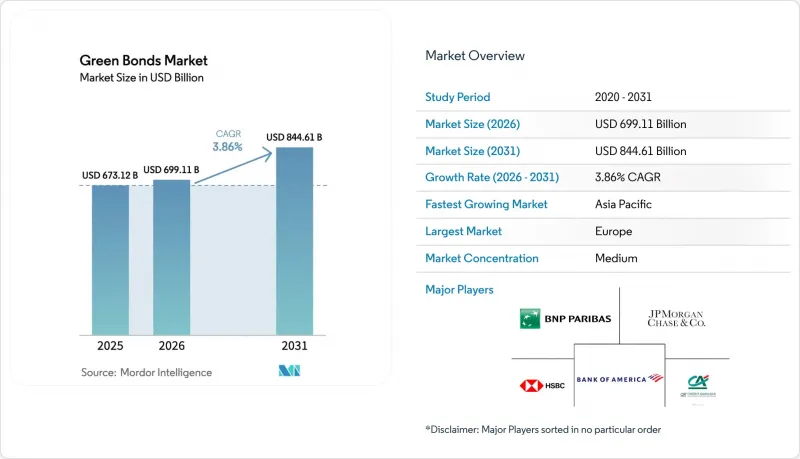
This report is Segmented by Issuer Type (Sovereigns, Supranationals & Agencies, Financial Corporates, Non-Financial Corporates, and Municipal & Local Authorities), Use-Of-Proceeds Sector (Energy, Buildings, Transport, Water & Wastewater, and More), Bond Format (Senior Unsecured, Asset-backed/Project Bond, Covered Bond, and More), and Geography. The Market Forecasts are Provided in Value (USD).
Global Green Bonds Market Trends and Insights
Sovereign Net-Zero Commitments Accelerating Sovereign Issuance
Sovereign issuance now anchors liquidity and price curves, exemplified by China's USD 824 million debut in London that set a cross-border RMB benchmark. Australia's USD 4.41 billion green bond attracted USD 13.86 billion in orders, illustrating the catalytic role of oversubscription in crowding in private capital. Canada expanded its framework to include nuclear expenditures, widening eligible assets without diluting environmental rigor. BIS analysis finds sovereign programs lift domestic corporate sustainable bond issuance by 23%, underscoring demonstration effects. With COP30 on the horizon, governments are timing deals to shape regional standards and secure first-mover reputational gains.
EU Green Bond Standard Spurring Corporate Supply
The EU Green Bond Standard (EuGB) took effect in December 2024, introducing external reviewer registration with ESMA and mandatory allocation reports. Only three issuers have adopted the EuGB so far, as compliance costs deter rapid uptake. The European Investment Bank's USD 3.15 billion EuGB issue sets a liquidity benchmark for corporates keen to tap Europe's USD 261.45 billion taxonomy-aligned investor pool. Financial institutions are early adopters because they already disclose taxonomy-aligned assets, gaining a funding cost edge that may spur competitive responses in other regions. As external jurisdictions reference EU criteria, arbitrage opportunities emerge for issuers able to navigate multiple taxonomies.
High Real Rates Widen Credit Spreads for Sub-Investment-Grade Issuers
Tighter monetary policy lifted 10-year Treasury yields by 40 basis points in early 2025, inflating borrowing costs for lower-rated issuers. ECB research shows compressed US spreads are vulnerable as USD 1 trillion of corporate debt awaits refinancing. Federal Reserve studies confirm the geranium accrues mainly to large investment-grade names, leaving smaller developers exposed to wider spreads. Higher discount rates erode net present values for long-term renewable projects, delaying some pipeline assets in emerging markets where subsidy buffers are thin. Issuers with foreign-currency liabilities face an added layer of risk as a strong USD amplifies debt-service burdens, prompting some to hedge rate and FX exposure at higher derivative costs. In response, multilaterals are extending blended-finance structures that absorb first-loss tranches, yet take-up remains limited by sovereign guarantee ceilings.
Other drivers and restraints analyzed in the detailed report include:
- Declining Clean-Energy LCOE Improves Project Bankability
- 'Biodiversity-Linked' Green Bonds Unlocking Nature Finance
- Persistent Greenwashing Concerns Raising Second-Party-Opinion Costs
For complete list of drivers and restraints, kindly check the Table Of Contents.
Segment Analysis
Sovereigns captured 31.85% of the green bond market share in 2025 as governments leveraged issuance for climate signaling ahead of multilateral forums. It highlights the growing role of governments in driving sustainable finance initiatives. Financial corporates are set to see their green bond market size grow at a 4.65% CAGR through 2031, driven by capital adequacy rules that encourage banks to prioritize ESG-linked assets. This trend reflects the increasing integration of environmental, social, and governance considerations into financial strategies. Additionally, the World Bank's USD 1.10 billion bond for 2025, which attracted a robust USD 1.95 billion in orders, underscored the steady benchmarks and perceived safety associated with development-bank paper, further solidifying investor confidence in supranational issuances.
Non-financial Corporates are reacting to supply-chain decarbonization pressures; Dow Chemical's USD 1.25 billion debut channels proceeds to its Path2Zero program. Municipal issuance remains underweighted at 23% of US green volume despite a USD 400 billion annual muni market, signaling a latent upside once disclosure protocols mature. Singapore's public housing agency issued USD 703 million in green notes, showcasing how sub-sovereigns can replicate sovereign playbooks to finance resilient infrastructure. A growing cadre of export credit agencies is also stepping in with guarantee schemes that lower coupons for industrial exporters, linking green bond proceeds to domestic content rules. Meanwhile, margin improvements for investment-grade corporates are encouraging repeat issuance programs that standardize documentation and shorten execution timelines.
Complete Report Scope:
- By Issuer Type
- Sovereigns
- Supranationals & Agencies
- Financial Corporates
- Non-Financial Corporates
- Municipal & Local Authorities
- By Use-of-Proceeds Sector
- Energy
- Buildings
- Transport
- Water & Wastewater
- Land Use & Biodiversity
- Industrial & ICT
- By Bond Format
- Senior Unsecured
- Asset-backed/Project Bond
- Covered Bond
- Sukuk
- By Geography
- North America
- Canada
- United States
- Mexico
- South America
- Brazil
- Peru
- Chile
- Argentina
- Rest of South America
- Europe
- United Kingdom
- Germany
- France
- Spain
- Italy
- BENELUX
- NORDICS
- Rest of Europe
- Asia-Pacific
- India
- China
- Japan
- Australia
- South Korea
- South-East Asia
- Rest of Asia-Pacific
- Middle East and Africa
- United Arab Emirates
- Saudi Arabia
- South Africa
- Nigeria
- Rest of Middle East and Africa
- North America
Geography Analysis
Europe commanded 43.70% of the green bond market in 2025, underpinned by pension-fund demand and the rollout of the EU Green Bond Standard. Germany's innovative twin-bond strategy, which issues both conventional and green tranches with synchronized maturities, has created distinct yield differentials, bolstering transparency in secondary pricing. Italy's BTP Green program allocated a significant USD 14.49 billion, projecting potential lifetime CO2 reductions of 66.6 million tons. However, a mere 9% of Europe's green bonds align fully with the EU taxonomy, highlighting a notable compliance gap that could hinder future issuances. This gap underscores the need for enhanced regulatory alignment and issuer adaptation to meet the stringent EU taxonomy requirements, which could influence the pace of green bond market growth in the region.
Asia-Pacific is the fastest-growing region at a 5.98% CAGR, buoyed by China's RMB-denominated sovereign green bond in London and Japan's USD 11 billion transition bond program. Hong Kong's innovative USD 765 million blockchain-based green bonds achieved a remarkable 15-20% savings in issuance costs, setting a precedent likely to be emulated by neighboring hubs. Singapore, under a consolidated framework, aims for a bold USD 35 billion in green issuances by 2030, reflecting its commitment to becoming a leading green finance hub. Meanwhile, Australia celebrated its first USD 4.41 billion deal, attracting global investor interest and signaling the country's growing focus on sustainable finance. The region's diverse approaches, from blockchain integration to large-scale sovereign programs, highlight its adaptability and potential to lead in green bond innovation.
In North America, progress is uneven. While US municipalities hold a modest share of the green bond market, state-level climate mandates in New York and California suggest a quicker adoption, especially with the arrival of standardized disclosures. These mandates, coupled with increasing investor awareness, are expected to accelerate green bond adoption in the United States. Canada's broadened framework, now inclusive of nuclear assets, diversifies eligible categories and signals robust federal endorsement, reflecting the country's strategic approach to expanding its green finance market. In South America, sovereigns are trailblazing with debt-for-nature swaps; Uruguay stands out, tying its KPI bond's coupon increments to forest conservation goals. This innovative approach aligns financial incentives with environmental outcomes, setting a benchmark for sustainable finance in the region. Over in the Middle East & Africa, the UAE and Saudi Arabia are at the forefront of the sustainable sukuk arena, artfully merging Islamic finance tenets with ESG commitments. Their leadership in this niche market underscores the region's ability to integrate cultural and financial principles with global sustainability standards, paving the way for further growth in sustainable finance.
- HSBC
- Credit Agricole CIB
- BNP Paribas
- Bank of America
- J.P. Morgan
- SEB
- NatWest Markets
- Citigroup
- Barclays
- Deutsche Bank
- UBS
- Mizuho Financial Group
- Societe Generale
- ING
- Goldman Sachs
- Industrial & Commercial Bank of China (ICBC)
- Fannie Mae
- KfW
- Nordea
- Standard Chartered
Additional Benefits:
- The market estimate (ME) sheet in Excel format
- 3 months of analyst support
TABLE OF CONTENTS
1 Introduction
- 1.1 Study Assumptions & Market Definition
- 1.2 Scope of the Study
2 Research Methodology
3 Executive Summary
4 Market Landscape
- 4.1 Market Overview
- 4.2 Market Drivers
- 4.2.1 Sovereign net-zero commitments accelerating sovereign issuance
- 4.2.2 EU Green Bond Standard spurring corporate supply
- 4.2.3 Declining clean-energy LCOE improves project bankability
- 4.2.4 'Biodiversity-linked' green bonds set to unlock nature finance
- 4.2.5 Tokenised green bonds lowering issuance costs for EM banks
- 4.2.6 Mutual-fund decarbonisation mandates driving muni green demand
- 4.3 Market Restraints
- 4.3.1 High real rates widen credit spreads for sub-investment grade issuers
- 4.3.2 Persistent 'green-washing' concerns raising second-party-opinion costs
- 4.3.3 Lack of interoperable Asian taxonomies stalls cross-border flows
- 4.3.4 Shrinking 'greenium' eroding pricing incentive
- 4.4 Value / Supply-Chain Analysis
- 4.5 Regulatory Landscape
- 4.6 Technological Outlook
- 4.7 Porter's Five Forces
- 4.7.1 Threat of New Entrants
- 4.7.2 Bargaining Power of Buyers
- 4.7.3 Bargaining Power of Suppliers
- 4.7.4 Threat of Substitutes
- 4.7.5 Competitive Rivalry
5 Market Size & Growth Forecasts (Value, USD)
- 5.1 By Issuer Type
- 5.1.1 Sovereigns
- 5.1.2 Supranationals & Agencies
- 5.1.3 Financial Corporates
- 5.1.4 Non-Financial Corporates
- 5.1.5 Municipal & Local Authorities
- 5.2 By Use-of-Proceeds Sector
- 5.2.1 Energy
- 5.2.2 Buildings
- 5.2.3 Transport
- 5.2.4 Water & Wastewater
- 5.2.5 Land Use & Biodiversity
- 5.2.6 Industrial & ICT
- 5.3 By Bond Format
- 5.3.1 Senior Unsecured
- 5.3.2 Asset-backed/Project Bond
- 5.3.3 Covered Bond
- 5.3.4 Sukuk
- 5.4 By Geography
- 5.4.1 North America
- 5.4.1.1 Canada
- 5.4.1.2 United States
- 5.4.1.3 Mexico
- 5.4.2 South America
- 5.4.2.1 Brazil
- 5.4.2.2 Peru
- 5.4.2.3 Chile
- 5.4.2.4 Argentina
- 5.4.2.5 Rest of South America
- 5.4.3 Europe
- 5.4.3.1 United Kingdom
- 5.4.3.2 Germany
- 5.4.3.3 France
- 5.4.3.4 Spain
- 5.4.3.5 Italy
- 5.4.3.6 BENELUX
- 5.4.3.7 NORDICS
- 5.4.3.8 Rest of Europe
- 5.4.4 Asia-Pacific
- 5.4.4.1 India
- 5.4.4.2 China
- 5.4.4.3 Japan
- 5.4.4.4 Australia
- 5.4.4.5 South Korea
- 5.4.4.6 South-East Asia
- 5.4.4.7 Rest of Asia-Pacific
- 5.4.5 Middle East and Africa
- 5.4.5.1 United Arab Emirates
- 5.4.5.2 Saudi Arabia
- 5.4.5.3 South Africa
- 5.4.5.4 Nigeria
- 5.4.5.5 Rest of Middle East and Africa
- 5.4.1 North America
6 Competitive Landscape
- 6.1 Market Concentration
- 6.2 Strategic Moves
- 6.3 Market Share Analysis
- 6.4 Company Profiles (includes Global level Overview, Market level overview, Core Segments, Financials as available, Strategic Information, Market Rank/Share for key companies, Products & Services, and Recent Developments)
- 6.4.1 HSBC
- 6.4.2 Credit Agricole CIB
- 6.4.3 BNP Paribas
- 6.4.4 Bank of America
- 6.4.5 J.P. Morgan
- 6.4.6 SEB
- 6.4.7 NatWest Markets
- 6.4.8 Citigroup
- 6.4.9 Barclays
- 6.4.10 Deutsche Bank
- 6.4.11 UBS
- 6.4.12 Mizuho Financial Group
- 6.4.13 Societe Generale
- 6.4.14 ING
- 6.4.15 Goldman Sachs
- 6.4.16 Industrial & Commercial Bank of China (ICBC)
- 6.4.17 Fannie Mae
- 6.4.18 KfW
- 6.4.19 Nordea
- 6.4.20 Standard Chartered
7 Market Opportunities & Future Outlook
- 7.1 White-space & Unmet-need Assessment

