PUBLISHER: Mordor Intelligence | PRODUCT CODE: 2119868

PUBLISHER: Mordor Intelligence | PRODUCT CODE: 2119868
Bed And Breakfast Accommodation - Market Share Analysis, Industry Trends & Statistics, Growth Forecasts (2026 - 2031)
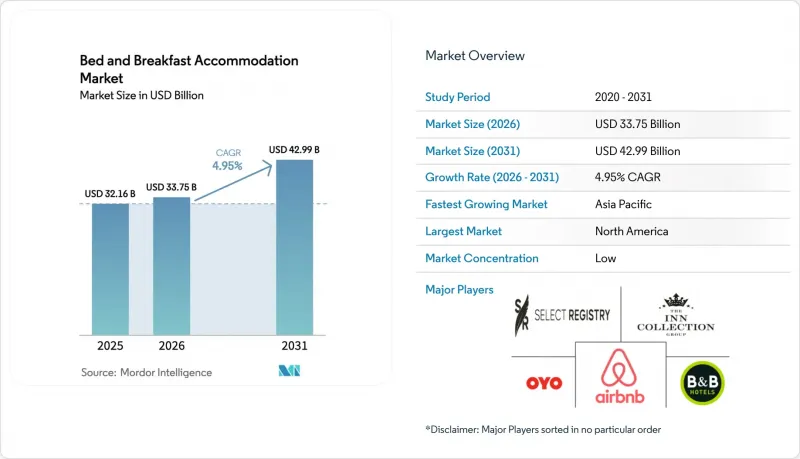
According to Mordor Intelligence, the bed and breakfast market size was valued at USD 32.16 billion in 2025 and estimated to grow from USD 33.75 billion in 2026 to reach USD 42.99 billion by 2031, at a CAGR of 4.95% during the forecast period (2026-2031).
This report Segments by Accommodation Type (Luxury B and Bs, Boutique / Heritage Inns, and More), Price Point (Luxury, Mid-Scale, and More), Traveller Type (Leisure, Business, and More), Booking Channel (Online Travel Agencies (OTAs), and More), Location Setting (Urban, Suburban, and More), Ownership Model (Independent, Franchise / Affiliated, and More), Geography (North America, and More).
Global Bed And Breakfast Accommodation Market Trends and Insights
Growing Demand for Personalized Experiential Travel
Travelers increasingly seek culturally rooted stays, and 54% of recent guests said local immersion now outweighs a property's star classification. Bed and breakfasts embed themselves in neighborhood life by partnering with artisans, farmers, and guides to craft one-off activities ranging from foraging walks to pottery workshops. Average U.S. guests booked 4.7 on-site experiences in 2023, up sharply from pre-pandemic norms, signaling higher ancillary-revenue opportunities. Millennials, who represent a large outbound cohort in Europe, commonly choose alternative lodging over chain hotels, fueling premium rates for story-rich heritage inns. Rural operators are layering in wellness sessions such as forest-bathing and yoga, positioning themselves for the fast-growing health-and-nature segment.
Rapid Expansion of Online Booking and OTA Ecosystems
Digital platforms captured a dominant share of reservations in 2024, yet direct website conversions display the strongest momentum at 12.9% CAGR through 2030. Commission-sensitive hosts now combine OTA reach for first-time discovery with sustained guest lifecycle tactics via email, loyalty perks, and mobile apps. The cost to acquire a direct booking fell to 7.1% of room revenue in 2023 as programmatic advertising tools matured, whereas OTA fees linger between 15% and 30%. Embedded AI within search engines automates personalized trip bundling, helping small properties deliver friction-free booking journeys. Voice search and "book-on-Google" flows are expected to elevate direct volumes further in the near term.
Tightening Zoning and STR Regulations
Provincial law in British Columbia restricts most urban short-term rentals to a principal residence, with significant fines for violators . Scotland now mandates licenses for all hosts, and parts of France require annual energy audits for new listings. City caps on permissible rental nights further constrain inventory in Paris, Barcelona, and Amsterdam. Compliance costs-ranging from safety certifications to digital registration-hit independent hosts hardest because they lack dedicated legal staff. In rural districts, the same rules often prove less stringent, producing an unintended shift of supply toward countryside markets.
Other drivers and restraints analyzed in the detailed report include:
- Surge in Domestic Short-Stay Tourism Post-Pandemic
- Rural Sustainability Grants Fueling Community B&Bs
- Intensifying Competition for Whole-Home Rentals
For complete list of drivers and restraints, kindly check the Table Of Contents.
Segment Analysis
Boutique and heritage inns captured 31.62% revenue in 2025, giving them the largest share across accommodation styles. Their curated architecture and localized storytelling tap directly into travelers' quest for memorable stays, a dynamic that keeps occupancy sturdy even during shoulder seasons. Within the bed and breakfast market, farm-stay and Agri-tourism venues register the quickest 9.22% CAGR, boosted by regional grants and consumer interest in food provenance. Luxury B&Bs, though niche, command high ADRs that fortify segment profitability during peak demand weekends. At the opposite end, economy units face margin compression from citywide yield wars against professional whole-home rentals.
Heritage hosts often integrate smart room controls and contactless check-ins while safeguarding historic character. This digital layer hastens guest satisfaction and raises review scores, protecting rate integrity. Agritourism sites in the European countryside leverage the bed and breakfast market size for rural tourism grants, reinforcing economic resilience. The segment's evolution underscores the broader preference shift toward immersive lodging over standardized hotel chains.
Online travel agencies owned 70.82% of reservations in 2025, yet direct website sales mark the fastest expansion path at 12.3% CAGR through 2031. Improved SEO, loyalty discounts, and one-click mobile payments empower independents to recapture costly OTA traffic. Predictive pricing engines adjust room rates against real-time comp-set data, ensuring channel profitability. Legacy offline agents still cater to seniors booking complex itineraries, but their share diminishes annually.
The shift toward direct bookings is supported by artificial intelligence integration in marketing platforms, with Google's Performance Max campaigns enabling small B&B operators to optimize advertising spend across multiple channels effectively. Mobile app adoption accelerates direct booking growth, particularly among younger travelers who prefer seamless, personalized booking experiences that OTAs struggle to deliver for individual properties.
Complete Report Scope:
- By Accommodation Type
- Luxury BandBs
- Boutique / Heritage Inns
- Farm-stay and Agri-tourism BandBs
- Budget / Economy BandBs
- By Price Point
- Luxury
- Mid-scale
- Economy
- By Traveller Type
- Leisure
- Business
- Bleisure / Work-cation
- Solo
- By Booking Channel
- Online Travel Agencies (OTAs)
- Direct Website / Mobile
- Offline Travel Agents
- By Location Setting
- Urban
- Suburban
- Rural
- Coastal / Island
- Heritage / Historic Towns
- By Ownership Model
- Independent
- Franchise / Affiliated
- Cooperative / Consortium
- By Geography
- North America
- Canada
- United States
- Mexico
- South America
- Brazil
- Peru
- Chile
- Argentina
- Rest of South America
- Asia-Pacific
- India
- China
- Japan
- Australia
- South Korea
- South East Asia (Singapore, Malaysia, Thailand, Indonesia, Vietnam, and Philippines)
- Rest of Asia-Pacific
- Europe
- United Kingdom
- Germany
- France
- Spain
- Italy
- BENELUX (Belgium, Netherlands, Luxembourg)
- NORDICS (Denmark, Finland, Iceland, Norway, Sweden)
- Rest of Europe
- Middle East and Africa
- United Arab Emirates
- Saudi Arabia
- South Africa
- Nigeria
- Rest of Middle East and Africa
- North America
Geography Analysis
North America retained 43.15% revenue share in 2025, buoyed by the United States' USD 1 trillion domestic travel spend and Canada's CAD 19.5 billion (USD 14.27 billion) accommodation turnover, up 14.7% year over year. Deep-rooted B&B culture in New England, the Pacific Northwest, and Atlantic Canada secures a stable guest pipeline, although urban zoning caps constrain new listings in cities such as New York and Vancouver. Mexico's revitalized heritage towns supplement regional momentum by attracting cross-border leisure traffic.
Asia-Pacific posts the quickest 8.45% CAGR through 2031 on the back of India's expanding middle class and China's progressive reopening. Improved air links streamlined visa processes, and government-funded rural tourism corridors spark fresh supply in hill stations, tea estates, and coastal fishing villages. Australia's state grants for agri-lodging conversion further draw investment to countryside estates. Varied regulations across jurisdictions require operators to fine-tune compliance strategies, yet the sheer scale of intra-regional travel propels steady occupancy gains.
Europe remains mature yet opportunity rich. Scotland's licensing, France's energy performance mandates, and Italy's new national accommodation codes raise compliance expenses, which could trigger consolidation. EU sustainability goals and Common Agricultural Policy funds channel capital into farmhouse restorations and eco-ins. Intraregional weekend breaks and rail travel keep domestic nights high, supporting occupancy even as long-haul segments fluctuate. Rural Brittany, the Italian Alps, and Eastern European wine valleys illustrate pockets where experiential demand sustains healthy rate growth despite broader regulatory friction.
- Airbnb, Inc.
- B&B HOTELS Group
- Booking Holdings Inc.
- Expedia Group Inc. (Vrbo)
- OYO Hotels & Homes
- Select Registry Distinguished Inns
- The Inn Collection Group
- RedAwning.com Inc.
- Vacasa
- Sonder Holdings Inc.
- Wyndham Hotels & Resorts
- Accor S.A. (greet, MGallery B&Bs)
- Choice Hotels International (Ascend Collection)
- Plum Guide
- Bedandbreakfast.eu
- MyBoutiqueHotel.com
- The Originals Human Hotels & Resorts
- Rural Retreats & Country Cottages
- Host & Stay
- Farm Stay UK*
Additional Benefits:
- The market estimate (ME) sheet in Excel format
- 3 months of analyst support
TABLE OF CONTENTS
1 Introduction
- 1.1 Study Assumptions & Market Definition
- 1.2 Scope of the Study
2 Research Methodology
3 Executive Summary
4 Market Landscape
- 4.1 Market Overview
- 4.2 Market Drivers
- 4.2.1 Growing Demand For Personalised Experiential Travel
- 4.2.2 Rapid Expansion Of Online Booking And Ota Ecosystems
- 4.2.3 Surge In Domestic Short-Stay Tourism Post-Pandemic
- 4.2.4 Rising Disposable Incomes Of Millennials And Boomers
- 4.2.5 Hybrid "Work-Cation" B&B Packages For Remote Workers
- 4.2.6 Rural Sustainability Grants Fuelling Community B&Bs
- 4.3 Market Restraints
- 4.3.1 Tightening Zoning And Str Regulations
- 4.3.2 Intensifying Competition From Whole-Home Rentals
- 4.3.3 Escalating Climate-Linked Insurance Premiums
- 4.3.4 Rural Labour Shortages Impacting Service Quality
- 4.4 Value / Supply-Chain Analysis
- 4.5 Regulatory Landscape
- 4.6 Technological Outlook
- 4.7 Porter's Five Forces Analysis
- 4.7.1 Bargaining Power of Suppliers
- 4.7.2 Bargaining Power of Buyers
- 4.7.3 Threat of New Entrants
- 4.7.4 Threat of Substitutes
- 4.7.5 Competitive Rivalry
5 Market Size & Growth Forecasts (Value)
- 5.1 By Accommodation Type
- 5.1.1 Luxury BandBs
- 5.1.2 Boutique / Heritage Inns
- 5.1.3 Farm-stay and Agri-tourism BandBs
- 5.1.4 Budget / Economy BandBs
- 5.2 By Price Point
- 5.2.1 Luxury
- 5.2.2 Mid-scale
- 5.2.3 Economy
- 5.3 By Traveller Type
- 5.3.1 Leisure
- 5.3.2 Business
- 5.3.3 Bleisure / Work-cation
- 5.3.4 Solo
- 5.4 By Booking Channel
- 5.4.1 Online Travel Agencies (OTAs)
- 5.4.2 Direct Website / Mobile
- 5.4.3 Offline Travel Agents
- 5.5 By Location Setting
- 5.5.1 Urban
- 5.5.2 Suburban
- 5.5.3 Rural
- 5.5.4 Coastal / Island
- 5.5.5 Heritage / Historic Towns
- 5.6 By Ownership Model
- 5.6.1 Independent
- 5.6.2 Franchise / Affiliated
- 5.6.3 Cooperative / Consortium
- 5.7 By Geography
- 5.7.1 North America
- 5.7.1.1 Canada
- 5.7.1.2 United States
- 5.7.1.3 Mexico
- 5.7.2 South America
- 5.7.2.1 Brazil
- 5.7.2.2 Peru
- 5.7.2.3 Chile
- 5.7.2.4 Argentina
- 5.7.2.5 Rest of South America
- 5.7.3 Asia-Pacific
- 5.7.3.1 India
- 5.7.3.2 China
- 5.7.3.3 Japan
- 5.7.3.4 Australia
- 5.7.3.5 South Korea
- 5.7.3.6 South East Asia (Singapore, Malaysia, Thailand, Indonesia, Vietnam, and Philippines)
- 5.7.3.7 Rest of Asia-Pacific
- 5.7.4 Europe
- 5.7.4.1 United Kingdom
- 5.7.4.2 Germany
- 5.7.4.3 France
- 5.7.4.4 Spain
- 5.7.4.5 Italy
- 5.7.4.6 BENELUX (Belgium, Netherlands, Luxembourg)
- 5.7.4.7 NORDICS (Denmark, Finland, Iceland, Norway, Sweden)
- 5.7.4.8 Rest of Europe
- 5.7.5 Middle East and Africa
- 5.7.5.1 United Arab Emirates
- 5.7.5.2 Saudi Arabia
- 5.7.5.3 South Africa
- 5.7.5.4 Nigeria
- 5.7.5.5 Rest of Middle East and Africa
- 5.7.1 North America
6 Competitive Landscape
- 6.1 Market Concentration
- 6.2 Strategic Moves & Developments
- 6.3 Market Share Analysis
- 6.4 Company Profiles (includes Global level Overview, Market level overview, Core Segments, Financials as available, Strategic Information, Market Rank/Share for key companies, Products & Services, and Recent Developments)
- 6.4.1 Airbnb, Inc.
- 6.4.2 B&B HOTELS Group
- 6.4.3 Booking Holdings Inc.
- 6.4.4 Expedia Group Inc. (Vrbo)
- 6.4.5 OYO Hotels & Homes
- 6.4.6 Select Registry Distinguished Inns
- 6.4.7 The Inn Collection Group
- 6.4.8 RedAwning.com Inc.
- 6.4.9 Vacasa
- 6.4.10 Sonder Holdings Inc.
- 6.4.11 Wyndham Hotels & Resorts
- 6.4.12 Accor S.A. (greet, MGallery B&Bs)
- 6.4.13 Choice Hotels International (Ascend Collection)
- 6.4.14 Plum Guide
- 6.4.15 Bedandbreakfast.eu
- 6.4.16 MyBoutiqueHotel.com
- 6.4.17 The Originals Human Hotels & Resorts
- 6.4.18 Rural Retreats & Country Cottages
- 6.4.19 Host & Stay
- 6.4.20 Farm Stay UK*
7 Market Opportunities & Future Outlook
- 7.1 White-space & Unmet-need Assessment

