PUBLISHER: Mordor Intelligence | PRODUCT CODE: 2119873

PUBLISHER: Mordor Intelligence | PRODUCT CODE: 2119873
Subscription E-commerce - Market Share Analysis, Industry Trends & Statistics, Growth Forecasts (2026 - 2031)
According to Mordor Intelligence, the subscription e-commerce market size is expected to grow from USD 180.48 billion in 2025 to USD 206.26 billion in 2026 and is forecast to reach USD 402.2 billion by 2031 at 14.28% CAGR over 2026-2031.
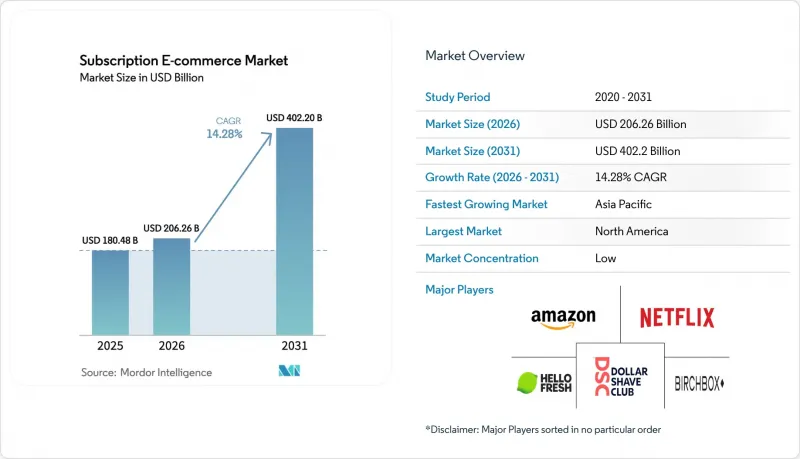
This report is Segmented by Subscription Model Type (Access (membership), Replenishment, Ad More), by Product Category (Beauty & Personal Care, Food & Beverages, and More), by Payment Mode (Credit / Debit Card, Digital Wallets, and More), by Geography (North America, South America, and More), and More Segments. The Market Forecasts are Provided in Terms of Value (USD).
Global Subscription E-commerce Market Trends and Insights
AI-powered hyper-personalization
Machine-learning engines now parse real-time usage patterns, historical orders, and external triggers to suggest replenishments or upgrades with better than 85% precision. Platforms that rolled out deep-learning models report significant gains in average revenue per user, confirming the revenue-uplift potential for the subscription e-commerce market. Generative AI automates customised content at scale, driving engagement email open rates by 37.37% across the subscription e-commerce market. Dynamic pricing modules use behavioural signals to optimise margins without eroding perceived value, strengthening lifetime profitability. Providers that fuse demographic, behavioural, and psychographic signals achieve up to one-third reduction in voluntary churn, demonstrating that data synthesis is central to resilience in the subscription e-commerce market. As AI tooling becomes more accessible, cost barriers drop, levelling the playing field for mid-sized operators.
Shift from ownership to "access" economy
Millennial and Gen Z cohorts prefer flexible usage over outright ownership, bolstering demand for vehicle, apparel, and electronics subscriptions. Low upfront cost, bundled maintenance, and rapid upgrade cycles heighten appeal, driving steady inflows into the subscription e-commerce market. Urbanisation compresses living space, making temporary access more practical than permanent possession, particularly for furniture or power tools. Automotive OEMs now couple insurance and over-the-air software updates into monthly packages, smoothing electric-vehicle adoption. Experience-oriented consumption is expected to remain a long-run catalyst in dense cities, sustaining structural tailwinds for the subscription e-commerce market.
Subscription fatigue & wallet-share limits
Visa's Subscription Manager streamlines subscription management by enabling cardholders to pause or cancel services with a single tap, reducing barriers to exit. The ongoing economic challenges have heightened consumer scrutiny over discretionary spending, prompting brands to enhance their offerings with value-added services such as expedited shipping, exclusive content, and VIP customer support. Regulatory requirements for transparent and straightforward cancellation processes are further intensifying the competitive landscape, compelling businesses to differentiate themselves effectively. These dynamics are driving merchants to prioritize utility by integrating complementary services that align with customer needs and justify continued spending. As a result, companies are increasingly focusing on delivering tangible value to retain wallet share amidst evolving consumer expectations and regulatory pressures.
Other drivers and restraints analyzed in the detailed report include:
- Subscription-friendly fintech rails
- Post-purchase analytics to cut churn
- Rising customer-acquisition costs on social platforms
For complete list of drivers and restraints, kindly check the Table Of Contents.
Segment Analysis
Hybrid models combine replenishment, access, and curation, enabling subscribers to toggle elements as needs evolve. The segment is expanding at 19.85% CAGR, the quickest rate within the subscription e-commerce market, reflecting its ability to blend inventory predictability with experiential variety. Replenishment still holds 35.75% of 2025 revenue, confirming durable demand for automatic delivery of consumables where usage patterns remain stable. Access memberships contribute about 25% of revenue, flourishing in digital media and automotive software, where early use unlocks premium value for the subscription e-commerce market. Curated boxes hover near a 15% share, drawing on surprise and personal discovery to sustain emotional bonds. Providers now deploy AI to automate shipment cadence, dissolving boundaries between models and reinforcing a single-customer view across the subscription e-commerce market.
Hybrid flexibility tempers subscription fatigue because users can pause or swap SKUs rather than cancel outright. Merchants gain diversified revenue streams that offset cyclical swings in single-model categories, raising lifetime value for the subscription e-commerce market. Fulfillment centres pool combined orders into a single parcel, lowering per-order logistics costs. Marketing teams insert replenishment staples into curated boxes, nudging customers toward broader baskets. Given these levers, hybrid formats are expected to keep outpacing other models in the subscription e-commerce market through 2031.
Health & wellness subscriptions are projected to grow at 21.15% CAGR, reflecting consumer focus on preventive care, personalised nutrition, and mental-health support . The category spans vitamin refills, tele-consultations, and DNA-guided diet plans synced with wearables, positioning it as a data-rich pillar within the subscription e-commerce market. Food & beverages retained the largest 2025 slice at 22.45% of revenue, with meal-kit operators exploiting supply-chain mastery to cut prep time below 30 minutes while sustaining freshness. Entertainment & digital media rolls out ad-supported tiers to balance price sensitivity with growth, maintaining a steady share of the subscription e-commerce market. Beauty lines integrate augmented-reality skin analysis that lifts recommendation accuracy, while pet-care boxes enjoy superior loyalty because owners prioritise animal well-being even during downturns.
Category diversification cushions the subscription e-commerce market against macro swings because different verticals peak at different seasons. Wellness plans spike during New Year fitness resolutions, whereas food kits rise during school terms. Operators cross-reference data to bundle complementary items, such as protein shakes with fitness apparel, driving multi-category revenue per household. Suppliers gain steadier demand forecasts, smoothing factory utilisation and lowering unit costs within the subscription e-commerce market. Regulators track health claims closely, pushing brands toward transparent labelling backed by scientific evidence to retain trust.
Complete Report Scope:
- By Subscription Model Type
- Access (membership)
- Replenishment
- Curation / Discovery Boxes
- Hybrid / Mixed
- By Product Category
- Beauty & Personal Care
- Food & Beverages
- Entertainment & Digital Media
- Fashion & Apparel
- Health & Wellness
- Pet Care
- Kids & Baby
- Home & Lifestyle
- Sports & Hobby Kits
- Other Niches
- By Payment Mode
- Credit / Debit Card
- Digital Wallets
- Buy-Now-Pay-Later (BNPL)
- Others (Direct Debit, Pay-by-Bank)
- By Platform Type
- Vertical-specific DTC
- Multi-category Marketplaces
- By Geography (Value, US$ Bn)
- North America
- United States
- Canada
- Mexico
- South America
- Brazil
- Argentina
- Chile
- Peru
- Rest of South America
- Europe
- United Kingdom
- Germany
- France
- Italy
- Spain
- BENELUX (Belgium, Netherlands, Luxembourg)
- NORDICS (Denmark, Finland, Iceland, Norway, Sweden)
- Rest of Europe
- Asia-Pacific
- China
- Japan
- India
- South Korea
- Australia
- South-East Asia
- Rest of Asia-Pacific
- Middle East and Africa
- Saudi Arabia
- United Arab Emirates
- South Africa
- Nigeria
- Rest of Middle East and Africa
- North America
Geography Analysis
North America held a 38.10% share in 2025, supported by high disposable income, advanced fulfilment networks, and consumer familiarity with recurring billing. Retailers deepened replenishment programs, and streaming platforms bundled mobile data to elevate perceived value. Regulatory insistence on one-click cancellations pressures brands to differentiate via experience rather than lock-in. Generative-AI chat agents now resolve 70% of support tickets without human escalation, preserving margins while sustaining satisfaction in the subscription e-commerce market.
Asia-Pacific is projected to contribute a 20.45% CAGR through 2031, reflecting smartphone ubiquity, rising middle-class spending, and e-commerce ecosystems that leapfrog brick-and-mortar retail. Digital wallets already outpace cards in transaction volume, fitting seamlessly into mobile-first subscription sign-ups in the subscription e-commerce market. Super-apps combine ride-hailing, meal delivery, and micro-insurance into multi-service bundles, raising average revenue per user at acquisition costs 45% below Western benchmarks. Domestic brands exploit influencer livestream commerce to scale rapidly, while logistics providers invest in cross-border express routes to sustain physical-goods subscriptions. Local regulators emphasise consumer protection and data localisation, shaping compliance frameworks for foreign entrants.
Europe's prospects brighten after the EU VAT in the Digital Age directive, adopted in February 2025, mandates real-time invoicing by July 2030, slashing compliance burden for cross-border subscription invoices. Nordic markets pioneer sustainable refill models, whereas Southern Europe sees rising appetite for lifestyle boxes. SEPA instant transfers settle payments within seconds, reinforcing consumer trust in recurring direct debits. Diversified cultural preferences keep category mixes varied across Europe, compelling merchants to localise assortments for optimal traction in the subscription e-commerce market.
- Amazon (Subscribe & Save)
- Netflix
- HelloFresh
- Dollar Shave Club
- Birchbox
- Blue Apron
- IPSY
- Walmart+
- Spotify
- Disney+
- Peloton
- Chewy Autoship
- Stitch Fix
- FabFitFun
- Loot Crate
- Scentbird
- Bespoke Post
- KiwiCo
- Plantry
- BarkBox
Additional Benefits:
- The market estimate (ME) sheet in Excel format
- 3 months of analyst support
TABLE OF CONTENTS
1 Introduction
- 1.1 Study Assumptions & Market Definition
- 1.2 Scope of the Study
2 Research Methodology
3 Executive Summary
4 Market Landscape
- 4.1 Market Overview
- 4.2 Market Drivers
- 4.2.1 AI-powered hyper-personalisation
- 4.2.2 Shift from ownership to "access" economy
- 4.2.3 Subscription-friendly fintech rails (pay-by-bank, BNPL)
- 4.2.4 Post-purchase analytics to slash churn
- 4.2.5 Corporate sustainability targets boosting refill models
- 4.2.6 Digital VAT reforms that harmonize cross-border billing
- 4.3 Market Restraints
- 4.3.1 Subscription fatigue & wallet-share limits
- 4.3.2 Rising customer-acquisition costs on social platforms
- 4.3.3 Fragmented global tax compliance for recurring billing
- 4.3.4 High last-mile logistics costs in emerging markets
- 4.4 Value / Supply-Chain Analysis
- 4.5 Regulatory Landscape
- 4.6 Technological Outlook
- 4.7 Porter's Five Forces
- 4.7.1 Threat of New Entrants
- 4.7.2 Bargaining Power of Suppliers
- 4.7.3 Bargaining Power of Buyers
- 4.7.4 Threat of Substitutes
- 4.7.5 Competitive Rivalry
5 Market Size & Growth Forecasts
- 5.1 By Subscription Model Type
- 5.1.1 Access (membership)
- 5.1.2 Replenishment
- 5.1.3 Curation / Discovery Boxes
- 5.1.4 Hybrid / Mixed
- 5.2 By Product Category
- 5.2.1 Beauty & Personal Care
- 5.2.2 Food & Beverages
- 5.2.3 Entertainment & Digital Media
- 5.2.4 Fashion & Apparel
- 5.2.5 Health & Wellness
- 5.2.6 Pet Care
- 5.2.7 Kids & Baby
- 5.2.8 Home & Lifestyle
- 5.2.9 Sports & Hobby Kits
- 5.2.10 Other Niches
- 5.3 By Payment Mode
- 5.3.1 Credit / Debit Card
- 5.3.2 Digital Wallets
- 5.3.3 Buy-Now-Pay-Later (BNPL)
- 5.3.4 Others (Direct Debit, Pay-by-Bank)
- 5.4 By Platform Type
- 5.4.1 Vertical-specific DTC
- 5.4.2 Multi-category Marketplaces
- 5.5 By Geography (Value, US$ Bn)
- 5.5.1 North America
- 5.5.1.1 United States
- 5.5.1.2 Canada
- 5.5.1.3 Mexico
- 5.5.2 South America
- 5.5.2.1 Brazil
- 5.5.2.2 Argentina
- 5.5.2.3 Chile
- 5.5.2.4 Peru
- 5.5.2.5 Rest of South America
- 5.5.3 Europe
- 5.5.3.1 United Kingdom
- 5.5.3.2 Germany
- 5.5.3.3 France
- 5.5.3.4 Italy
- 5.5.3.5 Spain
- 5.5.3.6 BENELUX (Belgium, Netherlands, Luxembourg)
- 5.5.3.7 NORDICS (Denmark, Finland, Iceland, Norway, Sweden)
- 5.5.3.8 Rest of Europe
- 5.5.4 Asia-Pacific
- 5.5.4.1 China
- 5.5.4.2 Japan
- 5.5.4.3 India
- 5.5.4.4 South Korea
- 5.5.4.5 Australia
- 5.5.4.6 South-East Asia
- 5.5.4.7 Rest of Asia-Pacific
- 5.5.5 Middle East and Africa
- 5.5.5.1 Saudi Arabia
- 5.5.5.2 United Arab Emirates
- 5.5.5.3 South Africa
- 5.5.5.4 Nigeria
- 5.5.5.5 Rest of Middle East and Africa
- 5.5.1 North America
6 Competitive Landscape
- 6.1 Market Concentration
- 6.2 Strategic Moves
- 6.3 Market Share Analysis
- 6.4 Company Profiles (includes Global level Overview, Market level overview, Core Segments, Financials as available, Strategic Information, Market Rank/Share for key companies, Products & Services, and Recent Developments)
- 6.4.1 Amazon (Subscribe & Save)
- 6.4.2 Netflix
- 6.4.3 HelloFresh
- 6.4.4 Dollar Shave Club
- 6.4.5 Birchbox
- 6.4.6 Blue Apron
- 6.4.7 IPSY
- 6.4.8 Walmart+
- 6.4.9 Spotify
- 6.4.10 Disney+
- 6.4.11 Peloton
- 6.4.12 Chewy Autoship
- 6.4.13 Stitch Fix
- 6.4.14 FabFitFun
- 6.4.15 Loot Crate
- 6.4.16 Scentbird
- 6.4.17 Bespoke Post
- 6.4.18 KiwiCo
- 6.4.19 Plantry
- 6.4.20 BarkBox
7 Market Opportunities & Future Outlook
- 7.1 White-space & Unmet-need Assessment

