PUBLISHER: Mordor Intelligence | PRODUCT CODE: 2119876

PUBLISHER: Mordor Intelligence | PRODUCT CODE: 2119876
Thailand Data Center Networking - Market Share Analysis, Industry Trends & Statistics, Growth Forecasts (2026 - 2031)
According to Mordor Intelligence, Thailand data center networking market size in 2026 is estimated at USD 540.86 million, growing from 2025 value of USD 490 million with 2031 projections showing USD 886.32 million, growing at 10.38% CAGR over 2026-2031.
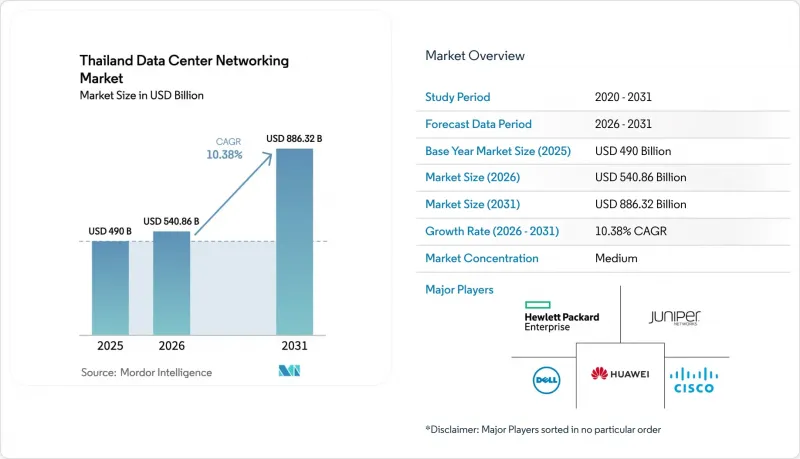
This report Segments the Industry Into Components (By Product, by Services), End-Users (IT & Telecommunication, BFSI, Other End-Users). Data-Center Type(Colocation, Hyperscalers/Cloud Service Providers, and More). And Bandwidth(<=10 GbE, 25-40 GbE, and More). The Market Forecasts are Provided in Terms of Value (USD).
Thailand Data Center Networking Market Trends and Insights
Cloud-first and hyperscale build-outs
Hyperscale cloud providers are scaling 400 GbE and 800 GbE fabrics to support AI and real-time analytics requirements concentrated in the Eastern Economic Corridor. Microsoft, AWS, and Google collectively announced more than USD 6 billion of incremental capacity in 2025 alone, triggering a steady upgrade cycle among regional carriers that peer with these facilities. The resulting demand for high-port-density spine switches and coherent optics is cascading into enterprise roadmaps. Vendors such as Ciena introduced 8192-slot coherent routers that deliver 800 Gbit/s per channel while consuming 30% less power. Large local banks are mirroring these architectures inside private cloud zones to keep latency below 1 ms for real-time payment rails.
Thailand 4.0 digital-economy initiatives
Public-sector digitalization mandates stable, low-latency networking from provincial hospitals to revenue-collection offices. Universal broadband targets by 2027 require hundreds of micro data centers at the sub-district level, each linked by software-defined WAN overlays. The Personal Data Protection Act is accelerating demand for encrypted east-west traffic visibility and zero-trust segmentation, pushing firewall throughput requirements above 1 Tb/s.
High capex for advanced networking gear
A typical 800 GbE leaf-spine deployment for a 5 MW facility can exceed USD 4 million in capital outlay, placing it beyond the reach of Thailand's mid-sized service providers. Leasing options are limited because local banks remain cautious about residual-value risk on rapidly obsoleting optical modules.
Other drivers and restraints analyzed in the detailed report include:
- OPEX-reduction pressure spurring network automation
- ASEAN Digital Gateway and cross-border traffic corridors
- Shortage of SDN / DevNet skill sets
For complete list of drivers and restraints, kindly check the Table Of Contents.
Segment Analysis
Products dominated 63.65% of 2025 revenue thanks to brisk orders for fixed-configuration spine switches and coherent optics. The Thailand data center networking market size for products is projected to reach USD 514.27 million by 2031 at an 8.12% CAGR, sustained by switch-to-server refresh cycles. In parallel, professional services, managed network operations, and training recorded a 11.78% CAGR, benefiting from scarce in-house DevSecOps talent. Enterprises choose managed services to obtain 24/7 monitoring and intent-based change control, cutting mean-time-to-repair below 30 minutes. Vendors bundle lifecycle support to guarantee firmware compliance under the Personal Data Protection Act. Demand for SLA-bound services stems from regulatory penalties that can exceed 3% of annual revenue for downtime-induced data breaches.
The Thailand data center networking market is also witnessing expanded consumption of proactive maintenance services that harness AI-driven telemetry. Operators ingest streaming sensor data into predictive models that pre-empt line-card failures up to 20 days in advance. Consulting and design services are in demand during edge-site build-outs, where space and cooling constraints call for custom topologies. Remote hands services gain traction among overseas cloud providers co-locating hardware in Bangkok but lacking resident engineers.
IT & telecommunications held 34.74% of Thailand data center networking market share in 2025, driven by 5G backhaul densification and OTT content caching nodes. Yet healthcare & life sciences will post a 12.96% CAGR through 2031 as hospitals digitalize imaging archives and deploy tele-ICU platforms. The Thailand data center networking market size for healthcare could top USD 112.34 million by 2031, assuming continued e-health reimbursement incentives. High-resolution CT scans generate 1-2 TB per session, pushing edge storage and 100 GbE interconnect mandates inside hospital campuses.
Pharmaceutical labs in Rayong are building air-gapped data centers for genome analytics using 400 GbE clusters. BFSI remains a high-value vertical with sustained appetite for deterministic low-latency networks supporting real-time settlement and fraud analytics. Government agencies expand secure WAN overlays that meet Cyber Security Act stipulations. Media & entertainment companies leverage adaptive bitrate encoding nodes placed in tourist hotspots, while manufacturing outfits operate private 5G MEC hubs enabling digital twins.
Complete Report Scope:
- By Component
- Products
- Ethernet Switches
- Routers
- Storage Area Network (SAN)
- Application Delivery Controllers (ADC)
- Network Security Appliances
- Software-Defined Networking (SDN) Controllers
- Optical Interconnects
- Services
- Installation and Integration
- Training and Consulting
- Support and Maintenance
- Managed Network Services
- Products
- By End-User
- IT and Telecommunications
- Banking, Financial Services and Insurance (BFSI)
- Government and Defense
- Media and Entertainment
- Healthcare and Life Sciences
- Manufacturing and Industrial
- Other End-Users
- By Data-Center Type
- Colocation
- Hyperscalers/Cloud Service Providers
- Edge/Micro Data Centers
- By Bandwidth
- Less Than equals to 10 GbE
- 25-40 GbE
- 50-100 GbE
- Greater Than 100 GbE
List of Companies Covered in this Report:
- Cisco Systems Inc.
- Huawei Technologies Co. Ltd.
- Juniper Networks Inc.
- Dell Technologies Inc.
- Hewlett Packard Enterprise (HPE)
- NVIDIA Corp. (Cumulus Networks)
- NEC Corporation
- IBM Corporation
- VMware Inc.
- Broadcom Inc.
- Schneider Electric SE
- Arista Networks Inc.
- Extreme Networks Inc.
- Fortinet Inc.
- F5 Inc.
- Edge-core Networks Corp.
- Super Micro Computer Inc.
- Nokia Corp.
- CommScope Holding Co.
- A10 Networks Inc.
Additional Benefits:
- The market estimate (ME) sheet in Excel format
- 3 months of analyst support
TABLE OF CONTENTS
1 INTRODUCTION
- 1.1 Study Assumptions and Market Definition
- 1.2 Scope of the Study
2 RESEARCH METHODOLOGY
3 EXECUTIVE SUMMARY
4 MARKET LANDSCAPE
- 4.1 Market Overview
- 4.2 Market Drivers
- 4.2.1 Cloud-first and hyperscale build-outs
- 4.2.2 Thailand 4.0 digital-economy initiatives
- 4.2.3 OPEX-reduction pressure spurring network automation
- 4.2.4 ASEAN Digital Gateway and cross-border traffic corridors
- 4.2.5 OTT video / e-sports edge-traffic outside Bangkok
- 4.2.6 ERC green-energy credit incentives for data centers
- 4.3 Market Restraints
- 4.3.1 High capex for advanced networking gear
- 4.3.2 Shortage of SDN / DevNet skill sets
- 4.3.3 Delays in subsea-cable landing permits
- 4.3.4 Rising electricity tariffs and looming carbon tax
- 4.4 Value / Supply-Chain Analysis
- 4.5 Regulatory Landscape
- 4.6 Technological Outlook
- 4.7 Porter's Five Forces
- 4.7.1 Threat of New Entrants
- 4.7.2 Bargaining Power of Buyers/Consumers
- 4.7.3 Bargaining Power of Suppliers
- 4.7.4 Threat of Substitute Products
- 4.7.5 Intensity of Competitive Rivalry
- 4.8 Assessment of the Impact on Macro Economic Trends on the Market
5 MARKET SIZE AND GROWTH FORECASTS (VALUE)
- 5.1 By Component
- 5.1.1 Products
- 5.1.1.1 Ethernet Switches
- 5.1.1.2 Routers
- 5.1.1.3 Storage Area Network (SAN)
- 5.1.1.4 Application Delivery Controllers (ADC)
- 5.1.1.5 Network Security Appliances
- 5.1.1.6 Software-Defined Networking (SDN) Controllers
- 5.1.1.7 Optical Interconnects
- 5.1.2 Services
- 5.1.2.1 Installation and Integration
- 5.1.2.2 Training and Consulting
- 5.1.2.3 Support and Maintenance
- 5.1.2.4 Managed Network Services
- 5.1.1 Products
- 5.2 By End-User
- 5.2.1 IT and Telecommunications
- 5.2.2 Banking, Financial Services and Insurance (BFSI)
- 5.2.3 Government and Defense
- 5.2.4 Media and Entertainment
- 5.2.5 Healthcare and Life Sciences
- 5.2.6 Manufacturing and Industrial
- 5.2.7 Other End-Users
- 5.3 By Data-Center Type
- 5.3.1 Colocation
- 5.3.2 Hyperscalers/Cloud Service Providers
- 5.3.3 Edge/Micro Data Centers
- 5.4 By Bandwidth
- 5.4.1 Less Than equals to 10 GbE
- 5.4.2 25-40 GbE
- 5.4.3 50-100 GbE
- 5.4.4 Greater Than 100 GbE
6 COMPETITIVE LANDSCAPE
- 6.1 Market Concentration
- 6.2 Strategic Moves
- 6.3 Market Share Analysis
- 6.4 Company Profiles (includes Global level Overview, Market level overview, Core Segments, Financials as available, Strategic Information, Market Rank/Share for key companies, Products and Services, and Recent Developments)
- 6.4.1 Cisco Systems Inc.
- 6.4.2 Huawei Technologies Co. Ltd.
- 6.4.3 Juniper Networks Inc.
- 6.4.4 Dell Technologies Inc.
- 6.4.5 Hewlett Packard Enterprise (HPE)
- 6.4.6 NVIDIA Corp. (Cumulus Networks)
- 6.4.7 NEC Corporation
- 6.4.8 IBM Corporation
- 6.4.9 VMware Inc.
- 6.4.10 Broadcom Inc.
- 6.4.11 Schneider Electric SE
- 6.4.12 Arista Networks Inc.
- 6.4.13 Extreme Networks Inc.
- 6.4.14 Fortinet Inc.
- 6.4.15 F5 Inc.
- 6.4.16 Edge-core Networks Corp.
- 6.4.17 Super Micro Computer Inc.
- 6.4.18 Nokia Corp.
- 6.4.19 CommScope Holding Co.
- 6.4.20 A10 Networks Inc.
7 MARKET OPPORTUNITIES and FUTURE OUTLOOK
- 7.1 White-space and Unmet-need Assessment

