PUBLISHER: Mordor Intelligence | PRODUCT CODE: 2119889

PUBLISHER: Mordor Intelligence | PRODUCT CODE: 2119889
Tissue Paper Converting Machines - Market Share Analysis, Industry Trends & Statistics, Growth Forecasts (2026 - 2031)
According to Mordor Intelligence, tissue paper converting machines market size in 2026 is estimated at USD 1.67 billion, growing from 2025 value of USD 1.61 billion with 2031 projections showing USD 1.98 billion, growing at 3.47% CAGR over 2026-2031.
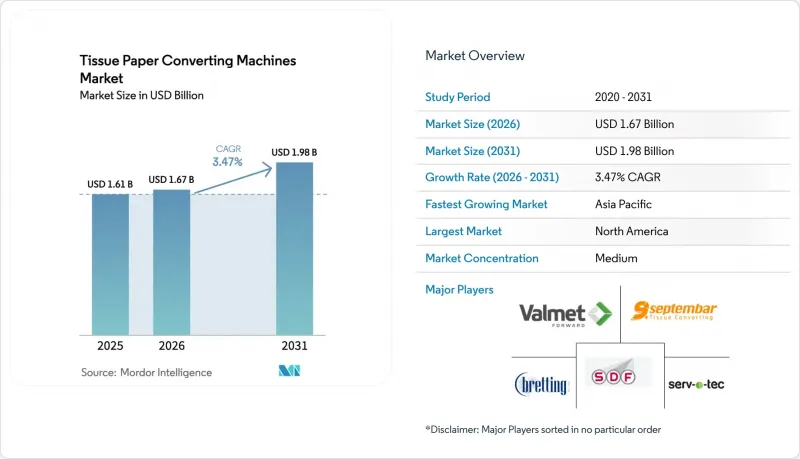
Tissue Paper Converting Machines Market by Technology (Automatic, Semi-Automatic), by Machine Type (Toilet Roll Converting Lines, Kitchen Roll Converting Lines, and More), End-Use Sector (At-Home (Retail), Away-From-Home), Production Speed (High-Speed Lines (>=800 M/Min, and More)), and by Geography. The Market Forecasts are Provided in Terms of Value (USD).
Global Tissue Paper Converting Machines Market Trends and Insights
Rising Global Tissue Consumption and Hygiene Awareness
Sustained post-pandemic hygiene priorities keep tissue volumes on an upward curve. Institutional buyers now request premium converting lines that can handle softer substrates, deeper embossing, and rapid changeovers for differentiated branding. New energy-efficient machines such as Toscotec's INGENIA cut energy use by 35% yet maintain through-air-dried quality, a combination that unlocks both cost and environmental gains. Commercial kitchens and food-service chains fuel steady orders for kitchen-roll formats with higher absorbency standards, pushing converters toward multi-emboss units and in-line ply bonding. Product mix complexity encourages factories to add flexible unwind stands and programmable knife systems, enabling them to shift between retail and institutional SKUs without long downtime. This sustained demand backdrop undergirds the tissue paper converting machines market and encourages continued equipment modernisation despite moderate headline growth.
Growing Trend of Automation in Tissue Converting
Automation now shapes competitive advantage. Automatic systems already represent two-thirds of installed capacity and grow faster than the broader tissue paper converting machines market. TAPPI's Tissue 101 and Tissue 202 courses highlight the sector's commitment to up-skilling operators for such lines. BW Converting's MIAC 2024 showcase introduced high-speed interfolders and coreless rewinding modules, proving that automation opens new product avenues. Fully integrated drives, servo knife positions, and automatic roll-handling robots shorten changeovers and trim labor costs while improving safety. Factories without such technology risk falling behind on cost, quality, and delivery reliability, prompting a replacement wave that keeps the tissue paper converting machines market expansion intact.
High Capex for Greenfield Converting Plants
A new integrated mill demands hundreds of millions of dollars. First Quality Tissue recently earmarked USD 984 million for two Thru-Air-Dried lines plus converting halls in Ohio. Even for established firms, such sums dictate lengthy payback horizons. Smaller companies often forgo large-scale builds and instead upgrade existing lines, which tempers incremental capacity growth in the tissue paper converting machines market. Interest-rate swings further complicate investment timing, especially in emerging regions where credit costs stay elevated.
Other drivers and restraints analyzed in the detailed report include:
- Sustainability-Oriented Innovations in Converting Tech
- Digital-Twin and IoT Boosting OEE
- Volatile Pulp and Energy Prices
For complete list of drivers and restraints, kindly check the Table Of Contents.
Segment Analysis
Automatic lines hold 65.15% of tissue paper converting machines market share in 2025 and expand at a 4.66% CAGR through 2031. These smart systems integrate servo drives, robotic roll handling, and camera-based defect detection. Their superior throughput and lower labor-to-output ratio lift factory productivity, helping purchasers offset higher sticker prices over the asset life. Semi-automatic units remain relevant to niche converters needing flexibility at modest capex, especially in developing economies where wage structures still favor manual intervention.
Advanced automation also provides the foundation for digital overlays. FactoryPal, now majority-owned by Valmet, feeds real-time data from automatic lines into AI models that propose set-point changes for uptime improvement. As more converters upgrade, the tissue paper converting machines market size for fully automatic solutions is projected to expand steadily, reinforcing the technology's dominant status.
Toilet-roll lines remain the volume backbone, accounting for 44.92% of the tissue paper converting machines market size in 2025. Yet kitchen-roll lines post the strongest 7.12% CAGR, reflecting consumer preference for thicker kitchen towels and heightened cleaning routines in food-service outlets. Embossing-pattern flexibility and ply bonding quality now influence purchase decisions more than raw speed, spurring OEMs to offer rapid-change print and emboss cassettes.
Folded-tissue and paper-napkin lines serve institutional catering, airlines, and hospitality. Although these segments grow slower, quick pack count changeovers and inline folding accuracy retain importance. OEMs developing multi-format platforms attract buyers aiming to amortise capex across diversified product portfolios, strengthening competition inside the tissue paper converting machines market.
Complete Report Scope:
- By Technology
- Automatic
- Semi-automatic
- By Machine Type
- Toilet-Roll Converting Lines
- Kitchen-Roll Converting Lines
- Folded-Tissue Converting Lines
- Paper-Napkin Converting Lines
- Stand-alone Systems
- By End-Use Sector
- At-Home (Retail)
- Away-from-Home (Commercial / Industrial)
- By Production Speed
- High-speed Lines (greater than 800 m/min)
- Medium-speed Lines (400-799 m/min)
- Low-speed Lines (less than 400 m/min)
- By Geography
- North America
- United States
- Canada
- Mexico
- Europe
- Germany
- United Kingdom
- France
- Italy
- Russia
- Rest of Europe
- Asia-Pacific
- China
- Japan
- India
- South Korea
- Southeast Asia
- Australia and New Zealand
- Rest of Asia-Pacific
- Middle East and Africa
- Middle East
- Saudi Arabia
- United Arab Emirates
- Turkey
- Rest of Middle East
- Africa
- South Africa
- Nigeria
- Egypt
- Rest of Africa
- South America
- Brazil
- Argentina
- Rest of South America
- Middle East
- North America
Geography Analysis
North America led the tissue paper converting machines market with 40.12% share in 2025. Recent commitments such as Kimberly-Clark's USD 2 billion multiyear upgrade program and First Quality Tissue's nearly USD 1 billion Thru-Air-Dried expansion illustrate continuous reinvestment in advanced assets. Retrofit activity also remains robust as mills pursue energy savings and digital dashboards to counter tight labor pools. Mature demand limits headline growth but underpins a reliable service and upgrade market for OEMs.
Asia-Pacific represents the principal growth engine with a forecast 6.63% CAGR to 2031. China's converters scale quickly, ordering European high-speed lines to raise domestic quality standards. Regional suppliers such as Baosuo and Dalian Mach provide cost-efficient alternatives, intensifying competition and broadening equipment access. Rising middle-class incomes raise per-capita tissue use, while government hygiene campaigns spur institutional consumption. These factors together promise the strongest absolute gains for the tissue paper converting machines market across all regions.
Europe balances technology leadership with strict sustainability codes. Italian brands OMET, Maflex, and Korber Tissue keep market clout by coupling mechanical performance with noise and energy compliance. Valmet's joint venture with Korber on digital services signals further innovation clustering in Europe. Although demand volumes rise modestly, premium equipment pricing and high aftermarket spend make Europe strategically important for technology diffusion across the global tissue paper converting machines market.
- C.G. Bretting Manufacturing Company Inc.
- Valmet Oyj
- 9. Septembar Tissue Converting
- SERV-O-TEC GmbH
- SDF Spezialmaschinen GmbH
- Zambak Kagit
- OMET Srl
- Kawanoe Zoki Co. Ltd
- MTorres Disenos Industriales S.A.U
- Baosuo Paper Machinery Manufacture Co. Ltd
- A.Celli Paper SpA
- United Converting Tissue SRL
- Futura SpA
- Paper Converting Machine Company (PCMC)
- Fujian TMX Machinery Mfg. Co. Ltd
- Chan Li Machinery Co. Ltd
- Unimax Group Engineering & Development Corp.
- ICM Makina
- Gambini SpA
- Korber Tissue (Korber Solutions)
Additional Benefits:
- The market estimate (ME) sheet in Excel format
- 3 months of analyst support
TABLE OF CONTENTS
1 INTRODUCTION
- 1.1 Study Assumptions and Market Definition
- 1.2 Scope of the Study
2 RESEARCH METHODOLOGY
3 EXECUTIVE SUMMARY
4 MARKET LANDSCAPE
- 4.1 Market Overview
- 4.2 Market Drivers
- 4.2.1 Rising global tissue consumption and hygiene awareness
- 4.2.2 Growing trend of automation in tissue converting
- 4.2.3 Sustainability-oriented innovations in converting tech
- 4.2.4 Digital-twin and IoT boosting OEE
- 4.2.5 Surge in private-label AfH short-run demand
- 4.3 Market Restraints
- 4.3.1 High capex for greenfield converting plants
- 4.3.2 Volatile pulp and energy prices
- 4.3.3 Shortage of skilled operators for advanced lines
- 4.3.4 Stricter noise and energy rules on machinery
- 4.4 Supply-Chain Analysis
- 4.5 Regulatory Landscape
- 4.6 Technological Outlook
- 4.7 Porter's Five Forces Analysis
- 4.7.1 Threat of New Entrants
- 4.7.2 Bargaining Power of Suppliers
- 4.7.3 Bargaining Power of Buyers
- 4.7.4 Threat of Substitutes
- 4.7.5 Industry Rivalry
- 4.8 Tissue-Paper Demand Trends and Impact on Production and Equipment
- 4.9 Market Trends in Tissue Converting Machines Industry
- 4.9.1 Future Market Trends and Growth Expectations
- 4.9.2 Key Challenges vs Competitor Innovations
- 4.9.3 Comparative Analysis - OMET Srl vs Competitors
- 4.9.4 Technology Insights - Tissue Converting Machines
5 MARKET SIZE AND GROWTH FORECASTS (VALUE)
- 5.1 By Technology
- 5.1.1 Automatic
- 5.1.2 Semi-automatic
- 5.2 By Machine Type
- 5.2.1 Toilet-Roll Converting Lines
- 5.2.2 Kitchen-Roll Converting Lines
- 5.2.3 Folded-Tissue Converting Lines
- 5.2.4 Paper-Napkin Converting Lines
- 5.2.5 Stand-alone Systems
- 5.3 By End-Use Sector
- 5.3.1 At-Home (Retail)
- 5.3.2 Away-from-Home (Commercial / Industrial)
- 5.4 By Production Speed
- 5.4.1 High-speed Lines (greater than 800 m/min)
- 5.4.2 Medium-speed Lines (400-799 m/min)
- 5.4.3 Low-speed Lines (less than 400 m/min)
- 5.5 By Geography
- 5.5.1 North America
- 5.5.1.1 United States
- 5.5.1.2 Canada
- 5.5.1.3 Mexico
- 5.5.2 Europe
- 5.5.2.1 Germany
- 5.5.2.2 United Kingdom
- 5.5.2.3 France
- 5.5.2.4 Italy
- 5.5.2.5 Russia
- 5.5.2.6 Rest of Europe
- 5.5.3 Asia-Pacific
- 5.5.3.1 China
- 5.5.3.2 Japan
- 5.5.3.3 India
- 5.5.3.4 South Korea
- 5.5.3.5 Southeast Asia
- 5.5.3.6 Australia and New Zealand
- 5.5.3.7 Rest of Asia-Pacific
- 5.5.4 Middle East and Africa
- 5.5.4.1 Middle East
- 5.5.4.1.1 Saudi Arabia
- 5.5.4.1.2 United Arab Emirates
- 5.5.4.1.3 Turkey
- 5.5.4.1.4 Rest of Middle East
- 5.5.4.2 Africa
- 5.5.4.2.1 South Africa
- 5.5.4.2.2 Nigeria
- 5.5.4.2.3 Egypt
- 5.5.4.2.4 Rest of Africa
- 5.5.4.3 South America
- 5.5.4.3.1 Brazil
- 5.5.4.3.2 Argentina
- 5.5.4.3.3 Rest of South America
- 5.5.4.1 Middle East
- 5.5.1 North America
6 COMPETITIVE LANDSCAPE
- 6.1 Market Concentration
- 6.2 Strategic Moves
- 6.3 Market Share Analysis
- 6.4 Company Profiles (includes Global-level Overview, Market-level Overview, Core Segments, Financials, Strategic Information, Market Rank/Share, Products and Services, Recent Developments)
- 6.4.1 C.G. Bretting Manufacturing Company Inc.
- 6.4.2 Valmet Oyj
- 6.4.3 9. Septembar Tissue Converting
- 6.4.4 SERV-O-TEC GmbH
- 6.4.5 SDF Spezialmaschinen GmbH
- 6.4.6 Zambak Kagit
- 6.4.7 OMET Srl
- 6.4.8 Kawanoe Zoki Co. Ltd
- 6.4.9 MTorres Disenos Industriales S.A.U
- 6.4.10 Baosuo Paper Machinery Manufacture Co. Ltd
- 6.4.11 A.Celli Paper SpA
- 6.4.12 United Converting Tissue SRL
- 6.4.13 Futura SpA
- 6.4.14 Paper Converting Machine Company (PCMC)
- 6.4.15 Fujian TMX Machinery Mfg. Co. Ltd
- 6.4.16 Chan Li Machinery Co. Ltd
- 6.4.17 Unimax Group Engineering & Development Corp.
- 6.4.18 ICM Makina
- 6.4.19 Gambini SpA
- 6.4.20 Korber Tissue (Korber Solutions)
7 MARKET OPPORTUNITIES AND FUTURE OUTLOOK
- 7.1 White-space and Unmet-Need Assessment

