PUBLISHER: Mordor Intelligence | PRODUCT CODE: 2119893

PUBLISHER: Mordor Intelligence | PRODUCT CODE: 2119893
360-Degree Camera - Market Share Analysis, Industry Trends & Statistics, Growth Forecasts (2026 - 2031)
According to Mordor Intelligence, the 360° camera market size was valued at USD 2.24 billion in 2025 and estimated to grow from USD 2.64 billion in 2026 to reach USD 5.98 billion by 2031, at a CAGR of 17.78% during the forecast period (2026-2031).
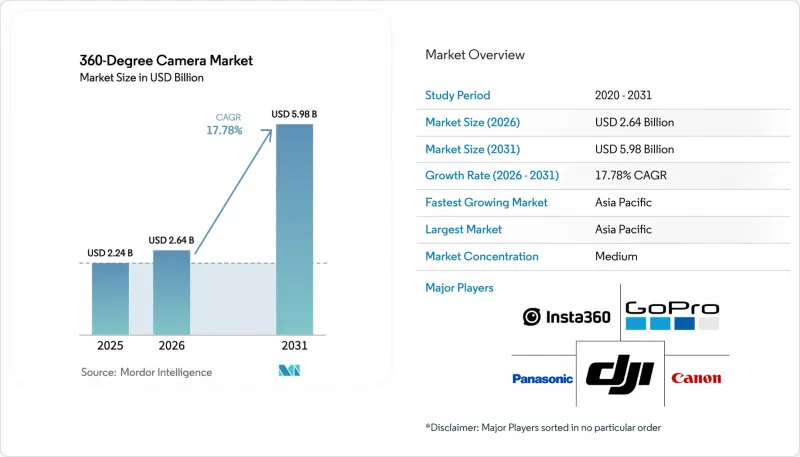
This report is Segmented by Connectivity Type (Wired, Wireless), Product Type (Single-Lens Pocket Cameras, and More), Resolution (High-Definition <=1080p, Ultra-HD 4K, Ultra-HD 8K and Above), End-User (Consumer, Media and Entertainment Production, and More), Distribution Channel (Online Marketplaces, Offline/Specialist Retail), and by Geography. The Market Forecasts are Provided in Terms of Value (USD).
Global 360-Degree Camera Market Trends and Insights
Integration of 360° cameras into autonomous-vehicle perception stacks in NA and EU pilot programs
Multimodal perception frameworks such as OmniDet demonstrate that surround-view fisheye arrays deliver depth estimation, visual odometry, and object detection at real-time throughput, supplying cost-effective blind-spot coverage that LiDAR alone cannot guarantee. Pilot fleets across Germany and California embed these rigs to move from Level 2 toward Level 4 capabilities, validating 360° vision as a critical path sensor. Research consortia like CoCar NextGen show the technology's role in data-centric development pipelines that shorten validation cycles for edge cases . The result is a measurable +3.2 percentage-point lift to forecast CAGR as automotive suppliers lock in multi-year sourcing commitments.
Surge in immersive live-streaming demand for esports and concerts across Asia
Production houses in Seoul, Singapore, and Shanghai now leverage glass-to-glass 360° workflows, integrating Panasonic AK-UC4000 chains with the KAIROS IP platform to eliminate moire under LED walls while pushing HDR feeds at sub-2-frame latency. Esports arenas report dwell-time extensions and monetizable viewpoint switching that translate into new advertising inventory. Concert promoters replicate the model, and national 5G rollouts underpin bandwidth headroom, driving a +2.8 percentage-point CAGR uplift.
Fragmented stitching-software standards hindering professional broadcast interoperability
Broadcasters face vendor lock-in as proprietary SDKs, such as NVIDIA VRWorks, dominate high-quality stitching workflows yet remain closed. VSF and EBU guidelines address transport but omit 360° stitching specifics, forcing studios to develop in-house tools that inflate capex and delay live-production rollouts . Until SMPTE ratifies a uniform mezzanine format, adoption stagnates, shaving 2.1 percentage points off CAGR.
Other drivers and restraints analyzed in the detailed report include:
- Rapid VR-based training adoption by Middle-East defense agencies
- Growth of virtual property-tour services in European luxury real-estate
- High bandwidth cost for UHD 360° streaming in emerging APAC
For complete list of drivers and restraints, kindly check the Table Of Contents.
Segment Analysis
Wireless systems commanded 66.42% of the 360° camera market in 2025 and are forecast to grow at an 17.98% CAGR. Automotive integrators favor Wi-Fi 6 and ultra-wideband links that simplify head-unit retrofits, while offshore inspection drones rely on sub-sea acoustic relays that remove tether requirements. Wired SDI continues in studio control rooms where zero-dropout reliability is non-negotiable. A wave of multi-path video-over-5G prototypes suggests further displacement of cabling in field production.
Emerging use cases in warehouse automation pair 360° vision with private 5G slices, allowing forklifts to stream low-latency feeds to edge AI servers. These systems are increasingly integrated with 3D camera solutions to improve object detection, navigation, and pallet positioning. As battery densities advance, operating hours extend, eroding the few remaining objections to wireless deployments. Vendor roadmaps prioritize firmware-level encryption to protect telematics data, cementing wireless as the default transport layer for the 360° camera market.
Single-lens pocket units held the largest share at 53.35% in 2025, popular among social-media creators for tap-to-share convenience. However, fleet insurers' mandates propel in-vehicle 360° dash-cams to an 18.22% CAGR. Automotive-grade enclosures with -40 °C cold-start ratings and ASIL-B compliant image sensors differentiate this sub-segment.
Professional multi-lens rigs, though niche, underpin premium volumetric video shoots and XR stages requiring sub-pixel parallax fidelity. Vendors address weight constraints through carbon-fiber housings and remove extraneous cabling to meet drone lift limits. As the 360° camera market size for industrial inspection widens, ruggedized multi-lens designs secure procurement from oil and gas operators seeking explosion-proof certifications.
Complete Report Scope:
- By Connectivity Type
- Wired
- Wireless
- By Product Type
- Single-Lens Pocket Cameras
- Multi-Lens Professional Rigs
- In-Vehicle 360- Dash-Cams
- By Resolution
- High-Definition (less than or equal to1080p)
- Ultra-HD 4K
- Ultra-HD 8K and Above
- By End-User
- Consumer
- Media and Entertainment Production
- Automotive (Surround-View and AD AS)
- Defence and Security
- Commercial Surveillance and Retail
- Healthcare and Tele-Surgery
- Travel, Tourism and Hospitality
- Industrial and Robotics Inspection
- Other End-user
- By Distribution Channel
- Online Marketplaces
- Offline / Specialist Retail
- By Geography
- North America
- United States
- Canada
- Mexico
- South America
- Brazil
- Argentina
- Rest of South America
- Europe
- United Kingdom
- Germany
- France
- Italy
- Spain
- Rest of Europe
- Asia-Pacific
- China
- Japan
- India
- South Korea
- Rest of Asia-Pacific
- Middle East and Africa
- Middle East
- GCC
- Turkey
- Israel
- Rest of Middle East
- Africa
- South Africa
- Nigeria
- Egypt
- Rest of Africa
- Middle East
- North America
Geography Analysis
Asia Pacific led the 360° camera market with a 41.50% share in 2025 and is forecast to grow at 18.74% CAGR. Chinese OEM clusters around Shenzhen integrate optics, ASICs, and casing under one roof, slashing lead times and enabling agile SKU pivots. Domestic players dominate local e-commerce festivals, then leverage scale to undercut competitors abroad, creating a virtuous production-volume loop. Regional 5G penetration and youth-skewing content consumption fuel prosumer upgrades, further enlarging addressable demand.
North America remains the largest individual national bloc by value, underpinned by autonomous vehicle pilots, Hollywood XR studios, and a risk-centric fleet insurance ecosystem. Regulatory momentum in states such as California mandates multi-sensor redundancy, embedding 360° cameras in perception stacks. The entertainment sector's premium for real-time volumetric capture fortifies pricing power, while defense contracts supply downside protection during consumer-market fluctuations.
Europe delivers steady adoption anchored in luxury real-estate virtual tours and industrial automation. GDPR compliance pressures have spawned privacy-by-design camera lines that auto-blur faces in public spaces, giving regional manufacturers a differentiation wedge. Cross-border live-production workflows-London galleries streaming Milan fashion catwalks-require interoperable stitching solutions; until standards mature, integrators bundle proprietary toolchains as value-added services.
- Insta360 (Arashi Vision Inc.)
- GoPro Inc.
- Samsung Electronics Co. Ltd.
- Sony Group Corp.
- Ricoh Co. Ltd.
- SZ DJI Technology Co. Ltd.
- Panasonic Holdings Corp.
- Nikon Corp.
- Canon Inc.
- LG Electronics Inc.
- Kandao Tech.
- Kodak Pixpro (JK Imaging)
- Immervision
- Panono (Professional360 GmbH)
- FeiyuTech
- Garmin Ltd.
- Rylo Inc. (Apple Vision Team)
- Xiaomi Corp.
- Wodsee Electronics Ltd.
- Hikvision
- FIMI Technology Ltd
Additional Benefits:
- The market estimate (ME) sheet in Excel format
- 3 months of analyst support
TABLE OF CONTENTS
1 INTRODUCTION
- 1.1 Study Assumptions and Market Definition
- 1.2 Scope of the Study
2 RESEARCH METHODOLOGY
3 EXECUTIVE SUMMARY
4 MARKET LANDSCAPE
- 4.1 Market Overview
- 4.2 Market Drivers
- 4.2.1 Integration of 360 Cameras into Autonomous Vehicle Perception Stacks in NA and EU Pilot Programs
- 4.2.2 Surge in Immersive Live-Streaming Demand for Esports and Concerts across Asia
- 4.2.3 Rapid VR-Based Training Adoption by Middle-East Defence Agencies
- 4.2.4 Growth of Virtual Property-Tour Services in European Luxury Real-Estate
- 4.2.5 Remote Industrial-Robot Inspection of Offshore Energy Assets
- 4.2.6 Fleet Insurers in the US Mandating 360- Dash-Cams for Telematics-based Risk Scoring
- 4.3 Market Restraints
- 4.3.1 Fragmented Stitching Software Standards Hindering Professional Broadcast Interoperability
- 4.3.2 High Bandwidth Cost for UHD 360- Streaming in Emerging Asia-Pacific
- 4.3.3 GDPR-Driven Privacy Litigation Risk for Public-Space Recording in EU
- 4.3.4 Thermal-Management Constraints in Compact Wearable Form-Factors
- 4.4 Supply-Chain Analysis
- 4.5 Regulatory and Technological Outlook
- 4.6 Porter's Five Forces Analysis
- 4.6.1 Bargaining Power of Suppliers
- 4.6.2 Bargaining Power of Buyers
- 4.6.3 Threat of New Entrants
- 4.6.4 Threat of Substitutes
- 4.6.5 Intensity of Competitive Rivalry
- 4.7 Investment Analysis
5 MARKET SIZE AND GROWTH FORECASTS (VALUE)
- 5.1 By Connectivity Type
- 5.1.1 Wired
- 5.1.2 Wireless
- 5.2 By Product Type
- 5.2.1 Single-Lens Pocket Cameras
- 5.2.2 Multi-Lens Professional Rigs
- 5.2.3 In-Vehicle 360- Dash-Cams
- 5.3 By Resolution
- 5.3.1 High-Definition (less than or equal to1080p)
- 5.3.2 Ultra-HD 4K
- 5.3.3 Ultra-HD 8K and Above
- 5.4 By End-User
- 5.4.1 Consumer
- 5.4.2 Media and Entertainment Production
- 5.4.3 Automotive (Surround-View and AD AS)
- 5.4.4 Defence and Security
- 5.4.5 Commercial Surveillance and Retail
- 5.4.6 Healthcare and Tele-Surgery
- 5.4.7 Travel, Tourism and Hospitality
- 5.4.8 Industrial and Robotics Inspection
- 5.4.9 Other End-user
- 5.5 By Distribution Channel
- 5.5.1 Online Marketplaces
- 5.5.2 Offline / Specialist Retail
- 5.6 By Geography
- 5.6.1 North America
- 5.6.1.1 United States
- 5.6.1.2 Canada
- 5.6.1.3 Mexico
- 5.6.2 South America
- 5.6.2.1 Brazil
- 5.6.2.2 Argentina
- 5.6.2.3 Rest of South America
- 5.6.3 Europe
- 5.6.3.1 United Kingdom
- 5.6.3.2 Germany
- 5.6.3.3 France
- 5.6.3.4 Italy
- 5.6.3.5 Spain
- 5.6.3.6 Rest of Europe
- 5.6.4 Asia-Pacific
- 5.6.4.1 China
- 5.6.4.2 Japan
- 5.6.4.3 India
- 5.6.4.4 South Korea
- 5.6.4.5 Rest of Asia-Pacific
- 5.6.5 Middle East and Africa
- 5.6.5.1 Middle East
- 5.6.5.1.1 GCC
- 5.6.5.1.2 Turkey
- 5.6.5.1.3 Israel
- 5.6.5.1.4 Rest of Middle East
- 5.6.5.2 Africa
- 5.6.5.2.1 South Africa
- 5.6.5.2.2 Nigeria
- 5.6.5.2.3 Egypt
- 5.6.5.2.4 Rest of Africa
- 5.6.5.1 Middle East
- 5.6.1 North America
6 COMPETITIVE LANDSCAPE
- 6.1 Market Concentration
- 6.2 Strategic Moves
- 6.3 Market Share Analysis
- 6.4 Company Profiles (includes Global-level Overview, Market-level Overview, Core Segments, Financials, Strategic Information, Market Rank/Share, Products and Services, Recent Developments)
- 6.4.1 Insta360 (Arashi Vision Inc.)
- 6.4.2 GoPro Inc.
- 6.4.3 Samsung Electronics Co. Ltd.
- 6.4.4 Sony Group Corp.
- 6.4.5 Ricoh Co. Ltd.
- 6.4.6 SZ DJI Technology Co. Ltd.
- 6.4.7 Panasonic Holdings Corp.
- 6.4.8 Nikon Corp.
- 6.4.9 Canon Inc.
- 6.4.10 LG Electronics Inc.
- 6.4.11 Kandao Tech.
- 6.4.12 Kodak Pixpro (JK Imaging)
- 6.4.13 Immervision
- 6.4.14 Panono (Professional360 GmbH)
- 6.4.15 FeiyuTech
- 6.4.16 Garmin Ltd.
- 6.4.17 Rylo Inc. (Apple Vision Team)
- 6.4.18 Xiaomi Corp.
- 6.4.19 Wodsee Electronics Ltd.
- 6.4.20 Hikvision
- 6.4.21 FIMI Technology Ltd
7 MARKET OPPORTUNITIES AND FUTURE OUTLOOK
- 7.1 White-space and Unmet-Need Assessment

