PUBLISHER: Mordor Intelligence | PRODUCT CODE: 2119894

PUBLISHER: Mordor Intelligence | PRODUCT CODE: 2119894
Contract Management Software - Market Share Analysis, Industry Trends & Statistics, Growth Forecasts (2026 - 2031)
According to Mordor Intelligence, contract management software market size in 2026 is estimated at USD 3.77 billion, growing from 2025 value of USD 3.48 billion with 2031 projections showing USD 5.64 billion, growing at 8.39% CAGR over 2026-2031.
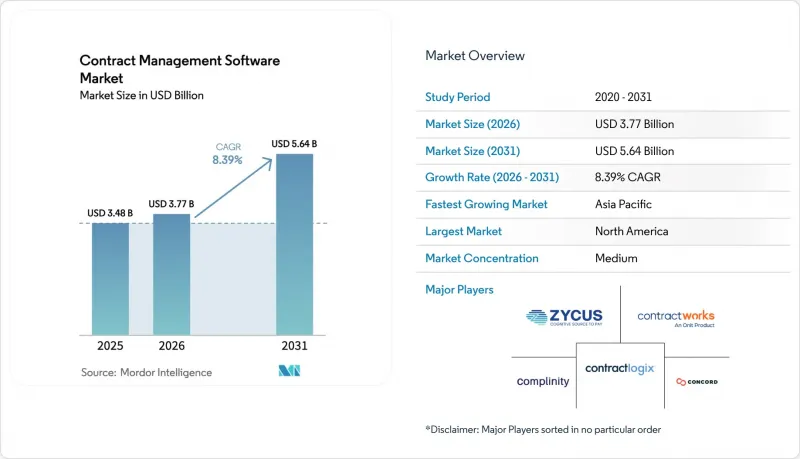
This report is Segmented by Deployment Mode (Cloud, and More), Component (Software, and More), Contract Type (Buy-Side, and More), Business Function (Legal, and More), Pricing Model (SaaS, and More), Integration Level (Standalone CLM, and More), Organization Size (SME, and More), End-User Industry (BFSI, and More), and Geography. The Market Forecasts are Provided in Terms of Value (USD).
Global Contract Management Software Market Trends and Insights
Surging Enterprise Demand for Unified Buy-Side and Sell-Side CLM Across Regulated Industries
Unified platforms let organizations monitor obligations and revenue leakages end-to-end, closing the 8.6% average value erosion gap highlighted in Deloitte's contract excellence survey. Industries with stringent oversight, such as healthcare under the Physician Payments Sunshine Act, prioritize integrated visibility so that procurement, legal, and finance teams detect overlapping clauses before penalties accrue. Financial institutions adopt the same logic to cross-reference trading agreements with onboarding documentation. The trend also shortens audit cycles, as auditors access a single source of truth rather than patchwork repositories
Rapid Shift to AI-Enabled Contract Analytics for Risk and Obligation Management in North America
Generative AI shifts contract repositories from passive storage to decision engines that highlight indemnity gaps, renewal triggers, and force-majeure clauses within seconds. DocuSign's Intelligent Agreement Management platform illustrates the new baseline; its AI review features contributed to USD 776 million Q4 2025 revenue, beating analyst expectations. Japanese conglomerates echo this value, with Sojitz Tech Innovation reclaiming 7,000 analyst hours annually via Contract One. As only 55% of legal departments formally employ CLM today, untapped upside remains substantial.
Fragmented Legacy Contract Data Silos Hindering AI Model Accuracy
Decades of unstructured PDFs and scanned images impede machine learning, forcing costly preprocessing. Conga's CEO notes that post-merger enterprises often cannot locate evergreen clauses across subsidiaries, risking missed revenue. Japanese firms solve the problem by bulk digitizing archives; Japan Oil Transportation cut 1,000 digitization hours with TOKIUM PR Times. Yet many global companies still face multi-year cleanup projects before AI delivers promised value
Other drivers and restraints analyzed in the detailed report include:
- Acceleration of Remote and Hybrid Work Models Driving E-Signature-Native CLM Adoption
- Vendor Push Toward Verticalised CLM Templates Boosting Uptake in Europe
- Low Digital Maturity of Tier-2 Suppliers in South America and Africa Limiting Addressable Market
For complete list of drivers and restraints, kindly check the Table Of Contents.
Segment Analysis
Cloud deployments accounted for 76.85% revenue in 2025 as regulators removed lock-in fears through the Data Act, which obliges providers to enable switching within 30 days. The contract management software market size for cloud solutions is projected to reach USD 4.32 billion by 2031 at an 8.32% CAGR. Enterprises prefer elastic capacity to ingest surges of contracts during mergers, while seamless API connectivity accelerates integrated workflows.
On-premise and hybrid models persist in defense and government, where sovereignty and air-gapped infrastructure are mandated. Specialized vendors such as Unison tailor secure enclaves that align with FedRAMP and ITAR directives.
Software retained 62.75% share in 2025, yet services outpace at 12.02% CAGR because organizations need consulting to harmonize processes, migrate data, and train users. Implementations covering people, process, and technology contain value erosion to near 3%, versus above 8% for tool-only rollouts.
Managed services also include AI model tuning, clause library curation, and ongoing compliance updates. Vendors bundle outcome-based engagements, assuring measurable risk-mitigation metrics that resonate with CFOs seeking post-implementation clarity.
Buy-side documents represented 55.12% revenue in 2025 because procurement teams rely on pricing, delivery, and quality clauses to control spend. Internal and policy-driven contracts grow faster at 9.12% as ESG and climate-disclosure rules escalate documentation needs. For example, SEC climate rules from May 2024 require granular reporting on supply chain impact, expanding internal audit workloads.
Sell-side contracts remain critical to recurring revenue, yet firms increasingly feed both commercial and internal documents into unified search so that cross-dependencies surface during renegotiations.
Complete Report Scope:
- By Deployment Mode
- Cloud
- On-premise
- By Component
- Software
- Services
- By Contract Type
- Buy-side
- Sell-side
- Non-commercial/Internal
- By Business Function
- Legal
- Sales and Marketing
- Procurement and Supply Chain
- Finance and Accounting
- HR and Administration
- By Pricing Model
- Subscription (SaaS)
- One-time License
- By Integration Level
- Standalone CLM
- Integrated with ERP/CRM/SCM suites
- By Organization Size
- Large Enterprises
- Small and Medium Enterprises (SMEs)
- By End-user Industry
- BFSI
- Government and Public Sector
- Healthcare and Life Sciences
- Retail and E-commerce
- Manufacturing and Automotive
- IT and Telecom
- Energy and Utilities
- Others (Media, Education, etc.)
- By Geography
- North America
- United States
- Canada
- Mexico
- Europe
- Germany
- United Kingdom
- France
- Nordics
- Rest of Europe
- South America
- Brazil
- Rest of South America
- Asia-Pacific
- China
- Japan
- India
- South-East Asia
- Rest of Asia-Pacific
- Middle East and Africa
- Middle East
- Gulf Cooperation Council Countries
- Turkey
- Rest of Middle East
- Africa
- South Africa
- Rest of Africa
- Middle East
- North America
Geography Analysis
North America accounted for 41.05% revenue in 2025 owing to complex litigation exposure, SEC climate-risk filings, and federal acquisition updates that add contract tracking layers. Cloud maturity and procurement digitalization keep the region ahead, while the GSA's AI Center of Excellence encourages agencies to modernize agreement workflows. Public-sector momentum spills into private verticals, reinforcing a self-sustaining adoption loop.
Asia-Pacific is the fastest climber at 9.18% CAGR through 2031. Japanese conglomerates report AI extraction accuracy hitting 98%, proving local language and format challenges can be solved at scale. South-East Asian SMEs, which represent 97% of enterprises, now gain affordable SaaS access as broadband and e-payment rails mature. China's manufacturing base and India's SaaS start-ups inject further velocity, aided by governments prioritizing cross-border trade digitalization.
Europe enjoys steady demand as the Data Act, effective September 2025, enforces portability, boosting confidence in cloud CLM. GDPR continues to drive specialized clauses for personal-data processing, while multilingual contract templates gain traction among pan-EU supply chains. Sub-regions like DACH and Nordics show above-average adoption because of advanced manufacturing and green-transition programs that rely on ESG-ready documentation.
South America and Middle East & Africa remain nascent, hampered by supplier digital gaps and data-residency concerns. Yet signs of momentum emerge as cloud data centers proliferate and governments publish electronic signature statutes. Vendors that offer offline-capable mobile apps position well for these frontier opportunities.
- SAP Ariba
- Icertis
- Conga (Apttus)
- DocuSign CLM (SpringCM)
- Coupa Software
- Agiloft
- SirionLabs
- JAGGAER
- Zycus
- Ironclad
- Gatekeeper
- ContractWorks
- Contract Logix
- CobbleStone Software
- Juro
- GEP Smart
- Corcentric
- Malbek Inc.
- Symfact
- Aavenir
- Lexion AI
Additional Benefits:
- The market estimate (ME) sheet in Excel format
- 3 months of analyst support
TABLE OF CONTENTS
1 INTRODUCTION
- 1.1 Study Assumptions and Market Definition
- 1.2 Scope of the Study
2 RESEARCH METHODOLOGY
3 EXECUTIVE SUMMARY
4 MARKET LANDSCAPE
- 4.1 Market Overview
- 4.2 Market Drivers
- 4.2.1 Surging enterprise demand for unified buy-side and sell-side CLM across regulated industries
- 4.2.2 Rapid shift to AI-enabled contract analytics for risk and obligation management in North America
- 4.2.3 Acceleration of remote and hybrid work models driving e-signature-native CLM adoption
- 4.2.4 Vendor push toward verticalised CLM templates (e.g., life sciences, utilities) boosting uptake in Europe
- 4.2.5 Rising pressure from ESG-linked supplier compliance mandates in global procurement
- 4.2.6 Integration of CLM with enterprise SaaS suites (ERP, CRM, PLM) lowering switching costs in Asia-Pacific
- 4.3 Market Restraints
- 4.3.1 Fragmented legacy contract data silos hindering AI model accuracy
- 4.3.2 Low digital maturity of Tier-2 suppliers in South America and Africa limiting addressable market
- 4.3.3 Complex change-management costs within highly regulated government agencies
- 4.3.4 Data-residency restrictions delaying cross-border cloud CLM roll-outs in MEA
- 4.4 Industry Ecosystem Analysis
- 4.5 Technological Outlook
- 4.6 Porter's Five Forces Analysis
- 4.6.1 Bargaining Power of Suppliers
- 4.6.2 Bargaining Power of Buyers
- 4.6.3 Threat of New Entrants
- 4.6.4 Threat of Substitutes
- 4.6.5 Intensity of Competitive Rivalry
5 MARKET SIZE AND GROWTH FORECASTS (VALUES)
- 5.1 By Deployment Mode
- 5.1.1 Cloud
- 5.1.2 On-premise
- 5.2 By Component
- 5.2.1 Software
- 5.2.2 Services
- 5.3 By Contract Type
- 5.3.1 Buy-side
- 5.3.2 Sell-side
- 5.3.3 Non-commercial/Internal
- 5.4 By Business Function
- 5.4.1 Legal
- 5.4.2 Sales and Marketing
- 5.4.3 Procurement and Supply Chain
- 5.4.4 Finance and Accounting
- 5.4.5 HR and Administration
- 5.5 By Pricing Model
- 5.5.1 Subscription (SaaS)
- 5.5.2 One-time License
- 5.6 By Integration Level
- 5.6.1 Standalone CLM
- 5.6.2 Integrated with ERP/CRM/SCM suites
- 5.7 By Organization Size
- 5.7.1 Large Enterprises
- 5.7.2 Small and Medium Enterprises (SMEs)
- 5.8 By End-user Industry
- 5.8.1 BFSI
- 5.8.2 Government and Public Sector
- 5.8.3 Healthcare and Life Sciences
- 5.8.4 Retail and E-commerce
- 5.8.5 Manufacturing and Automotive
- 5.8.6 IT and Telecom
- 5.8.7 Energy and Utilities
- 5.8.8 Others (Media, Education, etc.)
- 5.9 By Geography
- 5.9.1 North America
- 5.9.1.1 United States
- 5.9.1.2 Canada
- 5.9.1.3 Mexico
- 5.9.2 Europe
- 5.9.2.1 Germany
- 5.9.2.2 United Kingdom
- 5.9.2.3 France
- 5.9.2.4 Nordics
- 5.9.2.5 Rest of Europe
- 5.9.3 South America
- 5.9.3.1 Brazil
- 5.9.3.2 Rest of South America
- 5.9.4 Asia-Pacific
- 5.9.4.1 China
- 5.9.4.2 Japan
- 5.9.4.3 India
- 5.9.4.4 South-East Asia
- 5.9.4.5 Rest of Asia-Pacific
- 5.9.5 Middle East and Africa
- 5.9.5.1 Middle East
- 5.9.5.1.1 Gulf Cooperation Council Countries
- 5.9.5.1.2 Turkey
- 5.9.5.1.3 Rest of Middle East
- 5.9.5.2 Africa
- 5.9.5.2.1 South Africa
- 5.9.5.2.2 Rest of Africa
- 5.9.5.1 Middle East
- 5.9.1 North America
6 COMPETITIVE LANDSCAPE
- 6.1 Market Concentration
- 6.2 Strategic Moves
- 6.3 Market Share Analysis
- 6.4 Company Profiles {(includes Global level Overview, Market level overview, Core Segments, Financials as available, Strategic Information, Market Rank/Share for key companies, Products and Services, and Recent Developments)}
- 6.4.1 SAP Ariba
- 6.4.2 Icertis
- 6.4.3 Conga (Apttus)
- 6.4.4 DocuSign CLM (SpringCM)
- 6.4.5 Coupa Software
- 6.4.6 Agiloft
- 6.4.7 SirionLabs
- 6.4.8 JAGGAER
- 6.4.9 Zycus
- 6.4.10 Ironclad
- 6.4.11 Gatekeeper
- 6.4.12 ContractWorks
- 6.4.13 Contract Logix
- 6.4.14 CobbleStone Software
- 6.4.15 Juro
- 6.4.16 GEP Smart
- 6.4.17 Corcentric
- 6.4.18 Malbek Inc.
- 6.4.19 Symfact
- 6.4.20 Aavenir
- 6.4.21 Lexion AI
7 MARKET OPPORTUNITIES AND FUTURE OUTLOOK
- 7.1 White-space and Unmet-need Assessment

