PUBLISHER: Mordor Intelligence | PRODUCT CODE: 2119905

PUBLISHER: Mordor Intelligence | PRODUCT CODE: 2119905
Field Force Automation - Market Share Analysis, Industry Trends & Statistics, Growth Forecasts (2026 - 2031)
According to Mordor Intelligence, the field force automation market size was valued at USD 4.1 billion in 2025 and estimated to grow from USD 4.76 billion in 2026 to reach USD 10.07 billion by 2031, at a CAGR of 16.15% during the forecast period (2026-2031).
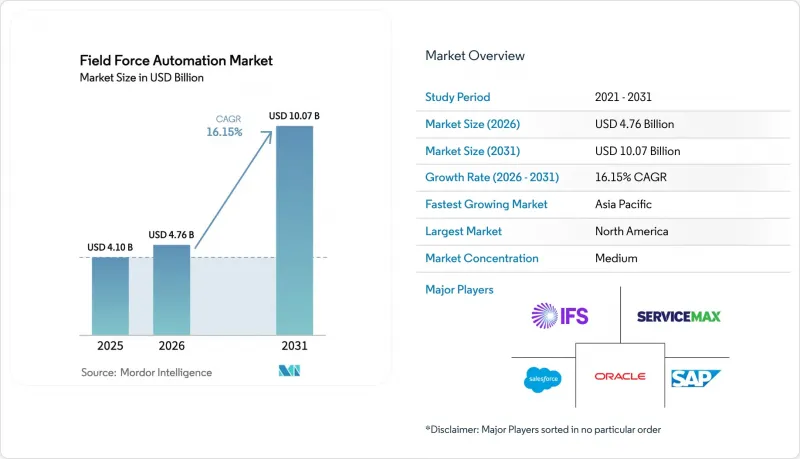
This report is Segmented by Component (Software/Solution, Services), Deployment (Cloud, On-Premise, Hybrid), Enterprise Size (SMEs, Large Enterprises), Platform (Android, IOS, Windows), Functionality (Scheduling and Dispatch, Route Optimisation, and More), End-User Industry (Healthcare, IT and Telecom, Manufacturing, and More), and Geography. Market Forecasts in Value (USD).
Global Field Force Automation Market Trends and Insights
Surge in same-day-delivery commitments driving route optimization
E-commerce giants have made next-day shipping the norm and same-day fulfillment the new differentiator. Sixty percent of North American retailers now offer same-day delivery, compelling logistics teams to deploy AI-enabled route-optimization engines that cut delivery time by 30% and raise drops per driver by 25%. Competitive intensity keeps capital flowing into real-time navigation, traffic prediction, and mobile proof-of-delivery tools that turn last-mile execution into a profit lever rather than a cost center. Regional carriers increasingly select SaaS platforms that can scale rapidly during peak seasons without new infrastructure spend. As 5G and edge processing mature, dynamic rerouting will further squeeze idle time and boost asset utilization.
US Electronic Visit Verification mandates boosting home-health mobile apps
The 21st Century Cures Act enforces EVV for Medicaid-funded home visits, creating mandatory digital check-ins across all US states by 2025. Michigan's USD 11.3 million EVV contract illustrates state-level investment and speeds mobile-app rollout among care agencies . Compliance deadlines are prompting providers to integrate GPS stamps, biometric confirmation, and automated timesheets, yielding richer data for caregiver dispatch and patient-outcome analytics. Platform vendors are layering AI models that predict visit duration and recommend optimal travel paths, lifting workforce productivity and lowering fraud risk.
Unionised labour privacy caps limiting tracking capabilities
Europe's strong unions and GDPR framework constrain continuous GPS monitoring, obliging employers to justify data collection and offer "right-to-disconnect" windows . Vendors now embed consent dashboards, anonymized heatmaps, and shift-based tracking toggles to preserve analytics without persistent surveillance. These design choices may form new global privacy benchmarks, but they can dilute optimization granularity and slow ROI calculations in highly unionized sectors.
Other drivers and restraints analyzed in the detailed report include:
- 5G rollout enabling video-assisted remote maintenance
- Tele-health expansion raising nurse-scheduling complexity
- Legacy ERP integration challenges hampering adoption
For complete list of drivers and restraints, kindly check the Table Of Contents.
Segment Analysis
Software/Solution generated 67.45% Field Force Automation market share in 2025, while the Services segment is growing at a 16.8% CAGR as enterprises seek expertise to orchestrate change programs and domain-specific compliance. Platform vendors are embedding AI, IoT connectors, and low-code workflow builders, but implementation still demands process redesign, data migration, and user-adoption coaching. In healthcare, services teams navigate HIPAA audits, whereas utilities focus on outage-management playbooks. Over the forecast horizon, bundled managed-service contracts will dominate mid-market deals, locking in multi-year revenue streams. The trend underlines that software differentiation alone is insufficient; operational assurance and ongoing optimization now dictate renewal cycles.
Services engagements increasingly include predictive-maintenance setup, mobile UX tailoring, and cross-platform security hardening. Vendors augment core deployments with value-added analytics sprints that translate field telemetry into board-level KPIs. As a result, the Field Force Automation market size for professional services is expected to exceed USD 2.75 billion by 2031, reflecting a compound shift from license sales toward lifetime outcome partnerships. Talent scarcity in AI model-ops and cybersecurity further elevates services margins, creating a dual-flywheel where successful implementations trigger expansion modules and adjacent consulting work.
Cloud-hosted offerings captured 71.05% Field Force Automation market share in 2025 and continue to outpace on-premise at a 15.6% CAGR. Always-on connectivity, elastic scaling, and evergreen updates make SaaS platforms a default choice for geographically dispersed teams. Field supervisors gain real-time dashboards, while IT avoids asset refresh cycles. However, sovereign-cloud mandates in China and Russia force vendors to offer region-specific hosting or hybrid architectures.
On-premise remains entrenched in defense and financial-services accounts that require air-gapped environments. Hybrid models are rising as CIOs segment sensitive datasets behind the firewall while pushing scheduling and route optimization to the cloud. Across regions, migration roadmaps emphasize phased module adoption to mitigate change fatigue. Consequently, the Field Force Automation market size for hybrid-cloud deployments is projected to grow 13.6% annually, supported by containerized micro-services that ease workload portability.
Complete Report Scope:
- By Component
- Software / Solution
- Services
- By Deployment
- Cloud
- On-Premise
- Hybrid
- By Enterprise Size
- Small and Medium-sized Enterprises (SMEs)
- Large Enterprises
- By Platform
- Android
- iOS
- Windows
- By Functionality
- Scheduling and Dispatch
- Route and Location Optimisation
- Work-Order Management
- Inventory and Parts Management
- Billing and Invoicing
- Others
- By End-User Industry
- Healthcare and Life Sciences
- IT and Telecom
- Manufacturing
- Retail and E-commerce
- Transportation and Logistics
- Energy and Utilities
- Oil and Gas
- Construction
- Public Sector
- Others
- By Geography
- North America
- United States
- Canada
- Mexico
- South America
- Brazil
- Argentina
- Rest of South America
- Asia-Pacific
- China
- Japan
- India
- South Korea
- Southeast Asia
- Australia
- New Zealand
- Rest of Asia-Pacific
- Europe
- United Kingdom
- Germany
- France
- Italy
- Spain
- Nordics
- Rest of Europe
- Middle East and Africa
- Middle East
- Africa
- North America
Geography Analysis
North America contributed 37.45% of revenue in 2025, underpinned by high labor costs that sharpen automation economics and by regulatory deadlines like EVV that compel digital proof of service. Minnesota's phased EVV rollout underscores how mandates create immediate modernization budgets . Manufacturing near-shoring is adding distributed plants that depend on seamless field-service coordination; more than 300,000 reshored jobs in 2022 enlarged the addressable fleet of technicians.
Asia Pacific is the fastest-growing region, forecast at 17.2% CAGR through 2031, buoyed by 5G saturation, government smart-factory incentives, and a swelling base of connected machinery. Somboon Advance Technology recorded a 60% earnings jump and 30% cost cut after adopting 5G-enabled field solutions in Thailand, exemplifying ROI potential. Yet regional diversity demands localization; India's patchy connectivity spurs offline-first workflows, whereas Japan emphasizes stringent quality-control logs.
Europe balances steady Western adoption with a nascent Eastern pipeline. GDPR steers product roadmaps toward data-minimization and fine-grained consent. The Middle East and Africa region focuses on outage-management for grid-electrification and remote asset inspections in mining. South America gains momentum in Brazil and Argentina but wrestles with currency swings and ERP fragmentation that lengthen payback periods. Vendors increasingly structure risk-sharing contracts to unlock projects in economically volatile markets.
- Salesforce.com Inc.
- Oracle Corporation
- SAP SE
- ServiceMax Inc. (PTC)
- IFS AB
- ClickSoftware (Salesforce)
- Astea International (IFS)
- Microsoft Corporation
- Zebra Technologies Corporation
- Trimble Inc.
- Verizon Connect
- ATandT Inc.
- BT Group plc
- Clevest (Itron Inc.)
- FieldAware (ServiceMax)
- ProntoForms Corporation
- Zinier Inc.
- OverIT S.p.A
- KloudGin Inc.
- MSI Data Corporation
- Skedulo
- FieldEZ Technologies
- Jobber
- Praxedo
- GE Digital
- Pegasystems Inc.
Additional Benefits:
- The market estimate (ME) sheet in Excel format
- 3 months of analyst support
TABLE OF CONTENTS
1 INTRODUCTION
- 1.1 Study Assumptions and Market Definition
- 1.2 Scope of the Study
2 RESEARCH METHODOLOGY
3 EXECUTIVE SUMMARY
4 MARKET LANDSCAPE
- 4.1 Market Overview
- 4.2 Market Drivers
- 4.2.1 Surge in same-day-delivery commitments driving real-time route optimisation in N. America retail logistics
- 4.2.2 US Electronic Visit Verification (EVV) mandates boosting mobile home-health apps
- 4.2.3 5G rollout in APAC enabling video-assisted remote maintenance for industrial OEMs
- 4.2.4 Tele-health expansion raising nurse-scheduling complexity in Europe
- 4.2.5 Grid-electrification projects in Middle East need mobile outage-management tools
- 4.2.6 Carbon-tracking disclosure rules prompting digital trip-footprint logging
- 4.3 Market Restraints
- 4.3.1 Unionised labour privacy caps on live tracking in W. Europe
- 4.3.2 Legacy ERP integration gaps in mid-size LatAm manufacturers
- 4.3.3 Volatile satellite-data costs for remote African mining sites
- 4.3.4 Rising cyber-insurance premiums for healthcare workforce apps
- 4.4 Value / Supply-Chain Analysis
- 4.5 Regulatory and Technological Outlook
- 4.6 Porter's Five Forces
- 4.6.1 Bargaining Power of Suppliers
- 4.6.2 Bargaining Power of Buyers
- 4.6.3 Threat of New Entrants
- 4.6.4 Threat of Substitutes
- 4.6.5 Competitive Rivalry
- 4.7 Investment Analysis
5 MARKET SIZE AND GROWTH FORECASTS (VALUE)
- 5.1 By Component
- 5.1.1 Software / Solution
- 5.1.2 Services
- 5.2 By Deployment
- 5.2.1 Cloud
- 5.2.2 On-Premise
- 5.2.3 Hybrid
- 5.3 By Enterprise Size
- 5.3.1 Small and Medium-sized Enterprises (SMEs)
- 5.3.2 Large Enterprises
- 5.4 By Platform
- 5.4.1 Android
- 5.4.2 iOS
- 5.4.3 Windows
- 5.5 By Functionality
- 5.5.1 Scheduling and Dispatch
- 5.5.2 Route and Location Optimisation
- 5.5.3 Work-Order Management
- 5.5.4 Inventory and Parts Management
- 5.5.5 Billing and Invoicing
- 5.5.6 Others
- 5.6 By End-User Industry
- 5.6.1 Healthcare and Life Sciences
- 5.6.2 IT and Telecom
- 5.6.3 Manufacturing
- 5.6.4 Retail and E-commerce
- 5.6.5 Transportation and Logistics
- 5.6.6 Energy and Utilities
- 5.6.7 Oil and Gas
- 5.6.8 Construction
- 5.6.9 Public Sector
- 5.6.10 Others
- 5.7 By Geography
- 5.7.1 North America
- 5.7.1.1 United States
- 5.7.1.2 Canada
- 5.7.1.3 Mexico
- 5.7.2 South America
- 5.7.2.1 Brazil
- 5.7.2.2 Argentina
- 5.7.2.3 Rest of South America
- 5.7.3 Asia-Pacific
- 5.7.3.1 China
- 5.7.3.2 Japan
- 5.7.3.3 India
- 5.7.3.4 South Korea
- 5.7.3.5 Southeast Asia
- 5.7.3.6 Australia
- 5.7.3.7 New Zealand
- 5.7.3.8 Rest of Asia-Pacific
- 5.7.4 Europe
- 5.7.4.1 United Kingdom
- 5.7.4.2 Germany
- 5.7.4.3 France
- 5.7.4.4 Italy
- 5.7.4.5 Spain
- 5.7.4.6 Nordics
- 5.7.4.7 Rest of Europe
- 5.7.5 Middle East and Africa
- 5.7.5.1 Middle East
- 5.7.5.2 Africa
- 5.7.1 North America
6 COMPETITIVE LANDSCAPE
- 6.1 Market Concentration
- 6.2 Strategic Moves
- 6.3 Market Share Analysis
- 6.4 Company Profiles {(includes Global level Overview, Market level overview, Core Segments, Financials as available, Strategic Information, Market Rank/Share for key companies, Products and Services, and Recent Developments)}
- 6.4.1 Salesforce.com Inc.
- 6.4.2 Oracle Corporation
- 6.4.3 SAP SE
- 6.4.4 ServiceMax Inc. (PTC)
- 6.4.5 IFS AB
- 6.4.6 ClickSoftware (Salesforce)
- 6.4.7 Astea International (IFS)
- 6.4.8 Microsoft Corporation
- 6.4.9 Zebra Technologies Corporation
- 6.4.10 Trimble Inc.
- 6.4.11 Verizon Connect
- 6.4.12 ATandT Inc.
- 6.4.13 BT Group plc
- 6.4.14 Clevest (Itron Inc.)
- 6.4.15 FieldAware (ServiceMax)
- 6.4.16 ProntoForms Corporation
- 6.4.17 Zinier Inc.
- 6.4.18 OverIT S.p.A
- 6.4.19 KloudGin Inc.
- 6.4.20 MSI Data Corporation
- 6.4.21 Skedulo
- 6.4.22 FieldEZ Technologies
- 6.4.23 Jobber
- 6.4.24 Praxedo
- 6.4.25 GE Digital
- 6.4.26 Pegasystems Inc.
7 MARKET OPPORTUNITIES AND FUTURE OUTLOOK
- 7.1 White-space and Unmet-Need Assessment

