PUBLISHER: Mordor Intelligence | PRODUCT CODE: 2119910

PUBLISHER: Mordor Intelligence | PRODUCT CODE: 2119910
China Almond - Market Share Analysis, Industry Trends & Statistics, Growth Forecasts (2026 - 2031)
According to Mordor Intelligence, the China almond market was valued at USD 502.48 million in 2025 and is projected to grow from USD 526.60 million in 2026 to USD 665.71 million by 2031, registering a CAGR of 4.80% during the forecast period from 2026 to 2031.
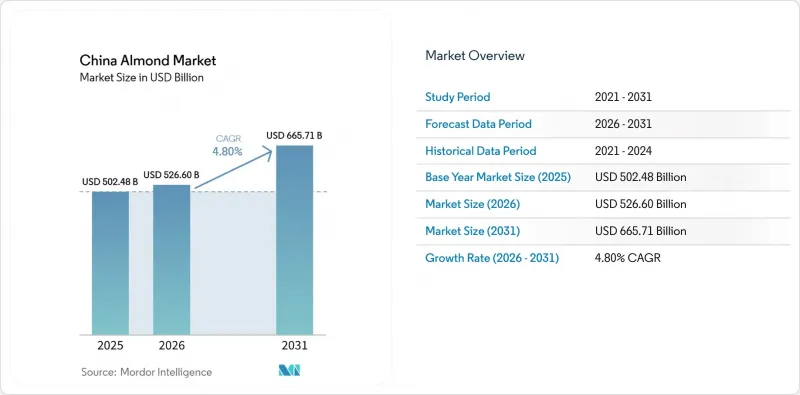
The China Almond Market Report Includes Production Analysis (Volume), Consumption Analysis (Value and Volume), Export Analysis (Value and Volume), Import Analysis (Value and Volume), Wholesale Price Trend Analysis and Forecast, Regulatory Framework, Logistics and Infrastructure, and Seasonality Analysis. The Market Forecasts are Provided in Terms of Value (USD) and Volume (Metric Tons).
China Almond Market Trends and Insights
Health-Oriented Snacking and Functional Nutrition
Health-oriented snacking is driving almond consumption in China as consumers increasingly prefer nutritious, convenient, and portion-controlled foods for everyday use rather than seasonal gifting. Branded manufacturers are expanding roasted, flavored, and mixed-nut offerings through modern retail and e-commerce channels, supporting higher demand for imported almond kernels. According to the United States Department of Agriculture (USDA) Foreign Agricultural Service (2025), China had more than 338,000 bakery outlets as of April 2025, reflecting the growing use of almonds in healthy snacks and value-added food products beyond traditional consumption. This trend continues to support sustained growth in almond imports and packaged nut sales.
Expansion of Plant-Based Dairy Alternatives
Plant-based dairy alternatives are creating new growth opportunities for the China almond market as consumers increasingly seek lactose-free and health-focused beverage options. Almond milk is gaining wider adoption in cafes, bakeries, and food manufacturing, driving demand for almond flour, paste, and blanched kernels as functional ingredients. According to Olam Food Ingredients (2024), the company opened its fifth Customer Solutions Center in Shanghai to support Chinese food manufacturers with application development for bakery, beverage, and dairy-alternative products. The expansion reflects rising industry demand for value-added almond ingredients and continued innovation across China's plant-based food market.
Import-Cost and Tariff Volatility
Import costs and tariff uncertainty continue to constrain China's almond market by raising procurement costs and limiting sourcing flexibility for importers. China's limited domestic almond production makes the market highly dependent on imports, exposing processors to trade policy changes and price volatility. According to the Almond Board of California (2025), United States-origin almonds remain subject to an effective 45% import tariff in China, while Australian almonds continue to benefit from zero-duty access under the China-Australia Free Trade Agreement. This tariff disparity has shifted sourcing patterns toward Australia and increased cost pressures across China's almond supply chain.
Other drivers and restraints analyzed in the detailed report include:
- E-Commerce and Live-Commerce Penetration
- Zero-Tariff and Supply-Diversification Benefits for Australian Almonds
- Climate-Sensitive Domestic Production in Xinjiang
For complete list of drivers and restraints, kindly check the Table Of Contents.
Complete Report Scope:
- Production Analysis
- Production Volume
- Area Harvested and Yield
- Consumption Analysis (Value and Volume)
- Trade Analysis (Value and Volume)
- Import Market Analysis
- Import Value and Volume
- Key Supplying Markets
- Export Market Analysis
- Export Value and Volume
- Key Destinations Markets
- Import Market Analysis
- Wholesale Price Trend Analysis and Forecast
- Regulatory Framework
- Logistics and Infrastructure
- Seasonality Analysis
List of Companies Covered in this Report:
- Blue Diamond Growers
- Three Squirrels Co., Ltd.
- Bestore Co., Ltd.
- Chacha Food Company Limited
- Wonderful Pistachios & Almonds LLC (The Wonderful Company LLC)
- Olam Food Ingredients Pte. Ltd. (Olam Group Limited)
- Select Harvests Limited
- Almondco Australia Limited
- Harris Woolf California Almonds (Harris Woolf Corporation)
- Waterford Nut Co., Inc.
- California Almond Packers & Exporters Inc.
- Campos Brothers Farms
Additional Benefits:
- The market estimate (ME) sheet in Excel format
- 3 months of analyst support
TABLE OF CONTENTS
1 Introduction
- 1.1 Study Assumptions and Market Definition
- 1.2 Scope of the Study
2 Research Methodology
3 Executive Summary
4 Market Landscape
- 4.1 Market Overview
- 4.2 Market Drivers
- 4.2.1 Health-oriented snacking and functional nutrition
- 4.2.2 Expansion of plant-based dairy alternatives
- 4.2.3 E-commerce and live-commerce penetration
- 4.2.4 Growing bakery, confectionery and cafe applications
- 4.2.5 Zero-tariff and supply-diversification benefits for Australian almonds
- 4.2.6 Almond-based product localization for Chinese taste preferences
- 4.3 Market Restraints
- 4.3.1 Import-cost and tariff volatility
- 4.3.2 Climate-sensitive domestic production in Xinjiang
- 4.3.3 Stringent import compliance and allergen-control requirements
- 4.3.4 Competition from lower-priced nuts and snack alternatives
- 4.4 Opportunities
- 4.5 Challenges
- 4.6 Value Chain Analysis
- 4.7 Technologies and usage of AI in the Industry
- 4.8 Input Market Analysis
- 4.8.1 Seeds
- 4.8.2 Fertilizers
- 4.8.3 Crop Protection Chemicals
- 4.9 Distribution Channel Analysis
- 4.10 Market Sentiment Analysis
- 4.11 PESTLE Analysis
5 Market Size and Growth Forecasts (Value and Volume)
- 5.1 Production Analysis
- 5.1.1 Production Volume
- 5.1.2 Area Harvested and Yield
- 5.2 Consumption Analysis (Value and Volume)
- 5.3 Trade Analysis (Value and Volume)
- 5.3.1 Import Market Analysis
- 5.3.1.1 Import Value and Volume
- 5.3.1.2 Key Supplying Markets
- 5.3.2 Export Market Analysis
- 5.3.2.1 Export Value and Volume
- 5.3.2.2 Key Destinations Markets
- 5.3.1 Import Market Analysis
- 5.4 Wholesale Price Trend Analysis and Forecast
- 5.5 Regulatory Framework
- 5.6 Logistics and Infrastructure
- 5.7 Seasonality Analysis
6 End Use and Application
- 6.1 Primary Applications and Emerging Applications
- 6.2 Consumption Breakdown by Industries
7 Competitive Landscape
- 7.1 Overview of the Competition
- 7.2 Recent Developments
- 7.3 Market Concentration Analysis
- 7.4 Company Profiles (Includes Global Level Overview, Market Level Overview, Core Segments, Financials as Available, Strategic Information, Market Rank/Share for Key Companies, Products and Services, and Recent Developments)
- 7.4.1 Blue Diamond Growers
- 7.4.2 Three Squirrels Co., Ltd.
- 7.4.3 Bestore Co., Ltd.
- 7.4.4 Chacha Food Company Limited
- 7.4.5 Wonderful Pistachios & Almonds LLC (The Wonderful Company LLC)
- 7.4.6 Olam Food Ingredients Pte. Ltd. (Olam Group Limited)
- 7.4.7 Select Harvests Limited
- 7.4.8 Almondco Australia Limited
- 7.4.9 Harris Woolf California Almonds (Harris Woolf Corporation)
- 7.4.10 Waterford Nut Co., Inc.
- 7.4.11 California Almond Packers & Exporters Inc.
- 7.4.12 Campos Brothers Farms
8 Market Opportunities and Future Outlook

