PUBLISHER: Mordor Intelligence | PRODUCT CODE: 2120252

PUBLISHER: Mordor Intelligence | PRODUCT CODE: 2120252
Dairy Blends - Market Share Analysis, Industry Trends & Statistics, Growth Forecasts (2026 - 2031)
According to Mordor Intelligence, the dairy blends market is expected to grow from USD 3.21 billion in 2025 to USD 3.51 billion in 2026 and is projected to reach USD 5.35 billion by 2031, registering a compound annual growth rate (CAGR) of 8.77% during the forecast period (2026-2031).
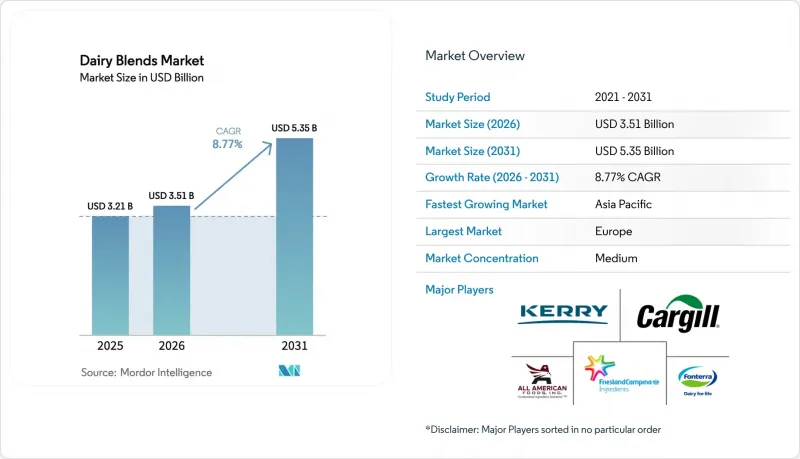
This report is Segmented by Product Type (Milk Blends, Cream Blends, Butter Blends, Others), Form (Powder, Liquid, Others), Application (Food, Beverages, Infant Formula, Other Applications), Fat Content (Full Fat, Low Fat, Fat Free), and Geography (North America, Europe, Asia-Pacific, South America, Middle East and Africa). The Market Forecasts are Provided in Terms of Value (USD) and Volume (Tonnes).
Global Dairy Blends Market Trends and Insights
Rising adoption of dairy blends across bakery, confectionery, and beverages
Bakery and confectionery manufacturers are substituting pure butter and cream with cost-optimized blends that maintain mouthfeel while reducing saturated-fat declarations on nutrition panels. Fonterra launched Anchor Easy Bakery UHT Cream in China during 2024, targeting industrial bakers who require ambient-stable emulsions that survive high-temperature ovens without curdling. Beverage formulators are layering dairy blends into ready-to-drink coffee and protein shakes, where whey-casein ratios dictate foam stability and perceived creaminess. FrieslandCampina partnered with Selecta in January 2024 to supply liquid milk and creamers across 16 European markets, embedding its Lattiz dispensing system into office break rooms. Ice-cream producers blend milk solids with vegetable fats to lower freezing points and improve scoopability, a technique that also hedges against dairy-price spikes. Confectionery fillings in chocolates and biscuits increasingly use dairy blends to achieve specific melting profiles without the cost volatility of pure cocoa butter or anhydrous milk fat.
Expansion of foodservice and quick-service restaurants across globe
The rapid growth of foodservice, particularly quick-service restaurants (QSRs), is a significant driver for the global dairy blends market. Restaurants and QSRs require large quantities of stable, easy-to-handle ingredients such as powdered milk blends, creamers, custard/batter mixes, sauce bases, and fortified powders. These ingredients help reduce on-site processing time, minimize waste, and ensure consistent taste across multiple outlets. As global chains expand, they increasingly demand customized dairy blends that provide predictable functionality, such as foaming, mouthfeel, and shelf-stable protein content, at a lower cost compared to fresh milk. This trend encourages manufacturers and ingredient suppliers to innovate and expand their supply capabilities. In 2024, food sales at foodservice outlets reached USD 1.52 trillion, with full-service establishments contributing USD 552.7 billion and limited-service establishments contributing USD 550.7 billion. These dynamics directly support larger and more consistent institutional purchases of dairy blend powders and premixes for use in beverages, desserts, bakery, and savory applications.
Volatile raw milk and dairy ingredient prices raising costs
Raw milk prices experienced notable fluctuations due to weather disruptions, rising feed costs, and herd-size adjustments, which typically lag demand changes by over a year. The butter market exhibited significant volatility, with European spot prices increasing sharply as reduced cream availability prompted processors to prioritize cheese production to achieve higher margins. Blenders without long-term supply contracts faced margin pressures during milk price spikes, as downstream customers resisted mid-contract price adjustments. Smaller cooperatives, lacking access to the hedging tools utilized by multinational processors to manage feed and milk costs, were more exposed to spot-market volatility. Feed costs, which constitute the largest portion of dairy farm expenses, were heavily influenced by corn and soybean markets. These markets, in turn, were affected by energy prices and geopolitical events, creating widespread volatility across the dairy supply chain.
Other drivers and restraints analyzed in the detailed report include:
- Growing demand for fortified and high-protein dairy products
- Advances in blending, processing, and shelf-life technologies
- Growing competition from plant-based and vegan alternatives
For complete list of drivers and restraints, kindly check the Table Of Contents.
Segment Analysis
Milk blends accounted for a share of 41.91% in 2025, while butter blends are projected to grow at a rate of 9.81% from 2026 to 2031. This growth is expected to surpass that of milk blends and cream blends, as manufacturers incorporate dairy fats with rapeseed or olive oil to enhance spreadability directly from the refrigerator without the trans-fat concerns associated with hydrogenation. Milk blends dominate the market due to their use as a base for reconstituted beverages, yogurt cultures, and infant formula, where maintaining standardized protein and lactose ratios is essential for regulatory compliance and sensory consistency. Cream blends are primarily used in coffee creamers, whipped toppings, and ice cream bases, where the size of fat globules plays a key role in foam stability and mouthfeel.
Other product types, such as cheese blends and yogurt blends, target cost-sensitive segments by partially substituting dairy solids with starches or vegetable proteins. This approach helps reduce input costs while maintaining consumer acceptance. Cheese blends, which combine natural cheese with emulsifying salts and vegetable oils, are widely used in pizza chains due to their ability to enhance melt and stretch properties, ensuring consistent performance under heat lamps. Similarly, the growing preference for butter blends aligns with consumer demand for convenience, as spreadable formats eliminate the need for softening. Additionally, flavored butter variants support premiumization by commanding higher price points compared to standard butter products.
Powder formats accounted for 46.71% of the 2025 revenue, while liquid dairy blends are expected to grow at a rate of 9.51% from 2026 to 2031. This growth is supported by ultra-high-temperature and extended-shelf-life technologies, which facilitate ambient distribution and eliminate the need for cold-chain logistics in emerging markets. Ultra-high-temperature processing involves heating the product to a temperature of 135-150 degrees Celsius for a few seconds, effectively sterilizing it and enabling a longer shelf life without refrigeration. Extended-shelf-life processing, on the other hand, combines microfiltration to remove bacteria with pasteurization at 72 degrees Celsius. This process results in a refrigerated shelf life of 60 to 90 days, significantly reducing retail waste and allowing for longer distribution windows. These advancements are driving the demand for liquid dairy blends, particularly in regions where cold-chain infrastructure is limited.
Powder formats continue to dominate in infant formula, sports nutrition, and emergency food aid due to their extended shelf life, low shipping weight, and suitability for ambient storage, particularly in regions with unreliable electricity. Other formats, such as condensed and evaporated milk, cater to niche applications in confectionery and bakery, where high solids content and caramelized flavors are preferred. Growth in liquid formats is primarily observed in foodservice, where ready-to-use products reduce reconstitution labor, and in retail ready-to-drink beverages, where consumers are willing to pay a premium for convenience. Investments in cold-chain infrastructure across Asia-Pacific and Africa are facilitating liquid-blend distribution to urban centers, although rural areas continue to depend on powder formats due to infrastructure limitations.
Complete Report Scope:
- By Product Type
- Milk Blends
- Cream Blends
- Butter Blends
- Others
- By Form
- Powder
- Liquid
- Others
- By Application
- Food
- Bakery
- Confectionery
- Ice Cream
- Cheese
- Yogurt
- Other Food Applications
- Beverages
- Infant Formula
- Other Applications
- Food
- By Fat Content
- Full Fat
- Low Fat
- Fat Free
- By Geography
- North America
- United States
- Canada
- Mexico
- Rest of North America
- Europe
- Germany
- United Kingdom
- Italy
- France
- Spain
- Netherlands
- Poland
- Belgium
- Sweden
- Rest of Europe
- Asia-Pacific
- China
- India
- Japan
- Australia
- Indonesia
- South Korea
- Thailand
- Singapore
- Rest of Asia-Pacific
- South America
- Brazil
- Argentina
- Colombia
- Chile
- Peru
- Rest of South America
- Middle East and Africa
- South Africa
- Saudi Arabia
- United Arab Emirates
- Nigeria
- Egypt
- Morocco
- Turkey
- Rest of Middle East and Africa
- North America
Geography Analysis
Europe accounted for a significant 28.91% market share in 2025, supported by its advanced processing infrastructure and steady demand for high-quality dairy products. Key production hubs in Germany, France, and the Netherlands contribute to the region's market strength. Europe's market maturity is evident in its focus on premiumization, sustainability certifications, and novel-ingredient approvals that enable functional dairy blends. However, the European market encounters several operational challenges, such as strict environmental regulations, occasional disease outbreaks, and farmer concerns related to taxation and subsidy frameworks. These factors impact production capacity and market dynamics within the region.
The Asia-Pacific region is projected to grow at a rate of 9.19% from 2026 to 2031. This expansion is driven by increasing demand for infant formula in China and India, urbanization that supports the adoption of convenient dairy products, and rising incomes that facilitate protein-rich diets. Key factors such as growing disposable incomes, rapid urbanization, and heightened health awareness in major markets like China, India, and Japan further support this growth. The market also benefits from robust government support programs and strategic collaborations within the industry. Furthermore, advancements in lactose-removal technologies address specific dietary needs prevalent in Asian markets, contributing to sustained growth in the region.
North America continues to hold a strong market position, while emerging opportunities are evident in South America and the Middle East and Africa. The Middle East and Africa, in particular, show significant growth potential driven by increasing urbanization and rising dairy consumption. However, these regions face challenges such as infrastructure constraints and complex regulatory frameworks, which can affect market entry and expansion strategies. Despite these challenges, they remain key growth areas for market participants aiming to diversify geographically.
- All American Foods Inc.
- Cargill Incorporated
- Davisco Foods International
- FrieslandCampina Ingredients
- Fonterra Co-operative Group Ltd (NZMP)
- AAK AB
- Ingredion Incorporated
- Lactalis Group
- Dana Dairy Group
- Dairy Farmers of America, Inc.
- AGROPUR
- The Milky Whey, Inc.
- Arla Foods
- Dairy Kingdom
- Archer Daniels Midland Company
- Cape Food Ingredients
- Valio Ltd.
- Batory Foods
- Bel Group
- Land O'Lakes Inc.
- Kerry Group plc.
Additional Benefits:
- The market estimate (ME) sheet in Excel format
- 3 months of analyst support
TABLE OF CONTENTS
1 INTRODUCTION
- 1.1 Study Assumptions and Market Definition
- 1.2 Scope of the Study
2 RESEARCH METHODOLOGY
3 EXECUTIVE SUMMARY
4 MARKET LANDSCAPE
- 4.1 Market Overview
- 4.2 Market Drivers
- 4.2.1 Rising adoption of dairy blends across bakery, confectionery, and beverages
- 4.2.2 Expansion of foodservice and quick-service restaurants across globe
- 4.2.3 Growing demand for fortified and high-protein dairy products
- 4.2.4 Advances in blending, processing, and shelf-life technologies
- 4.2.5 Increasing preference for personalized nutrition driving product variety
- 4.2.6 Youth-focused flavor innovation and marketing boosting appeal
- 4.3 Market Restraints
- 4.3.1 Volatile raw milk and dairy ingredient prices raising costs
- 4.3.2 Growing competition from plant-based and vegan alternatives
- 4.3.3 Shelf-life limitations in fresh and liquid blend formats
- 4.3.4 High prevalence of lactose intolerance constraining demand
- 4.4 Supply Chain Analysis
- 4.5 Technology Outlook
- 4.6 Porter's Five Forces
- 4.6.1 Threat of New Entrants
- 4.6.2 Bargaining Power of Buyers
- 4.6.3 Bargaining Power of Suppliers
- 4.6.4 Threat of Substitute Products
- 4.6.5 Intensity of Competitive Rivalry
5 MARKET SIZE AND GROWTH FORECASTS (VALUE, VOLUME)
- 5.1 By Product Type
- 5.1.1 Milk Blends
- 5.1.2 Cream Blends
- 5.1.3 Butter Blends
- 5.1.4 Others
- 5.2 By Form
- 5.2.1 Powder
- 5.2.2 Liquid
- 5.2.3 Others
- 5.3 By Application
- 5.3.1 Food
- 5.3.1.1 Bakery
- 5.3.1.2 Confectionery
- 5.3.1.3 Ice Cream
- 5.3.1.4 Cheese
- 5.3.1.5 Yogurt
- 5.3.1.6 Other Food Applications
- 5.3.2 Beverages
- 5.3.3 Infant Formula
- 5.3.4 Other Applications
- 5.3.1 Food
- 5.4 By Fat Content
- 5.4.1 Full Fat
- 5.4.2 Low Fat
- 5.4.3 Fat Free
- 5.5 By Geography
- 5.5.1 North America
- 5.5.1.1 United States
- 5.5.1.2 Canada
- 5.5.1.3 Mexico
- 5.5.1.4 Rest of North America
- 5.5.2 Europe
- 5.5.2.1 Germany
- 5.5.2.2 United Kingdom
- 5.5.2.3 Italy
- 5.5.2.4 France
- 5.5.2.5 Spain
- 5.5.2.6 Netherlands
- 5.5.2.7 Poland
- 5.5.2.8 Belgium
- 5.5.2.9 Sweden
- 5.5.2.10 Rest of Europe
- 5.5.3 Asia-Pacific
- 5.5.3.1 China
- 5.5.3.2 India
- 5.5.3.3 Japan
- 5.5.3.4 Australia
- 5.5.3.5 Indonesia
- 5.5.3.6 South Korea
- 5.5.3.7 Thailand
- 5.5.3.8 Singapore
- 5.5.3.9 Rest of Asia-Pacific
- 5.5.4 South America
- 5.5.4.1 Brazil
- 5.5.4.2 Argentina
- 5.5.4.3 Colombia
- 5.5.4.4 Chile
- 5.5.4.5 Peru
- 5.5.4.6 Rest of South America
- 5.5.5 Middle East and Africa
- 5.5.5.1 South Africa
- 5.5.5.2 Saudi Arabia
- 5.5.5.3 United Arab Emirates
- 5.5.5.4 Nigeria
- 5.5.5.5 Egypt
- 5.5.5.6 Morocco
- 5.5.5.7 Turkey
- 5.5.5.8 Rest of Middle East and Africa
- 5.5.1 North America
6 COMPETITIVE LANDSCAPE
- 6.1 Market Concentration
- 6.2 Strategic Moves
- 6.3 Market Share Analysis
- 6.4 Company Profiles (includes Global level Overview, Market level overview, Core Segments, Financials as available, Strategic Information, Market Rank/Share for key companies, Products and Services, and Recent Developments)
- 6.4.1 All American Foods Inc.
- 6.4.2 Cargill Incorporated
- 6.4.3 Davisco Foods International
- 6.4.4 FrieslandCampina Ingredients
- 6.4.5 Fonterra Co-operative Group Ltd (NZMP)
- 6.4.6 AAK AB
- 6.4.7 Ingredion Incorporated
- 6.4.8 Lactalis Group
- 6.4.9 Dana Dairy Group
- 6.4.10 Dairy Farmers of America, Inc.
- 6.4.11 AGROPUR
- 6.4.12 The Milky Whey, Inc.
- 6.4.13 Arla Foods
- 6.4.14 Dairy Kingdom
- 6.4.15 Archer Daniels Midland Company
- 6.4.16 Cape Food Ingredients
- 6.4.17 Valio Ltd.
- 6.4.18 Batory Foods
- 6.4.19 Bel Group
- 6.4.20 Land O'Lakes Inc.
- 6.4.21 Kerry Group plc.
7 MARKET OPPORTUNITIES AND FUTURE OUTLOOK

