PUBLISHER: Mordor Intelligence | PRODUCT CODE: 2120253

PUBLISHER: Mordor Intelligence | PRODUCT CODE: 2120253
Europe LiDAR - Market Share Analysis, Industry Trends & Statistics, Growth Forecasts (2026 - 2031)
According to Mordor Intelligence, Europe LiDAR market size in 2026 is estimated at USD 1.17 billion, growing from 2025 value of USD 1.01 billion with 2031 projections showing USD 2.42 billion, growing at 15.62% CAGR over 2026-2031.
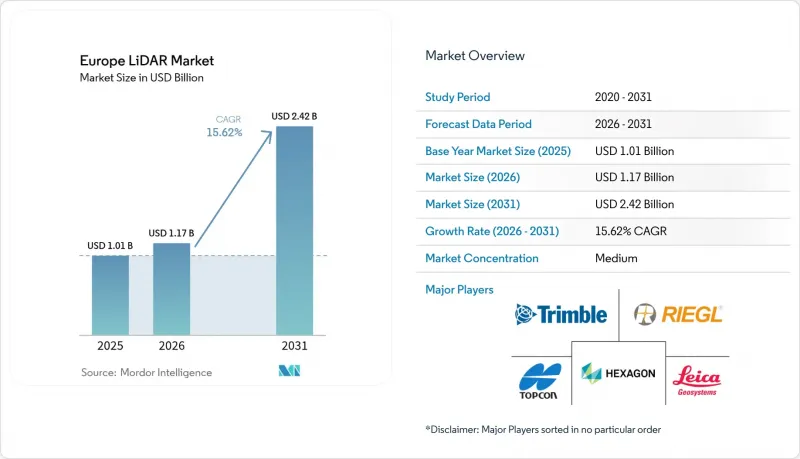
This report is Segmented by Product Type (Aerial LiDAR, Mobile/Vehicle-Mounted LiDAR, and More), Technology (Mechanical Scanning, Solid-State MEMS, and More), Platform (UAV/Drone, Ground Vehicle, and More), End-Use Industry (Automotive and Transportation, Engineering Construction and Surveying, and More), and Country. The Market Forecasts are Provided in Terms of Value (USD).
Europe LiDAR Market Trends and Insights
Rapid ADAS uptake spurred by Euro-NCAP 2026 sensor-based safety ratings
Euro-NCAP's revised 2026 protocol forces OEMs to deploy redundant perception suites that include LiDAR to achieve five-star scores. German premium brands have already commercialized Level 3 driving packages that bundle long-range LiDAR at price points exceeding EUR 5,000, validating consumer willingness to pay for the technology. Regulatory pressure compresses adoption timelines, encourages multi-sourcing strategies, and anchors high-volume demand forecasts through 2030. Infrastructure providers follow suit, upgrading test tracks and certification labs to handle multi-sensor validation, while tier-1s invest in solid-state roadmaps to meet cost-down targets. As a result, the European LiDAR market experiences cross-industry ripple effects, pushing suppliers to improve weather robustness and cybersecurity compliance simultaneously.
UAV-LiDAR demand for corridor mapping and digital-twin projects
Across rail, power, and fiber corridors, European engineering firms deploy drone-mounted LiDAR to obtain centimeter-level point clouds that feed asset-management platforms. Systems such as RIEGL's miniVUX-2UAV deliver 200,000 measurements per second to capture true-color point clouds needed for vegetation encroachment and slope-stability analysis. Municipal agencies favor UAV workflows because flight permits can be issued rapidly under the EU's risk-based drone rules, though strict BVLOS limitations still add planning complexity. Project owners note substantial cost savings versus helicopter surveys, and the ability to refresh datasets quarterly enables predictive maintenance regimes. As energy-transition projects proliferate, corridor-mapping volume feeds steady demand into the European LiDAR market, even as vendors lobby for uniform BVLOS standards to unlock scale.
High unit cost of long-range, high-resolution sensors
Premium automotive-grade LiDAR still commands list prices between EUR 3,000 and EUR 10,000 per unit, while full-waveform survey systems exceed EUR 100,000, curbing demand among cost-sensitive SMEs. European distributors confront margin compression as Chinese entrants drop prices 30-50%, forcing re-negotiations with OEMs and public agencies. To offset sticker shock, integrators now market subscription models that bundle hardware, analytics, and maintenance under multi-year SLAs. Government procurement frameworks begin to score total cost of ownership rather than capital expenditure alone, rewarding vendors that demonstrate lifecycle savings. The ability to localize manufacturing inside the EU will become a differentiator once proposed carbon-border adjustments take effect, tempering import-price advantages.
Other drivers and restraints analyzed in the detailed report include:
- Solid-state cost decline from automotive-scale production
- EU-funded smart-city LiDAR deployments
- Performance degradation in fog, rain, and snow
For complete list of drivers and restraints, kindly check the Table Of Contents.
Segment Analysis
Mobile/Vehicle-Mounted units secured the largest slice of the European LiDAR market size, commanding 46.60% revenue share in 2025. Adoption accelerates as automotive OEMs integrate long-range sensors for Level 3 functionality and logistics operators equip yard tractors for autonomous marshalling. Mobile mapping vans also dominate municipal asset inventories, capturing curb condition, street furniture, and tree-canopy data in a single pass. Bathymetric/Marine LiDAR follows a steeper trajectory, advancing at a 16.6% CAGR to 2031 amid record offshore wind leasing and coastal resilience programs. Floating platforms, leveraging automotive-grade solid-state cores, cut setup costs by two-thirds and unlock measurements in previously inaccessible deep-water sites.
Continued cost convergence amplifies product-type rebalancing. As solid-state modules drop below USD 500, warehouse AGVs and construction machinery become mainstream targets, while terrestrial tripod systems transition from static documentation to periodic progress-tracking roles. Suppliers now bundle SLAM algorithms to turn backpack scanners into 3D mobile capture rigs for heritage preservation, opening a niche but recurring revenue. In aggregate, demand profiles show a clear preference for systems that can traverse complex environments, reinforcing mobile dominance in the European LiDAR market.
Mechanical Scanning retained 51.20% of the European LiDAR market share in 2025, thanks to entrenched survey workflows and abundant spare parts inventories. Users appreciate known calibration routines and field-serviceable designs suited to rugged operations. However, FMCW/Hybrid and other solid-state approaches outpace at a 16.7% CAGR to 2031 as automotive validation completes and scalable packaging slashes per-unit cost. FMCW's inherent Doppler capability delivers velocity data critical for collision-avoidance algorithms, and its interference immunity solves cross-talk issues in multi-sensor fleets.
European R&D, buoyed by the EUR 5 million CoRaLi-DAR project, seeks to leapfrog first-generation flash systems by integrating silicon photonics transmitters with MEMS beam-steerers. Parallel software innovation leverages edge AI to compress point-cloud streams, removing bandwidth bottlenecks. The tipping point is expected once automotive solid-state volumes exceed 10 million annually, triggering spill-over into construction and security domains. Consequently, the technology mix will rebalance toward solid-state architectures, although mechanical platforms will persist in ultra-long-range airborne mapping where the current solid-state range is insufficient.
Complete Report Scope:
- By Product Type
- Aerial LiDAR
- Mobile/Vehicle-Mounted LiDAR
- Terrestrial (Tripod) LiDAR
- Bathymetric/Marine LiDAR
- By Technology
- Mechanical Scanning
- Solid-State MEMS
- Solid-State Flash/OPA
- FMCW/Hybrid
- By Platform
- UAV/Drone
- Ground Vehicle
- Handheld/Backpack
- Fixed Infrastructure
- Marine/Shipborne
- By End-use Industry
- Automotive and Transportation
- Engineering, Construction and Surveying
- Industrial and Logistics Automation
- Aerospace and Defense
- Environmental Monitoring and Agriculture
- Smart Cities and Infrastructure
- Other End-use Industries
- By Country
- United Kingdom
- Germany
- France
- Spain
- Italy
- Netherlands
- Belgium
- Switzerland
- Rest of Europe
List of Companies Covered in this Report:
- Leica Geosystems AG
- Hexagon AB
- RIEGL Laser Measurement Systems GmbH
- Topcon Corporation
- Trimble Inc.
- SICK AG
- Teledyne Optech Inc.
- FARO Technologies Inc.
- Velodyne Lidar Inc.
- Ouster Inc.
- Luminar Technologies Inc.
- Innoviz Technologies Ltd.
- Hesai Technology Co., Ltd.
- RoboSense (Beijing LeiShen) Technology Co., Ltd.
- Cepton Technologies Inc.
- Phoenix LiDAR Systems LLC
- YellowScan SAS
- Microdrones GmbH
- Emesent Pty Ltd.
- GeoSLAM Limited
- Leosphere SA
- Valeo SA
Additional Benefits:
- The market estimate (ME) sheet in Excel format
- 3 months of analyst support
TABLE OF CONTENTS
1 INTRODUCTION
- 1.1 Study Assumptions and Market Definition
- 1.2 Scope of the Study
2 RESEARCH METHODOLOGY
3 EXECUTIVE SUMMARY
4 MARKET LANDSCAPE
- 4.1 Market Overview
- 4.2 Market Drivers
- 4.2.1 Rapid ADAS uptake spurred by Euro-NCAP 2026 sensor-based safety ratings
- 4.2.2 UAV-LiDAR demand for corridor-mapping and digital-twin projects
- 4.2.3 Solid-state cost decline from automotive-scale production
- 4.2.4 EU-funded smart-city LiDAR deployments (traffic, pollution, crowd flow)
- 4.2.5 Offshore wind-farm site assessment via Floating LiDAR Systems
- 4.2.6 Mandatory BIM Level 3 digital-twin specs in EU public-works tenders
- 4.3 Market Restraints
- 4.3.1 High unit cost of long-range, high-resolution sensors
- 4.3.2 Performance degradation in fog, rain and snow
- 4.3.3 Strict BVLOS drone-flight regulations
- 4.3.4 Supply-chain dependence on GaAs/SiGe laser diodes
- 4.4 Industry Value Chain Analysis
- 4.5 Regulatory Landscape
- 4.6 Technological Outlook
- 4.7 Porter's Five Forces Analysis
- 4.7.1 Bargaining Power of Suppliers
- 4.7.2 Bargaining Power of Buyers
- 4.7.3 Threat of New Entrants
- 4.7.4 Intensity of Competitive Rivalry
- 4.7.5 Threat of Substitutes
- 4.8 Impact of Macroeconomic Trends on the Market
5 MARKET SIZE AND GROWTH FORECASTS (VALUES)
- 5.1 By Product Type
- 5.1.1 Aerial LiDAR
- 5.1.2 Mobile/Vehicle-Mounted LiDAR
- 5.1.3 Terrestrial (Tripod) LiDAR
- 5.1.4 Bathymetric/Marine LiDAR
- 5.2 By Technology
- 5.2.1 Mechanical Scanning
- 5.2.2 Solid-State MEMS
- 5.2.3 Solid-State Flash/OPA
- 5.2.4 FMCW/Hybrid
- 5.3 By Platform
- 5.3.1 UAV/Drone
- 5.3.2 Ground Vehicle
- 5.3.3 Handheld/Backpack
- 5.3.4 Fixed Infrastructure
- 5.3.5 Marine/Shipborne
- 5.4 By End-use Industry
- 5.4.1 Automotive and Transportation
- 5.4.2 Engineering, Construction and Surveying
- 5.4.3 Industrial and Logistics Automation
- 5.4.4 Aerospace and Defense
- 5.4.5 Environmental Monitoring and Agriculture
- 5.4.6 Smart Cities and Infrastructure
- 5.4.7 Other End-use Industries
- 5.5 By Country
- 5.5.1 United Kingdom
- 5.5.2 Germany
- 5.5.3 France
- 5.5.4 Spain
- 5.5.5 Italy
- 5.5.6 Netherlands
- 5.5.7 Belgium
- 5.5.8 Switzerland
- 5.5.9 Rest of Europe
6 COMPETITIVE LANDSCAPE
- 6.1 Market Concentration
- 6.2 Strategic Moves
- 6.3 Market Share Analysis
- 6.4 Company Profiles (includes Global level Overview, Market level overview, Core Segments, Financials as available, Strategic Information, Market Rank/Share for key companies, Products and Services, and Recent Developments)
- 6.4.1 Leica Geosystems AG
- 6.4.2 Hexagon AB
- 6.4.3 RIEGL Laser Measurement Systems GmbH
- 6.4.4 Topcon Corporation
- 6.4.5 Trimble Inc.
- 6.4.6 SICK AG
- 6.4.7 Teledyne Optech Inc.
- 6.4.8 FARO Technologies Inc.
- 6.4.9 Velodyne Lidar Inc.
- 6.4.10 Ouster Inc.
- 6.4.11 Luminar Technologies Inc.
- 6.4.12 Innoviz Technologies Ltd.
- 6.4.13 Hesai Technology Co., Ltd.
- 6.4.14 RoboSense (Beijing LeiShen) Technology Co., Ltd.
- 6.4.15 Cepton Technologies Inc.
- 6.4.16 Phoenix LiDAR Systems LLC
- 6.4.17 YellowScan SAS
- 6.4.18 Microdrones GmbH
- 6.4.19 Emesent Pty Ltd.
- 6.4.20 GeoSLAM Limited
- 6.4.21 Leosphere SA
- 6.4.22 Valeo SA
7 MARKET OPPORTUNITIES AND FUTURE OUTLOOK
- 7.1 White-Space and Unmet-Need Assessment

