PUBLISHER: Mordor Intelligence | PRODUCT CODE: 2120254

PUBLISHER: Mordor Intelligence | PRODUCT CODE: 2120254
Water-soluble Polymer - Market Share Analysis, Industry Trends & Statistics, Growth Forecasts (2026 - 2031)
According to Mordor Intelligence, the water-soluble polymer market size is estimated at USD 39.22 billion in 2026, and is expected to reach USD 49.04 billion by 2031, at a CAGR of 4.57% during the forecast period (2026-2031).
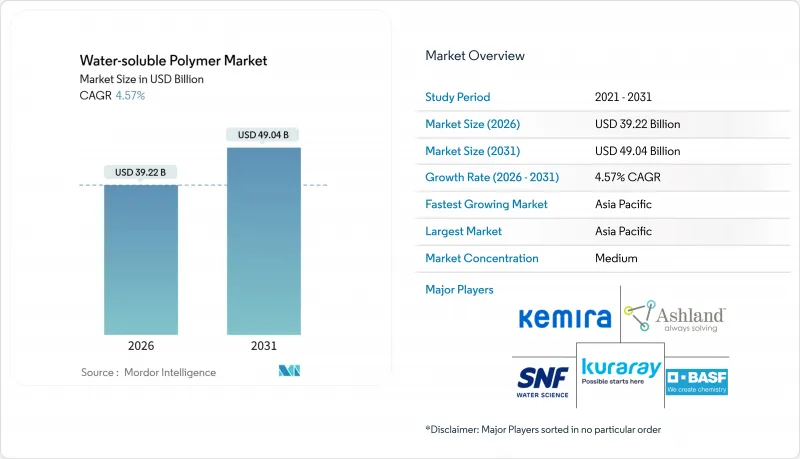
This report is Segmented by Type (Polyacrylamide, Polyvinyl Alcohol, Guar Gum, Gelatin, Xanthan Gum, Polyacrylic Acid, Polyethylene Glycol, and Other Types), End-User Industry (Water Treatment, Food and Beverage, Personal Care and Hygiene, and More), and Geography (Asia-Pacific, North America, Europe, South America, and Middle-East and Africa). The Market Forecasts are Provided in Terms of Value (USD).
Global Water-soluble Polymer Market Trends and Insights
Surging Global Municipal and Industrial Wastewater Treatment Investment
In 2025, global spending on wastewater treatment reached significant levels. This surge in investment has driven up the demand for ultra-high-molecular-weight anionic polyacrylamides, known for their ability to reduce sludge volumes and cut disposal costs. By the end of 2025, China implemented nationwide Class 1A effluent limits, leading to increased polyacrylamide consumption. Meanwhile, India's National Mission for Clean Ganga allocated substantial funds for the establishment of new sewage plants. Each of these plants will require polymer flocculants. In the Middle East, newly commissioned desalination projects in 2025 are utilizing polyacrylic acid and polyethylene glycol antiscalants. These are essential for safeguarding membranes in a new capacity. Collectively, these initiatives position municipal and industrial players as leaders in the water-soluble polymer market.
Shale-Gas Polymer Demand Rebound in North America
In 2025, North American operators consumed significant volumes of water-soluble polymers, coinciding with crude prices stabilizing. Partially hydrolyzed polyacrylamide, a key player in polymer flooding, boasts an incremental recovery advantage over traditional waterflooding. Meanwhile, xanthan gum is carving out a larger share in high-salinity reservoirs, bolstered by new U.S. capacity that became operational in 2024-2025. Additionally, federal grants are fueling research into thermally stable, degradable copolymers aimed at mitigating formation damage. Collectively, these developments underscore the oilfield's pivotal role in bolstering the water-soluble polymer market.
Raw-Material Price Volatility
In 2024-2025, acrylonitrile prices fluctuated significantly following propylene disruptions in China. This volatility compressed polyacrylamide margins. Similarly, vinyl acetate monomer prices experienced a notable surge during the same timeframe. Meanwhile, guar gum prices increased sharply as drought conditions in India slashed the harvest. Such fluctuations challenge cost predictability in the water-soluble polymer market.
Other drivers and restraints analyzed in the detailed report include:
- Personal-Care Formulators Accelerating Shift Toward Water-Soluble Rheology Modifiers
- European Union and Asian Phosphorus-Free Discharge Rules Boosting Advanced Polyacrylamides
- Escalating End-of-Life and Toxicity Regulations on Non-Biodegradable Polymers
For complete list of drivers and restraints, kindly check the Table Of Contents.
Segment Analysis
Polyacrylamide delivered 24.48% of 2025 revenue and will expand at a 4.75% CAGR to 2031. This growth is largely attributed to newly implemented phosphorous discharge regulations, which favor ultra-high-molecular-weight grades of polyacrylamide. These grades can significantly reduce sludge disposal costs. As a result, polyacrylamide is poised to play a pivotal role in the water-soluble polymer market, especially in treatment chemistries. Meanwhile, PVA films, commonly used in unit-dose detergents, are witnessing strong growth. However, potential restrictions on microplastics present a looming challenge. Guar gum faced challenges due to raw material risks stemming from a crop shortfall in India, leading to a notable shift towards xanthan gum in fracturing fluids. Gelatin continues to dominate the soft-gel capsule market, bolstered by an increase in high-bloom output from contract manufacturing organizations (CMOs) in the Asia-Pacific region. Both polyacrylic acid and sodium polyacrylate are seeing heightened demand in hygiene products and for inhibiting scale in cooling water. This demand surge is further supported by the introduction of new low-residual-monomer grades, which are in line with California's stringent consumer-product regulations. While PEG remains a sought-after ingredient in injectables and cosmetics, it is under increasing scrutiny, prompting research and development to pivot towards bio-based alternatives. Additionally, cellulose ethers, pectin, and modified starches continue to carve out niche roles in the market, bolstered by their Generally Recognized As Safe (GRAS) status and a natural branding approach.
Polyacrylamide's leading position in the market is not just a testament to its technical prowess but also to China's backward-integrated cost structures. These structures have significantly bolstered the segment's share in the broader water-soluble polymer market. While PVA's rising popularity in consumer pods signals a diversification of revenue streams, suppliers face a pressing challenge: to produce credible biodegradation documentation by 2027 to maintain their market volume. The volatility of guar gum, especially in light of India's crop challenges, has prompted oilfield users to broaden their polymer selections, safeguarding their profit margins from unpredictable weather-related supply disruptions. Suppliers of gelatin, riding the wave of growth in biologics, must remain vigilant against risks like bovine spongiform encephalopathy, emphasizing the need for stringent traceability measures. Producers of polyacrylic acid are now promoting ultra-low-monomer variants, solidifying their foothold in hygiene and household markets, especially as regulatory scrutiny intensifies. As the market evolves, PEG and niche specialty types are expected to shift focus towards the more lucrative pharmaceutical and medical-device sectors. In contrast, natural hydrocolloids are actively seeking efficiencies in fermentation processes to stay competitive against synthetic alternatives.
Complete Report Scope:
- By Type
- Polyacrylamide
- Polyvinyl Alcohol
- Guar Gum
- Gelatin
- Xanthan Gum
- Polyacrylic Acid
- Polyethylene Glycol
- Other Types (Cellulose Ethers, Pectin, and Starch)
- By End-User Industry
- Water Treatment
- Food and Beverage
- Personal Care and Hygiene
- Oil and Gas
- Pulp and Paper
- Pharmaceutical
- Other End-user Industries (Agrochemicals)
- By Geography
- Asia-Pacific
- China
- India
- Japan
- South Korea
- Indonesia
- Malaysia
- Thailand
- Vietnam
- Rest of Asia-Pacific
- North America
- United States
- Canada
- Mexico
- Europe
- Germany
- United Kingdom
- France
- Italy
- Spain
- Russia
- Nordic Countries
- Rest of Europe
- South America
- Brazil
- Argentina
- Colombia
- Rest of South America
- Middle-East and Africa
- Saudi Arabia
- South Africa
- Rest of Middle-East and Africa
- Asia-Pacific
Geography Analysis
Asia-Pacific held 50.17% of global value in 2025 and will advance at a 4.74% CAGR through 2031. This growth is bolstered by substantial investments in wastewater management in China and India's comprehensive rural water initiative. Countries like Japan, South Korea, and various Southeast Asian nations are amplifying demand by enhancing their pharmaceutical excipient capacities and wastewater infrastructures. Given its leading role in both the production and consumption of water-soluble polymers, the Asia-Pacific region solidifies its dominance in the market.
North America is witnessing a resurgence, driven by stabilizing shale-gas activities and the EPA's stringent zero-discharge regulations, which have compelled coal plants to transition to advanced polymers. Canada is at the forefront, experimenting with amphoteric polyacrylamides for oil-sands tailings. Meanwhile, Mexico is channeling funds into upgrading wastewater systems in its major metropolitan areas. These diverse initiatives underscore North America's significant standing in the water-soluble polymer market.
Europe is reshaping its product offerings in response to its push for phosphorus-free effluents and stringent microplastic regulations. This shift is steering the market towards high-charge-density polyacrylamides and eco-friendly alternatives. With numerous municipal plants in need of tertiary upgrades, there's an anticipated demand surge for polymers. While Nordic countries champion natural hydrocolloids due to biodegradability mandates, projects in Russia's Volga Basin are spurring growth in Eastern Europe.
South America is capitalizing on Brazil's ambitious sanitation initiative, Argentina's experimental polymer seed-coating, and mining endeavors in the Andes to boost regional consumption. In the Middle-East and Africa, efforts to expand desalination capacities and modernize wastewater facilities in South Africa are bolstering the demand for scale inhibitors and flocculants, further diversifying the global water-soluble polymer landscape.
- Arkema
- Ashland
- BASF SE
- CP Kelco U.S. Inc.
- Dow
- DuPont
- Evonik Industries
- Gantrade Corporation
- Kemira
- Kuraray Co. Ltd
- LG Chem
- Merck KGaA
- Mitsubishi Chemical Corporation
- Nouryon
- Polysciences Inc.
- SNF Group
- Solvay S.A.
- Sumitomo Seika Chemicals Co. Ltd
- Wacker Chemie AG
Additional Benefits:
- The market estimate (ME) sheet in Excel format
- 3 months of analyst support
TABLE OF CONTENTS
1 Introduction
- 1.1 Study Assumptions and Market Definition
- 1.2 Scope of the Study
2 Research Methodology
3 Executive Summary
4 Market Landscape
- 4.1 Market Overview
- 4.2 Market Drivers
- 4.2.1 Surging global municipal and industrial wastewater-treatment investment
- 4.2.2 Shale-gas EOR polymer demand rebound in North America
- 4.2.3 Personal-care formulators accelerating shift toward water-soluble rheology modifiers
- 4.2.4 European Union and Asian phosphorus-free discharge rules boosting advanced polyacrylamides
- 4.2.5 Rapid growth of unit-dose e-commerce packaging using PVA films
- 4.3 Market Restraints
- 4.3.1 Raw-material price volatility
- 4.3.2 Escalating end-of-life and toxicity regulations on non-biodegradable polymers
- 4.3.3 Forthcoming micro-plastic limits on soluble/dispersible chemistries
- 4.4 Value Chain Analysis
- 4.5 Porter's Five Forces
- 4.5.1 Bargaining Power of Suppliers
- 4.5.2 Bargaining Power of Buyers
- 4.5.3 Threat of New Entrants
- 4.5.4 Threat of Substitutes
- 4.5.5 Degree of Competition
5 Market Size and Growth Forecasts (Value)
- 5.1 By Type
- 5.1.1 Polyacrylamide
- 5.1.2 Polyvinyl Alcohol
- 5.1.3 Guar Gum
- 5.1.4 Gelatin
- 5.1.5 Xanthan Gum
- 5.1.6 Polyacrylic Acid
- 5.1.7 Polyethylene Glycol
- 5.1.8 Other Types (Cellulose Ethers, Pectin, and Starch)
- 5.2 By End-User Industry
- 5.2.1 Water Treatment
- 5.2.2 Food and Beverage
- 5.2.3 Personal Care and Hygiene
- 5.2.4 Oil and Gas
- 5.2.5 Pulp and Paper
- 5.2.6 Pharmaceutical
- 5.2.7 Other End-user Industries (Agrochemicals)
- 5.3 By Geography
- 5.3.1 Asia-Pacific
- 5.3.1.1 China
- 5.3.1.2 India
- 5.3.1.3 Japan
- 5.3.1.4 South Korea
- 5.3.1.5 Indonesia
- 5.3.1.6 Malaysia
- 5.3.1.7 Thailand
- 5.3.1.8 Vietnam
- 5.3.1.9 Rest of Asia-Pacific
- 5.3.2 North America
- 5.3.2.1 United States
- 5.3.2.2 Canada
- 5.3.2.3 Mexico
- 5.3.3 Europe
- 5.3.3.1 Germany
- 5.3.3.2 United Kingdom
- 5.3.3.3 France
- 5.3.3.4 Italy
- 5.3.3.5 Spain
- 5.3.3.6 Russia
- 5.3.3.7 Nordic Countries
- 5.3.3.8 Rest of Europe
- 5.3.4 South America
- 5.3.4.1 Brazil
- 5.3.4.2 Argentina
- 5.3.4.3 Colombia
- 5.3.4.4 Rest of South America
- 5.3.5 Middle-East and Africa
- 5.3.5.1 Saudi Arabia
- 5.3.5.2 South Africa
- 5.3.5.3 Rest of Middle-East and Africa
- 5.3.1 Asia-Pacific
6 Competitive Landscape
- 6.1 Market Concentration
- 6.2 Strategic Moves
- 6.3 Market Share(%)/Ranking Analysis
- 6.4 Company Profiles (includes Global-level Overview, Market-level Overview, Core Segments, Financials, Strategic Information, Products and Services, Recent Developments)
- 6.4.1 Arkema
- 6.4.2 Ashland
- 6.4.3 BASF SE
- 6.4.4 CP Kelco U.S. Inc.
- 6.4.5 Dow
- 6.4.6 DuPont
- 6.4.7 Evonik Industries
- 6.4.8 Gantrade Corporation
- 6.4.9 Kemira
- 6.4.10 Kuraray Co. Ltd
- 6.4.11 LG Chem
- 6.4.12 Merck KGaA
- 6.4.13 Mitsubishi Chemical Corporation
- 6.4.14 Nouryon
- 6.4.15 Polysciences Inc.
- 6.4.16 SNF Group
- 6.4.17 Solvay S.A.
- 6.4.18 Sumitomo Seika Chemicals Co. Ltd
- 6.4.19 Wacker Chemie AG
7 Market Opportunities and Future Outlook
- 7.1 White-space and Unmet-need Assessment

