PUBLISHER: Mordor Intelligence | PRODUCT CODE: 2120300

PUBLISHER: Mordor Intelligence | PRODUCT CODE: 2120300
Alcohol Ingredients - Market Share Analysis, Industry Trends & Statistics, Growth Forecasts (2026 - 2031)
According to Mordor Intelligence, the global alcohol ingredients market size in 2026 is estimated at USD 9.02 billion, growing from 2025 value of USD 8.67 billion with 2031 projections showing USD 10.99 billion, growing at 4.03% CAGR over 2026-2031.
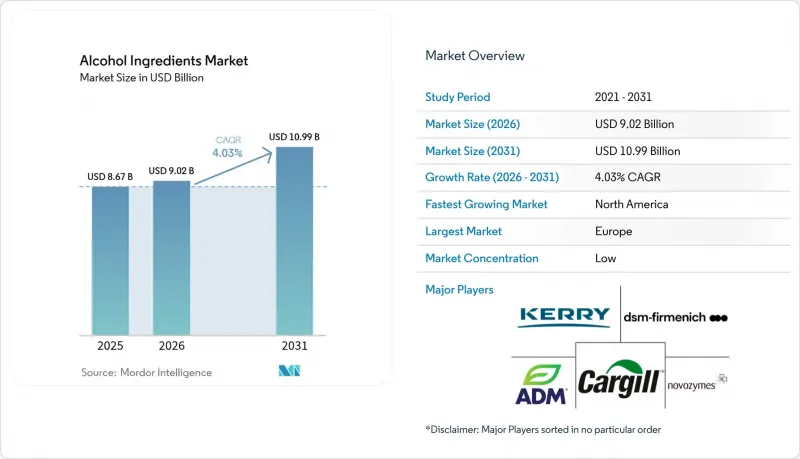
This report is Segmented by Ingredient Type (Yeast, Enzymes, Colorants, Flavors and Salts and More), Application (Beer, Spirits, and More), and Geography (North America, Europe, Asia-Pacific, South America, and Middle East and Africa). The Market Forecasts are Provided in Terms of Value and Volume (USD/Tonnes).
Global Alcohol Ingredients Market Trends and Insights
Rising Demand for Premium and Craft Alcoholic Beverages
Premium spirits have significantly increased their share of international spirits value over the last decade, with super-premium segments experiencing substantial growth compared to standard tiers. This shift toward premium products has led ingredient suppliers to develop specialized formulations that provide complex sensory profiles and authenticity markers for quality-focused consumers. Craft distilleries now source botanical extracts, heritage grains, and specialized yeast strains to create distinctive products, generating demand for ingredients that command higher premiums than standard alternatives. This trend benefits suppliers of specialty flavor compounds and natural colorants, as craft producers avoid synthetic additives to maintain their artisanal identity. While North America and Europe dominate this market due to their established craft beverage sectors, the Asia-Pacific region shows increasing premiumization trends that indicate potential growth opportunities.
Ongoing Innovations in Ingredient Formulations
Advances in fermentation technology enable ingredient manufacturers to develop compounds that address beverage formulation challenges. For example, Novozymes introduced specialized enzymes for distilling applications that optimize production efficiency while maintaining flavor profiles. The company's fermentation platforms produce functional ingredients, including adaptogens and nootropics, which combine alcohol and wellness attributes to meet evolving consumer preferences for relaxation without alcohol's effects. These technological developments particularly benefit low- and no-alcohol beverage formulations, where ingredients must replicate alcohol's sensory characteristics through alternative compounds. The implementation timeline continues to extend due to stringent regulatory approval requirements and the complex process of commercial scaling for biotechnology-derived ingredients in the beverage industry.
Stringent Regulations Governing Alcohol Production, Use, and Labeling
The regulatory landscape for alcoholic beverage ingredients continues to evolve with increased oversight of safety and labeling requirements. The FDA's initiative to phase out synthetic dyes affects colorant supplier compliance , while EFSA's evaluation of botanical ingredients impacts suppliers of herbal extracts and adaptogens . In the United States, TTB labeling regulations require detailed ingredient disclosure, which enhances transparency but challenges suppliers' ability to protect proprietary formulations. The regulatory requirements differ across regions, with European markets typically requiring more comprehensive safety documentation compared to emerging markets. This creates variations in ingredient approval timelines and compliance expenses. These regulations directly influence product launches and market entry strategies.
Other drivers and restraints analyzed in the detailed report include:
- Trend Toward Natural, Organic, and Clean-Label Alcohol Ingredients
- Advancements in Fermentation and Production Technologies
- Consumer Skepticism Toward Synthetic Additives
For complete list of drivers and restraints, kindly check the Table Of Contents.
Segment Analysis
Malt ingredients continue to dominate the market share, maintaining their strong position as the primary component in the global alcohol consumption landscape, particularly in beer production. The flavors and salts category has emerged as the segment experiencing the most rapid growth, showcasing the industry's evolution toward sophisticated taste profiles and premium offerings that extend beyond conventional brewing applications.
Leading malting companies, including Malteurop and Boortmalt, have made significant investments in innovative malting technologies and environmentally conscious malt processing methods. These advancements not only minimize environmental impact but also provide brewers and distillers with an extensive range of flavor possibilities. The malt segment's growth is further supported by industry-wide sustainability initiatives, exemplified by major brewing companies like Molson Coors, which has established comprehensive sustainable barley sourcing goals while implementing measures to reduce water consumption in agricultural processes.
Complete Report Scope:
- By Ingredient Type
- Yeast
- Enzymes
- Colorants
- Flavors and Salts
- Malt Ingredients
- Other Ingredients
- By Application
- Beer
- Spirits
- Whiskey
- Vodka
- Rum
- Brandy
- Gin
- Other Spirits
- Wine
- Others
- By Geography
- North America
- United States
- Canada
- Mexico
- Rest of North America
- Europe
- Germany
- United Kingdom
- Italy
- France
- Spain
- Netherlands
- Rest of Europe
- Asia-Pacific
- China
- India
- Japan
- Australia
- Rest of Asia-Pacific
- South America
- Brazil
- Argentina
- Rest of South America
- Middle East and Africa
- South Africa
- Rest of Middle East and Africa
- North America
Geography Analysis
Europe stands as the cornerstone of the market, commanding a robust 33.29% share in 2025, built upon generations of brewing and distilling expertise. The region's success stems from its deep-rooted philosophy of prioritizing quality craftsmanship over mass production. Under the vigilant oversight of EFSA and national quality standards, European ingredient suppliers must maintain comprehensive safety documentation and organic certifications to operate in the market. The craft brewing industry, while growing steadily, remains firmly anchored in its heritage, utilizing traditional ingredients and time-tested production methods that justify premium pricing. Environmental consciousness shapes the industry's future, with companies like Carlsberg leading the charge through their commitment to 100% regenerative raw materials by 2040. The region's strong cultural connection to terroir and protected designation of origin creates valuable opportunities for ingredient suppliers who can authenticate their products' heritage and traditional production methods.
North America demonstrates remarkable market momentum, projecting a 4.79% CAGR through 2031, fueled by an innovative craft beverage movement that continuously pushes boundaries in flavor and production techniques. The region's maturing craft brewing segment actively seeks specialized ingredients, from unique botanical extracts to heritage grains and novel yeast strains, enabling brewers to distinguish themselves in competitive markets. The regulatory environment, overseen by the FDA and TTB, creates distinct compliance pathways that encourage innovation in fermentation technology and ingredient processing. Industry leaders like AB InBev are reshaping the supply chain through ambitious sustainability goals, including their net-zero target by 2040 and successful implementation of 100% renewable energy brewing operations in Europe.
The Asia-Pacific region represents a frontier of opportunity, where rapid economic growth drives premium product demand and evolving regulatory frameworks support ingredient innovation. The region's immense population base and growing middle class present substantial volume potential, despite having less standardized regulatory processes than Western markets. Traditional fermentation expertise in China and Japan provides a unique foundation for ingredient innovation, effectively combining ancient wisdom with modern production requirements. In parallel, South America and Middle East & Africa, while smaller in market share, offer strategic value through opportunities in local ingredient sourcing and climate-adapted production methods, particularly for suppliers who understand regional preferences and regulatory landscapes.
- Cargill Inc.
- Archer Daniels Midland
- Kerry Group plc
- DSM-Firmenich
- Novozymes A/S
- Sensient Technologies Corp.
- Dohler GmbH
- Lallemand Inc.
- Lesaffre
- Novozymes A/S
- Treatt plc
- DDW, The Color House
- AB Enzymes
- Givaudan SA
- International Flavors & Fragrances
- Angel Yeast Co. Ltd.
- Ashland Global Holdings
- Ingredion Inc.
- Savory Flavors Ltd.
- Symrise AG
Additional Benefits:
- The market estimate (ME) sheet in Excel format
- 3 months of analyst support
TABLE OF CONTENTS
1 INTRODUCTION
- 1.1 Study Assumptions and Market Definition
- 1.2 Scope of the Study
2 RESEARCH METHODOLOGY
3 EXECUTIVE SUMMARY
4 MARKET LANDSCAPE
- 4.1 Market Overview
- 4.2 Market Drivers
- 4.2.1 Rising demand for premium and craft alcoholic beverages
- 4.2.2 Ongoing innovations in ingredient formulations
- 4.2.3 Trend toward natural, organic, and clean-label alcohol ingredients
- 4.2.4 Advancements in fermentation and production technologies
- 4.2.5 Shift in consumer preferences toward exotic and unique flavors
- 4.2.6 Increasing interest in botanical extracts, adaptogens, and functional additives
- 4.3 Market Restraints
- 4.3.1 Stringent regulations governing alcohol production, use, and labeling
- 4.3.2 Consumer skepticism toward synthetic additives
- 4.3.3 Difficulty in maintaining ingredient purity and quality
- 4.3.4 Shelf-life limitations and stability issues with certain ingredients
- 4.4 Supply Chain Analysis
- 4.5 Regulatory Outlook
- 4.6 Porter's Five Forces
- 4.6.1 Threat of New Entrants
- 4.6.2 Bargaining Power of Buyers/Consumers
- 4.6.3 Bargaining Power of Suppliers
- 4.6.4 Threat of Substitute Products
- 4.6.5 Intensity of Competitive Rivalry
5 MARKET SIZE AND GROWTH FORECASTS (VALUE AND VOLUME)
- 5.1 By Ingredient Type
- 5.1.1 Yeast
- 5.1.2 Enzymes
- 5.1.3 Colorants
- 5.1.4 Flavors and Salts
- 5.1.5 Malt Ingredients
- 5.1.6 Other Ingredients
- 5.2 By Application
- 5.2.1 Beer
- 5.2.2 Spirits
- 5.2.2.1 Whiskey
- 5.2.2.2 Vodka
- 5.2.2.3 Rum
- 5.2.2.4 Brandy
- 5.2.2.5 Gin
- 5.2.2.6 Other Spirits
- 5.2.3 Wine
- 5.2.4 Others
- 5.3 By Geography
- 5.3.1 North America
- 5.3.1.1 United States
- 5.3.1.2 Canada
- 5.3.1.3 Mexico
- 5.3.1.4 Rest of North America
- 5.3.2 Europe
- 5.3.2.1 Germany
- 5.3.2.2 United Kingdom
- 5.3.2.3 Italy
- 5.3.2.4 France
- 5.3.2.5 Spain
- 5.3.2.6 Netherlands
- 5.3.2.7 Rest of Europe
- 5.3.3 Asia-Pacific
- 5.3.3.1 China
- 5.3.3.2 India
- 5.3.3.3 Japan
- 5.3.3.4 Australia
- 5.3.3.5 Rest of Asia-Pacific
- 5.3.4 South America
- 5.3.4.1 Brazil
- 5.3.4.2 Argentina
- 5.3.4.3 Rest of South America
- 5.3.5 Middle East and Africa
- 5.3.5.1 South Africa
- 5.3.5.2 Rest of Middle East and Africa
- 5.3.1 North America
6 COMPETITIVE LANDSCAPE
- 6.1 Market Concentration
- 6.2 Strategic Moves
- 6.3 Market Ranking Analysis
- 6.4 Company Profiles (includes Global-level Overview, Market-level Overview, Core Segments, Financials (if available), Strategic Information, Market Rank/Share, Products and Services, Recent Developments)
- 6.4.1 Cargill Inc.
- 6.4.2 Archer Daniels Midland
- 6.4.3 Kerry Group plc
- 6.4.4 DSM-Firmenich
- 6.4.5 Novozymes A/S
- 6.4.6 Sensient Technologies Corp.
- 6.4.7 Dohler GmbH
- 6.4.8 Lallemand Inc.
- 6.4.9 Lesaffre
- 6.4.10 Novozymes A/S
- 6.4.11 Treatt plc
- 6.4.12 DDW, The Color House
- 6.4.13 AB Enzymes
- 6.4.14 Givaudan SA
- 6.4.15 International Flavors & Fragrances
- 6.4.16 Angel Yeast Co. Ltd.
- 6.4.17 Ashland Global Holdings
- 6.4.18 Ingredion Inc.
- 6.4.19 Savory Flavors Ltd.
- 6.4.20 Symrise AG
7 MARKET OPPORTUNITIES AND FUTURE OUTLOOK

